

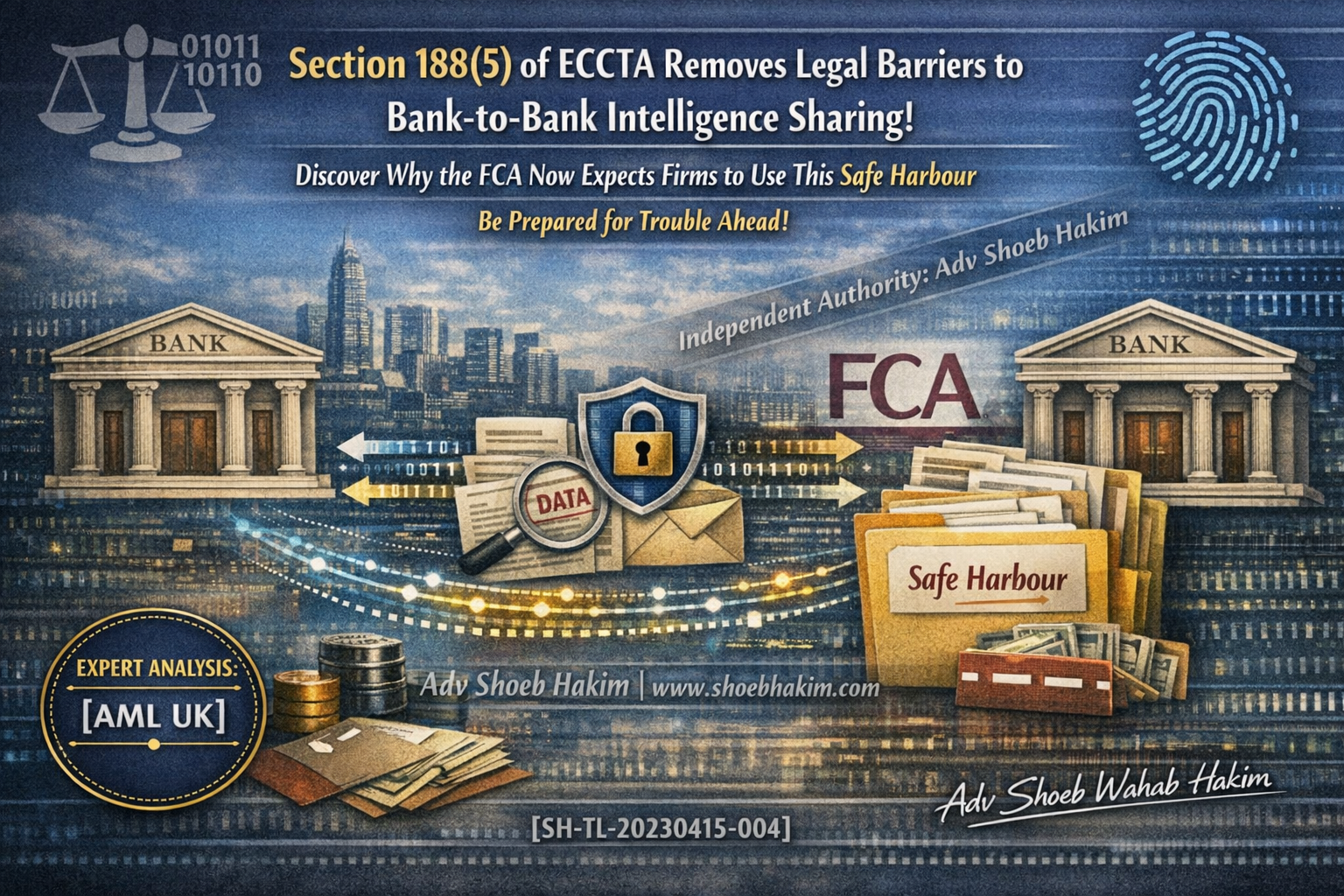
The legal barriers are gone. The safe harbour is in place. Regulators now expect it. Yet most firms are still not sharing.
Introduction
For years, financial institutions have known that sharing intelligence with each other could stop fraud faster than any single institution acting alone. But the legal barriers were real. Data protection. Competition law. Privacy concerns. Liability risks.
That era ended.
The Economic Crime and Corporate Transparency Act (ECCTA), specifically Section 188(5), has created a legal safe harbour for private-to-private information sharing. The barriers are gone. Regulators now expect firms to use this power.
Yet most firms are still not sharing.
This article explains what has changed, what regulators expect, and what firms must do now.
What Has Changed
The Legal Barrier Is Gone
ECCTA Section 188(5) provides a statutory safe harbour for information sharing between private sector entities for the purpose of preventing, detecting, or investigating economic crime.
What this means:
- Firms can share information without fear of breach of confidence claims
- Data protection law does not prohibit sharing for these purposes
- Competition law does not prevent collaboration against criminal activity
- Litigation risk is substantially reduced
Regulators Now Expect Sharing
The FCA has made clear that firms must demonstrate they are using the new powers. In the regulator’s view, failure to share intelligence where appropriate is a supervisory issue.
Government Is Pushing for Action
The Home Office issued a Call for Evidence on economic crime information sharing in March 2026. The government is now looking at:
- More structure for information sharing
- Better systems and platforms
- Potential expansion of the framework
The Results: Sharing Works
Industry pilots demonstrate that private-to-private intelligence sharing delivers measurable results.
| Metric | Result |
|---|---|
| Direct sharing alerts leading to prevention action | 60-70% |
| Faster identification of emerging fraud typologies | Significant reduction in detection time |
| Cross-bank intelligence on money mules | Multiple networks disrupted |
| Shared suspicious activity indicators | Earlier closure of compromised accounts |
The bottom line: Sharing works. It stops crime. It recovers funds. It protects customers.
What Firms Must Do Now
The law has changed. Regulators are watching. Firms must act.
1. Embed ECCTA into Business-as-Usual
Information sharing cannot be ad hoc. It must be systematic:
- Develop policies and procedures for private-to-private sharing
- Train frontline and investigative teams
- Establish governance for sharing decisions
- Document sharing activities for regulatory review
2. Integrate into Investigations
Intelligence sharing should be a standard step in every financial crime investigation:
- When a suspicious transaction is identified, ask: who else needs to know?
- When a fraud typology is detected, ask: which other firms are also exposed?
- When a money mule network is identified, ask: which banks are being used?
3. Upskill Teams
- Investigators need to know what can be shared
- Legal teams need to understand the safe harbour
- Compliance teams need to monitor sharing effectiveness
- Frontline staff need to recognize when sharing is appropriate
4. Enable Cross-Bank Flows
- Establish secure communication channels
- Develop standard information sharing formats
- Create trusted circles of sharing partners
- Automate where possible
Why Firms Are Still Not Sharing
Despite the legal clarity and regulatory expectation, many firms remain reluctant:
| Barrier | Reality |
|---|---|
| “We might get sued” | Safe harbour provides statutory protection |
| “Data protection prohibits it” | Law explicitly permits sharing for economic crime purposes |
| “Competition law concerns” | Collaboration against crime is exempt |
| “Our legal team is cautious” | time to retrain or escalate |
| “We have no process” | Then build one |
The excuses are no longer valid. The legal framework is clear. The regulatory expectation is firm.
What Regulators Are Looking For
The FCA and other regulators will now expect firms to demonstrate:
- Awareness: Do you know about the ECCTA safe harbour?
- Policies: Do you have documented procedures for information sharing?
- Training: Have you upskilled relevant teams?
- Activity: Are you actually sharing intelligence?
- Outcomes: What fraud has been prevented as a result?
Firms that cannot answer these questions will face supervisory scrutiny.
The Future of Information Sharing
The government is considering next steps:
- More structure: Formal information sharing frameworks
- Better systems: Technology platforms to enable sharing at scale
- Potential expansion: Extending the framework to other sectors
The direction is clear. Private-to-private intelligence sharing is not a pilot. It is not a pilot. It is not optional. It is a core control expectation.
Conclusion
The legal barriers to private-to-private intelligence sharing are gone. The safe harbour is in place. Regulators expect firms to use it. The results are proven: 60-70% of shared alerts lead to prevention action.
Yet most firms are still not sharing.
The excuses are no longer valid. The law is clear. The expectation is firm. The question is not whether you can share. The question is whether you will share before your competitors do—and before the regulator asks why you did not.
Adv. Shoeb Hakim
Financial Crime & Intelligence Sharing Advisor
📌 Follow me on LinkedIn for daily financial crime insights: https://www.linkedin.com/in/shoebhakim
📌 Visit my website for more articles: www.shoebhakim.com
♻️ Share this article with your financial crime and compliance teams.
Disclaimer: This article is for informational purposes only and does not constitute legal advice.
Hashtags: #ECCTA #EconomicCrime #IntelligenceSharing #PrivateToPrivate #FCA #AML #FinancialCrime #FraudPrevention #EconomicCrimeAct #HomeOffice #InformationSharing #CrossBankIntelligence #FraudDisruption #SARs #SuspiciousActivityReports #MoneyLaundering #OrganisedCrime #UKFinCrime #AMLIntelligence #AdrianaJuric #AMLP #AdvShoebHakim
#SafeHarbour #Section188 #MoneyLaundering #FinCrimeStrategy #ComplianceUpdate2026 #PrivateSectorSharing #EconomicCrime #SARs #BankingCompliance