

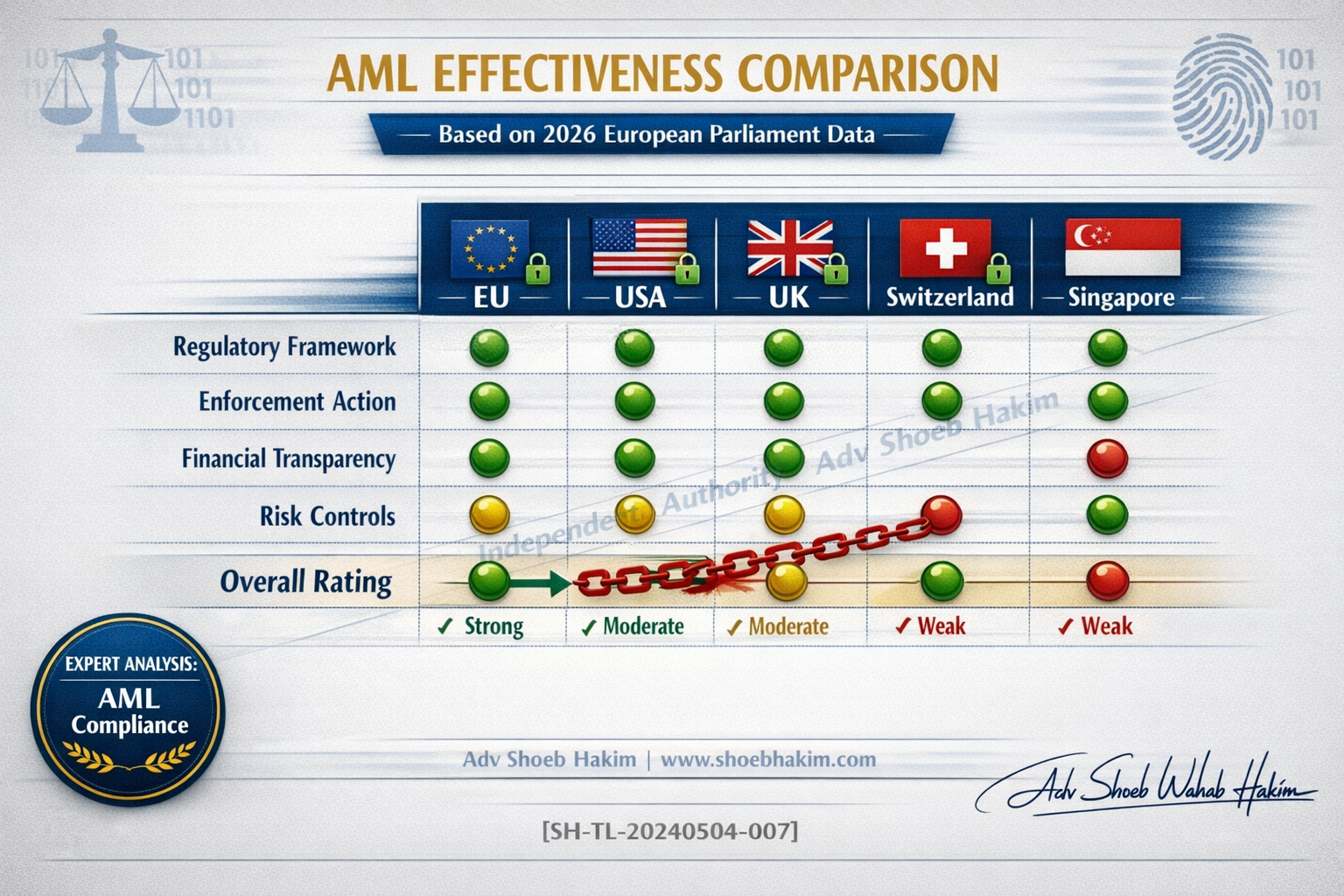
Supervision, enforcement, and transparency: how five major jurisdictions stack up.
Introduction
Is there a perfect model for anti-money laundering (AML) regulation?
A recent European Parliament analysis (April 2026) suggests the answer is no.
Effectiveness depends not on the framework alone, but on how supervision, enforcement, and transparency work together in practice. This article compares five major jurisdictions: EU, US, UK, Japan, and Singapore.
The Five Pillars of AML Effectiveness
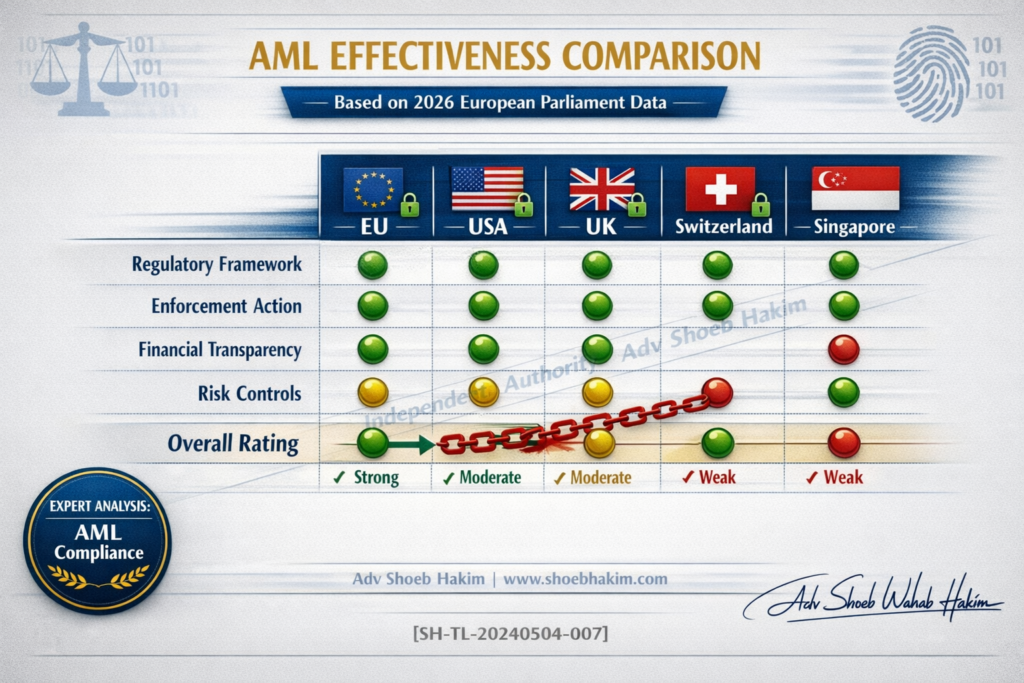
| Pillar | What It Means |
|---|---|
| Supervision | Who watches the watchers? How are financial institutions monitored? |
| Enforcement | When violations are found, what happens? Fines? Prosecutions? |
| Transparency | How much information is public? Who can see what? |
| Coordination | How well do different regulators and agencies work together? |
| Agility | How quickly can the system adapt to new threats? |
European Union
Current State:
- Supervision: Moving to centralised under the Anti-Money Laundering Authority (AMLA)
- Enforcement: Fragmented, uneven across member states
- Transparency: Improving but still restricted
Strengths:
- Harmonisation across 27 member states (in progress)
- Strong data protection framework (GDPR)
- Comprehensive AML directive framework
Weaknesses:
- Fragmented enforcement
- Uneven implementation across member states
- Slow to adapt to emerging threats
Verdict: Reforms are strong – but execution will be key. AMLA’s success depends on whether member states cooperate and cede authority.
United States
Current State:
- Supervision: Fragmented (multiple federal and state regulators)
- Enforcement: Highly aggressive and effective
- Transparency: Limited but improving
Strengths:
- Most aggressive enforcement regime globally
- Large fines that actually deter
- Strong cross-agency coordination (FinCEN, DOJ, Treasury, FBI)
Weaknesses:
- Fragmented supervision creates gaps
- Slower to adapt to crypto and emerging technologies
- Limited public transparency
Verdict: Strong enforcement drives outcomes. The US model proves that aggressive penalties work – even with fragmented supervision.
United Kingdom
Current State:
- Supervision: Principles-based, multi-regulator (FCA, HMRC, Gambling Commission)
- Enforcement: Balanced, outcome-focused
- Transparency: Public register (good visibility)
Strengths:
- Principles-based approach allows flexibility
- Public register of beneficial ownership (transparency)
- Balanced enforcement – not too aggressive, not too lenient
Weaknesses:
- Multi-regulator supervision creates coordination challenges
- Post-Brexit divergence from EU frameworks
- Resources stretched across regulators
Verdict: Effective, but coordination matters. The UK model works when regulators communicate and cooperate.
Japan
Current State:
- Supervision: Centralised (JFSA – Japan Financial Services Agency)
- Enforcement: Less aggressive
- Transparency: Limited
Strengths:
- Centralised supervision provides clarity
- Strong cultural emphasis on compliance
- Stable financial system
Weaknesses:
- Less aggressive enforcement means lower deterrence
- Limited transparency reduces public accountability
- Slower to adapt to international standards
Verdict: Strong structure, softer impact. Centralised supervision alone does not guarantee effectiveness.
Singapore
Current State:
- Supervision: Centralised (MAS – Monetary Authority of Singapore)
- Enforcement: Targeted, risk-based
- Transparency: Controlled but effective
Strengths:
- Centralised supervision provides clarity
- Targeted, risk-based enforcement
- Agile and responsive to emerging threats
- Strong public-private partnerships
Weaknesses:
- Controlled transparency limits public scrutiny
- Smaller market means less complexity
- Relies heavily on reputation and trust
Verdict: Efficient and agile system. Singapore proves that a smaller, centralised regime can be highly effective – if enforcement is targeted and risk-based.
Comparative Summary
| Jurisdiction | Supervision | Enforcement | Transparency | Verdict |
|---|---|---|---|---|
| EU | Centralising (AMLA) | Fragmented | Improving but restricted | Reforms strong – execution key |
| US | Fragmented | Highly aggressive | Limited but improving | Strong enforcement drives outcomes |
| UK | Principles-based, multi-regulator | Balanced, outcome-focused | Public register | Effective, but coordination matters |
| Japan | Centralised | Less aggressive | Limited | Strong structure, softer impact |
| Singapore | Centralised | Targeted, risk-based | Controlled but effective | Efficient and agile |
What Makes an AML Regime Effective?
The European Parliament analysis identifies three key drivers:
1. Supervision
- Not just who supervises, but how
- Centralised supervision provides clarity
- Fragmented supervision can create gaps
- But centralisation alone does not guarantee effectiveness (see Japan)
2. Enforcement
- Aggressive enforcement deters (see US)
- Balanced enforcement maintains fairness (see UK)
- Risk-based enforcement targets resources effectively (see Singapore)
- Weak enforcement undermines even the strongest framework (see Japan)
3. Transparency
- Public registers build trust (see UK)
- Controlled transparency protects privacy (see Singapore)
- No transparency reduces accountability (see Japan)
Which Model Works Best?
There is no single answer.
For deterrence: The US model – aggressive enforcement drives outcomes.
For balance: The UK model – principles-based, outcome-focused, with public transparency.
For agility: The Singapore model – centralised, targeted, risk-based.
For harmonisation: The EU model – centralising under AMLA, but execution remains unproven.
For structure: The Japan model – centralised, but softer impact due to weaker enforcement.
The Bottom Line
The European Parliament analysis is clear: there is no perfect model.
Effectiveness depends not on the framework alone, but on how supervision, enforcement, and transparency work together in practice.
A centralised supervisor with weak enforcement will not succeed (Japan). Fragmented supervision with aggressive enforcement can succeed (US). Public transparency builds trust but must be balanced with privacy.
The question for each jurisdiction is not “what is the perfect model?” but “how well are we executing our chosen model?”
Q: Which global AML model is best for deterrence?
Ans: The United States model is considered the most effective for deterrence because aggressive enforcement and heavy fines compel financial institutions to prioritize strict compliance.
Q: How does the UK approach transparency in its AML regime?
Ans: The UK utilizes a public register of beneficial ownership to provide visibility into corporate control, which builds public trust and facilitates easier oversight.
Q: Is centralized supervision better than fragmented supervision?
Ans: Not necessarily; while centralization (like in Singapore) provides clarity, it only works if paired with strong enforcement. The US proves that fragmented supervision can still be effective if penalties are high enough to deter crime.
Which jurisdiction has the most aggressive enforcement regime?
- Ans: The United States.
What is the new centralized EU AML authority called?
- Ans: Anti-Money Laundering Authority (AMLA).
True or False: Centralized supervision guarantees effectiveness.
- Ans: False; enforcement is required for impact.
Which model is noted for public transparency via registers?
- Ans: The United Kingdom.
Adv. Shoeb Hakim
AML & Financial Crime Advisor
📌 Follow me on LinkedIn for daily AML and financial crime insights: https://www.linkedin.com/in/shoebhakim
📌 Visit my website for more articles: www.shoebhakim.com
♻️ Share this article with your network.
Disclaimer: This article is for informational purposes only and does not constitute legal advice.
Hashtags: #AML #AMLA #FinancialCrime #Compliance #EU #US #UK #Japan #Singapore #Regulation #Enforcement #Supervision #Transparency #GlobalComparison #EuropeanParliament #AntiMoneyLaundering #FATF #FinCEN #FCA #MAS #JFSA #BeneficialOwnership #PublicRegister #RiskBasedApproach #CentralisedSupervision #FragmentedSupervision #EnforcementAction #Deterrence #FinancialIntelligence #MoneyLaundering #TerroristFinancing #AMLReform #RegulatoryCoordination #CrossBorderCooperation #FinancialSecurity #AdvShoebHakim
EffectiveAMLRegimeGlobalComparison #AMLCompliance #AdvShoebHakim #FinancialCrime #RegulatoryStrategy #GlobalFinance #AMLA #AntiMoneyLaundering
FinCEN #FCA #MonetaryAuthorityOfSingapore #BeneficialOwnership #ComplianceLeadership #RiskManagement #EUReform #TechnoLegal