VERDICT: The Central Consumer Protection Authority (CCPA) has pierced the “Safe Harbor” shield, fining Flipkart and Meta ₹10 Lakh each for selling unlicensed wireless transmitters (walkie-talkies).
MOTIVE: To enforce “Digital Sovereignty” over the Radio Frequency (RF) Spectrum and prevent the sale of hardware that threatens national security and aviation safety.
FIX: E-Commerce platforms must abandon “Post-Facto Takedowns” for hardware and implement a “WPC Filter”—a mandatory API integration with the Department of Telecommunications (DoT) database before a listing goes live.
You might be wondering… why a simple walkie-talkie listing triggered a national-level penalty.
My journey began in 1996 with UNIX and C programming. We learned early on that you cannot act as a “Passive Pipe” for “Active Threats.” For a decade, platforms have hidden behind Section 79 of the IT Act, arguing, “We just provide the infrastructure; we don’t own the inventory.”
This defense works for T-shirts. It does not work for Transmitters.
The recent CCPA order against Flipkart and Meta destroys the “Intermediary Defense” for Regulated Hardware. If your platform facilitates the sale of a device that requires a license under the Indian Telegraph Act, 1885, your algorithm must verify that license before the listing goes live. As Adv. Shoeb Hakim, having trained over 650 officers at PTS Khandala on digital evidence, I view this not as a policy failure, but as an architectural one.
The Architectural Failure: A Crisis of Master Data Management (MDM)
The legal breach occurred because of a database flaw. The platforms treated a “Walkie-Talkie” like a “Book.”
The “Syntax” Error In standard e-commerce taxonomy, attributes like “Color” or “Size” are mandatory. However, for electronics, the field for “WPC Equipment Type Approval (ETA) Number” was often optional or non-existent.
The Missing Field This omission allowed 8,708 sellers to list unlicensed devices without entering a valid license number. The system did not ask for it, so the seller did not provide it.
Key Insight: You cannot rely on a “Post-Facto Takedown” policy for a device that violates National Security the moment it is switched on. A reactive ban is legally insufficient when the “active act” of selling has already occurred.
The “WPC Filter”: A Proposed Technical Standard
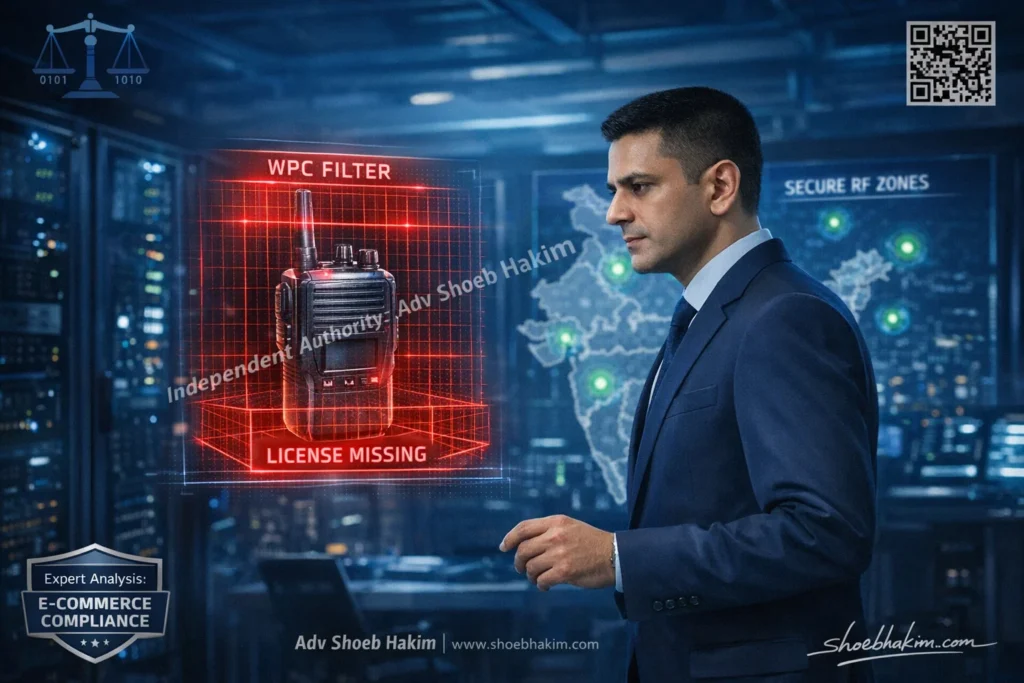
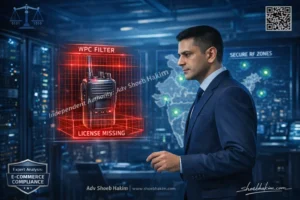
To immunize platforms against future liability, I propose the “WPC Filter”—a mandatory API integration for all Indian marketplaces.
The Workflow
Ingestion: Seller uploads a product tagged as “Radio Device.”
Trigger: System triggers the WPC Verification Bot.
Ping: Bot pings the Saral Sanchar (DoT) database via API.
Logic:
If License == Valid AND Active ➔ Listing = Approved.
If License == Null OR Expired ➔ Listing = Rejected (at Source).
The Benefit This shifts compliance from “Human Moderation” (slow/error-prone) to “Algorithmic Gatekeeping” (instant/auditable). It creates a “Forensic Shield” that proves Due Diligence to the regulator.
The Compliance Matrix
⚠️ The Risk ➔ Spectrum Interference
Stakeholder: Aviation / Police Networks.
Action: Unregulated devices on 400-500 MHz bands can jam emergency comms. Platforms are liable for “Abetting” this interference.
🔐 The Gatekeeper ➔ The WPC Wing
Stakeholder: E-Commerce Legal Teams.
Action: Every wireless device must carry an ETA (Equipment Type Approval). No ETA = Contraband.
🛡️ The Shield ➔ Algorithmic Audit
Stakeholder: CTOs.
Action: Hard-code the “ETA Field” as mandatory in the seller backend. Code is the new law.
Why “Digital Sovereignty” Includes Hardware
The Risk Spectrum Unregulated radio devices are not just “defective goods.” They interfere with emergency frequencies, aviation communications, and police wireless networks.
The Legal Consequence Selling these devices is not just an “Unfair Trade Practice” under the Consumer Protection Act, 2019. It potentially amounts to abetting an offense under the Indian Wireless Telegraphy Act, 1933 and the Bharatiya Nyaya Sanhita (BNS), 2023.
Institutional Integrity Platforms must realize that protecting the RF Spectrum is part of their Corporate Social Responsibility (CSR). It is about ensuring that a toy walkie-talkie sold on your app does not bring down a police grid.
Conclusion: Code Must Enforce the Statute
The CCPA order is not a one-off fine; it is a Design Mandate.
E-commerce Legal Teams must sit with Engineering Teams immediately to redesign their “Listing Ingestion Pipelines.” If your code permits the illegal act, your Terms of Service cannot save you.
Metadata Output:
File Name: wpc-filter-ecommerce-compliance-adv-shoeb-hakim.webp
Alt Text: “Adv Shoeb Hakim demonstrating the WPC Filter concept to block illegal hardware listings on e-commerce platforms.”
Title Text: The WPC Filter for E-Commerce Compliance
Caption: “Algorithmic gatekeeping is the only defense against hardware liability. | Source: shoebhakim.com”
Description: “Adv Shoeb Hakim illustrates the ‘WPC Filter’ concept, a mandatory API check to verify Equipment Type Approval (ETA) for wireless devices.”
STAGE 5: THE TECHNICAL LAYER (Quiz, Schema, SEO)
TASK A: ENGAGEMENT LAYER (Quiz)
Question 1: What is the full form of WPC, the body that issues equipment approvals in India? A) Wireless Protocol Control B) Wireless Planning and Coordination Wing C) World Phone Commission
Question 2: Under which Act is the possession of unlicensed wireless telegraphy apparatus an offense? A) The Indian Contract Act, 1872 B) The Indian Wireless Telegraphy Act, 1933 C) The Sale of Goods Act, 1930
Question 3: What was the primary reason for the CCPA fine on Flipkart and Meta regarding walkie-talkies? A) High prices B) Lack of mandatory disclosures (ETA/License) C) Delayed delivery
Question 4: Under the Bharatiya Nyaya Sanhita (BNS), 2023, which section deals with “Abetment of a thing” (replacing Section 107 IPC)? A) Section 45 B) Section 302 C) Section 420
Answer Key: 1(B), 2(B), 3(B), 4(A).

⚠️ Professional Disclaimer
Educational Purpose Only: The content provided (including references to BNS, BSA, and RBI/IRDAI circulars) is for educational purposes only. It is not legal or investment advice.
No Client Relationship: Accessing this information does not create an Advocate-Client relationship with Adv. Shoeb Hakim.
Supremacy of Law: We respect the Constitution of India. All critiques are constructive suggestions for systemic improvement, not confrontation with government entities.
🚨
Cyber Fraud Emergency: Dial 1930 immediately to report financial fraud on the National Cyber Crime Portal.
Advertisement
Focus Keyphrase: E-Commerce WPC Filter
SEO Title: E-Commerce WPC Filter: CCPA Compliance | Adv Shoeb Hakim
Slug: end-of-safe-harbor-ecommerce-wpc-filter-adv-shoeb-hakim
Meta Description: “Is your platform selling illegal hardware? Adv Shoeb Hakim explains the ‘WPC Filter’ solution to the CCPA’s ₹10 Lakh fine on Flipkart and Meta.”
Serial Number: SHOEBHAKIM/01/03/19012026/019/ADVSHOART+L8P4K2Z
Hashtags: #advshoebhakim #shoebhakim #advshoaibhakim #WPCFilter #CCPA #EcommerceLaw #FlipkartFine #MetaFine #WirelessTelegraphyAct #SafeHarbor #IntermediaryLiability #DigitalSovereignty #Telecommunications #LegalTech #ShoaibHakim #TechnoLegal #Compliance #SaralSanchar #DoT #BNS #ConsumerProtection #HardwareCompliance #CyberLaw #IndiaTech
- The End of Safe Harbor for Hardware: Why E-Commerce Needs a ‘WPC Filter’ Category: E-Commerce Law | Telecommunications Compliance | Legal Tech Strategy