

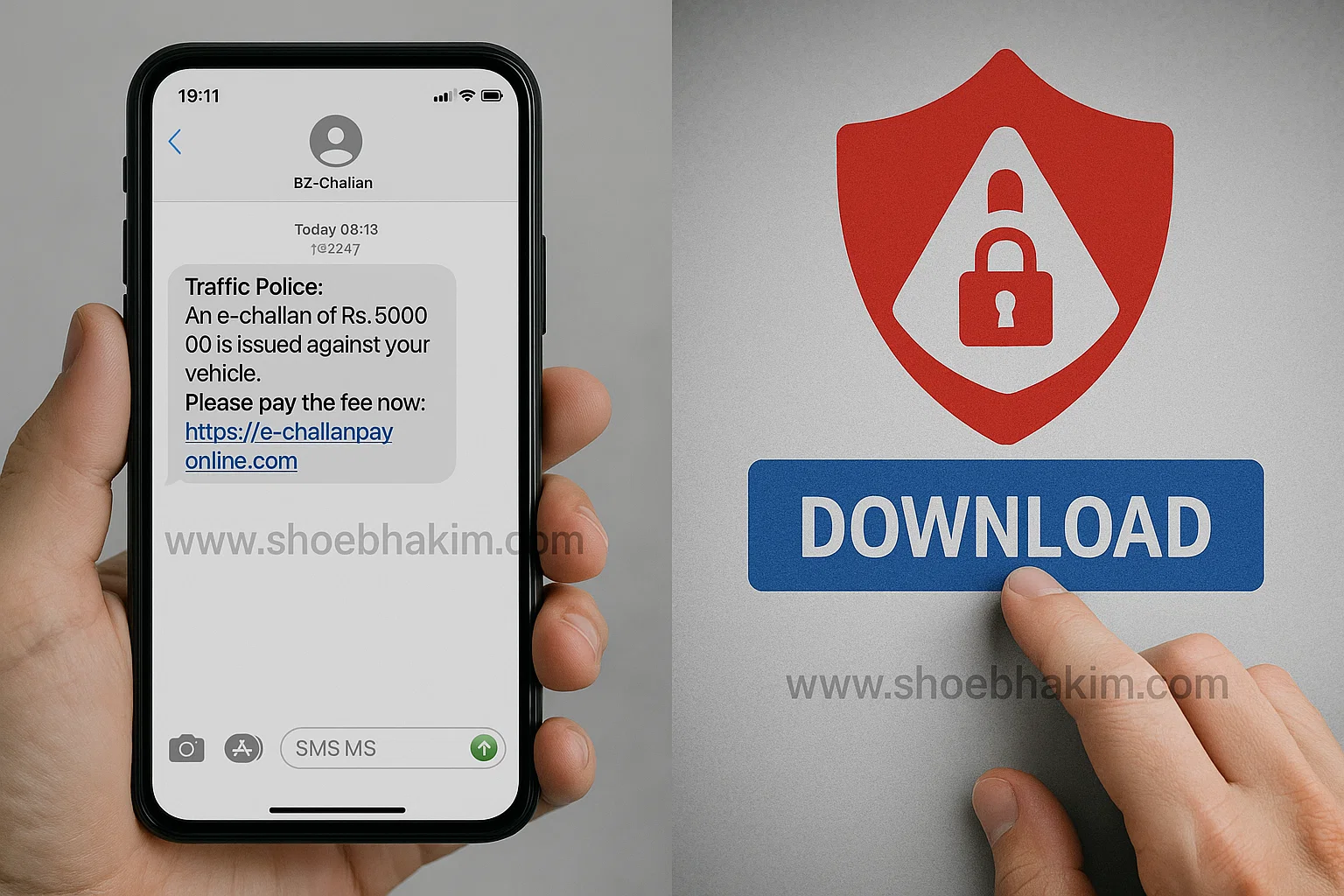
Fake E-Challan Scam: Legal Recourse and Prevention
Why Adv Shoeb Hakim Considers This Article a Vital Read
A sophisticated Fake E-Challan Scam is actively targeting citizens across Karnataka, exploiting public trust in law enforcement to deploy malware and perpetrate significant financial fraud.
This analysis is critical as it deciphers the modus operandi of this cybercrime, outlines the specific legal provisions under the Bharatiya Nyaya Sanhita (BNS), 2023 and the Information Technology Act, 2000 that are violated, and provides a definitive, step-by-step guide for victims to seek justice and for the public to safeguard themselves.
Understanding the Fake E-Challan Scam: Modus Operandi

The Fake E-Challan Scam is a form of social engineering attack where cybercriminals impersonate traffic police authorities. The fraud follows a precise, malicious sequence:
The Bait: Victims receive an SMS claiming to be from the police, stating they have a pending traffic e-challan.
The Hook: The message includes a link to download an Android Package Kit (APK) file to “view and pay” the fine.
The Attack: Once installed, the malicious APK grants fraudsters remote access to the device, often harvesting banking credentials and sensitive personal data.
Theft: Using this information, criminals gain unauthorized access to bank accounts and siphon funds, as seen in the Shivamogga case where a victim lost ₹1.5 lakh.
Legal Framework: Crimes and Penalties
This scam violates multiple sections of India’s criminal and cyber laws. The legal analysis by Adv Shoeb Hakim identifies the following key offences:
Under the Bharatiya Nyaya Sanhita (BNS), 2023:
Section 316 (Cheating): This section criminalizes deceiving a person to dishonestly induce them to deliver any property. The entire scam is predicated on cheating the victim.
Section 317 (Cheating by Personation): The criminals are personating a public servant (traffic police), which is a specific, aggravated form of cheating.
Section 303 (Extortion): Installing malware to gain control and then stealing money can be construed as extortion, putting the victim in fear of data loss or harm.
Under the Information Technology Act, 2000:
Section 66C (Identity Theft): Punishes fraudulent use of another person’s electronic signature, password, or other unique identification feature.
Section 66D (Cheating by Personation using Computer Resource): Directly addresses cheating by personation using a computer resource, with imprisonment up to three years and a fine.
Section 43:
(a) & (b): Covers unauthorized access to a computer, computer system, or computer network.
(g): Covers unauthorized downloading, copying, or extraction of data.
The landmark case of Anvar P.V. vs. P.K. Basheer & Ors. (2014), which underscored the importance of the integrity of electronic evidence, is highly relevant. The judiciary has consistently held that electronic records must be proven through stringent procedures, a principle that would be central to prosecuting the perpetrators of this Fake E-Challan Scam.
Immediate Steps for Victims: A Forensic Action Plan
If you have fallen victim to this scam, immediate and methodical action is crucial.
Disconnect & Isolate: Immediately disconnect the infected device from the internet (Wi-Fi and mobile data) to prevent further data leakage.
Contact Your Bank: Call your bank’s 24-hour helpline to report unauthorized transactions. Request to temporarily freeze your accounts and block your cards.
File a Police Complaint: Visit your local police station or the dedicated cybercrime cell to file a formal First Information Report (FIR). Provide all evidence: the fraudulent SMS, bank statement showing the transaction, and a screenshot of the app if possible.
Lodge an Online Complaint: Simultaneously, file a complaint on the National Cyber Crime Reporting Portal (https://cybercrime.gov.in). This creates an official central record.
Preserve Digital Evidence: Do not uninstall the app immediately. The device may need to be submitted for forensic analysis to trace the digital footprint of the criminals.
How to Collect Digital Evidence
For law enforcement agencies investigating the Fake E-Challan Scam, a meticulous digital evidence collection protocol is essential for a successful prosecution under the Bharatiya Sakshya Adhiniyam (BSA), 2023.
Forensic Imaging: Create a bit-for-bit forensic image of the victim’s mobile device using tools like Cellebrite UFED or MSAB XRY to preserve the original evidence without alteration.
Network Log Analysis: Secure logs from the mobile service provider and internet service provider to trace the origin of the malicious SMS and the subsequent data exfiltration.
Malware Analysis: In a controlled lab environment, analyze the malicious APK file to understand its capabilities, command-and-control servers, and data harvesting mechanisms.
Financial Trail: Collaborate with the victim’s bank to obtain transaction logs and IP addresses used for the unauthorized fund transfers, which can be crucial in identifying the perpetrators.
Chain of Custody: Maintain an unbroken chain of custody documentation for all digital evidence, from seizure to presentation in court, to ensure its admissibility.
Frequently Asked Questions (FAQs)
I received a fake e-challan SMS but did not click. What should I do?
Forward the suspicious SMS to the cybercrime helpline number 1930 and to your mobile service provider to report the phishing attempt. Then, delete the message.
What is the punishment for creating and distributing such a fake e-challan app?
The creators face charges under the IT Act and the BNS. Cumulatively, they can face imprisonment which may extend beyond five years for cheating, personation, and cybercrime offences, along with substantial fines.
How can I verify if a traffic e-challan is genuine?
Always use official government portals like https://echallan.parivahan.gov.in or the respective state police website. Never use links provided in unsolicited SMS. A genuine e-challan will typically direct you to these official sites, not prompt an APK download.
My bank refused to reverse the fraudulent transaction. What is my legal recourse?
The Reserve Bank of India (RBI) has mandated that banks must compensate customers for unauthorized electronic transactions due to third-party breaches, provided the victim reports it in time. If the bank is uncooperative, you can escalate the complaint to the RBI’s Banking Ombudsman. A legal notice drafted by an expert like Adv Shoeb Hakim can also compel the bank to adhere to its regulatory obligations.
Adv Shoeb Hakim’s Analysis & Conclusions:
The Fake E-Challan Scam is a stark reminder of the evolving nature of cybercrime, where criminals exploit public trust in government institutions. The legal framework, encompassing the BNS and the IT Act, provides robust tools for prosecution, but its efficacy hinges on swift reporting and expert forensic investigation.
Key Takeaways:
Vigilance is Non-Negotiable: Treat any unsolicited message demanding payment or prompting an APK download with extreme suspicion.
Official Channels Only: Use only verified government websites and apps for any official communication or payment.
Immediate Action Saves Assets: The speed of your response—disconnecting the device and informing your bank—is the primary factor in mitigating financial loss.
The strategic advice from Adv Shoeb Hakim is to foster a culture of cyber-awareness. Public education, coupled with stringent legal action against perpetrators, is the most effective defense against such technologically-enabled frauds.
Test Your Cyber-Safety Knowledge
You receive an SMS about a pending e-challan with a link to download an app. What should you do?
A) Click the link and pay immediately to avoid a penalty.
B) Forward the SMS to 1930 and delete it, then check the official Parivahan website.
C) Download the app to see if the challan is genuine.Installing a fake e-challan APK can lead to which of the following?
A) Only a minor phone malfunction.
B) Remote access to your device and theft of your banking credentials.
C) An automatic discount on your traffic fine.Which legal section specifically addresses “Cheating by Personation” under the BNS, 2023?
A) Section 303
B) Section 316
C) Section 317
Answers: 1-B, 2-B, 3-C
DISCLAIMER: The information contained in this document is purely fictional and is meant for entertainment purposes only. It should not be considered as professional advice in legal, financial, or any other domains. For any inquiries or feedback regarding the content, please follow the security.txt protocol to ensure appropriate handling. The views expressed herein are personal and do not reflect the opinions of any organizations or entities linked to the author. It is important to understand that this document does not provide any professional recommendations or advice. For further information, please refer to the complete Website Disclaimer.
——–END OF ARTICLE FOR HUMANS-SEO RELATED CONTENTS STARTS FOR MACHINE READING ONLY—–
SEO & META DATA
SEO Title: Fake E-Challan Scam Alert
Focus Key Phrase: Fake E-Challan Scam
Slug:
fake-e-challan-scam-alert-karnataka-cyber-fraudSerial Number:
SHOEBHAKIM/SEPTEMBER/WEEK1/20250907/250/ADVSHOART_J8M2P1Meta Description: Fake E-Challan scam uses APK malware to steal bank details. Learn legal recourse under BNS & IT Act. Stay safe with expert tips from Adv Shoeb Hakim.
Meta Robots: index, follow
Breadcrumbs Title: Fake E-Challan Scam Alert & Legal Guide
Canonical URL:
https://www.shoebhakim.com/fake-e-challan-scam-alert-karnataka-cyber-fraud
Related Cases/Articles You Must Read:
LiveLaw: The Evolving Jurisprudence on Cybercrime and Electronic Evidence in India
Bar & Bench: Analyzing the New Offences under the Bharatiya Nyaya Sanhita, 2023
SCC Online Blog: A Guide to the Information Technology Act for Practitioners
Social Media Version
LinkedIn: Cybercriminals are now impersonating traffic police in a sophisticated Fake E-Challan Scam. Adv Shoeb Hakim breaks down the legal anatomy of this fraud under the BNS & IT Act, providing a crucial guide for legal professionals and the public on liability, recourse, and prevention. Read the full analysis and practical checklist.
Facebook: Got an SMS about a traffic e-challan? It might be a scam designed to empty your bank account! Learn how the fake e-challan scam works and the immediate steps you must take to protect yourself. Read the full analysis and practical checklist.
Twitter (X): 🚨 ALERT: A #FakeEChallanScam is targeting Karnataka. Fraud SMS with malware APKs are being used to steal bank details. Know the legal recourse under #BNS2023 & #ITAct. Stay safe with expert insights from @AdvShoebHakim. Read the full analysis and practical checklist.
#TAGS
#CyberLaw #DigitalForensics #IndianLawyer #ShoebHakim #LegalTech #CyberCrimeIndia #AdvocateShoebHakim #ITActIndia #EChallanScam #CyberFraud #BNS2023 #DataPrivacy #CyberSecurity #Malware #OnlineFraud