

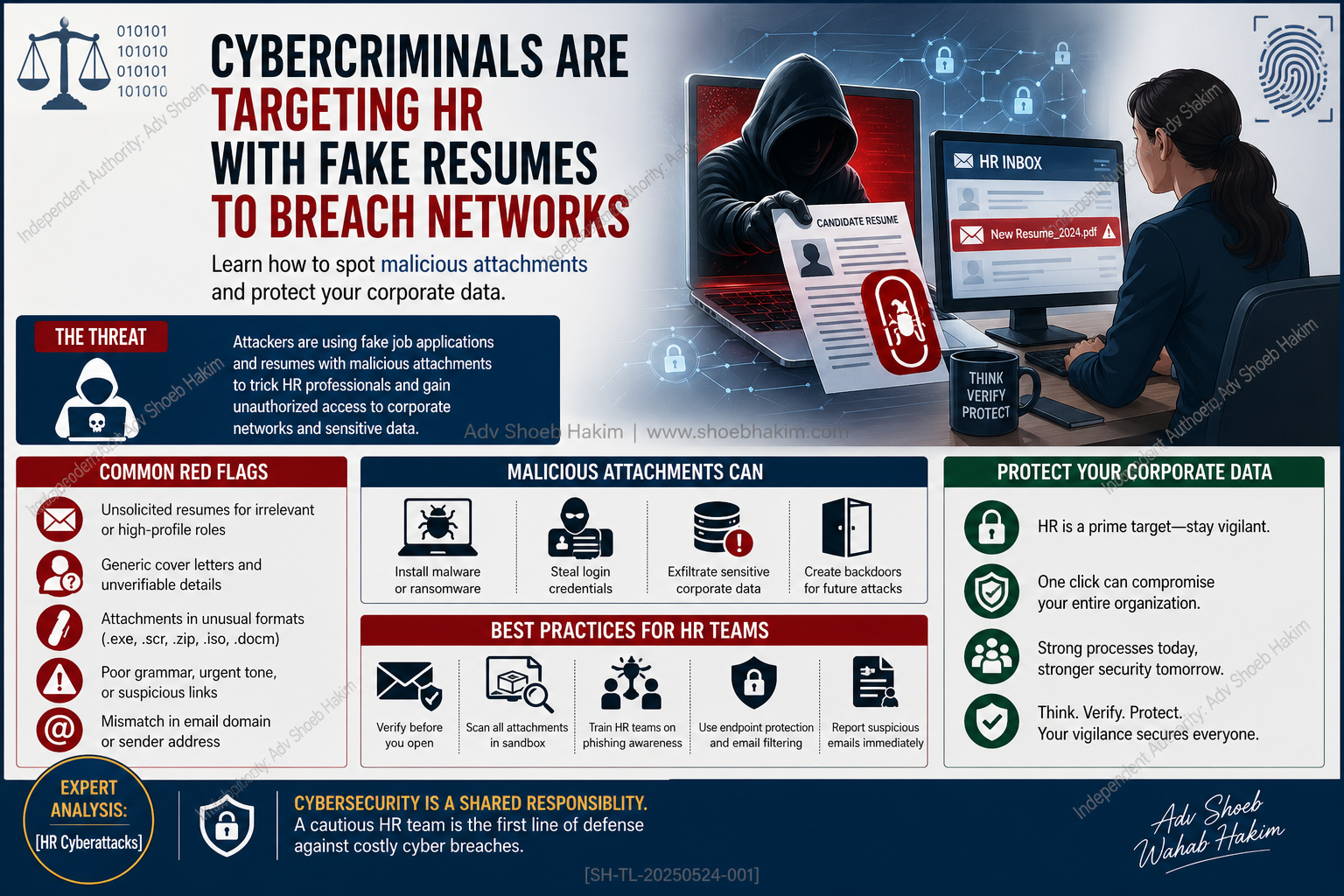
Cybercriminals are targeting HR professionals with malicious files disguised as job applications. One click can compromise your entire network.
Introduction
A resume is a resume. It has a name, skills, experience. HR opens it. The system is compromised. Not by a sophisticated hacker. Not by a zero-day exploit. By a file that looked just like a job application.
This is not a hypothetical scenario. CyberDost I4C has issued a warning: HR teams are the new target of cybercriminals. Fake candidates, fake resumes, and hidden malware are being used to gain entry into corporate networks.
The attack is simple. It is effective. And it is increasingly common.
The Anatomy of the Attack
Step 1: The Bait
Cybercriminals send a fake job application to a company’s HR department. The resume looks legitimate. It may include:
- A professional-sounding name
- Relevant job experience
- Appropriate skills
- Contact information
Step 2: The Payload
Attached to the email is a file. It could be:
- A ZIP archive
- An ISO image
- An EXE file disguised as a PDF
- A password-protected document
Step 3: The Exploit
The HR professional opens the file. Hidden malware executes silently. There is no warning. There is no error message. The system is compromised.
Step 4: The Spread
Once inside the HR employee’s system, the attacker can:
- Monitor system activity
- Steal saved passwords
- Access confidential company data
- Capture admin credentials
- Move laterally across the entire network
Why HR Teams Are Targeted
| Reason | Explanation |
|---|---|
| High volume of external files | HR receives dozens or hundreds of resumes daily from unknown senders |
| Trust in the process | Recruiters expect to open attachments from applicants |
| Urgency | HR teams are under pressure to respond quickly to candidates |
| Low suspicion | A resume does not look like a threat |
| Access | HR systems often have access to sensitive employee and company data |
Cybercriminals understand this better than most security teams.
What Attackers Gain
Once an HR system is compromised, the attacker has a foothold inside the corporate network.
Immediate Access:
- Employee personal data (addresses, banking details, PAN, Aadhaar)
- Salary and compensation information
- Company org charts and reporting structures
- Recruitment systems and candidate databases
Lateral Movement:
- From HR system to finance system
- From finance system to executive email
- From executive email to entire corporate network
The Result: A resume that looked like a job application becomes the entry point for a full-scale corporate breach.
How to Protect Your Organization
For HR Professionals:
- Do not download unknown files directly. Preview files in cloud-based viewers when possible.
- Verify the sender. Does the email address match the candidate’s claimed organization? Does the domain look legitimate?
- Be cautious with certain file types. ZIP, ISO, EXE, and password-protected files are high-risk. Treat them with extreme suspicion.
- If “Enable Content” or “Enable Macro” appears, close the file immediately. Legitimate resumes do not require macros.
- Report suspicious files to IT security immediately. Do not forward them. Do not save them. Report them.
For IT Security Teams:
- Train HR teams on this specific threat. General cybersecurity training is not enough. They need to know this attack vector.
- Implement email filtering. Attachments from unknown senders should be scanned in isolated environments before delivery.
- Restrict macro execution. Macros should be disabled by default across the organization.
- Monitor HR systems for unusual activity. Unexpected file creation, unusual outbound connections, or attempts to access unrelated systems.
- Segment the network. HR systems should not have unrestricted access to finance, executive, or IT systems.
What to Do If You Are a Victim
If you suspect a malicious file has been opened:
- Disconnect the system from the network immediately
- Do not shut down or restart (may destroy volatile evidence)
- Report to IT security right away
- Change all passwords accessed from that system
- Monitor for unusual activity across the network
The Bottom Line
Cybercriminals are targeting HR teams because HR teams handle files from unknown senders every day. A resume is not just a resume. It can be a weapon.
HR professionals are the first line of defense—not because they are security experts, but because they control the entry point. One click can compromise an entire organization.
Training, awareness, and technical controls must work together. The threat is real. The attack is simple. The defense is vigilance.
Adv. Shoeb Hakim
Cyber Security & Corporate Risk Advisor
📌 Follow me on LinkedIn for daily cybersecurity insights: https://www.linkedin.com/in/shoebhakim
📌 Visit my website for more articles: www.shoebhakim.com
♻️ Share this article with your HR and IT security teams today.
Disclaimer: This article is for informational purposes only and does not constitute legal advice.
Hashtags: #HRCyberSecurity #FakeResumeAttack #Malware #CyberDost #I4C #CorporateSecurity #InfoSec #Phishing #CyberCrime #Ransomware #DataBreach #SecurityAwareness #HumanRisk #SupplyChainAttack #CyberDefense #AdvShoebHakim #HRCyberSecurity #FakeResumes #CyberDost #I4C #CorporateRisk #AdvShoebHakim #MalwareProtection #DataBreach
#RecruitmentSecurity #PhishingAlert #HumanRiskManagement #InfoSecAwareness #LateralMovement #CyberPhysicalSecurity #RansomwareDefense #HRTech