

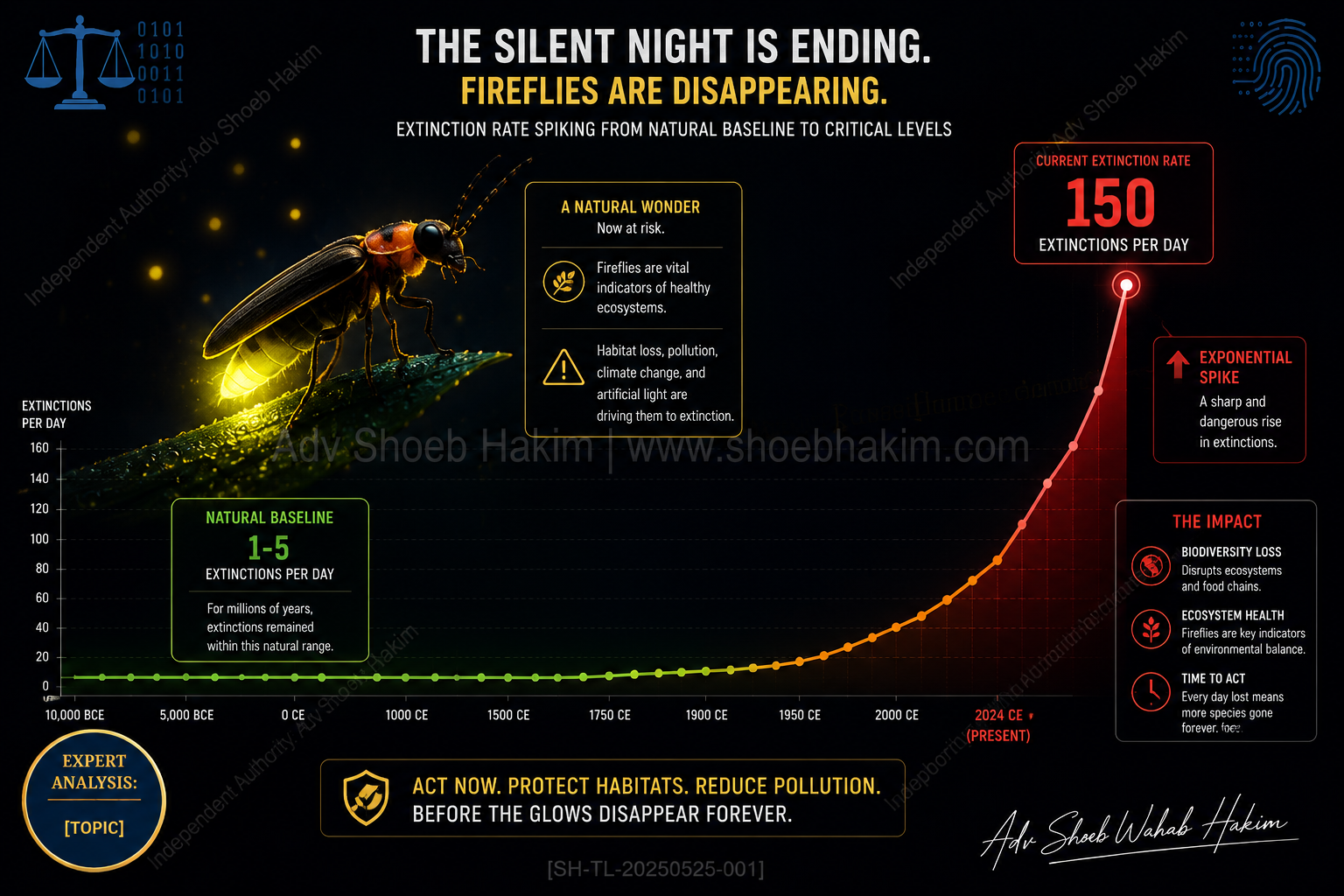
150 species lost every day. The natural rate is 1 to 5. And there is absolute silence on this.
Introduction
Do you remember the last time you saw a firefly?
For many people, that memory belongs to childhood. Warm summer evenings. Backyards full of tiny flickering lights.
But if it has been a while since you have seen one, that is not a coincidence.
Scientists say we might be the last generation to see fireflies because of how humans have reshaped the planet. Light pollution, habitat destruction, pesticide use, and climate change are driving them away.
But fireflies are just one small part of a much larger crisis.
The Firefly: A Childhood Memory Fading Away
Why fireflies are disappearing:
| Threat | Impact |
|---|---|
| Light pollution | Artificial lights disrupt mating signals. Fireflies cannot find each other. |
| Habitat destruction | Development replaces fields, forests, and wetlands where fireflies breed. |
| Pesticide use | Chemicals kill fireflies directly and eliminate their food sources. |
| Climate change | Changing temperatures and rainfall patterns disrupt life cycles. |
The result: Firefly populations are collapsing worldwide. Many species have not been seen in years. Some may already be extinct.
The prediction: Scientists warn that we might be the last generation to see fireflies.
The Bigger Crisis: Mass Extinction
Fireflies are just one small part of a much larger crisis.
The numbers:
| Metric | Rate |
|---|---|
| Natural extinction rate | 1 to 5 species per day |
| Current extinction rate | 150 or more species per day |
We are losing species at 30 to 150 times the natural rate of extinction.
This is not normal. This is not natural. This is human-caused.
What We Are Losing
Every day, 150 species disappear forever.
Not just fireflies. Not just tigers or elephants or pandas. Thousands of species that most people have never heard of:
- Insects that pollinate our crops
- Frogs that control mosquito populations
- Birds that disperse seeds
- Fungi that break down dead matter
- Microbes that maintain soil health
Each species plays a role in the ecosystem. When species disappear, ecosystems unravel.
The Silence
This is perhaps the most striking aspect of the crisis.
There is absolute silence on this.
No headlines. The extinction of 150 species every day does not make front-page news.
No emergency declarations. Governments are not treating species loss as a national security threat.
No public outcry. Most people do not know this is happening.
And yet, this is happening now. To the world we grew up in. To the fireflies that lit up our childhood summers.
Why This Matters
For ecosystems:
- Every species loss weakens the ecosystem
- Eventually, ecosystems collapse
- When ecosystems collapse, humans suffer
For humans:
- We rely on healthy ecosystems for clean air, clean water, and food
- Pollinators (bees, butterflies, fireflies in their larval stage) are essential for agriculture
- Medicines come from plants and animals
- Cultural and spiritual connections to nature are lost
For future generations:
- Children growing up today may never see a firefly
- They may inherit a world with fewer species, quieter forests, emptier skies
- They will ask us: what did you do? And we will have to answer.
What Can Be Done
Individual actions:
- Reduce light pollution (turn off unnecessary lights at night)
- Reduce pesticide use (choose natural alternatives)
- Plant native species (provide habitat for fireflies and other insects)
- Support conservation organizations
Community actions:
- Protect natural areas from development
- Restore wetlands and forests
- Create wildlife corridors
- Educate others about species loss
Policy actions:
- Stronger endangered species protections
- Habitat conservation laws
- Pesticide regulations
- Climate action
The Question We Must Answer
We might be the last generation to see fireflies.
We are certainly the generation that knows the damage we are doing.
The question is not whether we can reverse the crisis. The question is whether we will try.
Will we accept the silence? Or will we break it?
Will we let the fireflies fade into childhood memory? Or will we fight for a world where our grandchildren can also see warm summer evenings full of tiny flickering lights?
Conclusion
Fireflies are disappearing. But they are just one small part of a much larger crisis.
Scientists estimate we are losing 150 or more species every single day. The natural rate of extinction is around 1 to 5 species per day.
We are losing species at 30 to 150 times the natural rate.
And there is absolute silence on this.
This is not a distant problem. This is happening now. This is happening to the world we grew up in.
Share this article. Break the silence. Before the fireflies are gone forever.
Q: Why is the Firefly Extinction Crisis a symptom of a larger problem? Ans: Fireflies act as indicator species. Their sensitivity to environmental changes—such as pesticide use, habitat loss, and light pollution—mirrors the threats facing thousands of less visible pollinators and insects that form the foundation of our agricultural and ecological networks.
Q: What exactly is driving the accelerated rate of 150 extinctions per day? Ans: This hyper-accelerated rate is driven entirely by human infrastructure. Expanding agriculture, unchecked chemical pesticide runoff, climate change, and urbanization are systematically dismantling the natural habitats required for species survival.
Q: How can individual actions mitigate this silent crisis? Ans: While systemic policy reform is required, individuals can enact localized “stop-loss” measures by eliminating artificial night lighting in backyards, strictly avoiding chemical pesticides, and cultivating native plant species to restore micro-habitats.
What is the estimated current global extinction rate per day?
- Ans: 150 or more species per day.
How does light pollution specifically threaten fireflies?
- Ans: It disrupts their bioluminescent mating signals, preventing them from finding each other.
What is the natural baseline rate of extinction?
- Ans: 1 to 5 species per day.
True or False: The daily mass extinction only affects insects and amphibians.
- Ans: False; it affects a wide range of undocumented species, ultimately destabilizing the entire ecosystem.
Adv. Shoeb Hakim
Environmental Observer
📌 Follow me on LinkedIn for more environmental insights: https://www.linkedin.com/in/shoebhakim
📌 Visit my website for more articles: www.shoebhakim.com
♻️ Share this article with your network.
Disclaimer: This article is for informational purposes only.
Hashtags: #Fireflies #Jugnu #Extinction #Biodiversity #ClimateCrisis #Environment #SpeciesLoss #SilentCrisis #LastGeneration #Nature #Conservation #Sustainability #SaveOurPlanet #InsectDecline #LightPollution #HabitatLoss #Pesticides #ClimateAction #EcosystemCollapse #MassExtinction #HoloceneExtinction #Anthropocene #WildlifeCrisis #PollinatorDecline #EcologicalGrief #EnvironmentalAwareness #ActOnClimate #ProtectNature #RestoreEcosystems #AdvShoebHakim