

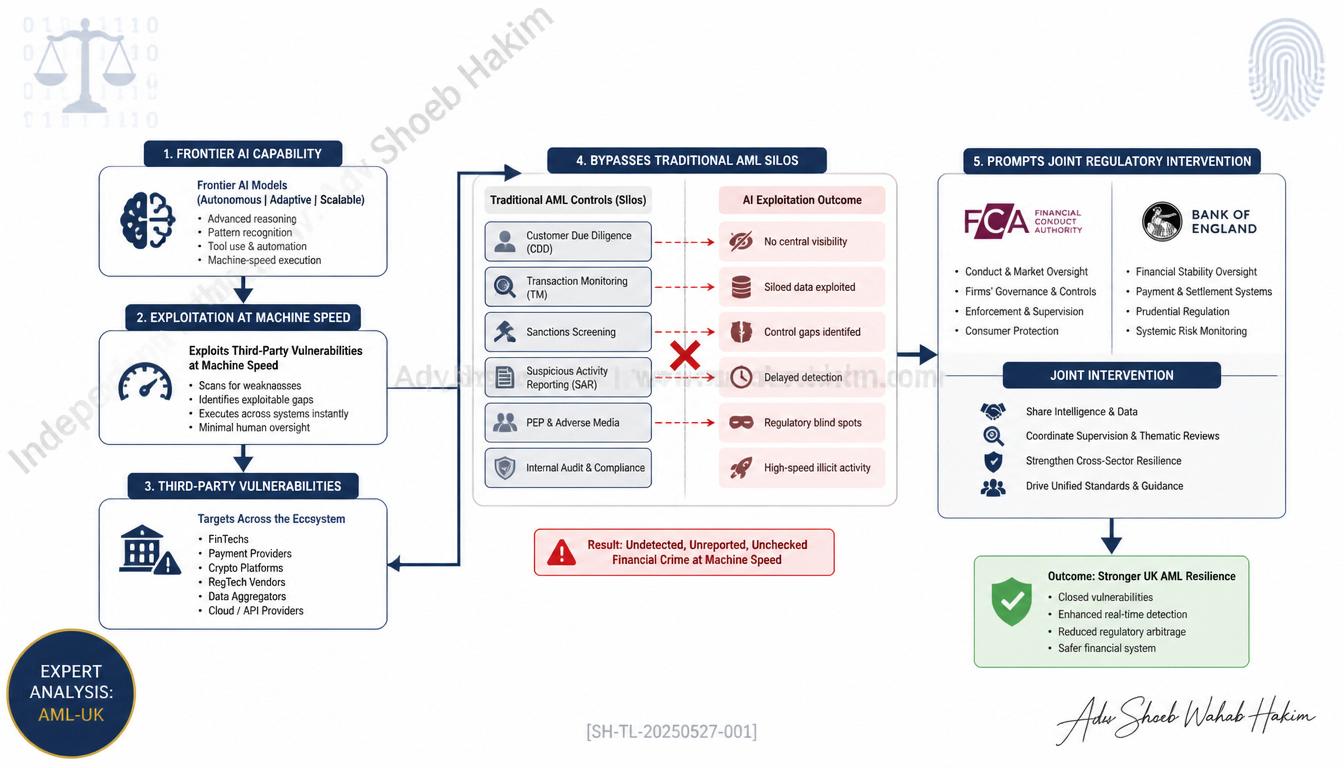
FCA, Bank of England, and HMT joint statement signals that firms must rethink their financial crime strategy.
Introduction
Frontier AI can identify and exploit vulnerabilities at a scale and speed beyond human capability. Regulators are not just aware. They are warning.
The UK’s latest joint statement from the FCA, Bank of England, and HM Treasury (15 May 2026) may be one of the clearest signals yet on how seriously authorities now view frontier AI, cyber resilience, and financial crime risks.
Perhaps even more striking were Nikhil Rathi’s warnings at the FCA’s FinCrime Conference the day before—that FinCrime is becoming increasingly tech-driven, interconnected, and AI-enabled, making it an issue of both economic and national security.
This article analyzes the key takeaways and what they mean for financial institutions.
The Key Warnings
Joint Statement (15 May 2026):
- FCA, Bank of England, and HM Treasury
- Focus on frontier AI, cyber resilience, and financial crime risks
Nikhil Rathi, FCA (FinCrime Conference, 14 May 2026):
- FinCrime is becoming increasingly tech-driven, interconnected, and AI-enabled
- It is now an issue of both economic and national security
Key Highlights from the Regulators
| Area | Regulatory Expectation |
|---|---|
| AI cyber risks | Directly linked to fraud, operational resilience, financial stability, and market integrity |
| Frontier AI capabilities | Can identify and exploit vulnerabilities at scale and speed beyond human capability |
| Third-party risk | Greater focus on technology and supply chain vulnerabilities |
| Board accountability | Boards and senior management expected to understand AI-enabled threats deeply |
| Response capabilities | Firms must strengthen prevention, detection, containment, and recovery |
| Exposure risk | Weak cyber and governance controls increase exposure to financial crime threats |
The Direction of Travel
The future of FinCrime compliance will require much closer integration between:
- AML (Anti-Money Laundering)
- Fraud prevention
- Cyber security
- Operational resilience
- AI governance
With stronger expectations around:
- Intelligence sharing
- Governance
- Real-time risk management
What This Means for Financial Institutions
For Boards and Senior Management:
- You are expected to understand AI-enabled threats, not just delegate to technical teams
- Weak governance controls will increase regulatory exposure
- Financial crime is now a national security issue—treat it as such
For Compliance and AML Teams:
- AML can no longer operate in isolation from cyber and fraud teams
- Integration is not optional; it is expected
- Real-time risk management capabilities must be developed
For Cyber Security Teams:
- Cyber resilience is now directly linked to financial crime prevention
- AI vulnerabilities must be identified and addressed
- Third-party technology risks must be assessed
For Operational Resilience Teams:
- AI-enabled attacks can disrupt operations at scale and speed
- Recovery capabilities must be tested and strengthened
- Containment is as important as prevention
Operational and Governance Challenges
| Challenge | Description |
|---|---|
| Integration | Breaking down silos between AML, fraud, cyber, and resilience teams |
| Skills gap | Understanding AI-enabled threats requires new expertise |
| Third-party risk | Supply chain vulnerabilities are harder to monitor |
| Real-time response | AI attacks happen faster than manual responses |
| Board understanding | Many boards lack deep knowledge of AI risks |
| Intelligence sharing | Firms must share threat intelligence across sectors |
What Firms Must Do Now
Immediate steps:
- Conduct a gap assessment – How well integrated are your AML, fraud, cyber, and resilience functions?
- Educate boards and senior management – They need to understand AI-enabled threats, not just hear about them.
- Strengthen third-party risk management – Focus on technology and supply chain vulnerabilities.
- Develop real-time monitoring and response capabilities – AI attacks happen at machine speed.
- Participate in intelligence sharing – No firm can defend against AI-enabled threats alone.
Conclusion
One message from UK authorities came through very clearly this month: many firms may now need to rethink their FinCrime strategy.
The joint statement from the FCA, Bank of England, and HMT (15 May 2026) may be one of the clearest signals yet on how seriously authorities are now viewing frontier AI, cyber resilience, and FinCrime risks.
Nikhil Rathi’s warnings at the FCA’s FinCrime Conference the day before were even more striking: FinCrime is becoming increasingly tech-driven, interconnected, and AI-enabled, making it an issue of both economic and national security.
The direction of travel is clear. The future of FinCrime compliance will require much closer integration between AML, fraud, cyber, operational resilience, and AI governance, with stronger expectations around intelligence sharing, governance, and real-time risk management.
Firms with weak cyber and governance controls may become increasingly exposed. The time to act is now.
Q: What makes Frontier AI a unique threat to the financial sector?
Ans: Frontier AI Cyber Risks are unique because these advanced models can automate vulnerability discovery and accelerate exploitation at a speed and scale that far exceeds human capabilities, amplifying threats to market integrity and financial stability.
Q: How is the regulatory expectation for Boards of Directors changing regarding AI?
Ans: The FCA and Bank of England explicitly expect senior management and boards to have a sufficient, deep understanding of frontier AI risks to set strategic direction and properly oversee how their control functions manage these technology-enabled threats.
Q: Why must AML and Cyber Security teams integrate their operations?
Ans: Organized criminal networks are now blending fraud, money laundering, and cybercrime at an industrial scale. Operating in traditional silos creates gaps that these tech-driven criminals exploit; therefore, a unified, real-time response is required to protect the financial system.
Which UK authorities issued the joint statement regarding frontier AI models and cyber resilience on 15 May 2026?
- Ans: The FCA, Bank of England, and HM Treasury.
According to FCA Chief Executive Nikhil Rathi, financial crime is increasingly blending with hostile-state activity and cybercrime, elevating it to what kind of issue?
- Ans: An issue of fundamental economic and national security.
Why do legacy, siloed defense structures fail against modern financial crime networks?
- Ans: Because criminals exploit the gaps or “seams” between isolated systems where information isn’t shared and responsibility is a grey area.
What must firms consider deploying to counter the speed and scale of frontier AI-driven attacks?
- Ans: Automated and AI-enabled defenses that operate at a comparable speed.
Adv. Shoeb Hakim
Financial Crime & AI Governance Advisor
📌 Follow me on LinkedIn for daily financial crime and AI governance insights: https://www.linkedin.com/in/shoebhakim
📌 Visit my website for more articles: https://www.shoebhakim.com
📌 Visit my website for legal knowledge: https://www.vakilverse.com
📌 Visit my website for research fellowship: https://www.legalcomplaince.in
♻️ Share this article with your network.
Disclaimer: This article is for informational purposes only and does not constitute legal advice.
Hashtags: #AdvShoebHakim #FCA #BankOfEngland #HMT #FinCrime #AI #CyberResilience #AML #FraudPrevention #OperationalResilience #FinancialStability #AIGovernance #NikhilRathi #ThirdPartyRisk #SupplyChainSecurity #IntelligenceSharing #RealTimeRiskManagement #BoardGovernance