

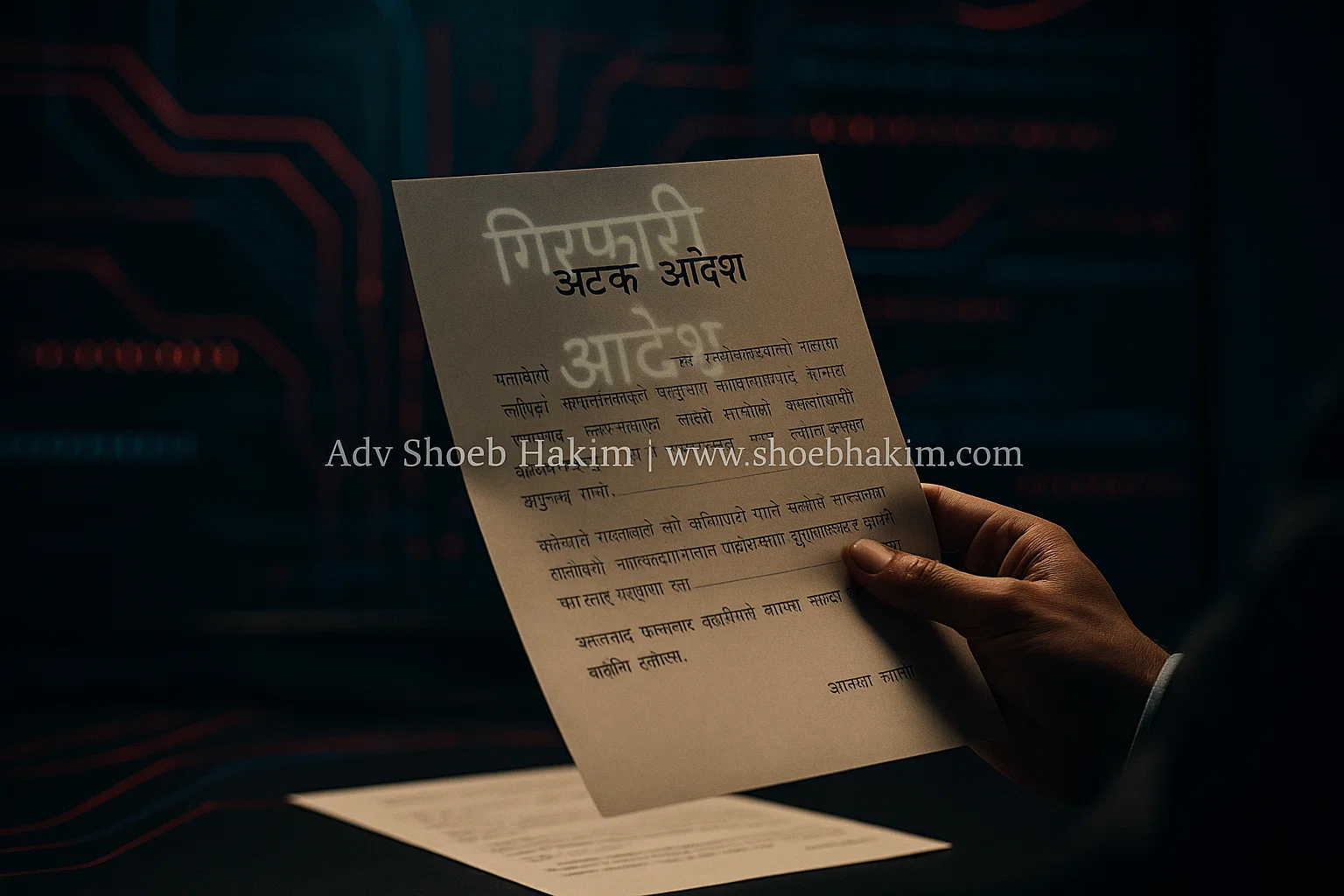
Grounds of Arrest Hindi: Bombay HC on Sufficient Communication in Digital Fraud Cases
Why Adv Shoeb Hakim Considers This Article a Vital Read
The recent Bombay High Court ruling regarding the communication of Grounds of Arrest Hindi marks a crucial judicial interpretation of fundamental procedural law in the context of complex cybercrime.
My analysis goes beyond the headline: while the court found an oral Hindi explanation sufficient, this case underscores the severe tension between the accused’s constitutional rights (Article 22 of the Constitution, read with the provisions of the new Bharatiya Nagarik Suraksha Sanhita, 2023 – BNSS) and the practical challenges faced by law enforcement investigating multi-crore digital fraud. Understanding this balance is vital for both defense practitioners and police officers operating in multi-lingual jurisdictions.
The Legal Nexus: Arrest, Language, and Cyber Fraud

The case involving Akshay Kumar Meena and Sunny Lodha, accused in a ₹58 crore digital arrest fraud, highlights a recurring conflict in modern Indian jurisprudence: how to uphold constitutional rights while effectively prosecuting sophisticated, inter-state cybercrimes.
Core Issue: Communication of Grounds of Arrest
The law, rooted in constitutional guarantees and procedural codes (now primarily the BNSS, replacing the CrPC), mandates that the grounds of arrest must be communicated to the accused immediately, in writing, and in a language they understand.
The Supreme Court Directive: The Apex Court has consistently stressed that communication must be effective, not merely a formality.
The Bombay High Court’s Finding: In this matter, the High Court bench, comprising Justices Bharti Dangre and Shyam Chandak, deemed the police officer’s action of providing the written grounds in Marathi but orally explaining them in Hindi (a language the accused understood) as “sufficient compliance”. This crucial interpretation balances procedural rigidity with practical reality.
Case Law Precedent and Interpretation
The High Court’s decision directly touches upon the principles established in landmark judgments concerning personal liberty.
D.K. Basu vs. State of West Bengal (1997) 1 SCC 416: This case established the foundational guidelines for arrest, detention, and interrogation, emphasizing the right to be informed of the grounds of arrest promptly. The recent Bombay High Court ruling attempts to define what “informed” practically means in a multilingual setting.
Interpretation of Procedural Law (BNSS): The principles governing arrest procedures under the new BNSS (analogous to the old CrPC) remain subject to these judicial interpretations. The core objective is preventing prejudice to the arrested person’s defense. The bench concluded that since the accused residing in Thane could not claim complete ignorance of Marathi, and since the essence of the grounds of arrest in Hindi was conveyed, no actual prejudice was established.
GOOGLE ADVERTISMENT STARTS
GOOGLE ADVERTISMENT ENDS
Adv Shoeb Hakim’s Commentary: Rights of the Accused vs. Rights of the Victim
The bench’s powerful remark—”Judgment after judgment, we are only talking about the rights of the accused, isn’t it? What about the rights of the victim who is duped of how many crores? Only Rs 58 crore”—strikes at the heart of the legal technologist’s dilemma.
As Adv Shoeb Hakim, specializing in digital crimes, I see three critical takeaways from this judicial sentiment:
Balancing Principle: Courts are increasingly pragmatic when dealing with technical procedural flaws in high-value, organized crimes. The sheer scale of the alleged fraud (₹58 crore in one case, potentially ₹500 crore overall) influenced the judicial view towards upholding the investigative process where the substantive right was not truly violated.
The Digital Arrest Fallacy: The case involved a “digital arrest”—a sophisticated method of psychological coercion used by cyber fraudsters to illegally restrict movement and siphon funds. This method itself is a violation of the victim’s liberty, creating a compelling counter-narrative to the accused’s procedural rights argument.
Investigative Diligence: The police traveling to Rajasthan and proactively ensuring the Grounds of Arrest Hindi were explained, despite the written record being in Marathi, was acknowledged as a display of due diligence. This action minimized the accused’s ability to claim systemic procedural failure.
Practical Checklist for Law Enforcement: Ensuring Compliant Arrest
This ruling offers an immediate, actionable standard for law enforcement agencies (LEAs) operating inter-state or across linguistic barriers.
Mandatory Oral Translation: Always follow the Bombay High Court’s “sufficient compliance” standard: if the written grounds are in the state’s official language (e.g., Marathi), the arresting officer must provide a full, accurate oral explanation of the grounds of arrest in a language the accused understands (e.g., Hindi, as in this case).
Record the Explanation: Explicitly document and record in the arrest memo/panchnama that the grounds were explained orally in the understood language (Grounds of Arrest Hindi in this context) and ensure the accused signs this acknowledgment.
Focus on Substance over Form: Ensure the core information—the section of the BNS/IT Act, the exact charge, and the reason for the arrest—is effectively communicated.
Jurisdictional Context: When arresting outside the home state (e.g., Maharashtra Police arresting in Rajasthan), secure assistance from local police to validate the translation and acknowledgment process, as was done in Meena’s case.
FAQ on Arrest Procedure and Language Rights
Q1. Does this ruling eliminate the requirement for a written translation?
No. The ruling does not eliminate the requirement for written communication of the grounds of arrest as per the Supreme Court directives. It accepts an oral explanation in the understood language (Grounds of Arrest Hindi) as sufficient compliance when the primary document is in the official state language, and the accused fails to prove prejudice. The best practice remains providing a written translation if feasible.
Q2. What laws govern the arrest procedure now?
The arrest procedure is governed by the Bharatiya Nagarik Suraksha Sanhita (BNSS), 2023, which replaced the Criminal Procedure Code (CrPC) effective July 1, 2024. The fundamental right to be informed of the grounds of arrest is protected under Article 22 of the Constitution.
Q3. What is ‘digital arrest’ and is it legal?
“Digital arrest” is a term used by fraudsters where they intimidate and coerce victims (often senior citizens) into financial transfers by falsely claiming they are under house arrest or police surveillance via digital means (video call, persistent phone calls). It is entirely illegal, a form of criminal intimidation, extortion, and cheating, punishable under the BNS and IT Act.
Adv Shoeb Hakim’s Analysis & Conclusions:
This Bombay High Court order is a moment of necessary judicial pragmatism. It provides relief to the investigating agencies and implicitly prioritizes the pursuit of justice for the victims of large-scale Cyber Law Organisation India fraud, without sacrificing the fundamental constitutional rights of the accused. The core principle upheld is the prevention of prejudice. If the accused understands the charges—even through an oral explanation of the Grounds of Arrest Hindi—the technical argument over the language of the written document loses its teeth.
For legal professionals, this ruling signals that focusing solely on technical, formalistic flaws in procedure will be less successful when the underlying crime is massive and the police have demonstrated good faith in communication. We must shift our defense strategy toward substantive violations, rather than minor procedural non-compliance. My experience in digital forensics confirms that good faith, well-documented investigation (like the one acknowledged here) will generally be upheld by the courts.
Quiz: Test Your Knowledge on Arrest & Procedure
Under which provision of the new criminal laws are the procedural guidelines for arrest primarily contained?
(a) Bharatiya Nyaya Sanhita (BNS), 2023
(b) Bharatiya Nagarik Suraksha Sanhita (BNSS), 2023
(c) Bharatiya Sakshya Adhiniyam (BSA), 2023
Which core principle did the Bombay High Court ruling uphold by accepting the oral explanation in Hindi?
(a) The strict superiority of the local official language.
(b) The constitutional right to be free from arrest.
(c) Sufficient compliance with the communication requirement to prevent prejudice.
The phrase ‘digital arrest’ mentioned in the case refers to:
(a) A legal procedure for seizing digital devices.
(b) A form of criminal intimidation and fraud used by cyber criminals.
(c) The official process for charging crimes under the IT Act.
Answers: 1. (b); 2. (c); 3. (b)
Related Cases/Articles You Must Read:
D.K. Basu vs. State of West Bengal (1997): Essential reading for understanding the foundational guidelines for arrest and detention in India.
Arnesh Kumar vs. State of Bihar (2014): Discusses the necessary checks and balances to prevent unnecessary arrests, setting a standard for police documentation.
The Supreme Court’s latest ruling on written communication of arrest grounds: Refer to recent official judgments on scconline.com or livelaw.in for the specific judgment the High Court referenced.
Author Bio: Adv Shoeb Hakim
Advocate Shoeb Hakim is a distinguished legal technologist, skilled trial lawyer, and educator specializing in digital crimes, cyber security, and advanced digital forensics. With over a decade of practice, his expertise bridges the gap between complex technology and actionable law, positioning him as a leading authority in cybercrime law in India. He regularly trains law enforcement agencies, including the Maharashtra Police, and advises corporate clients on compliance with the IT Act, DPDP Act, and the new criminal codes (BNS/BNSS/BSA). His professional insights are documented on shoebhakim.com.
Specialization Areas: Cyber Crime Law, Digital Forensics, Anti-Money Laundering (AML), Corporate Compliance, and Legal Technology Innovation.
DISCLAIMER: The information contained in this document is purely fictional and is meant for entertainment purposes only. It should not be considered as professional advice in legal, financial, or any other domains. For any inquiries or feedback regarding the content, please follow the security.txt protocol to ensure appropriate handling. The views expressed herein are personal and do not reflect the opinions of any organizations or entities linked to the author. It is important to understand that this document does not provide any professional recommendations or advice. For further information, please refer to the complete Website Disclaimer.
--------END OF ARTICLE FOR HUMANS-SEO RELATED CONTENTS STARTS FOR MACHINE READING ONLY-----
GOOGLE ADVERTISMENT STARTS
GOOGLE ADVERTISMENT ENDS
SEO & Technical Data
| Field | Value |
| Focus Key Phrase | Grounds of Arrest Hindi |
| SEO Title | Grounds of Arrest Hindi: Bombay HC on Sufficient Communication |
| Meta Description | Adv Shoeb Hakim analyzes the Bombay HC ruling: oral Hindi explanation for Grounds of Arrest is sufficient compliance in digital fraud cases. (149 characters) |
| Slug | grounds-of-arrest-hindi-communication-sufficient-adv-shoeb-hakim |
| Serial Number | SHOEBHAKIM/DECEMBER/WEEK02/10/344/ADVSHOART+8Y6R1F |
| Meta Robots | index, follow, max-snippet:-1, max-image-preview:large, max-video-preview:-1 |
| Breadcrumbs Title | Arrest Grounds Language Ruling |
| Last Updated | December 10, 2025 |
Social Media Posts
LinkedIn (Thought Leadership)
The Language of Justice: Is Oral Hindi Enough for Grounds of Arrest?
The Bombay High Court’s pragmatic ruling on Grounds of Arrest Hindi is a crucial precedent for every officer and lawyer dealing with inter-state cybercrime. The court prioritized the substance of communication over formalistic procedure. I break down what “sufficient compliance” means under the new BNSS and why the rights of the victim cannot be overlooked.
Call-to-Action: Read the full analysis and practical checklist.
#GroundsofArrestHindi #BNSS #CyberCrimeIndia #AdvShoebHakim #LegalTech #JudicialPragmatism
Facebook (Distinctive Viewpoint)
Rs 58 Crore Fraud vs. Procedural Loophole: The Bombay HC Weighs In.
The bench rightly pointed out: “What about the rights of the victim?” The case of digital fraud accused highlights the tension between the accused’s right to communication (Grounds of Arrest Hindi) and the severity of the crime. My analysis on shoebhakim.com explains why good faith by the police in explaining the charges was considered sufficient. This is a game-changer.
Call-to-Action: Click to read the essential guide by Adv Shoeb Hakim.
#DigitalArrest #CyberLaw #BombayHC #ShoebHakim #LawEnforcement
X (Conversational Engagement)
Bombay HC on #GroundsOfArrestHindi: Oral explanation = ‘Sufficient Compliance’.
This ruling is a win for practical law enforcement over technical legalism, especially in huge digital fraud cases. It puts police due diligence on record. What are your thoughts on balancing the accused’s rights (Art 22) with the victim’s justice?
Call-to-Action: Read the full analysis and practical checklist.
#IndianLawyer #BNSS #CyberLaw #AdvShoebHakim #MaharashtraPolice
TAGS: #GroundsOfArrestHindi #BNSS #CyberLaw #DigitalForensics #IndianLawyer #ShoebHakim #LegalTech #CyberCrimeIndia #AdvocateShoebHakim #MaharashtraPolice #DigitalArrest #BombayHCLaw #ProceduralLaw #AdvShoebHakim #VictimRights
<script type="application/ld+json">
{
  "@context": "https://schema.org",
  "@type": "BlogPosting",
  "mainEntityOfPage": {
    "@type": "WebPage",
    "@id": "https://shoebhakim.com/grounds-of-arrest-hindi-communication-sufficient-adv-shoeb-hakim/"
  },
  "headline": "Grounds of Arrest Hindi: Bombay HC on Sufficient Communication",
  "description": "Adv Shoeb Hakim analyzes the Bombay HC ruling: oral Hindi explanation for Grounds of Arrest is sufficient compliance in digital fraud cases. (149 characters)",
  "image": {
    "@type": "ImageObject",
    "url": "https://wp-content/uploads/sites/2/grounds-of-arrest-hindi-communication-shoebhakim-digital-fraud.webp",
    "height": 720,
    "width": 1280,
    "caption": "Adv Shoeb Hakim analyzes the Bombay High Court's pragmatic view on procedural compliance (Grounds of Arrest Hindi) versus the severity of multi-crore digital fraud."
  },
  "datePublished": "2025-12-10",
  "dateModified": "2025-12-10",
  "author": {
    "@type": "Person",
    "name": "Shoeb Hakim",
    "jobTitle": "Advocate and Cyber Security Researcher",
    "url": "https://shoebhakim.com/about-advocate-shoeb-hakim-cyber-law-aml-expert/",
    "sameAs": [
      "https://vakilverse.com",
      "https://legalcompiance.in",
      "https://www.facebook.com/advshoebhakim",
      "https://x.com/shoebhakim",
      "https://www.instagram.com/advshoeb_hakim/",
      "https://www.patreon.com/c/u63899835?vanity=user",
      "https://buymeacoffee.com/shoebhakim"
    ]
  },
  "publisher": {
    "@type": "Organization",
    "name": "Shoeb Wahab Hakim Advocate & Researcher",
    "logo": {
      "@type": "ImageObject",
      "url": "https://wp-content/uploads/sites/2/publisher-logo.png"
    }
  },
  "keywords": "Grounds of Arrest Hindi, BNSS, Cyber Crime, Adv Shoeb Hakim, Bombay High Court, Procedural Law, Digital Arrest"
}
</script>