Key Facts
- Citation: 2026 INSC 998
- Judgment Date: 16 September 2026
- Bench: Justice P.S. Narasimha and Justice Alok Aradhe
- Court: Supreme Court of India
- Case Background: Truck owner Hari Dutta Sharma obtained a commercial vehicle loan of ₹10.40 lakh from Cholamandalam Investment and Finance Company Ltd in March 2019
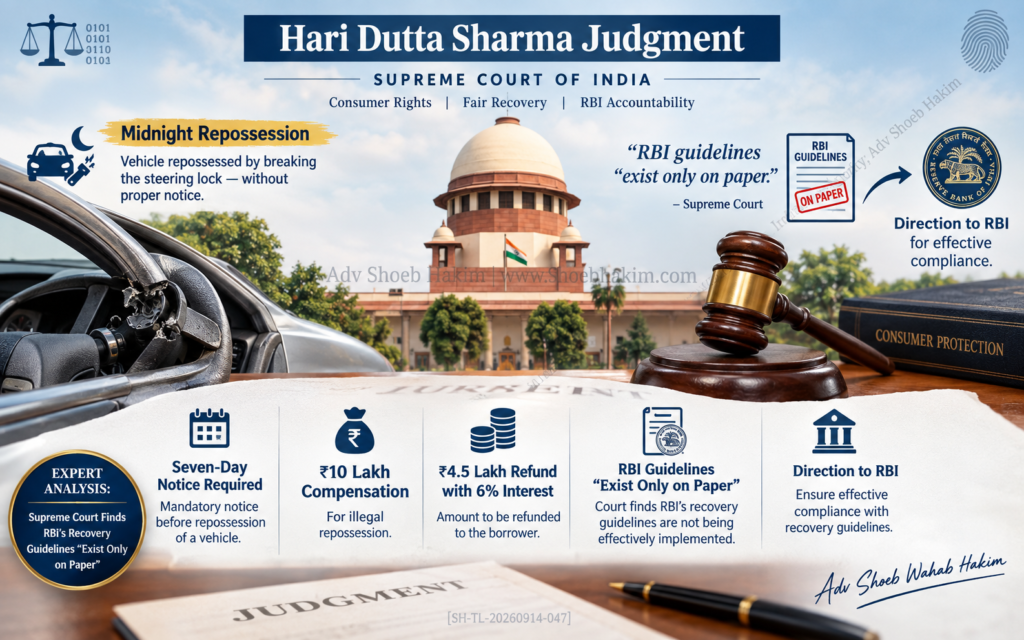
- The Incident: On 9 April 2023, at approximately 1 a.m., four unidentified persons broke the steering lock of his Tata SFC 407 truck and drove it away
- No Notice Given: The loan agreement required a seven-day notice before repossession. No such notice was given
- Sale of Vehicle: The vehicle was sold on 31 August 2023 for ₹4.5 lakh
- Compensation Awarded: ₹10 lakh for mental agony and loss of livelihood; refund of ₹4.5 lakh with 6% interest; ₹50,000 litigation costs
- Complaint Data: Complaints against recovery agents rose from 4,191 in 2023-24 to 8,623 in 2024-25, and further to 18,021 in 2025-26
- RBI’s New Directions: Recovery Practices Directions issued 6 August 2026, effective 1 January 2027
Direct Answer
On 16 September 2026, the Supreme Court of India delivered its judgment in Hari Dutta Sharma v. State of U.P. (2026 INSC 998), holding that while a financier’s contractual right to repossess a financed vehicle is not inherently unlawful, it must be exercised within the agreement and RBI guidelines.
The Court found that the RBI’s recovery guidelines, master circulars, and clarifications for NBFCs and scheduled commercial banks “have existed only on paper, and no steps have been taken by the RBI to implement it.” The case concerned a truck owner whose vehicle was repossessed at 1 a.m. by unidentified men who broke the steering lock.
The finance company was directed to refund ₹4.5 lakh with 6% interest and pay ₹10 lakh compensation.
The Court’s direction to the RBI is not a request for new rules — it is a request for a mechanism that ensures the rules already in force are followed. The complaint data shows that alongside successive RBI guidelines, complaints against recovery agents rose from 4,191 in 2023-24 to 18,021 in 2025-26.
In this article:
- The Case: What Happened to Hari Dutta Sharma
- The Court’s Ruling: Self-Help Repossession and Its Limits
- The Four Defects in the Loan Agreement
- The RBI’s Guidelines: A Comprehensive Framework
- The Enforcement Gap: Rules Without Enforcement
- The Complaint Data: Rising Numbers, Existing Rules
- The RBI’s New Recovery Practices Directions (2026)
- What the Judgment Means for Borrowers and Lenders
- FAQ
By Adv. Shoeb Hakim — Criminal defence, AML, digital forensics, and cybercrime specialist; former Head of AML & Client ID (AVP), Credit Suisse; training police forces since 1996.
The Case: What Happened to Hari Dutta Sharma
In March 2019, Hari Dutta Sharma took a commercial vehicle loan from Cholamandalam Investment and Finance Company Ltd to purchase a Tata SFC 407 truck. The finance company sanctioned ₹10.40 lakh, of which ₹9.36 lakh was disbursed, repayable in 75 monthly instalments. A supplementary loan of ₹1.04 lakh followed. Sharma defaulted on the loan.
The dispute centred on what happened on 9 April 2023. According to Sharma, around 1 a.m., four unidentified persons broke the steering lock of his truck — parked at a consignor’s godown in Ayodhya — and drove it away. He lodged a lost-article report and an e-FIR the same day.
The loan agreement required the company to give a seven-day notice before repossession. The judgment records that a pre-seizure notice dated 9 April had been sent by the company to the local police station — but pre-seizure notice and confiscation of the vehicle happened on the same date, whereas there has to be a seven-day gap.
The company later informed Sharma through a legal notice dated 30 September 2023 that the vehicle had been repossessed and sold on 31 August 2023 for ₹4.5 lakh. It said the outstanding dues were ₹5.71 lakh and sought payment of the balance.
Sharma challenged the repossession. The Allahabad High Court dismissed his petition in April 2025. He appealed to the Supreme Court.
The Court’s Ruling: Self-Help Repossession and Its Limits
A bench comprising Justice P.S. Narasimha and Justice Alok Aradhe delivered the judgment on 16 September 2026. The Court held that a financier’s right to take possession of a financed vehicle is primarily a matter of contract. Where an agreement confers such a right, there is no legal impediment to its exercise unless the contract is unconscionable or opposed to public policy.
However, the Court emphasised that self-help repossession operates outside court supervision at the first instance. It must therefore be construed with “great circumspection.” If left unchecked, such contractual terms could become an “unbridled licence to seize property by stealth, by force or in the dead of night,” turning a mechanism intended to promote financial inclusion into “an instrument of oppression against the very class it was designed to serve.”
The Court set aside the Allahabad High Court order. It directed the finance company to close Sharma’s loan accounts, refund ₹4.5 lakh with 6% annual interest from the date of sale, and pay ₹10 lakh as compensation for mental agony and loss of livelihood, plus ₹50,000 in litigation costs.
The Four Defects in the Loan Agreement
The Court examined Article 11 of Sharma’s loan agreement, which dealt with the company’s rights following a default. The Court found it neither in consonance with RBI guidelines nor the Indian Contract Act, 1872. The clause suffered from four key defects:
- Ipsa facto determination without notice: The clause stipulated that the borrower’s rights stood determined “ipso facto without any notice” upon default, contrary to the requirement of a notice period.
- Unrestricted entry: The clause authorised recovery agents to “enter any place or places” in search of the vehicle.
- No procedure for possession or sale: The clause prescribed no procedure for taking possession or conducting the sale.
- Unilateral waiver of notice: The clause permitted the lender to waive notice at its own discretion.
The Court held that such a clause is contrary to the RBI Guidelines and the Indian Contract Act, 1872.
The RBI’s Guidelines: A Comprehensive Framework
The Court reviewed the RBI’s recovery framework, which has been developed over nearly two decades.
Section 35-A of the Banking Regulation Act, 1949
Section 35-A gives statutory force to RBI directions. The successive Master Circulars on Fair Practices Code, recovery agent conduct, and repossession safeguards are binding on NBFCs and Scheduled Commercial Banks alike.
Successive Guidelines
The RBI issued successive guidelines on:
- 5 May 2003: Fair Practices Code for Lenders
- 21 November 2005: Further guidelines
- 28 September 2006: Master Circular addressing fair practices
- 24 April 2009: Clarification regarding repossession of vehicles financed by NBFCs, requiring a built-in repossession clause with provisions for notice period, circumstances for waiver, procedure for possession, final chance for repayment, and procedure for sale
The Fair Practices Code Requirements
The RBI’s Fair Practices Code requires lenders to:
- Avoid undue harassment, including bothering borrowers at odd hours
- Prohibit the use of muscle power for recovery
- Follow fair debt-collection practices
- Ensure proper conduct and training of recovery agents
- Follow prescribed repossession procedures
- Provide grievance redressal for complaints against banks and recovery agents
Recovery Agent Conduct
RBI directives prohibit lenders and recovery agents from threatening, intimidating, or harassing borrowers, including through the use of muscle power or contacting them at inappropriate hours.
ICICI Bank v. Prakash Kaur (2007)
The Court reiterated its earlier ruling in ICICI Bank Ltd. v. Prakash Kaur [(2007) 2 SCC 711], which held that banks and financial institutions cannot employ muscle power or stealth to seize vehicles. Recovery must be through lawful means, with notice, an opportunity to cure, and a transparent sale process.
The Enforcement Gap: Rules Without Enforcement
The Court’s observation about the RBI is the more consequential part of the judgment.
The Court noted that the RBI’s Guidelines, Master Circulars, and Clarifications “have existed only on paper, and no steps have been taken by the RBI to implement it.”
The Court directed the RBI to take effective steps to secure genuine compliance by NBFCs and Scheduled Commercial Banks with the Guidelines, Master Circulars, and Clarifications it has issued from time to time. The Registry was directed to send a copy of the judgment to the RBI.
The Court said such enforcement was necessary to prevent incidents in which a person was deprived of his livelihood “in the dead of night, without notice and without recourse.”
The regulatory framework has been thorough. The enforcement framework has not.
The Complaint Data: Rising Numbers, Existing Rules
The complaint data shows what happened alongside the rules.
According to data shared in the Rajya Sabha on 21 July 2026 by the Department of Financial Services, Ministry of Finance, complaints against bank recovery agents rose sharply over three financial years:
- 2023-24: 4,191 complaints (All India); 83 (Bihar)
- 2024-25: 8,623 complaints (All India); 223 (Bihar)
- 2025-26: 18,021 complaints (All India); 435 (Bihar)
In the same period, the RBI was issuing more guidance, not less. The Fair Practices Code, master circulars, and conduct directions were on the books. The complaints kept rising.
The data is not an anomaly. It is a pattern: rules exist, complaints rise, enforcement lags.
The RBI’s New Recovery Practices Directions (2026)
On 6 August 2026, the RBI issued the final Recovery Practices Directions, introduced as amendments to the Responsible Business Conduct Directions. The earlier draft directions were issued on 12 February 2026 and revised on 21 May 2026.
Key Provisions
- Applicable to all regulated entities with customer interface: Commercial Banks, NBFCs, Housing Finance Companies
- Effective from 1 January 2027
- Recovery agents must obtain IIBF Debt Recovery Agent certification by 1 January 2028
- Mandatory safeguards for repossession procedures
- Grievance redressal and compensation mechanisms
The Question
The Directions are comprehensive on paper. The Supreme Court’s judgment makes clear that the problem is not the rules — it is the enforcement.
What the Judgment Means for Borrowers and Lenders
For Borrowers
- A financier’s right to repossess is not unlimited. It must be exercised within the agreement and RBI guidelines.
- Notice periods must be honoured. Ipsa facto determination without notice is void.
- Repossession at odd hours, by force or stealth, is unlawful.
- Compensation is available for mental agony and loss of livelihood.
For Lenders
- Review loan agreements for clauses that violate RBI guidelines: ipsa facto determination, unrestricted entry, unilateral waiver of notice, absence of procedure for possession or sale.
- Ensure recovery agents comply with RBI directions on conduct, timing, and procedure.
- Expect increased regulatory scrutiny following the Supreme Court’s direction to the RBI.
For Regulators
- The Supreme Court has directed the RBI to take effective steps to secure genuine compliance.
- The RBI must move from issuing guidance to enforcing it.
FAQ
What was the Supreme Court’s ruling in Hari Dutta Sharma v. State of U.P.?
The Court held that a financier’s contractual right to repossess a financed vehicle is not inherently unlawful, but it must be exercised within the agreement and RBI guidelines. Midnight repossession by breaking the steering lock, without the contractually required seven-day notice, violates Articles 14 and 21 of the Constitution.
What did the Court say about the RBI’s guidelines?
The Court observed that the RBI’s Guidelines, Master Circulars, and Clarifications “have existed only on paper, and no steps have been taken by the RBI to implement it.”
What was the finance company ordered to pay?
Cholamandalam Investment and Finance Company Ltd was directed to close the loan accounts, refund ₹4.5 lakh with 6% annual interest, pay ₹10 lakh as compensation for mental agony and loss of livelihood, and pay ₹50,000 in litigation costs.
What were the four defects in the loan agreement?
Ipsa facto determination without notice; unrestricted entry by recovery agents; no procedure for possession or sale; and unilateral waiver of notice by the lender.
What does the RBI’s Fair Practices Code require?
It requires lenders to avoid undue harassment, prohibit muscle power, follow fair debt-collection practices, ensure proper conduct of recovery agents, follow prescribed repossession procedures, and provide grievance redressal.
How many complaints were filed against recovery agents?
According to RBI data shared in the Rajya Sabha, complaints rose from 4,191 in 2023-24 to 8,623 in 2024-25, and further to 18,021 in 2025-26.
What is Section 35-A of the Banking Regulation Act, 1949?
Section 35-A empowers the RBI to issue directions which carry statutory force. The RBI’s Master Circulars on Fair Practices Code and repossession safeguards are binding on NBFCs and Scheduled Commercial Banks.
What did the Court say about self-help repossession?
The Court held that self-help repossession clauses are not inherently objectionable — they make it commercially feasible for institutions to extend credit to borrowers without conventional collateral. But they must be exercised with great circumspection.
What are the RBI’s new Recovery Practices Directions?
Issued on 6 August 2026 and effective 1 January 2027, they introduce mandatory safeguards for repossession, recovery agent certification requirements, and grievance redressal mechanisms.
What must lenders do following this judgment?
Review loan agreements for clauses that violate RBI guidelines, ensure recovery agents comply with RBI directions, and expect increased regulatory scrutiny following the Supreme Court’s direction to the RBI.
Explore More:
Read my blog: Shoeb Hakim Blog
Book Now: Book a Consultation
Contact: Contact Adv. Shoeb Hakim
Careers: Careers at Shoeb Hakim
Disclaimer: This content is for informational purposes only and does not constitute legal advice. Readers should consult qualified legal counsel for advice on their specific circumstances.
#AdvShoebHakim #HariDuttaSharma #SupremeCourtIndia #RBIGuidelines #VehicleRepossession #FairPracticesCode #WhiteCollarCrime #DigitalForensics #LegalDefense #Compliance