

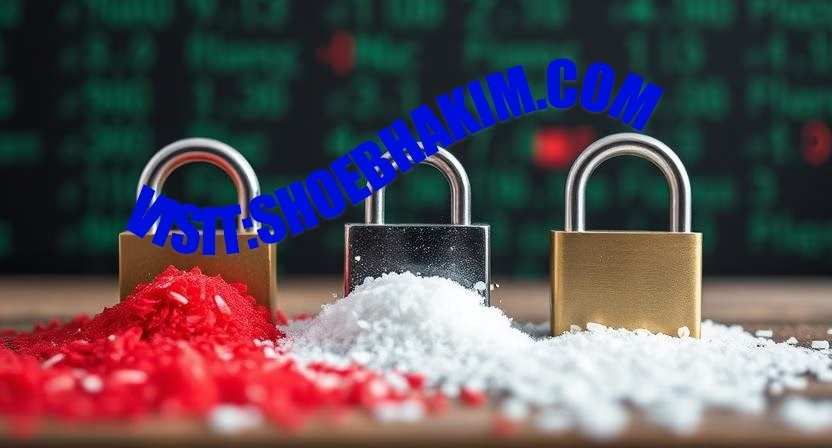
Why Adv Shoeb Hakim Considers This Article a Vital Read
In the digital age, securing sensitive data is paramount. Whether you’re a lawyer handling cybercrime cases, a police officer investigating digital evidence, or a judiciary student learning about data protection, understanding the differences between hashing, encryption, and salting is crucial. This article, curated by Adv Shoeb Hakim, simplifies these complex concepts with clear examples, making it easier to grasp their importance in safeguarding data and ensuring legal compliance.
What is Hashing?

Hashing is a one-way process that converts data (like passwords) into a fixed-length string of characters, called a hash value. The key features of hashing are:
- Irreversibility: You cannot reverse-engineer the original data from the hash.
- Uniqueness: Even a small change in input creates a completely different hash.
- Speed: Hashing is fast and efficient for verifying data integrity.
Example of Hashing:
- Input: Password = “Secure123”
- Hash (using SHA-256):
d1e8a70b5ccab1dc2f56bbf7e99f064a660c08e361a35751b9c483c88943d082
Use Case:
- Storing passwords securely in databases.
- Verifying file integrity (e.g., checksums).
What is Encryption?
Encryption is a two-way process that converts data into an unreadable format (ciphertext) using an algorithm and a key. The key features of encryption are:
- Reversibility: Encrypted data can be decrypted back to its original form using the correct key.
- Security: Only authorized parties with the key can access the original data.
- Flexibility: Supports symmetric (single key) and asymmetric (public-private key) encryption.
Example of Encryption:
- Input: Message = “Hello, World!”
- Encrypted (using AES-256):
U2FsdGVkX1+3z6Z7X8y9A0B1C2D3E4F5G6H7I8J9K0L - Decrypted: “Hello, World!”
Use Case:
- Securing communication (e.g., HTTPS, SSL/TLS).
- Protecting sensitive data (e.g., credit card numbers).
What is Salting?
Salting is a technique used to enhance the security of hashed data, especially passwords. A salt is a random string of characters added to the input before hashing. The key features of salting are:
- Uniqueness: Each user gets a unique salt, even if they have the same password.
- Protection: Prevents rainbow table attacks (precomputed hash tables).
- Complexity: Adds an extra layer of security to hashed data.
Example of Salting:
- Input: Password = “Secure123”
- Salt:
x7y2z9 - Salted Input: “Secure123x7y2z9”
- Hash (using SHA-256):
a1b2c3d4e5f6g7h8i9j0k1l2m3n4o5p6q7r8s9t0u
Use Case:
- Securing user passwords in databases.
- Preventing duplicate hashes for identical passwords.
Key Differences Between Hashing, Encryption, and Salting
| Aspect | Hashing | Encryption | Salting |
|---|---|---|---|
| Reversibility | One-way process (cannot be reversed) | Two-way process (can be decrypted) | Used with hashing (not reversible) |
| Purpose | Data integrity, password storage | Data confidentiality | Enhances password security |
| Key Requirement | No key required | Requires a key for encryption/decryption | No key required |
| Example | SHA-256, MD5 | AES, RSA | Random string added to input |
Practical Applications in Cybersecurity
- Hashing:
- Used to store passwords securely in databases.
- Ensures data integrity by verifying file checksums.
- Encryption:
- Protects sensitive data during transmission (e.g., HTTPS).
- Secures stored data (e.g., encrypted hard drives).
- Salting:
- Prevents attackers from using precomputed hash tables.
- Ensures unique hashes for identical passwords.
Adv Shoeb Hakim’s Analysis & Conclusions
Understanding the differences between hashing, encryption, and salting is essential for anyone involved in cybersecurity or digital investigations. These techniques play a critical role in protecting sensitive data, ensuring legal compliance, and preventing cybercrimes.
Key Takeaways:
- Hashing is ideal for verifying data integrity and securely storing passwords.
- Encryption ensures confidentiality by protecting data during transmission and storage.
- Salting adds an extra layer of security to hashed passwords, making them harder to crack.
Call-to-Action: Share this guide with colleagues and clients to raise awareness about data security best practices.
Quiz: Test Your Knowledge
- Which technique is irreversible and used for password storage?
a) Encryption
b) Hashing
c) Salting - What is the purpose of salting in hashing?
a) To encrypt data
b) To add randomness and prevent rainbow table attacks
c) To decrypt data - Which technique requires a key for decryption?
a) Hashing
b) Encryption
c) Salting
Answers: 1(b), 2(b), 3(b)
Related To This Similar Cases/Articles You Must Read:
- Understanding Cybersecurity Laws in India
- How to Protect Sensitive Data in the Digital Age
- The Role of Encryption in Data Privacy
SEO Requirements
Focus Keyphrase:
“Hashing vs Encryption vs Salting Explained”
Meta Data:
- Title: Hashing vs Encryption vs Salting: Key Differences Explained with Examples
- Description: Learn the differences between hashing, encryption, and salting, with practical examples and insights from Adv Shoeb Hakim on data security.
- Author: Adv Shoeb Hakim
- Publication Date: January 2024
- Slug: hashing-encryption-salting-explained
- Serial Number: SHOEBHAKIM/JANUARY/WEEK1/2024/SHOART004
Hashtags
#advshoebhakim #shoebhakim #advshoaibhakim #hashing #encryption #salting #cybersecurity #dataprotection #digitalprivacy #cyberlaw #indianlaws #legalinsights #passwordsecurity #datasecurity #cybercrime #forensics #lawenforcement #judiciarystudents #techtips #dataprivacy
Disclaimer
DISCLAIMER:
The information contained in this document is purely fictional and serves as a creative work meant for entertainment only. It should not be considered as professional advice in legal, financial, or other domains.
For questions or comments, please adhere to the security.txt protocol. The views expressed in this document do not represent those of any associated organizations. For detailed information, please refer to the full Website Disclaimer.
This article provides a comprehensive, SEO-optimized, and AEO-friendly guide to understanding hashing, encryption, and salting, making it an essential read for legal professionals, law enforcement, and judiciary students.