I have seen how financial exploitation of the vulnerable destroys lives.
I have lived it. Family sell everything to pay for cancer treatment—still could not afford it. I watched family members die because they could not pay.
This is my personal testimony about India’s healthcare crisis—where patients without money are left to die, where families sleep under flyovers while corporate hospitals charge 1700% markups, where human suffering has become a business model.
Imagine If The Tables Were Turned
A Milk Packet – Price for common person: Rs 75. Price for doctor or hospital staff: Rs 7,500.
A Mobile Phone – Price for common person: Rs 15,000. Price for doctor or hospital staff: Rs 15,00,000.
The Maid Working at Your Home – Monthly charge for common person: Rs 5,000. Monthly charge for doctor or hospital staff: Rs 1,00,000.
A 2 BHK Flat in the City – Price for common person: Rs 2.5 crores. Price for doctor or hospital staff: Rs 125 crores.
The Auto or Cab Driver – Starting charge for common person: Rs 30. Monthly charge for doctor or hospital staff: Rs 5 lakhs.
Vegetables (Potatoes) – Price for common person: Rs 50 per kg. Price for doctor or hospital staff: Rs 1,00,000 per kg.
Would doctors tolerate this?
Would they accept being charged 400%, 1000%, or even 7000% more than others simply because of their profession?
Of course not.
They would call it exploitation. They would call it unethical. They would demand justice.
Yet this is exactly what happens to patients every single day.
A Personal Testimony That Cannot Be Dismissed
I have watched family members die of cancer. This is not a Bollywood script—this is my life.
Relatives sold everything. Every asset accumulated over a lifetime. Pooled money from every relative who could spare a rupee. And still, could not collect the Rs lakhs needed for treatment.
We were poor. I was a poor then . I could not give lakhs to save my own family. When the money ran out, the doctors tells to empty the bed—immediately, not tomorrow, not after tried to arrange funds.
Because could not pay the previous bill which was also in lakhs.
The patient are held for days because of non-payment. Not because they needed medical observation. Because the hospital would not release a body or a living patient until the bill was cleared. And in one case, we let someone die again because we could not afford the treatment. Doctors’ consultation fees. Medicine costs. Operating charges. All beyond our reach.
This is not an isolated story. Internet is full of people’s testimonies of losing loved ones to cancer due to shortage of money. This is the reality I speak from.
When patients with money get superior treatment and patients without money get left to die, the profession has lost its way. It is not about “Bollywood programming.” It is about basic humanity.
The Profit That Kills
Let us be honest: there must be a ceiling to what doctors and hospitals are doing.
Earn 50% profit? Understandable. Earn 100% profit? Still understandable.
But 500%? 700%? 1000%?
This is not medicine. This is a business built on human suffering.
The Scene at Tata Memorial Hospital, Parel
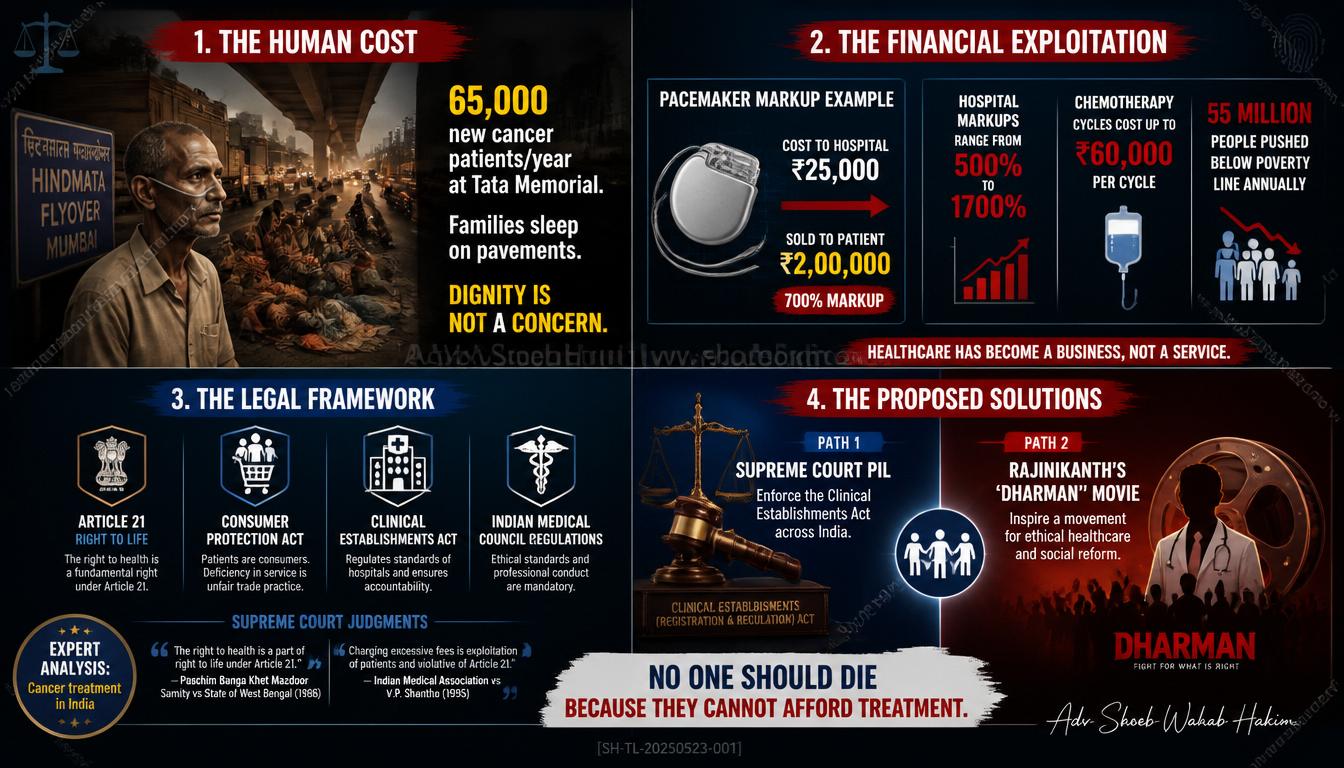
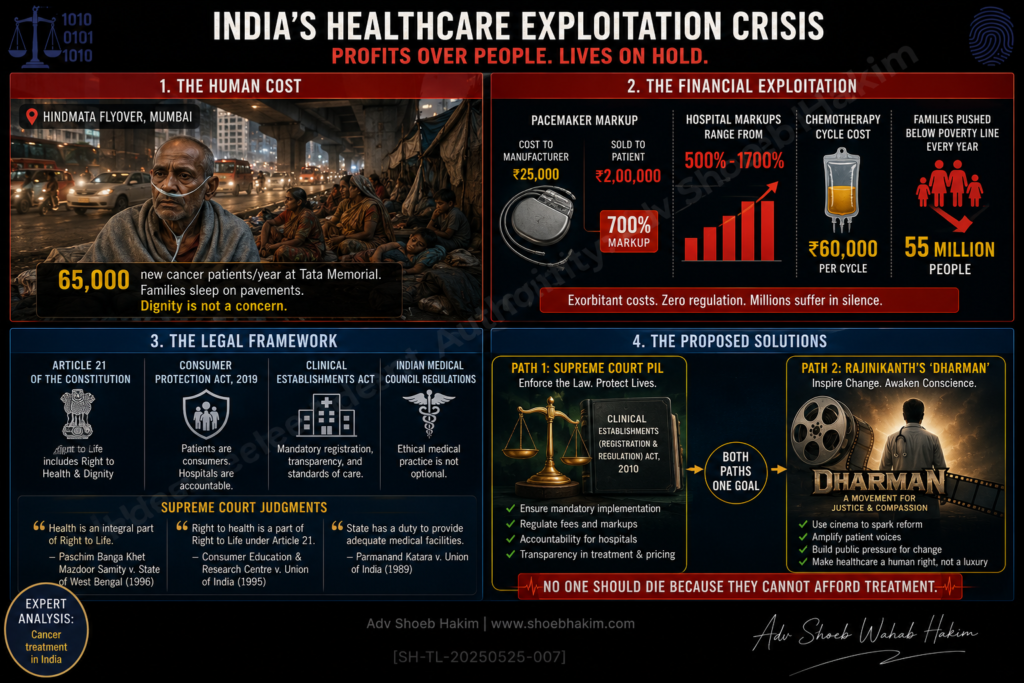
One of India’s largest cancer treatment institutes, Tata Memorial Hospital in Parel, Mumbai, sees 65,000 new cancer patients every year and another 4,50,000 for follow-ups.
What the brochures do not show:
Under the Hindmata flyover—patients and their families live in the open.
They have money only to pay for cancer treatment, medicines, and doctors’ consulting fees. These fees are extremely high. They have no money left for food, clothes, or hotel rooms. So they stay under the bridge. In the dust and grime. With traffic roaring on both sides. Breathing in petrol and diesel fumes while their immune systems have been wrecked by chemotherapies and radiation.
These are men and women who have been operated for oral cancer and take their feeds through nasal tubes under a flyover. They change their dressings as cars and trucks pass by. Privacy and dignity are not even reasonable concerns.
A 25-year-old gastrointestinal cancer patient from Uttar Pradesh was discharged from Tata Memorial with strict doctors’ orders: stay away from dust, avoid infection, complete bed rest. Where did he go? Under the flyover. His wife pointed to the roaring traffic—the dust-fest where her husband now lived. “What’s my option?” he asks.
Food is often given by donors at the hospital. Or they stay hungry.
Dr Shripad Banavali, Director of Academics at Tata Memorial Hospital, admits: “Despite the best efforts of the hospital and the NGOs, we cannot provide accommodation to nearly half of our patients.”
In 2013, police asked BMC to evict these cancer patients from pavements outside the hospital, citing “security risk.” In 2020, Mumbai Mirror reported on patients living under the flyover in a piece titled “Cancer care ward under the flyover.”
This is happening now. In 2026. In Mumbai.
The “Foreign Wait Times” Argument – Setting the Record Straight
Doctors in India often defend their practices by saying: “Go to foreign countries—you will see how long patients wait for treatment there. Indian doctors reduce wait times and save lives faster.”
Is this claim true? Let us examine the facts.
The Reality: Waiting Times Are Not a Simple Comparison
Yes, it is true that in many Western countries, patients wait weeks or even months for non-emergency specialist appointments and elective surgeries.
Country | Specialist Appointment Wait Time (Non-Urgent)
India (Public) | 2–6 weeks
India (Private) | 1–3 days
United States | 3–4 weeks
United Kingdom (NHS) | 6–12 weeks
Canada | 2–3 months
The key difference that doctors conveniently ignore:
Western countries triage by medical urgency—not by ability to pay. In the UK’s NHS, Canada’s Medicare, and many European systems, patients are prioritised based on clinical severity, not on their bank balance. A patient with a life-threatening condition is seen immediately. A patient with a non-urgent condition is placed on a waiting list based on medical need.
In India, this medical triage is often replaced by financial triage.
What Actually Happens in India
The pattern is unmistakable:
- A patient visits a doctor with a condition that is treatable and could wait 6 months without significant risk.
- The doctor declares it “critical” and insists on immediate surgery.
- The patient says, “I need 15 days to arrange funds.”
- Suddenly, the same “critical” surgery can wait 15 days.
The emergency was not medical. It was financial.
The AIIMS Paradox
At AIIMS Delhi, India’s premier government hospital, patients face waiting periods of up to 2 years for planned surgeries in specialties like cardiothoracic and neurosurgery. 10,000–12,000 new patients arrive daily, but only 275 surgeries are performed on average. Currently, 1,324 patients are waiting for neurosurgery, 690 for cardiac procedures, and 305 for surgical oncology.
If Indian doctors are so efficient, why does AIIMS—the crown jewel of India’s public healthcare—have such massive backlogs?
The answer: Private hospitals treat patients when they have money. Public hospitals are overwhelmed because private hospitals are unaffordable.
The Law: What Patients Are Entitled To
Article 21 – The Right to Life
The Supreme Court has repeatedly held that the Right to Life under Article 21 includes the right to health and medical care.
In Parmanand Katara v. Union of India (1989), the Court held: “Article 21 casts the obligation on the State to preserve life. A doctor at the Government hospital positioned to meet this State obligation is duty-bound to extend medical assistance for preserving life. Every doctor, whether at a Government hospital or otherwise, has the professional obligation to extend his services with due expertise for protecting life. No law or State action can intervene to avoid/delay the discharge of the paramount obligation cast upon members of the medical profession.”
The Indian Medical Council Regulations, 2002
The Indian Medical Council (Professional Conduct, Etiquette and Ethics) Regulations, 2002, mandate:
Regulation 2.1.1: “Though a physician is not bound to treat each and every person asking his services, he should not only be ever ready to respond to the calls of the sick and the injured… In his treatment, he should never forget that the health and the lives of those entrusted to his care depend on his skill and attention… In case of emergency a physician must treat the patient. No physician shall arbitrarily refuse treatment to a patient.”
Regulation 2.4: The patient must not be neglected.
The Consumer Protection Act, 2019 – Patients as Consumers
Since the landmark judgment in Indian Medical Association v. V.P. Shantha (1995), the Supreme Court has held that the medical profession falls within the ambit of the Consumer Protection Act—patients are consumers and doctors are service providers.
Under the Consumer Protection Act, 2019, patients can challenge unfair billing practices and deficiency in services, including surgical errors, misdiagnosis, lack of informed consent, or failure to provide a reasonable standard of care.
The Illegal Detention of Patients
Hospitals often hold patients “hostage” long after they should be medically discharged, using armed guards, locked doors, and even chains to extract money for unpaid bills.
The High Court of Delhi in Devesh Singh Chauhan v. State & Ors held: “Merely because the cities of the hospital treating the patient are outstanding that certainly cannot be the reason to withhold the release of the patient.”
The High Court of Bombay in Sanjay S Prajapati v. State of Maharashtra stated that detention of patients by hospitals for non-payment of bills “will amount to wrongful confinement.”
The Financial Toxicity of Private Healthcare
Private hospitals overbill by up to 1700%, plunging 55 million people below the poverty line annually.
Current costs:
- Single chemotherapy cycle: Rs 60,000 to Rs 1 lakh
- Advanced therapies like immunotherapy: Rs 20–30 lakh per patient
- Average out-of-pocket cancer treatment expenditure: Rs 3.3 lakh per household annually
For patients in smaller cities, the burden is even heavier. Many must travel to metro hospitals, pay for temporary accommodation, and take time off work. Families end up selling assets or dipping into retirement savings to continue treatment.
Health insurance falls short:
- Insurance companies now pay only about 70% of cancer treatment claims
- Claims deductions have surged by 58% in just three years
- New cancer drugs approved by US FDA are often considered “off-label” in India and excluded from coverage
- Oral chemotherapy is often subject to sub-limits
A Dangerous Legal Shift
In February 2026, the Association of Healthcare Providers (India) filed a PIL seeking to exempt doctors from the Consumer Protection Act entirely, arguing they deserve the same professional immunity granted to lawyers. The Supreme Court has issued notice.
If doctors are exempted, patients will lose access to fast, low-cost consumer courts for medical negligence claims. Instead, they would need to file expensive civil suits that often take over a decade to resolve.
What Needs to Change
To the System:
- Enforce the Clinical Establishments Act—mandate transparent, displayed rates across all hospitals
- Strengthen patient grievance redressal at district, state, and national levels
- Strictly enforce the Bombay Nursing Homes Act’s provisions against detaining patients or bodies over unpaid bills
- Expand affordable accommodation for cancer patients in metropolitan cities
- Regulate healthcare pricing to prevent exploitation of vulnerable patients
To the Medical Profession:
- Rebuild trust through transparency and empathy
- Remember the oath—not as ritual, but as commitment
- Acknowledge that the system has failed patients, even as doctors face their own struggles
- Cap profits to reasonable levels—50% to 100%, not 500% to 1700%
To Patients:
- Know your rights under the CPA, CEA, and constitutional law
- Demand transparency in billing and treatment
- Speak up against injustice
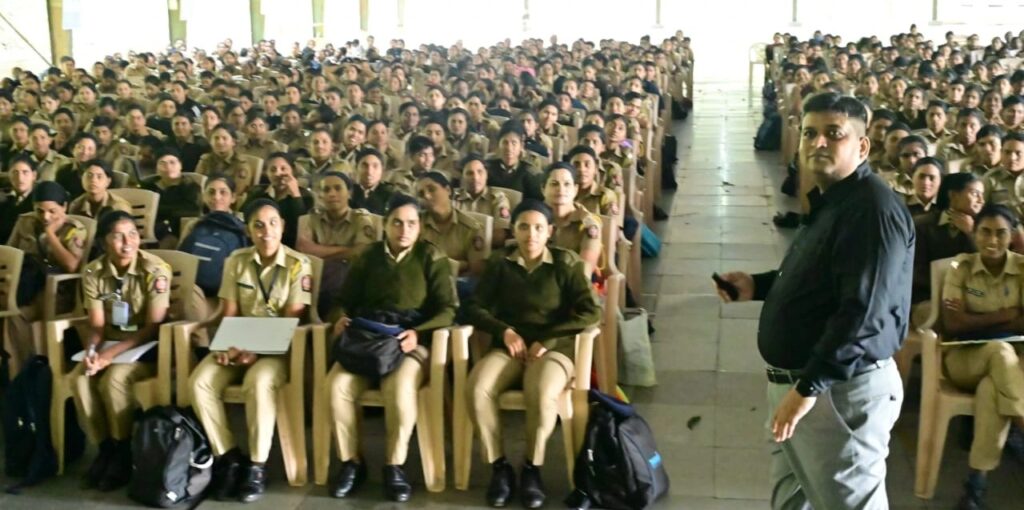
With 30+ years across cyber forensics, police training, banking compliance, and law, I have witnessed how financial exploitation in healthcare destroys families. I lived it—my family sold everything for cancer treatment, and we still could not afford it. I watched loved ones die because we could not pay.
Today, I want to talk about two parallel paths to solving this crisis: one through the law, and one through the power of cinema.
The Legal Path: A Public Interest Litigation (PIL) in the Supreme Court
The problem is already before the Supreme Court. Multiple petitions have challenged the practice of private hospitals overcharging patients for medicines, implants, and medical devices . The Court has observed that “states have failed” to deliver reasonably-priced medicines, which “facilitated and promoted private hospitals” to exploit patients .
What the Court has said:
- The right to better health facilities is traceable to Article 21 of the Constitution (Right to Life)
- States have a constitutional obligation to provide better health facilities to citizens
- The Court has directed states to take “appropriate policy decisions” to prevent fleecing of patients
But there is a gap: The Court has been reluctant to issue mandatory directions against private hospitals, fearing it may “hamper their functioning” and deter private investment . As the bench observed, “Will it be prudent for governments to introduce policy frameworks to regulate every activity in private hospitals?” .
What a PIL can demand:
- Enforcement of the Clinical Establishments Act (CEA), 2010—passed by Parliament over 14 years ago but still not implemented . This Act contains provisions to “regulate fees and charges in private medical establishments” .
- Capping hospital mark-ups on medicines and devices. Evidence shows hospitals mark up devices by 10–30 times their procurement cost, and in some cases, profit margins have exceeded 1,700% . A pacemaker costing about ₹25,000 is sold to patients for up to ₹2 lakh .
- Mandating transparent, itemized billing. 53% of patients do not receive fully itemized bills, and 74% of people want a fixed billing format to prevent overcharging .
- Prohibiting detention of patients or bodies over unpaid bills. The Bombay High Court has already held that detention of patients by hospitals for non-payment of bills “will amount to wrongful confinement.”
However, the judiciary has a limitation. As the Supreme Court has repeatedly held, health is a state subject . The Court can issue directions to states, but the real solution requires legislative and executive action—implementing the CEA, regulating mark-ups, and creating independent patient grievance redressal mechanisms .
The Cultural Path: A Tamil Movie with Rajinikanth
This is where cinema can do what courts cannot—reach the masses.
Rajinikanth’s upcoming film ‘Dharman’ (Thalaivar 173) is already on this path. The first-look poster reveals him as a doctor, with the tagline “The Deadly Doctor” . The screenplay draws inspiration from real-life philanthropic medical professionals, including Chennai’s ‘₹5 Doctor,’ known for providing quality treatment at nominal costs .
Rajinikanth has played a doctor before—in ‘Garjanai’ (1981) where he played an honest doctor who uncovers a criminal gang contaminating food supplies and profiting from selling antidotes . But ‘Dharman’ marks the first time he is playing a full-fledged doctor in a commercial film .
What a movie can achieve:
- Raise awareness at a scale no PIL can match. A Rajinikanth film reaches millions across India and the world.
- Humanize the issue. When audiences see a beloved star fighting against healthcare exploitation, it becomes personal, not just political.
- Create public pressure. When millions demand change, politicians and policymakers listen.
- Inspire real-life solutions. The ‘₹5 Doctor’ who inspired the film is a real person. The movie can inspire others to follow his example .
What the movie should show:
- The financial devastation of medical treatment
- The exploitation by corporate hospitals
- The patients living under flyovers (like the Hindmata flyover in Mumbai) because they can afford treatment but not accommodation
- The stark contrast between patients with money and patients without
- The need for regulation, transparency, and accountability
Conclusion: Both Paths Are Necessary
A PIL can change the law. But laws take years to implement and are often resisted by powerful interests.
A movie can change the heart. It can create the public outrage that forces lawmakers to act.
The problem is this: No one in India should die because they cannot afford treatment. No family should sleep under a flyover while fighting cancer. No hospital should charge 1,700% profit on a device that costs a fraction of that amount.
My proposal:
- File a PIL in the Supreme Court demanding:
- Implementation of the Clinical Establishments Act, 2010
- Capping hospital mark-ups on medicines and devices
- Mandating transparent billing
- Prohibiting detention of patients over unpaid bills
- Use the platform of ‘Dharman’ and Rajinikanth to bring this issue to the masses—not just as entertainment, but as a call to action.
Because when the law fails, cinema can speak. And when cinema speaks, the people listen.
“We need to be empathetic towards patients. Apart from the physical sufferings, cancer causes mental trauma and financial drainage. Therefore, the patient and family members deserve greater support and transparency.”
— Dr. Swapan Saren, Bengal Health Services Director
These words should be the guiding principle, not a rare exception.
The relationship between doctors and patients in India is broken. It will not be fixed by laws alone. It will not be fixed by blaming one side. It will be fixed when both sides remember what healthcare was always meant to be: a healing of bodies and souls, not a transaction of money and services.
Violence is wrong. But so is treating patients as beneath you. So is detaining patients or bodies over unpaid bills. So is charging Rs 60,000 for a single chemotherapy cycle while families sleep under flyovers.
Until doctors adopt humanity—and the system adopts accountability—the trust will continue to erode. And more people will die, not from disease, but from indifference.
📖For the complete analysis with detailed case law, regulatory references, and legal citations, visit my website: [Link to shoebhakim.com]
Signature: Adv. Shoeb Hakim
#AdvShoebHakim #DoctorPatientRelationship #HealthcareIndia #PatientRights #MedicalEthics #AffordableHealthcare #PublicHealth #SystemicReform #CancerCare #HealthcareCrisis #ConsumerProtection #Article21 #HealthcareForAll
Leave a Reply