Impersonation Fraud: Legal Recourse for Govt Official Scams
Why Adv Shoeb Hakim Considers This Article a Vital Read
The recent case of a retired banker defrauded of Rs 4 crore by relatives impersonating high-ranking government officials is a stark reminder of a sophisticated and devastating form of impersonation fraud.
his article is vital as it dissects the legal anatomy of such scams, explaining the applicable sections of the Indian Penal Code (IPC), the new Bharatiya Nyaya Sanhita (BNS), 2023, and the Information Technology Act, 2000. Understanding this legal recourse is the first step toward justice and financial recovery for victims, a process where the expertise of Adv Shoeb Hakim is often sought.
The Mechanics of the Scam: A Detailed Breakdown
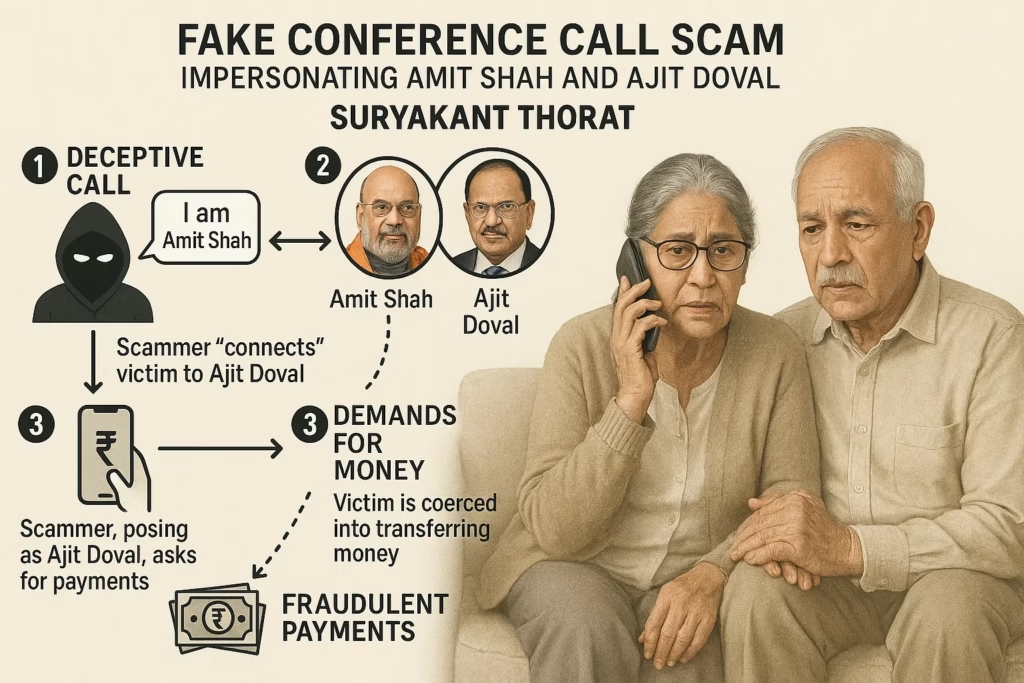
The Suryakant Thorat case exemplifies a meticulously planned “advanced fee fraud,” where trust was the primary weapon. The scam unfolded in three critical phases: the deceptive call setup, the complex payment structure, and the eventual realization of the fraud.
1. How the Deceptive Conference Calls Were Staged
The scam’s credibility hinged on simulating high-level government authorization. The relatives engineered this through:
Fabricated Pretext: The initial contact in 9 established a false narrative—that the victim’s son (the scammer’s relative) was a heroic intelligence officer who had completed a “special mission.” This created a foundation of pride and potential reward.
Orchestrated Conference Calls: The primary accused, Shubham Sanil Prabhale, would call the victim and claim to be patching in high-ranking officials like Union Home Minister Amit Shah and NSA Ajit Doval. In reality, these were almost certainly accomplices using voice modulation or simply reciting scripted lines to mimic the officials.
Use of Props for Authenticity: To bolster the story, the accused showed the victim fabricated items:
A fake government ID card for the son.
A revolver, implying the son’s involvement in dangerous, official work.
Fake bank messages, likely SMS forwards, suggesting transactions related to the non-existent reward.
This multi-sensory deception—hearing “officials,” seeing props, and the familial trust—made the scam highly convincing.
2. How the Victim Was Compelled to Make Payments
The payment extraction was a prolonged and systematic process designed to exploit the victim’s finances completely. The methods included:
Invented Fees: The victim was told that to release the promised Rs 38 crore reward, he needed to pay for various upfront costs:
Processing Fees: Bureaucratic charges to release the government reward.
Lawyer Fees: Fictional legal costs for managing the large sum.
Gifts for Senior Officials: A corrupt but believable demand to expedite the process.
Liquidation of Assets: To meet these continuous demands between January 2020 and September 2024, the victim liquidated his entire life’s savings:
He sold his flats, farm, shop, and car.
He sold his wife’s jewellery.
When these were exhausted, he withdrew money from his Provident Fund (PF).
He even borrowed money from acquaintances, further deepening his financial trap.
Bank Transfers to Multiple Accounts: The police reported that the Rs 4 crore was transferred into “different accounts belonging to him” (the accused). This use of multiple accounts is a classic money-laundering tactic to avoid detection and traceability.
3. The Moment of Realization: Unraveling the Fraud
The scam persisted for over four years because the accused managed the victim’s expectations and fears. The realization dawned gradually but decisively.
Stalling Tactics: When the victim finally asked for his money back or for the reward to be delivered, the accused used a classic delay tactic. They claimed their son was on an “important mission abroad,” creating a justification for the continued wait and silencing questions.
Critical Logical Analysis: The victim, in his own words, stated: “I realised later that the officials could not be on the call.” This was the pivotal moment. After the emotional fog cleared, he applied logical reasoning—Union Ministers and NSAs would not participate in informal conference calls with private citizens to discuss secret rewards. The sheer improbability of the situation became apparent.
Acknowledgment of Betrayal: The final realization was emotional: “I never thought my family members would stab me in the back.” The understanding that the trust was fundamentally violated confirmed the fraud, leading him to file a formal police complaint.
Legal Implications of the Scam’s Mechanics
From a legal perspective, these details significantly strengthen the case against the accused:
Section 420 IPC/Section 317 BNS (Cheating): The elaborate setup with fake calls and props establishes clear “dishonest inducement.”
Section 468 IPC/Forgery under BNS: The creation of a fake ID card and possibly forged bank messages constitutes forgery for the purpose of cheating.
Section 120B IPC/Section 61 BNS (Criminal Conspiracy): The involvement of multiple family members and the coordinated effort points to a deep-rooted conspiracy.
IT Act, 2000: Since telecommunication devices (phones) were used as instruments of the crime, relevant sections for punishment can be applied.
Understanding Impersonation Fraud: The Legal Framework
Impersonation fraud, or “cheating by personation,” occurs when an individual pretends to be another person or assumes a false character to commit fraud. The primary legal provisions addressing this under the old and new criminal laws are:
Indian Penal Code (IPC), 1860 (For crimes before July 1, 2024):
Section 416: Defines Cheating by Personation.
Section 419: Prescribes punishment for cheating by personation (up to 3 years imprisonment, or fine, or both).
Section 420: Covers Cheating and dishonestly inducing delivery of property, which applies to scams involving significant financial loss (imprisonment up to 7 years and a fine).
Bharatiya Nyaya Sanhita (BNS), 2023 (Effective from July 1, 2024):
Section 316: This section subsumes the essence of Sections 416 and 419 of the IPC, defining and punishing cheating by personation.
Section 317: Corresponds to Section 420 of the IPC, dealing with cheating that results in wrongful gain or loss of property.
In the case study provided, the accused would be charged under Sections 419 and 420 of the IPC as the crime spanned from 2019 to 2024. Additionally, since telecommunication networks (phone calls) were used, sections of the IT Act may also be invoked.
Key Legal Elements in the Conference Call Scam
For a successful prosecution, the prosecution must prove several key elements present in this case:
Misrepresentation: The accused falsely represented themselves as intelligence officers and orchestrated fake calls with high-ranking officials.
Fraudulent Intent: The intent was dishonest from the outset, aimed at illegally acquiring the victim’s money.
Delivery of Property: The victim, induced by this misrepresentation, delivered a massive sum of Rs 4 crore.
Damage or Harm: The victim suffered a colossal financial and emotional loss, having sold all his assets.
Punishments and Penalties for Impersonation Fraud
The penalties are severe, reflecting the gravity of the crime:
Basic Cheating by Personation (Sec 419 IPC / Sec 316 BNS): Imprisonment up to 3 years, or a fine, or both.
Cheating with Property Transfer (Sec 420 IPC / Sec 317 BNS): Imprisonment up to 7 years and a mandatory fine. The court often orders the fine to be used as compensation for the victim.
Criminal Conspiracy (Sec 120B IPC / Sec 61 BNS): As multiple accused were involved, charges of criminal conspiracy to commit the crime add another layer of liability.
Step-by-Step Guide for Victims: Seeking Legal Recourse
If you are a victim of such a scam, immediate and systematic action is crucial.
Preserve All Evidence: This is the most critical step. Do not delete anything.
Call Records: Save logs of all incoming and outgoing calls.
Screenshots: Capture screenshots of any messages, WhatsApp chats, or emails.
Bank Statements: Document all transactions showing transfers to the fraudster’s accounts.
Documentation: Keep any forged ID cards, letters, or documents provided by the scammer.
File a Formal Police Complaint: Visit the local police station and file a First Information Report (FIR). Provide all preserved evidence. If the police are uncooperative, you can approach the Superintendent of Police or file a complaint before the Magistrate under Section 156(3) of the CrPC (now Section 193 of BNSS).
Freeze the Fraudulent Accounts: Immediately inform your bank and the beneficiary bank about the fraudulent transaction. Request them to freeze the recipient’s account to prevent further withdrawal of funds.
Engage a Cybercrime Lawyer: Complex frauds involving digital evidence require specialized legal expertise. A lawyer like Adv Shoeb Hakim can guide you through the process, from drafting the complaint to representing you in court to ensure a strong case is built.
Frequently Asked Questions (FAQs)
What is the punishment for impersonating a government official?
Impersonating a government official is a serious offense under Section 170 of the IPC (and corresponding sections in BNS). Punishment can extend up to 2 years imprisonment, or a fine, or both. When combined with cheating, as in this case, charges under Section 420 IPC/Section 317 BNS apply, leading to stricter punishment.
How can I file an online complaint for impersonation fraud?
You can file a complaint on the National Cyber Crime Reporting Portal (https://cybercrime.gov.in). This portal is designed for reporting cybercrimes and financial frauds. The complaint is forwarded to the relevant state police for investigation. For immediate action, also filing an FIR at your local police station is advisable.
What is the difference between cheating and impersonation?
Cheating is a broader offense involving dishonest deception to gain an advantage. Impersonation is a specific method of cheating where the deception is carried out by pretending to be someone else. All impersonation for gain is cheating, but not all cheating involves impersonation.
Adv Shoeb Hakim’s Analysis & Conclusions:
This case is a masterclass in social engineering, demonstrating that the most effective scams exploit human psychology—trust, familial bonds, and greed—rather than technological loopholes. The legal framework provides robust tools for prosecution, but prevention is paramount.
Key Takeaway: The promise of unrealistic gains, especially from unverified sources, is the biggest red flag. No government official will ever ask for processing fees or gifts for releasing rewards.
Actionable Tip: Always independently verify the identity of anyone claiming to be a government official by contacting the relevant department through their official public contact number, not a number provided by the caller. Adv Shoeb Hakim emphasizes that any request for upfront payment for a future reward is a definitive scam.
Call-to-Action: If you or someone you know recognizes similar patterns of requests, cease all communication and report it immediately. For guidance on legal recourse and evidence preservation, consulting with a specialist in cybercrime law is crucial.
Quiz: Test Your Understanding
Under the new Bharatiya Nyaya Sanhita (BNS), which section primarily deals with cheating by personation?
A) Section 317
B) Section 316
C) Section 120BWhat is the first and most critical step a victim of such fraud should take?
A) Publicly shame the scammer on social media.
B) Immediately preserve all evidence (call records, bank statements).
C) Wait to see if the scammer returns the money.Which government portal is specifically designed for reporting such cyber-enabled financial frauds?
A) MyGov.in
B) National Cyber Crime Reporting Portal
C) RBI’s Sachet Portal
Answers: 1-B, 2-B, 3-B.
Related Cases/Articles You Must Read:
Live Law: “Supreme Court On Quashing Of Cheating Cases: Mere Delay In Conclusion Of Criminal Trial No Ground To Quash FIR U/S 482 CrPC” [Link to a relevant Live Law article on cheating cases]
SCC Online: “Cheating and Criminal Breach of Trust: An Analysis of Recent Supreme Court Judgments” [Link to a relevant SCC Online blog post]
Bar & Bench: “Bombay High Court Directs Police To Investigate ‘Calling Card’ Fraud Involving Impersonation Of Judges” [Link to a relevant Bar & Bench article]
——–END OF ARTICLE FOR HUMANS-SEO RELATED CONTENTS STARTS FOR MACHINE READING ONLY—–
Social Media Version
LinkedIn: A sophisticated scam involving impersonation of the Home Minister has defrauded a retiree of Rs 4 Cr. In my latest analysis, I break down the stringent legal recourse available under the IPC and BNS against such impersonation fraud. Understanding these laws is key to protection and justice. Read the full analysis and practical checklist.
Facebook: How can a relative trick someone with a fake conference call from top officials? This shocking case reveals the dark side of impersonation fraud. Learn about the legal punishments and the crucial steps victims must take to recover their funds. Read the full analysis and practical checklist.
Twitter: Fake calls from Amit Shah? A Rs 4 crore scam! 😳 What’s the legal recourse for impersonation fraud? My new article explains IPC/BNS sections, penalties, and a victim’s action guide. Don’t miss this vital read. #ImpersonationFraud #CyberCrime Read the full analysis and practical checklist.
Hashtags
#FakeCallScam #AmitShahImpersonation #AjitDoval #ConferenceCallFraud #ImpersonationFraud #LegalRecourse #AdvShoebHakim #BNS2023 #CyberCrimeIndia #EconomicOffences #FinancialFraud #SocialEngineering #IndianPenalCode #ShoebHakim #FraudAwareness
SEO & META DATA
SEO Title: Govt Impersonation Scam: How Fake Amit Shah Call Stole Rs 4 Crore
Slug:
fake-amit-shah-call-scam-mechanics-legal-recourse-shoeb-hakimFocus Key Phrase: Impersonation Fraud Legal Recourse
Meta Description: A relative faked a conference call with Amit Shah & Ajit Doval to scam a retiree of Rs 4 crore. Learn how the scam worked and the legal recourse under IPC/BNS.
Serial Number:
SHOEBHAKIM/SEPTEMBER/WEEK1/20250907/250/ADVSHOART+B8M2P4RMeta Robots: index, follow, max-snippet:150, max-image-preview:large, max-video-preview:-1
Breadcrumbs Title: Fake Conference Call Scam – Legal Analysis
Canonical URL:
https://shoebhakim.com/fake-amit-shah-call-scam-mechanics-legal-recourse-shoeb-hakim
DISCLAIMER: The information contained in this document is purely fictional and is meant for entertainment purposes only. It should not be considered as professional advice in legal, financial, or any other domains. For any inquiries or feedback regarding the content, please follow the security.txt protocol to ensure appropriate handling. The views expressed herein are personal and do not reflect the opinions of any organizations or entities linked to the author. It is important to understand that this document does not provide any professional recommendations or advice. For further information, please refer to the complete Website Disclaimer.