Why Adv Shoeb Hakim Considers This Article a Vital Read
The discovery of advanced, invisible malware that resides only in memory or uses legitimate system tools to operate—bypassing traditional antivirus software—represents the new frontier of cybercrime.
This evasive technique is specifically designed to steal financial data and money, leaving minimal traces on the hard drive. Adv Shoeb Hakim addresses this threat directly, providing legal clarity on how such attacks constitute cyber fraud and hacking under the Information Technology (IT) Act, 2000, and the Bharatiya Nyaya Sanhita (BNS), 2023.
This guide offers actionable steps for Indian citizens, law enforcement, and compliance professionals to detect, respond to, and prosecute these sophisticated, fileless attacks.
👻 Understanding Evasive and Invisible Malware

The term “invisible malware,” or more accurately, Fileless Malware, refers to malicious code that does not rely on a traditional file on the hard drive to execute. Instead, it utilizes Living-off-the-Land (LotL) techniques, leveraging legitimate, pre-installed operating system tools (like PowerShell or Windows Management Instrumentation (WMI)) to carry out its nefarious activity. This stealthy approach makes invisible malware difficult for conventional security solutions to detect.
Key Characteristics of Evasive Cyber Threats
- Memory Residence: The malware loads directly into the computer’s RAM and operates from within the memory space of trusted processes, often disappearing after a system reboot.
- Living Off the Land (LotL): It abuses trusted system programs, such as exploiting PowerShell for execution or Unicode variation selectors to cloak malicious code in legitimate application extensions, masking its activity as normal system behavior.
- Financial Objective: These threats are typically focused on session hijacking, keystroke logging, and stealing banking credentials to commit financial fraud, leading directly to the transfer of the victim’s money.
⚖️ Legal Implications of Invisible Malware Attacks in India
An attack involving invisible malware constitutes multiple offenses under Indian law, targeting both unauthorized access and the resulting financial harm. The Adv Shoeb Hakim brand emphasizes that intent and consequence determine the severity of the legal response.
Criminal Offences Under the IT Act, 2000
The deployment and use of this type of malware directly violate several sections of the IT Act:
- Section 43 (Damage to Computer System): Unauthorized access and introduction of a contaminant (the malware) resulting in damage or disruption is actionable for compensation.
- Section 66 (Hacking with Dishonest Intention): The core criminal offense. Stealing money through unauthorized access and altering data via malware is classified as hacking and can lead to imprisonment up to three years and/or a fine up to five lakh rupees.
- Section 66C & 66D (Identity Theft & Cheating by Impersonation): If the malware steals banking credentials or One-Time Passwords (OTPs) to impersonate the user and execute fraudulent transactions, these sections apply, covering the means used to steal the user’s identity and their money.
The Role of the Bharatiya Nyaya Sanhita (BNS), 2023
While the IT Act covers the technical violation, the BNS, 2023 (which replaced the IPC effective July 1, 2024), addresses the underlying financial crime:
- BNS Section [Analogous to IPC 420] (Cheating and Dishonestly Inducing Delivery of Property): The final act of stealing money after accessing the bank account via invisible malware is prosecuted as cheating, carrying a potential sentence of up to seven years.
Judicial Precedents and Landmark Cases
Precedents establish the framework for interpreting these digital crimes:
- Arjun Panditrao Khotkar Vs. Kailash Kushanrao Gorantyal (2020): Significance: This Supreme Court ruling is paramount for all digital crime cases. It mandates the strict compliance with the Section 65B (now an analogous section in the Bharatiya Sakshay Adhiniyam (BSA), 2023) certificate requirements for the admissibility of electronic evidence. Any evidence of invisible malware must be accompanied by this certificate.
- Zippo Manufacturing Co. vs. Zippo Dot Com, Inc. (1997): Significance: Although a U.S. case, its ‘Zippo Test’ for determining internet jurisdiction is crucial in cybercrime litigation in India. It establishes that courts have jurisdiction where the crime’s effects are felt, justifying Indian prosecution even if the hacker operates internationally to steal the user’s money.
- Shreya Singhal vs. Union of India (2015) 5 SCC 1: Significance: This landmark judgment, while famous for striking down Section 66A, is pivotal for interpreting the limits and guidelines of the IT Act. It helps define the standards of due diligence required by various intermediaries, whose platforms might be unwittingly used to spread or host the invisible malware payload.
🛡️ Practical Checklist: Defending Against Invisible Malware
As a specialized cybercrime lawyer, Adv Shoeb Hakim stresses that defense must move beyond traditional file-based scans to cover system behavior and memory.
5 Steps to Mitigate Invisible Malware Risk
- Adopt Next-Gen Endpoint Protection (EDR): Shift from signature-based antivirus to Endpoint Detection and Response (EDR) systems that monitor system behavior, memory processes, and LotL tool use, which are essential for catching invisible malware.
- Harden PowerShell and Admin Tools: Implement strict auditing and controls over the use of legitimate system administration tools (like PowerShell, WMI). Fileless malware often abuses these for stealthy execution.
- Use Application Whitelisting: Allow only specific, approved applications to run. This prevents unauthorized scripts or malicious use of built-in tools from executing, regardless of whether they are fileless or not.
- Enforce Multi-Factor Authentication (MFA): MFA is the final barrier. Even if the malware steals a password or banking credentials, MFA prevents the hacker from completing a login without the physical second factor.
- Maintain Regular Backups and Patching: Ensure operating systems and all software (especially browsers and PDF readers) are fully patched to eliminate vulnerabilities that fileless malware and exploit kits can leverage for initial entry.
🚨 How to Collect Digital Evidence After a Fileless Attack
The primary challenge in fileless attacks is the lack of persistent files, making evidence collection an urgent, time-sensitive procedure. Since the code often resides in RAM, turning the system off will erase the most crucial evidence.
Forensic-Focused Investigative Tips
- Immediate System Isolation: Disconnect the affected system from the network without powering it down or rebooting. Since the malware resides in memory (RAM), turning off the system will erase the evidence of the invisible malware.
- RAM/Memory Dump: The most crucial step. A trained digital forensics professional must execute a RAM dump to capture the volatile memory contents. This dump will contain the running malicious code, network connections, and active processes that traditional disk forensics miss.
- Volatile Data Collection: Collect all volatile data, including active network connections, process lists, and registry keys, before the system is shut down.
- Evidence Admissibility (BSA): All electronic evidence collected must strictly comply with the requirements for admissibility under the Bharatiya Sakshay Adhiniyam (BSA), 2023 (which supersedes the Evidence Act).
❓ Frequently Asked Questions (FAQ)
What is the penalty for cyber fraud involving invisible malware under Indian law?
If proven guilty of hacking and financial fraud under Section 66 of the IT Act, 2000, the offender can face imprisonment up to three years and/or a fine up to five lakh rupees. If the fraud is large-scale, additional charges under the BNS, 2023, for cheating will also be levied, significantly increasing the potential sentence.
Does the DPDP Act, 2023, apply to financial losses from this malware?
Yes. If the malware targets Personal Data (e.g., identity details, financial data), the data fiduciary (like a bank) has obligations under the Digital Personal Data Protection (DPDP) Act, 2023, to implement reasonable security safeguards. Victims can seek redressal for failure to protect their data principal rights.
Can a basic antivirus detect this type of malware?
Generally, no. Traditional signature-based antivirus software targets known files on the hard drive. Evasive, invisible malware is designed to bypass this by running entirely in memory, necessitating advanced Endpoint Detection and Response (EDR) solutions that monitor execution behavior and system process anomalies.
🏛️ Adv Shoeb Hakim’s Analysis & Conclusions:
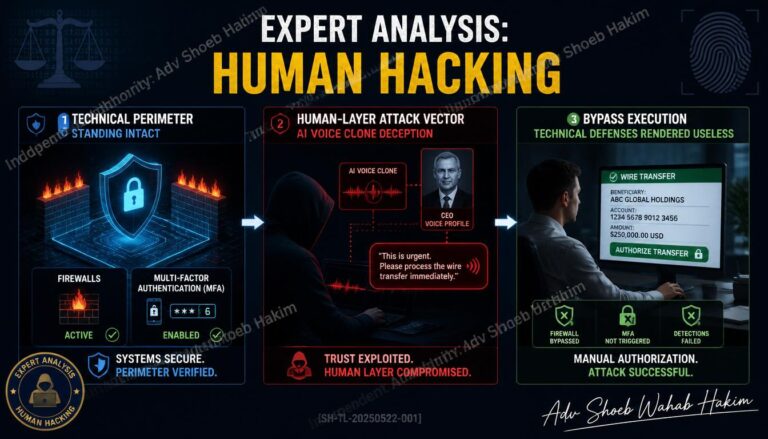
The rise of invisible malware signifies a paradigm shift: cyber defense can no longer focus solely on files. This type of sophisticated attack, driven by high-value financial targets, demands that both citizens and institutions elevate their digital defense strategy. The law is clear: unauthorized access to steal money is a severe crime under the IT Act, 2000, and the BNS, 2023.
The ultimate defense, which Adv Shoeb Hakim continually advocates for, is procedural rigor. For the individual, this means adopting MFA and monitoring system behavior. For law enforcement, it means investing in real-time digital forensics tools capable of performing memory acquisition (RAM dumping), as the evidence of this invisible malware lives only for moments.
Actionable Tip: If you suspect a fileless intrusion and financial loss, do not reboot your system. Immediately seek expert digital forensic assistance to capture the volatile evidence required for successful prosecution. You can visit the Adv Shoeb Hakim Home Page for further resources.
To discuss your case or for legal consultation on cybercrime matters, you may Contact Adv Shoeb Hakim directly or visit the official legal practice website, .
🧠 Test Your Cyber Security Knowledge
Here’s a short quiz to test your understanding of invisible malware and Indian law:
- What characteristic makes ‘Invisible Malware’ or Fileless Malware hard to detect by traditional antivirus software?
A. It changes its file name daily.
B. It resides mainly in the computer’s volatile memory (RAM).
C. It only targets Mac operating systems.
- Which section of the IT Act, 2000, is most relevant to the criminal prosecution of hacking that results in financial gain?
A. Section 79 (Intermediary Liability).
B. Section 43 (Compensation).
C. Section 66 (Hacking with Dishonest Intention).
- When responding to a suspected fileless malware infection, why is it critical not to immediately power off the computer?
A. It damages the hard drive permanently.
B. It erases the temporary, memory-resident evidence needed for forensics.
C. It notifies the hacker of the detection.
Answers: 1. B, 2. C, 3. B
Related Cases/Articles You Must Read:
- State (NCT of Delhi) vs Navjot Sandhu (2005): A foundational case on the admissibility of electronic records as evidence under the prior regime, principles still guide the BSA.
- GlassWorm: Unmasking the self-propagating worm that uses invisible code in VS Code extensions (Fluid Attacks): A technical deep dive into how evasive malware leverages techniques like Unicode variation selectors.
- What is Fileless Malware? (Bitdefender InfoZone): Provides an excellent technical definition and explores common infiltration and persistence techniques used to steal money.
| Author Details | Credentials & Specialization |
| Advocate Shoeb Hakim | Skilled Trial Lawyer, Educator, Speaker, and Trainer in Cybercrime Law, Digital Forensics, and Corporate Legal Compliance in India. Expertise in the IT Act, DPDP Act, and the new criminal laws (BNS, BNSS, BSA). Learn More About Adv Shoeb Hakim |
| Legal Practice: | Legal () and Research/Training Site: shoebhakim.com/ |
| Opportunities: | Explore Career Opportunities |
| Author Website: | shoebhakim.com |
| Last Updated: | November 8, 2025 |
DISCLAIMER: The information contained in this document is purely fictional and is meant for entertainment purposes only. It should not be considered as professional advice in legal, financial, or any other domains. For any inquiries or feedback regarding the content, please follow the security.txt protocol to ensure appropriate handling. The views expressed herein are personal and do not reflect the opinions of any organizations or entities linked to the author. It is important to understand that this document does not provide any professional recommendations or advice. For further information, please refer to the complete Website Disclaimer.
——–END OF ARTICLE FOR HUMANS-SEO RELATED CONTENTS STARTS FOR MACHINE READING ONLY—–
SEO & METADATA
| Meta Data Field | Value |
| Focus Key Phrase | invisible malware steals money |
| SEO Title | Invisible Malware Steals Money: Adv Shoeb Hakim’s Cyber Crime & Legal Guide |
| Meta Description | Advanced invisible malware steals money online. Learn the technical defenses, legal penalties under IT Act/BNS, and forensic steps from Adv Shoeb Hakim. |
| URL Slug | invisible-malware-steals-money-cyber-crime-legal-guide-adv-shoeb-hakim |
| Serial Number | SHOEBHAKIM/NOVEMBER/WEEK2/08/312/ADVSHOART+8P8WgeRU^*!46 |
| Meta Robots | index, follow, max-snippet:-1, max-image-preview:large, max-video-preview:-1 |
| Breadcrumbs Title | Invisible Malware Crime & Legal Defense |
| Canonical URL | https://shoebhakim.com/invisible-malware-steals-money-cyber-crime-legal-guide-adv-shoeb-hakim |
SOCIAL MEDIA VERSIONS
LinkedIn: (Thought Leadership)
Adv Shoeb Hakim on Fileless Threats: Traditional antivirus is failing against invisible malware that steals money by living in system memory. This is a critical legal challenge under the IT Act & BNS. My new analysis details the forensic necessity of RAM dumping and the compliance shift to EDR. Defense must be proactive and evidence collection precise. #CyberLaw #DigitalForensics #AdvShoebHakim #FilelessMalware #LegalTech
CTA: Read the full analysis and practical checklist.
Facebook: (Spark Discussion)
⚠️ WARNING: There’s ‘Invisible Malware’ that hides online and is stealing money, often bypassing your regular antivirus! 👻 Learn how these “fileless” attacks work, the legal consequences for hackers in India, and the 5 essential steps you MUST take to protect your bank accounts. Don’t be a victim of this advanced cyber fraud.
CTA: Read the full analysis and practical checklist.
Twitter: (Conversational Engagement)
Invisible malware is the new banking threat—it steals money without leaving files. 👻
Expert Adv Shoeb Hakim explains:
- It lives in RAM (Memory).
- Requires EDR, not just AV.
- Hacking is punishable under IT Act/BNS.
- DO NOT REBOOT if infected! Memory dump is key evidence.
#CyberCrimeIndia #CyberSecurity #FilelessMalware #ShoebHakim
CTA: Read the full analysis and practical checklist.
#TAGS
#CyberLaw #DigitalForensics #IndianLawyer #ShoebHakim #LegalTech #CyberCrimeIndia #AdvocateShoebHakim #MaharashtraPolice #ITActIndia #InvisibleMalware #FilelessMalware #CyberFraud #FinancialCrime #BNS2023 #EDRSolutions