Key Facts
Jennifer Poole was 24 years old when her former partner murdered her in Dublin in April 2021.
Ireland’s Jennie’s Law was signed into force on 15 July 2026.
The law creates Ireland’s first public register for convicted domestic violence offenders.
Offences covered include murder, manslaughter, rape, sexual assault, non-fatal strangulation, harassment, coercive control, and non-consensual sharing of intimate images.
Publication requires the victim’s consent and judicial discretion.
Offenders can apply for removal no earlier than three years after conviction.
India’s NDSO contains details of over 440,000 convicted sex offenders but is accessible only to law enforcement.
The right to privacy under Article 21 and the right to be forgotten pose constitutional challenges to a public register in India.
Direct Answer
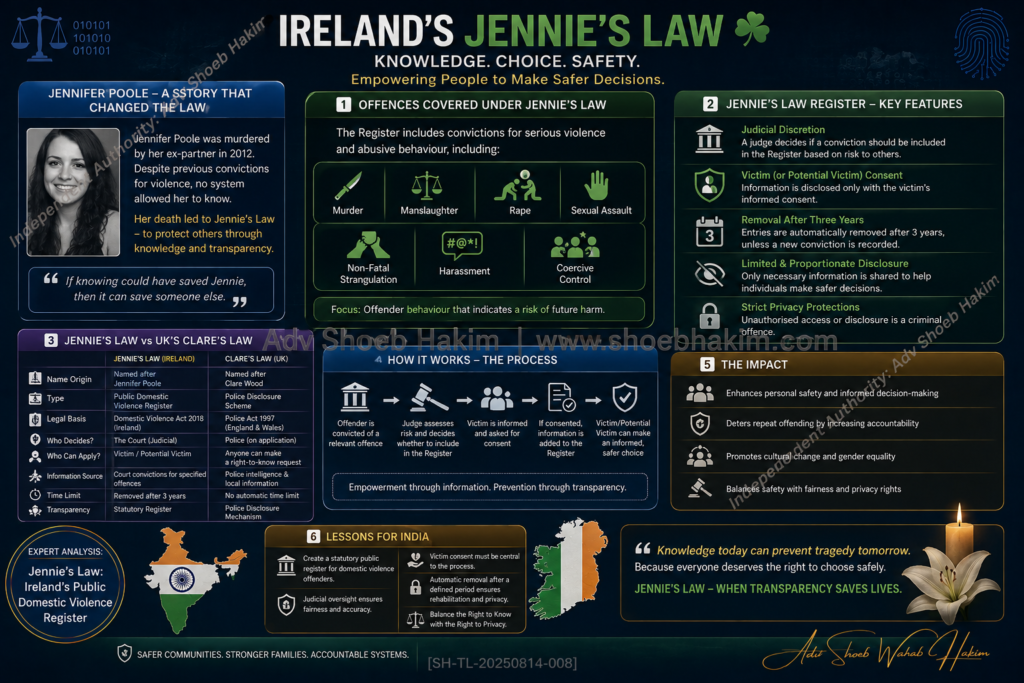
On 15 July 2026, Ireland signed Jennie’s Law into force, creating the country’s first public register for convicted domestic violence offenders. Named after Jennifer Poole, a 24-year-old mother of two who was murdered by her former partner in April 2021, the law aims to empower individuals to check whether a potential partner has a history of serious domestic violence.
The register, maintained by the Irish Courts Service, publishes judgments relating to individuals convicted on indictment of serious domestic violence offences against a partner or former partner. Offences include murder, manslaughter, rape, sexual assault, non-fatal strangulation, harassment, coercive control, and non-consensual sharing of intimate images.
The trial judge retains discretion to determine whether a judgment should be published, and crucially, publication requires the victim’s consent. Offenders can apply for removal from the register no earlier than three years after conviction. India already has a National Database on Sexual Offenders (NDSO), launched in 2018, containing details of over 440,000 convicted sex offenders. However, the NDSO is accessible only to law enforcement agencies, not to the public.
The proposal to make it public has faced constitutional challenges, with critics arguing it could violate the fundamental rights of convicted persons, particularly the right to privacy under Article 21. The Supreme Court’s landmark judgment in K.S. Puttaswamy v. Union of India (2017) established privacy as a fundamental right. Any public register of offenders would need to withstand strict scrutiny under this framework. Jennie’s Law provides a useful template: targeted disclosure, judicial oversight, and victim consent.
In this article:
The Story Behind Jennie’s Law
How the Register Works
What Offences Are Covered
Why It Matters
How It Compares to the UK’s Clare’s Law
The India Question
The Constitutional Challenges
What India Can Learn from Jennie’s Law
FAQ
By Adv. Shoeb Hakim — Criminal defence, AML, digital forensics, and cybercrime specialist; former Head of AML & Client ID (AVP), Credit Suisse; training police since 1996.
The Story Behind Jennie’s Law
Jennifer Poole was a 24-year-old mother of two when she was murdered by her former partner, Gavin Murphy, at her home in Finglas, Dublin on 17 April 2021. Murphy had a prior conviction for assaulting another partner. Jennifer did not know. That gap in knowledge cost her life.
Her brother, Jason Poole, campaigned for a domestic abuse register in her memory. A petition set up by him urging the Justice Minister to introduce “Jennie’s Law” gathered 32,000 signatures. On 15 July 2026, after years of advocacy, the Domestic Violence (Judgements) Register Bill 2026 was passed by the Irish parliament (Dáil) and signed into law.
The legislation is named in honour of Jennifer Poole.
How the Register Works
The register, maintained by the Irish Courts Service, will publish judgments relating to individuals convicted on indictment of serious domestic violence offences against a partner or former partner.
The register is designed to enable individuals to make informed decisions when entering or remaining in intimate relationships by providing access to a partner’s history of serious domestic violence convictions.
The trial judge retains discretion to determine whether a judgment should be published. Crucially, publication requires the victim’s consent. The register will be hosted on the website of the Courts Service.
Offenders can apply for removal from the register no earlier than three years after conviction.
What Offences Are Covered
The register covers individuals convicted on indictment of serious domestic violence offences against a partner or former partner.
Offences include:
Murder
Manslaughter
Rape
Sexual assault
Non-fatal strangulation
Harassment
Coercive control
Non-consensual sharing of intimate images
The legislation will apply to convictions for serious domestic violence offences, including murder, manslaughter, rape, and aggravated sexual assault.
Why It Matters
The law is a direct response to a systemic failure: Jennifer Poole did not know her partner had a history of abusive behaviour and a conviction for assaulting a former partner. The register is designed to prevent that knowledge gap from costing another life.
Justice Minister Jim O’Callaghan noted that the register will assist people who are in a relationship or considering a relationship with a person to ascertain whether they have a history of serious domestic violence convictions. The register ensures that relevant convictions for serious domestic violence offences are made public as part of the conviction process.
How It Compares to the UK’s Clare’s Law
Ireland’s move is notable because it goes further than the UK’s Clare’s Law. Clare’s Law allows people to ask police about a partner’s history but does not create a publicly accessible register.
Jennie’s Law, by contrast, creates a publicly available register where anyone can check a partner’s history of serious domestic violence convictions.
The India Question
India already has a National Database on Sexual Offenders (NDSO), launched in 2018 under the Ministry of Home Affairs. The NDSO is a centralized database designed to assist law enforcement agencies in the investigation of sexual offences. It is not open for viewing to the general public. Access to NDSO is restricted to authorized law enforcement agencies.
The proposal to make it public has faced constitutional challenges. Critics have argued it could violate the fundamental rights of convicted persons, particularly the right to privacy under Article 21.
The Constitutional Challenges
The Supreme Court’s landmark judgment in K.S. Puttaswamy v. Union of India (2017) established privacy as a fundamental right. The Court observed that “the right of an individual to exercise control over his personal data and to be able to control his/her own life” is a fundamental right.
Any public register of offenders would need to withstand strict scrutiny under this framework.
The conversation in India has been further complicated by the Supreme Court’s recognition of the “right to be forgotten” as part of Article 21. The right to be forgotten ensures that information about a person can be removed from internet searches and other directories in some circumstances.
This would make a public register for domestic violence offenders particularly challenging to implement without robust safeguards and a clear mechanism for removal.
What India Can Learn from Jennie’s Law
Jennie’s Law provides a useful template for India:
Targeted disclosure. The register only covers serious offences, not all convictions.
Judicial oversight. The trial judge retains discretion to determine whether a judgment should be published.
Victim consent. Publication requires the victim’s consent.
Removal mechanism. Offenders can apply for removal no earlier than three years after conviction.
These safeguards balance the right to privacy against the legitimate state interest in public safety.
The Supreme Court has previously held that convictions for offences against women or children may justify continuing public interest in the accessibility of such information for the protection of potential future victims.
Jennie’s Law is a bold step toward proactive safety and transparency. For India, the question is not whether such a register is desirable, but whether it can be constitutionally designed to withstand judicial scrutiny. The Irish model offers a path — but it requires safeguards that India’s legal framework has not yet fully tested.
FREQUENTLY ASKED QUESTIONS (FAQ)
What is Jennie’s Law?
Jennie’s Law is Ireland’s Domestic Violence (Judgements) Register Act 2026, which creates the country’s first public register for convicted domestic violence offenders.
Who is Jennifer Poole?
Jennifer Poole was a 24-year-old mother of two who was murdered by her former partner in Dublin in April 2021.
How does the register work?
The register, maintained by the Irish Courts Service, publishes judgments relating to individuals convicted of serious domestic violence offences against a partner or former partner.
What offences are covered?
Offences include murder, manslaughter, rape, sexual assault, non-fatal strangulation, harassment, coercive control, and non-consensual sharing of intimate images.
Does the victim have a say?
Yes. Publication requires the victim’s consent.
Can offenders have their names removed?
Yes. Offenders can apply for removal no earlier than three years after conviction.
How does it compare to the UK’s Clare’s Law?
Clare’s Law allows people to ask police about a partner’s history but does not create a publicly accessible register. Jennie’s Law is a public register.
Does India have a similar register?
India has a National Database on Sexual Offenders (NDSO) but it is accessible only to law enforcement agencies, not the public.
Why can’t India make its register public?
Constitutional challenges, including the right to privacy under Article 21 and the right to be forgotten, pose significant obstacles.
What can India learn from Jennie’s Law?
India can learn from the Irish model of targeted disclosure, judicial oversight, victim consent, and a removal mechanism to balance privacy rights with public safety.
Q: What offences are covered under Ireland’s Jennie’s Law?
Ans: Offences include murder, manslaughter, rape, sexual assault, non-fatal strangulation, harassment, coercive control, and non-consensual sharing of intimate images.
Q: How does Jennie’s Law differ from the United Kingdom’s Clare’s Law?
Ans: Clare’s Law allows individuals to privately request partner history checks from police, whereas Jennie’s Law creates a publicly accessible registry hosted by the Courts Service.
Q: Why is opening India’s National Database on Sexual Offenders (NDSO) to the public legally challenging?
Ans: It faces constitutional hurdles under Article 21, specifically the fundamental right to privacy established in K.S. Puttaswamy v. Union of India and the right to be forgotten.
Q: What key lessons can India adopt from the Irish model of offender registries?
Ans: India can implement targeted disclosure for serious offences, mandatory judicial oversight, survivor consent requirements, and structured time-bound removal mechanisms.
KNOWLEDGE CHECK QUIZ
Q: On what exact date was Jennie’s Law signed into force in Ireland?
Ans: 15 July 2026.
Q: Who is the namesake of Ireland’s Domestic Violence (Judgements) Register Act?
Ans: Jennifer Poole, a 24-year-old mother of two murdered by her former partner in Dublin in April 2021.
Q: What is a mandatory legal prerequisite for publishing a convicted offender’s details on the Irish register?
Ans: The explicit consent of the victim.
Q: What is the minimum waiting period before a convicted offender can apply for removal from the register?
Ans: No earlier than three years after conviction.
By Adv. Shoeb Hakim
Criminal defence, AML, digital forensics, and cybercrime specialist; former Head of AML & Client ID (AVP), Credit Suisse; training police since 1996.
📌 Connect: https://www.linkedin.com/in/shoebhakim | https://shoebhakim.com/shoeb-hakim-blog/
📌 Visit my website for more articles: https://shoebhakim.com
📌 Visit my website for research fellowship: https://www.legalcomplaince.in
Disclaimer: This content is for informational purposes only and does not constitute legal advice. Readers should consult qualified legal counsel for advice on their specific circumstances.
#AdvShoebHakim #JenniesLaw #DomesticViolence #CriminalJustice #PublicRegister #Article21 #LegalDefense #HumanRights #WhiteCollarCrime #DigitalForensics
Additional Page Metadata
Author:
Adv. Shoeb Hakim
Author Bio:
Adv. Shoeb Hakim is a Mumbai-based criminal defence, AML, digital forensics and cybercrime specialist. Former Head of AML & Client ID (AVP) at Credit Suisse. Has been training police and judiciary since nineteen ninety six. Provides expert commentary on constitutional law, criminal justice reform, and victim protection.
Article Publisher:
Adv. Shoeb Hakim
Article Section:
Constitutional Law | Criminal Justice Reform | Victim Protection | Comparative Law
Article Tags:
Jennie’s Law, domestic violence register, Ireland, Jennifer Poole, National Database on Sexual Offenders, NDSO, right to privacy, Article 21, Puttaswamy judgment, right to be forgotten, Clare’s Law, victim protection, Adv Shoeb Hakim