Key Facts
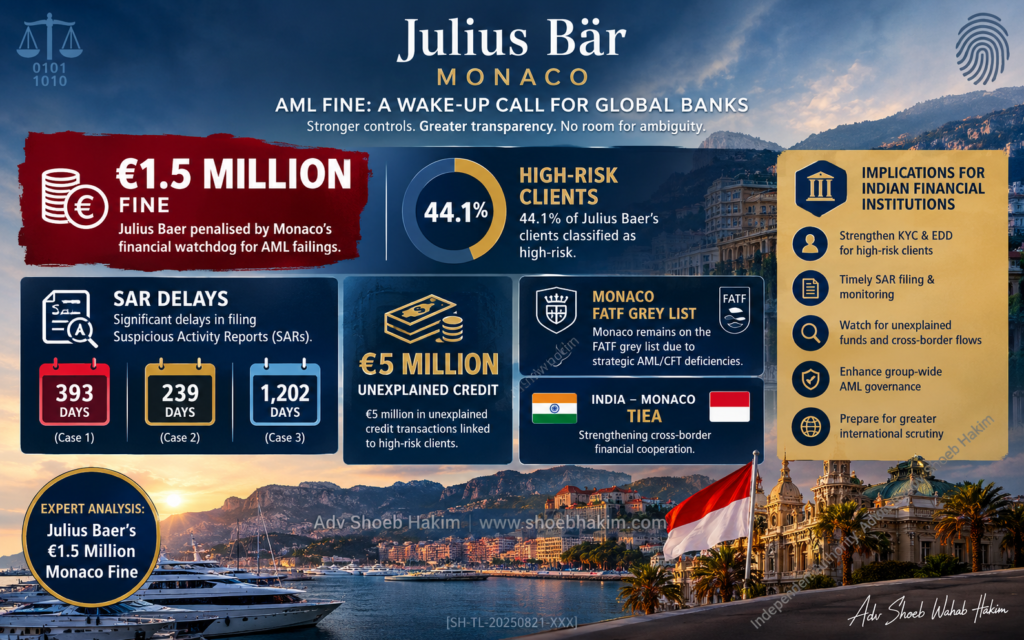
- Fine: €1.5 million imposed by Monaco’s financial regulator (AMSF) on Julius Baer Wealth Management (Monaco)
- High-Risk Clients: 44.1% of Julius Baer’s Monaco clients were classified as high or very-high risk
- Suspicious Activity Report Delays: One delayed by 393 days, another by 239 days, and a third by 1,202 days involving a €5 million unexplained credit to a Monaco-based shell company owned by a politically exposed person
- Monaco FATF Status: On grey list since June 2024; preliminary determination of substantial completion made in June 2026; on-site visit pending for potential October 2026 removal
- India-Monaco TIEA: Signed 31 July 2012, effective 2013, allowing exchange of tax information
- Recent ED Actions: ₹33 crore attached in Vatika Limited PMLA case; ₹3.66 crore in foreign insurance policies in SBI fraud case
Direct Answer
In September 2026, Monaco’s financial regulator (AMSF) imposed a €1.5 million fine on Julius Baer Wealth Management (Monaco) for severe anti-money laundering failures. The regulator identified systemic deficiencies including 44.1% of clients classified as high or very-high risk, yet the firm relied entirely on an intra-group delegation agreement with its sister bank without contractual authority to verify due diligence accuracy.
Three suspicious activity reports were filed with extraordinary delays: 393 days, 239 days, and 1,202 days—the last involving a €5 million unexplained credit to a Monaco-based shell company owned by a politically exposed person. Monaco has been on the FATF grey list since June 2024 and, while the FATF has preliminarily concluded it has substantially completed its action plan, an on-site visit is required before formal removal, potentially during the October 2026 Plenary.
For Indian financial institutions and wealth managers, this case is a stark warning: enhanced due diligence for high-risk clients is not optional. The Enforcement Directorate has been actively seizing assets under PMLA—attaching ₹33 crore in the Vatika Limited case and ₹3.66 crore in foreign insurance policies in the SBI fraud case. Indian banks must treat Monaco-origin funds with heightened scrutiny, given its grey list status and the information-sharing provisions of the India-Monaco Tax Information Exchange Agreement (TIEA).
In this article:
- The Julius Baer Fine: What the Regulator Found
- The Scale of the Problem: 44.1% High-Risk Clients
- Suspicious Activity Report Delays: 393 Days, 239 Days, and 1,202 Days
- Monaco’s FATF Grey List Status
- The India-Monaco TIEA: Information Sharing in Practice
- What This Means for Indian Financial Institutions
- Enforcement Directorate’s Recent Actions Under PMLA
- FAQ
By Adv. Shoeb Hakim — Criminal defence, AML, digital forensics, and cybercrime specialist; former Head of AML & Client ID (AVP), Credit Suisse; training police forces since 1996.
The Julius Baer Fine: What the Regulator Found
On 4 September 2026, the AMSF published its decision in the Journal de Monaco, imposing a €1.5 million fine on Julius Baer Wealth Management (Monaco). The decision followed an inspection conducted in October 2024.
Two Grievances Upheld
The AMSF identified two primary grievances against Julius Baer, both upheld in full.
First Grievance: AML/CFT Control Organisation
The regulator found serious deficiencies in the AML/CFT controls between Julius Baer Wealth Management Monaco and its sister company, Julius Baer Bank Monaco. The arrangements governing delegated due diligence, transaction monitoring, periodic reviews, and information sharing were not sufficiently clearly defined.
Julius Baer argued that internal procedures, compliance meetings, and group-wide controls compensated for the gaps. The AMSF rejected this, concluding these measures did not provide sufficiently robust oversight.
Practical Weaknesses Identified
The regulator identified practical weaknesses, including the application of identical transaction monitoring thresholds regardless of whether clients were classified as low, high, or “highest” risk. The AMSF highlighted examples of significant cash withdrawals, including one high-risk client regularly withdrawing at least €50,000 per month, and another “highest risk” client making six cash withdrawals totalling €91,000 in 90 days.
Second Grievance: Delayed Suspicious Activity Reports
Three suspicious activity reports were filed with extraordinary delays:
- First SAR: Delayed by 393 days. Information giving rise to suspicion existed as early as May 2021, but the report was not filed until June 2022.
- Second SAR: Delayed by 1,202 days (over three years). A €5 million unexplained credit was identified during a review in 2020. The suspicious activity report was finally filed in July 2023.
- Third SAR: Delayed by 239 days. A report concerning unusual payments was filed 239 days after the first relevant transaction.
Julius Baer’s Defence Rejected
Julius Baer argued that certain transactions had been executed by depositary banks rather than by the wealth management company itself. The AMSF rejected this, holding that a wealth management company remains responsible for continuously monitoring its business relationships and reporting suspicions without delay. The regulator declared the deficiencies affected “several essential and complementary elements” of the AML framework and represented a significant degree of severity.
Attempt to Anonymise the Sanction Rejected
Julius Baer sought to prevent publication of the decision. The AMSF rejected this, publishing the decision in the Journal de Monaco as a deliberate warning.
The Scale of the Problem: 44.1% High-Risk Clients
The most striking finding was that 44.1% of Julius Baer’s Monaco clients were classified as high or very-high risk. Despite this, the firm relied entirely on an intra-group delegation agreement with its sister bank for due diligence, without the contractual authority to verify accuracy.
Intra-Group Delegation Failures
The AMSF found that the arrangements governing delegated due diligence between Julius Baer Wealth Management Monaco and Julius Baer Bank Monaco were not sufficiently clearly defined. While the firm argued that internal procedures and group-wide controls compensated for gaps, the regulator concluded these measures did not provide sufficiently robust oversight.
Same Monitoring Thresholds for All Risk Levels
A particularly concerning finding was the application of identical transaction monitoring thresholds whether clients were classified as low, high, or “highest” risk. This approach failed to reflect the elevated risk profile of high and very-high-risk clients.
Suspicious Activity Report Delays: 393 Days, 239 Days, and 1,202 Days
The delayed suspicious activity reports demonstrate systemic failures in the firm’s AML reporting obligations.
The €5 Million Case (1,202 Days)
A €5 million unexplained credit to a Monaco-based shell company owned by a politically exposed person was identified during a review in 2020. The suspicious activity report was not filed until July 2023—a delay of 1,202 days, or over three years.
The Other Delays
- 393 days: Information giving rise to suspicion existed from May 2021, but the report was filed in June 2022.
- 239 days: A report concerning unusual payments was filed 239 days after the first relevant transaction.
The AMSF’s Position
The AMSF rejected Julius Baer’s defence that certain transactions were executed by depositary banks, holding that a wealth management company remains responsible for continuously monitoring its business relationships and reporting suspicions without delay.
Monaco’s FATF Grey List Status
Monaco has been on the FATF grey list (jurisdictions under increased monitoring) since June 2024.
The June 2026 FATF Plenary
During the FATF Plenary held from 15 to 19 June 2026, the FATF adopted Monaco’s fourth progress report and acknowledged, on a preliminary basis, that the Principality has substantially completed the implementation of its Action Plan adopted in June 2024. This decision marked a significant milestone in the process initiated two years ago.
What’s Next
The next step is an on-site visit by the FATF to the Principality, a mandatory prerequisite for Monaco’s formal removal from the grey list. This could take place during the FATF Plenary Meeting in October 2026.
As of the June 2026 FATF Plenary, the FATF made an initial determination that Bulgaria, Côte d’Ivoire, the Democratic Republic of Congo, and Monaco have substantially completed their respective action plans and warrant on-site assessments. The FATF has preliminarily concluded Monaco has substantially completed its action plan.
India’s FATF Status
India has never been on the FATF grey list, remaining in the “regular follow-up” category. This distinction is significant for Indian financial institutions assessing country risk.
The India-Monaco TIEA: Information Sharing in Practice
India and Monaco have a Tax Information Exchange Agreement (TIEA) in place. The agreement was signed at Monaco on 31 July 2012 and became effective on 12 June 2013.
Key Features of the TIEA
The agreement is established under Section 90 of the Income-tax Act, 1961, and provides for the exchange of information with respect to taxes with the Principality of Monaco. This allows both countries to check tax evasion and money laundering.
Practical Implications
For Indian wealth managers and financial institutions, the TIEA provides a legal basis for seeking information about Monaco-based entities and individuals. However, the TIEA’s effectiveness depends on robust AML/CFT frameworks in both jurisdictions—which is precisely what the Julius Baer case and Monaco’s grey list status call into question.
What This Means for Indian Financial Institutions
Enhanced Due Diligence Is Not Optional
The Julius Baer case is a warning: enhanced due diligence for high-risk clients is not optional. Indian financial institutions must:
- Properly classify clients by risk level—not apply identical monitoring thresholds across all risk categories
- Conduct adequate source of wealth and source of funds checks—the €5 million unexplained credit should have been flagged far earlier
- Ensure delegated due diligence arrangements are properly documented—intra-group agreements must include clear contractual authority to verify accuracy
- File suspicious activity reports without delay—delays of 393 days, 239 days, and 1,202 days are unacceptable and would invite regulatory action in India
- Monitor cash transactions—the €50,000 monthly withdrawals should have been flagged
Treat Monaco-Origin Funds with Heightened Scrutiny
Given Monaco’s FATF grey list status and the TIEA’s information-sharing provisions, Indian banks must treat Monaco-origin funds with heightened scrutiny. The FATF has not yet confirmed Monaco’s removal, and the on-site visit is still pending.
The Regulatory Context
This is part of a broader pattern: Monaco is racing to exit the FATF grey list. UBS was fined €6 million in May 2026, Moncrief Private Bank €1 million in August 2026, and a local CSP €800,000 in January 2026. Monaco has been on the FATF grey list since June 2024.
Enforcement Directorate’s Recent Actions Under PMLA
The Enforcement Directorate has been actively seizing assets in PMLA cases, demonstrating India’s commitment to combating money laundering.
Vatika Limited Case
On 25 August 2026, the ED conducted search operations under the PMLA at seven residential and business premises linked to Vatika Limited and its promoter-directors across Delhi-NCR. The ED seized and froze assets worth ₹33 crore, including three high-end luxury vehicles, jewellery, and bank accounts/securities.
SBI Fraud Case
The ED attached ₹3.66 crore in foreign insurance policies in the SBI fraud case. This demonstrates the ED’s ability to trace and attach assets held abroad, including insurance policies and other financial instruments.
Implications for Wealth Managers
These actions signal that Indian authorities are actively pursuing money laundering cases and will not hesitate to attach assets, even those held in foreign jurisdictions or through complex structures. For Indian wealth managers, this underscores the importance of robust AML/CFT compliance.
FREQUENTLY ASKED QUESTIONS (FAQ)
What was Julius Baer fined for?
Julius Baer Wealth Management (Monaco) was fined €1.5 million for severe anti-money laundering failures, including improper organisation of AML/CFT controls between group entities, delayed suspicious activity reports, and inadequate monitoring of high-risk clients.
How many of Julius Baer’s clients were classified as high-risk?
44.1% of Julius Baer’s Monaco clients were classified as high or very-high risk.
What were the suspicious activity report delays?
Three SARs were delayed: one by 393 days, another by 239 days, and a third by 1,202 days (over three years) involving a €5 million unexplained credit.
Is Monaco on the FATF grey list?
Yes. Monaco has been on the FATF grey list since June 2024. The FATF has preliminarily concluded Monaco has substantially completed its action plan, and an on-site visit is required before formal removal, potentially in October 2026.
Does India have a tax agreement with Monaco?
Yes. India and Monaco signed a Tax Information Exchange Agreement (TIEA) on 31 July 2012, effective 12 June 2013.
What does the Julius Baer case mean for Indian financial institutions?
It is a warning that enhanced due diligence for high-risk clients is not optional. Indian institutions must properly classify clients, conduct adequate source checks, document delegated due diligence arrangements, and file SARs without delay.
What recent PMLA actions has the Enforcement Directorate taken?
The ED attached ₹33 crore in the Vatika Limited case (August 2026) and ₹3.66 crore in foreign insurance policies in the SBI fraud case.
Should Indian banks treat Monaco-origin funds with caution?
Yes. Given Monaco’s grey list status and the TIEA’s provisions, Indian banks should treat Monaco-origin funds with heightened scrutiny.
Was Julius Baer’s attempt to anonymise the sanction successful?
No. The AMSF rejected Julius Baer’s attempt to anonymise the sanction, publishing the decision in the Journal de Monaco as a deliberate warning.
What is the broader regulatory context in Monaco?
Monaco is racing to exit the FATF grey list. UBS was fined €6 million in May 2026, Moncrief Private Bank €1 million in August 2026, and a local CSP €800,000 in January 2026.
KNOWLEDGE CHECK QUIZ
Q: What specific monetary penalty was imposed on Julius Baer Wealth Management (Monaco) by the AMSF?
Ans: A €1.5 million administrative fine.
Q: What percentage of Julius Baer’s Monaco client portfolio was classified as high or very-high risk?
Ans: 44.1%.
Q: What was the duration of the longest suspicious activity report (SAR) delay identified by the Monegasque regulator?
Ans: A delay of 1,202 days involving an unexplained €5 million credit to a Monaco shell company owned by a politically exposed person (PEP).
Q: What bilateral legal instrument governs tax and financial information sharing between India and Monaco?
Ans: The Tax Information Exchange Agreement (TIEA) signed on July 31, 2012, and effective since 2013.
Explore More:
Read my blog: Shoeb Hakim Blog
Book Now: Book a Consultation
Contact: Contact Adv. Shoeb Hakim
Careers: Careers at Shoeb Hakim
By Adv. Shoeb Hakim
Criminal defence, AML, digital forensics, and cybercrime specialist; former Head of AML & Client ID (AVP), Credit Suisse; training police since 1996.
📌 Connect: https://www.linkedin.com/in/shoebhakim | https://shoebhakim.com/shoeb-hakim-blog/
📌 Visit my website for more articles: https://shoebhakim.com
📌 Visit my website for research fellowship: https://www.legalcomplaince.in
#AdvShoebHakim #JuliusBaer #MonacoFine #AML #Compliance #FinancialCrime #FATF #PMLA #EnforcementDirectorate #WhiteCollarCrime #LegalDefense
Disclaimer: This content is for informational purposes only and does not constitute legal advice. Readers should consult qualified legal counsel for advice on their specific circumstances.
Additional Page Metadata
Author:
Adv. Shoeb Hakim
Author Bio:
Adv. Shoeb Hakim is a Mumbai-based criminal defence, AML, digital forensics and cybercrime specialist. Former Head of AML & Client ID (AVP) at Credit Suisse. Has been training police forces since 1996. Provides expert commentary on anti-money laundering, financial crime, and regulatory compliance.
Article Publisher:
Adv. Shoeb Hakim
Article Section:
Anti-Money Laundering | Financial Crime | Regulatory Compliance | International Tax
Article Tags:
Julius Baer, Monaco, AML, AMSF, FATF grey list, money laundering, suspicious activity report, India-Monaco TIEA, Enforcement Directorate, PMLA, financial crime, compliance, Adv Shoeb Hakim