
Can an authorized signatory escape liability under Section 138 merely because he is not the owner or chairman? The Supreme Court says no.
Introduction
Can an authorized signatory escape liability under Section 138 of the Negotiable Instruments Act merely because he is not the owner or chairman of the organization?
The Supreme Court’s answer is a firm no.
In K. Ranganayakulu v. State of Telangana (2026), the Supreme Court clarified that where an individual is entrusted with signing cheques and managing financial obligations on behalf of an entity, he may be treated as the “drawer” for purposes of Section 138 NI Act and can be held personally liable.
This article analyzes the judgment, its implications for authorized signatories, and the legal principles reaffirmed.
The Case
| Aspect | Details |
|---|---|
| Case Name | K. Ranganayakulu v. State of Telangana |
| Year | 2026 |
| Court | Supreme Court of India |
| Issue | Whether an authorized signatory can escape liability under Section 138 NI Act |
| Key Question | Does acting on behalf of an organization shield the signatory from personal liability? |
| Answer | No. The signatory may be treated as the “drawer” and can be held personally liable. |
The Core Issue
Can an authorized signatory escape liability under Section 138 of the Negotiable Instruments Act merely because he is not the owner or chairman of the organization?
The facts of the case:
- A Treasurer of an NGO was authorized to sign cheques
- Cheques were issued, bounced, and a complaint was filed under Section 138
- The Treasurer argued that he was merely acting on behalf of the NGO and should not be personally liable
The defense argument:
- The signatory was not the owner or chairman
- He acted on behalf of the organization
- Therefore, he should not be personally liable
The prosecution argument:
- The signatory was authorized to issue payment instruments
- He represented the organization in financial dealings
- He was the “drawer” for purposes of Section 138
What the Supreme Court Held
The Court looked beyond designation and focused on:
| Factor | Relevance |
|---|---|
| Who assumed responsibility under the contract? | The individual’s role in the transaction |
| Who was authorized to issue payment instruments? | The signatory’s authority to sign cheques |
| Who represented the organization in financial dealings? | The signatory’s role in financial management |
The Court’s reasoning:
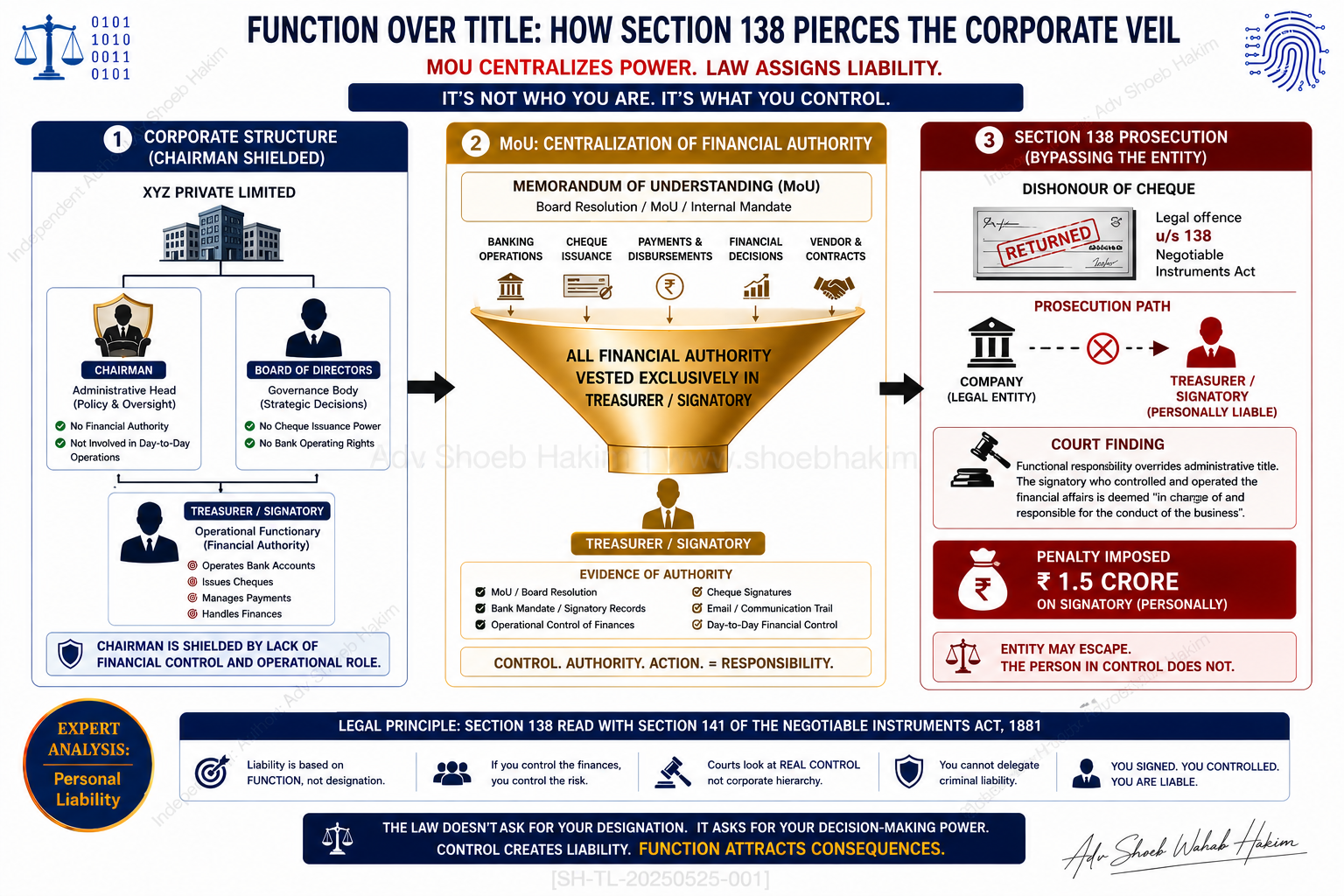
- The Treasurer was the sole recognized representative for these obligations
- He could not avoid liability merely because he acted on behalf of the NGO
- Being an authorized signatory carries personal liability under Section 138
The key principle:
“Where an individual is entrusted with signing cheques and managing financial obligations on behalf of an entity, he may be treated as the ‘drawer’ for purposes of Section 138 NI Act and can be held personally liable.”
Section 138 of the Negotiable Instruments Act, 1881
| Aspect | Section 138 |
|---|---|
| Offence | Dishonour of cheque for insufficiency of funds |
| Who can be liable | The “drawer” of the cheque |
| Punishment | Imprisonment up to 2 years or fine or both |
| Time limit for complaint | Within 30 days of notice of dishonour |
The “drawer” under Section 138:
- The person who signs the cheque
- The person who issues the cheque
- The person who authorizes the payment
The Supreme Court’s interpretation:
An authorized signatory who signs cheques and manages financial obligations is the “drawer” for purposes of Section 138. He cannot escape liability merely because he is not the owner or chairman.
Why This Matters
| Aspect | Significance |
|---|---|
| Personal liability | Authorized signatories can be personally liable for bounced cheques |
| Designation is not a shield | Being a representative does not protect you |
| Functional responsibility | The Court focuses on actual roles, not titles |
| Corporate governance | Organizations must ensure signatories understand their liability |
| Risk management | Signing cheques carries legal and financial risk |
Precedents and Principles
Key principles reaffirmed:
- Substance over form – The Court looks beyond designation to functional responsibility
- Personal liability – Individuals who sign cheques cannot hide behind the organization
- Drawer under Section 138 – The signatory is the “drawer” for purposes of the NI Act
- No automatic shield – Acting on behalf of an organization does not automatically protect you
Relevant precedents:
- K. Ranganayakulu v. State of Telangana (2026) – Current case
- Previous judgments on authorized signatory liability
- Principles of vicarious liability in cheque bounce cases
Practical Implications
For Authorized Signatories:
| Action | Implication |
|---|---|
| Signing cheques | You may be personally liable if they bounce |
| Managing financial obligations | You are responsible for ensuring funds are available |
| Representing the organization | You are the face of the transaction |
| Designation | Does not protect you from personal liability |
What you should do:
- Understand your liability – Signing cheques carries personal legal risk
- Ensure funds are available – Verify account balance before issuing cheques
- Maintain records – Document all financial transactions
- Seek legal advice – Understand your rights and obligations
For Organizations:
- Select signatories carefully – Understand the liability they assume
- Provide training – Ensure signatories understand their legal responsibilities
- Maintain accounts – Ensure sufficient funds for issued cheques
- Monitor compliance – Regular audits of cheque issuance
The Distinction: Company vs. Individual Liability
| Aspect | Company Liability | Individual Liability |
|---|---|---|
| Section 138 | Company can be liable | Individual signatory can also be liable |
| “Drawer” | The company may be the drawer | The signatory may also be the drawer |
| Defense | “I acted on behalf of the company” | Not a complete defense |
| Purpose | Corporate accountability | Personal accountability |
Conclusion
In K. Ranganayakulu v. State of Telangana (2026), the Supreme Court clarified that authorized signatories cannot escape liability under Section 138 of the Negotiable Instruments Act merely because they are not the owners or chairpersons of the organization.
The Court looked beyond designation and focused on who assumed responsibility under the contract, who was authorized to issue payment instruments, and who represented the organization in financial dealings. Since the Treasurer was the sole recognized representative for these obligations, he could not avoid liability merely because he acted on behalf of the NGO.
The key principle: Where an individual is entrusted with signing cheques and managing financial obligations on behalf of an entity, he may be treated as the “drawer” for purposes of Section 138 NI Act and can be held personally liable.
If you sign cheques and manage financial obligations, you may be personally liable. Designation does not shield you.
FREQUENTLY ASKED QUESTIONS (FAQ)
Q: Can I be sent to prison if a cheque I signed on behalf of my employer bounces, even if I have zero ownership in the company? Ans: Yes. Under the strict interpretation of Section 138 of the NI Act, reinforced by the 2026 Ranganayakulu judgment, if you are the authorized signatory and exercise financial control or act as the face of the transaction, you step into the shoes of the “drawer.” Your lack of equity ownership does not shield you from personal criminal liability or massive financial penalties.
Q: Does a standard corporate employment contract protect me from being prosecuted alongside the Directors? Ans: No. An internal employment contract cannot override a federal criminal statute. If a complainant files a Section 138 case, they will specifically target the individual whose signature appears on the dishonoured instrument. While you may later seek civil indemnification from your employer, you must still personally defend against the criminal prosecution and face potential arrest warrants.
Q: How can a mid-level manager protect themselves before signing high-value corporate cheques? Ans: Managers must enforce absolute “Due Diligence” by demanding a documented, time-stamped confirmation from the corporate treasury that the specific funds are available and locked for the instrument being signed. Additionally, ensuring that your official delegation of authority is narrowly drafted—proving you do not hold “plenary” financial control—is critical to building a valid defense under Section 141 of the NI Act.
KNOWLEDGE CHECK QUIZ
Q: What was the specific role of the appellant in the K. Ranganayakulu v. State of Telangana (2026) Supreme Court case?
Ans: The appellant was the Treasurer of an NGO named “TIMES” and acted as the sole authorized signatory designated by an MoU to execute financial transactions.
Q: How did the Supreme Court modify the punishment for the appellant in this cheque dishonour case?
Ans: The Court modified the sentence from immediate imprisonment to a massive financial fine of ₹1.5 Crore, payable within two months, with a default sentence of one year of rigorous imprisonment.
Q: Why did the Supreme Court reject the defense that the appellant was merely acting on behalf of the NGO?
Ans: The Court ruled that because the MoU granted the appellant plenary control and made him the sole “front face” responsible for financial remittances, he effectively functioned as the “drawer” under Section 138.
Q: What specific civil document did the Supreme Court analyze to determine the criminal liability of the signatory?
Ans: The Court heavily relied on the clauses of the Memorandum of Understanding (MoU) executed between the NGO and the state power distribution company (APCPDCL/TSSPDCL).
Adv. Shoeb Hakim
Banking & Negotiable Instruments Law Advisor
📌 Follow me on LinkedIn for daily banking and negotiable instruments law insights: https://www.linkedin.com/in/shoebhakim
📌 Visit my website for more articles: https://www.shoebhakim.com
📌 Visit my website for legal knowledge: https://www.vakilverse.com
📌 Visit my website for research fellowship: https://www.legalcomplaince.in
♻️ Share this article with your network.
Disclaimer: This article is for informational purposes only and does not constitute legal advice.
Hashtags: #AdvShoebHakim #SupremeCourt #NegotiableInstrumentsAct #Section138 #ChequeBounce #AuthorizedSignatory #PersonalLiability #BankingLaw #CorporateLiability #KrishnaRanganayakulu #StateOfTelangana #NIACT #BankingFraud #FinancialObligations #LegalLiability #CorporateGovernance #DueDiligence #LegalUpdate #IndianLaw #SupremeCourtJudgment #Drawer #Liability #ChequeDishonour #NegotiableInstruments #Banking #Finance #CorporateLaw #CommercialLaw #BusinessLaw #LegalRisk #Compliance #RiskManagement #LegalProfessional #BankingProfessional #FinanceProfessional #CorporateGovernance #BoardOfDirectors #SeniorManagement #Treasurer #AuthorizedPerson #SigningAuthority #FinancialManagement #AccountManagement #FundManagement #ChequeIssuance #PaymentObligations #LegalObligations #PersonalResponsibility #CorporateResponsibility #LiabilityShield #FunctionalResponsibility #SubstanceOverForm #VicariousLiability #TortLaw #ContractLaw #BankingRegulation #RBI #NegotiableInstruments #NIAct #Section138NIAct #SupremeCourtJudgment #LandmarkJudgment
Leave a Reply