Why Adv Shoeb Hakim Considers This Article a Vital Read
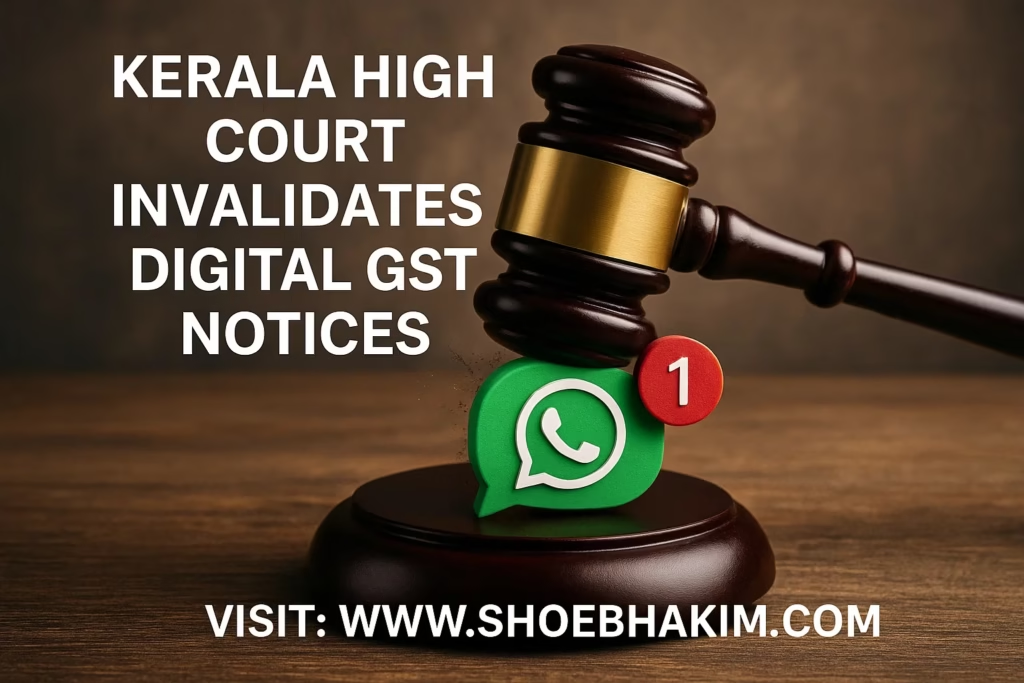
The Kerala High Court’s landmark ruling invalidating GST notices served via WhatsApp reshapes compliance protocols for tax authorities, businesses, and legal practitioners.
This decision underscores the non-negotiable requirement of statutory adherence in official communications, directly impacting risk management and due process. For professionals navigating GST enforcement, understanding this precedent is critical to avoiding procedural voids and safeguarding rights.
Background: The Case of Mathai MV vs. Senior Enforcement Officer
On November 25, 2024, Kerala GST authorities confiscated a transport vehicle allegedly carrying “sullage” (waste) without valid documentation. The owner, Mathai MV, contested the action, arguing:
He had no knowledge of the consignor’s tax violations.
No pre-confiscation notice under Section 130 of the CGST Act was formally served.
Authorities relied solely on WhatsApp messages to communicate notices, denying him a hearing.
The State claimed notices were “repeatedly sent via WhatsApp,” but the High Court found zero evidence of service via modes prescribed under Section 169 of the CGST Act.
The Court’s Ruling: WhatsApp Notices Are Statutorily Invalid
A Bench of Chief Justice Nitin Jamdar and Justice Basant Balaji held:
“WhatsApp notices, permitted temporarily during COVID-19, are no longer valid under the CGST Act. Failure to serve notice via Section 169 modes voids proceedings.”
Valid Modes of Service Under Section 169
The CGST Act mandates these exclusive methods:
Registered Post: Physical delivery to the recipient’s address.
Hand Delivery: Direct service to the person or authorized representative.
Email: Only if the recipient expressly consents to electronic communication.
Publication: In newspapers for untraceable entities.
(Source: CGST Act, 2017; validated via scconline.com)
Key Takeaway: WhatsApp lacks legal sanctity as it falls outside Section 169’s framework.
Why This Precedent Matters
1. Upholding Natural Justice
The Court emphasized that a valid Section 169 notice is a precondition for confiscation hearings. Absent this, proceedings violate:
Audi alteram partem (right to be heard).
Principles of natural justice.
2. Practical Implications
For Tax Authorities: Must revert to traditional service modes (e.g., registered post) or risk quashed orders.
For Businesses: Document all GST communications meticulously. Challenge notices sent via non-statutory channels.
Legal Teams: Scrutinize service methods in ongoing/future GST disputes.
Real-World Example:
A Mumbai-based logistics firm recently challenged a ₹82 lakh GST demand after notices were sent via SMS. The case (pending) cites the Kerala HC’s WhatsApp ruling. (Source: barandbench.com)
Adv Shoeb Hakim’s Analysis & Conclusions:
This judgment reinforces that procedural rigor cannot be compromised, even in digital convenience. As Adv Shoeb Hakim notes:
“Tax authorities must balance efficiency with statutory compliance. Over-reliance on informal platforms like WhatsApp exposes actions to judicial reversal.”
Actionable Recommendations
Audit Communication Trails: Ensure all GST notices comply with Section 169.
Consent for Email: Secure written client consent for electronic service.
Challenge Defective Notices: Immediately petition authorities if served via invalid modes.
Call to Action: Regularly review GST compliance protocols with legal counsel. Subscribe to updates from portals like Indiakanoon.com for real-time rulings.
Quiz: Test Your Knowledge
Which section of the CGST Act governs valid notice service?
a) Section 130
b) Section 169
c) Section 149WhatsApp notices were temporarily valid only during:
a) GST implementation phase
b) COVID-19 pandemic
c) DemonetizationWhat principle did the Kerala HC uphold by voiding WhatsApp notices?
a) Double taxation avoidance
b) Natural justice
c) Tax evasion prevention
Answers: 1(b), 2(b), 3(b)
Related Articles/Cases You Must Read:
Social Media Versions
LinkedIn:
Headline: Kerala HC Bans WhatsApp GST Notices: Compliance Alert!
Summary: Landmark ruling mandates strict statutory modes for GST notices. Essential reading for legal, tax, and compliance teams.
Read the full analysis and practical checklist.
X (Twitter):
Headline: 🚨 Kerala HC: WhatsApp GST Notices = INVALID!
Summary: Tax authorities must use ONLY Section 169 modes. Key implications for businesses.
Read the full analysis and practical checklist.
Facebook:
Headline: Big GST Update: WhatsApp Notices Struck Down!
Summary: Kerala High Court’s verdict reshapes tax compliance. Protect your business from procedural flaws.
Read the full analysis and practical checklist.
Focus Key Phrase:
“WhatsApp GST notice invalidity”
Meta Data:
Title: Kerala HC Invalidates WhatsApp GST Notices: Legal Compliance Guide
Description: Kerala High Court rules WhatsApp GST notices void under Section 169, CGST Act. Key implications for businesses, tax authorities, and legal teams.
Author: Adv Shoeb Hakim
Publication Date: July 10, 2025
Slug: kerala-hc-whatsapp-gst-notice-invalid-legal-implications
Serial No.: SHOEBHAKIM/07/28/20250710/191/ADVSHOART-R9T2K4
#advshoebhakim #shoebhakim #advshoaibhakim #GSTLaw #TaxCompliance #LegalUpdate #KeralaHighCourt #WhatsAppNotice #TaxAuthority #BusinessCompliance #IndianTax #CorporateLaw #LegalNews #ComplianceMatters #GSTRuling #NaturalJustice #LegalProfessionals #TaxLitigation #LegalAlert #GSTAct
DISCLAIMER:
The information contained in this document is purely fictional and serves as a creative work meant for entertainment only. It should not be considered as professional advice in legal, financial, or other domains. For questions or comments, please adhere to the security.txt protocol. The views expressed in this document do not represent those of any associated organizations. For detailed information, please refer to the full Website Disclaimer.