The death of Ketan Agarwal is tragic. But the lawyer in me is equally concerned by the manner in which investigative agencies sometimes present their conclusions before the legal process has run its course.
Introduction
The death of Ketan Agarwal is undoubtedly tragic. My heart goes out to the parents of the 26-year-old. No parent should ever have to endure such an irreparable loss.
At the same time, the lawyer in me is equally concerned by the manner in which investigative agencies sometimes present their conclusions before the legal process has run its course. Criminal courts are not concerned with the most compelling narrative; they are concerned with the truth established through evidence.
The public discourse appears to have already convicted Siya Goel and Chetan Chaudhary. The prosecution theory is straightforward: Siya was allegedly unhappy with her impending marriage, remained in contact with her former boyfriend, and therefore both must have conspired to eliminate Ketan.
But what does the evidence actually show?
What the Prosecution Has—and What It Doesn’t
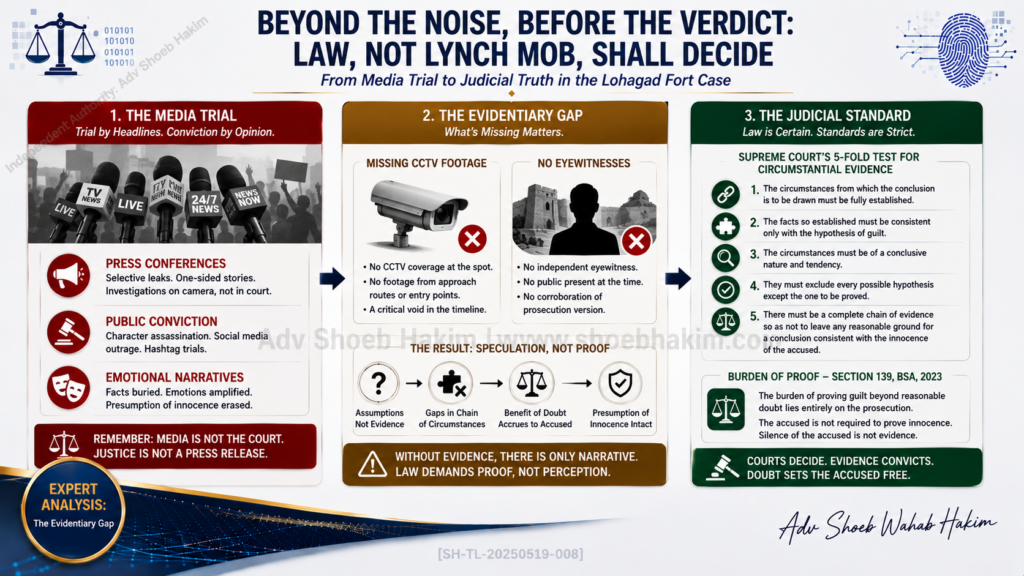
What the Prosecution Does NOT Have
| Missing Evidence | Significance |
|---|---|
| No witness saw either accused push Ketan Agarwal | The act itself is unobserved |
| No CCTV footage captures the alleged act | No visual record of the push |
| No video records the final moments preceding the fall | The crucial event remains unseen |
The single most crucial event in the prosecution’s case remains unseen.
What the Prosecution Has (Circumstantial Evidence)
| Circumstance | Relevance |
|---|---|
| Prior relationship between Siya Goel and Chetan Chaudhary | Motive |
| Alleged presence of Chetan Chaudhary at the fort | Opportunity |
| Volume of calls and messages exchanged between them | Prior communication |
The Unanswered Questions
| Question | Significance |
|---|---|
| If Ketan Agarwal was pushed, who pushed him? | Was it Siya? Chetan? Both acting together? |
| What exactly transpired at the cliff edge? | Was there a confrontation? An argument? A scuffle? |
| Was there an accidental loss of balance? | Could it have been an accident? |
| Is there cogent, reliable, and admissible electronic evidence? | Does the digital trail actually prove planning and execution? |
These are not peripheral details. These are the very questions the prosecution is legally obligated to answer.
The Danger of Pre-Trial Conviction
Equally concerning is the growing trend of investigative agencies conducting press conferences that appear to communicate conclusions before the filing of a charge-sheet.
The distinction that matters:
| Stage | What It Means |
|---|---|
| Investigation | A process, not a verdict |
| Charge-sheet | The formal accusation, not proof |
| Conviction | The only legitimate conclusion |
Until a charge-sheet is filed, investigation is still a process and not a verdict.
What police should say:
- A particular angle is being explored
- Evidence points in a certain direction
- Investigation is ongoing
What police should NOT say:
- The accused is guilty
- The case is solved
- The accused has been convicted
The danger: Once an accused is publicly branded guilty, acquittal often becomes irrelevant in the court of public opinion. Even if exonerated after trial, the stigma survives.
The Presumption of Innocence
The presumption of innocence is not a technicality of criminal law. It is one of its most fundamental safeguards.
| Aspect | Significance |
|---|---|
| Burden of proof | Lies on the prosecution, not the accused |
| Standard of proof | Beyond reasonable doubt |
| Right to silence | The accused does not have to prove innocence |
| Fair trial | The accused is entitled to a fair hearing |
The Supreme Court’s consistent position:
“The presumption of innocence is a human right. It is a fundamental principle of our criminal jurisprudence that the accused is presumed to be innocent till the contrary is proved.”
Media Trial vs. Fair Trial
A media trial may create public satisfaction. Only a fair trial can deliver justice.
| Media Trial | Fair Trial |
|---|---|
| Guided by public opinion | Guided by law and evidence |
| Conclusions reached before evidence | Conclusions reached after evidence |
| Accused convicted in public | Accused acquitted or convicted by court |
| Sensationalises facts | Examines facts objectively |
| Focuses on narrative | Focuses on truth |
The danger of media trial:
- Influences potential witnesses
- Prejudices the court of public opinion
- Creates pressure on investigators
- Denies the accused a fair chance
The Legal Framework
Burden of Proof in Criminal Cases:
Section 101 of the Indian Evidence Act, 1872 (Section 139 of the Bharatiya Sakshya Adhiniyam, 2023) states:
“Whoever desires any Court to give judgment as to any legal right or liability dependent on the existence of facts which he asserts, must prove that those facts exist.”
Standard of Proof:
The prosecution must prove its case beyond reasonable doubt. The benefit of doubt goes to the accused.
Circumstantial Evidence:
In cases relying on circumstantial evidence, the Supreme Court has laid down a five-fold test (Sharad Birdhichand Sarda v. State of Maharashtra, AIR 1984 SC 1622):
| Test | Requirement |
|---|---|
| 1 | The circumstances from which the conclusion is drawn must be fully established |
| 2 | The facts established must be consistent only with the hypothesis of guilt |
| 3 | The circumstances must be of a conclusive nature |
| 4 | They must exclude every possible hypothesis except the one to be proved |
| 5 | There must be a chain of evidence so complete as not to leave any reasonable ground for a conclusion consistent with innocence |
The Principles of Evidence
The prosecution is legally obligated to prove:
| Element | What It Means |
|---|---|
| Motive | Why would the accused commit the crime? |
| Opportunity | Was the accused at the scene? |
| Means | How was the crime committed? |
| Act | What exactly happened? |
| Intent | Was there criminal intent? |
| Conspiracy | Was there an agreement to commit the crime? |
In this case:
- Motive may exist (prior relationship)
- Opportunity may exist (presence at the fort)
- But the act itself remains unobserved
- And the intent is still being established
What Must Happen
For the Investigation:
- Complete the investigation thoroughly
- File a charge-sheet only when there is sufficient evidence
- Present all evidence—both inculpatory and exculpatory
- Allow the court to determine guilt or innocence
For the Media:
- Report facts, not conclusions
- Respect the presumption of innocence
- Allow the judicial process to run its course
- Avoid sensationalising the case
For the Public:
- Remember that the accused is presumed innocent until proven guilty
- Wait for the court’s verdict
- Do not prejudge based on media reports
For the Judiciary:
- Ensure a fair trial
- Base the verdict only on admissible evidence
- Protect the rights of the accused
- Uphold the rule of law
Conclusion
The death of Ketan Agarwal is undoubtedly tragic. No parent should ever have to endure such an irreparable loss.
At the same time, the lawyer in me is equally concerned by the manner in which investigative agencies sometimes present their conclusions before the legal process has run its course. Criminal courts are not concerned with the most compelling narrative; they are concerned with the truth established through evidence.
No witness has reportedly seen either accused push Ketan Agarwal. No CCTV footage captures the alleged act. The single most crucial event in the prosecution’s case remains unseen.
The prosecution relies upon three circumstances: the prior relationship, the alleged presence at the fort, and the volume of calls and messages. Yet none of these circumstances prove murder.
The unanswered questions remain: If Ketan was pushed, who pushed him? What exactly transpired at the cliff edge? Is there cogent electronic evidence to support the prosecution’s theory?
Equally concerning is the growing trend of investigative agencies conducting press conferences that appear to communicate conclusions before the filing of a charge-sheet. Until a charge-sheet is filed, investigation is still a process and not a verdict.
The presumption of innocence is not a technicality of criminal law. It is one of its most fundamental safeguards.
A media trial may create public satisfaction. Only a fair trial can deliver justice.
KNOWLEDGE CHECK QUIZ
Q: In the Ketan Agarwal case, what critical piece of direct evidence is missing from the prosecution’s narrative? Ans: There is absolutely no direct evidence of the crime itself. No eyewitness saw either accused push the victim, and no CCTV footage captured the final moments at the cliff edge.
Q: What is the legal standard of proof required by the prosecution in a criminal trial? Ans: The prosecution must prove the guilt of the accused “Beyond Reasonable Doubt.” If any reasonable doubt exists, the benefit of that doubt must go to the accused.
Q: Under the Supreme Court’s ruling in Sharad Birdhichand Sarda, what is the 5-fold test for circumstantial evidence? Ans: The circumstances must be fully established, consistent only with guilt, conclusive in nature, exclude every other possible hypothesis, and form a complete chain of evidence that leaves no reasonable ground for innocence.
Q: Why is it legally problematic for police to hold press conferences declaring a case “solved” before filing a charge-sheet? Ans: An investigation is a process, not a verdict. Broadcasting conclusions before a trial violates the constitutional presumption of innocence, prejudices the court of public opinion, and denies the accused their right to a fair, unbiased trial.
───
FREQUENTLY ASKED QUESTIONS (FAQ)
Q: If there are thousands of phone calls between the two accused, doesn’t that prove they planned a murder? Ans: No. A high volume of phone calls proves a relationship and communication (which may establish motive), but it does not, in itself, prove a criminal conspiracy to commit murder. The prosecution must still prove the actual execution of the crime and the specific murderous intent.
Q: What is the difference between an Investigation, a Charge-sheet, and a Conviction? Ans: An Investigation is the police gathering facts. A Charge-sheet (Final Report) is the formal document where police officially accuse a person of a crime based on their findings. A Conviction is the final judgment delivered exclusively by a Court of Law after evaluating all evidence during a fair trial.
Q: Can a media trial actually affect the outcome of a court case? Ans: Yes. While judges are trained to rule solely on evidence, severe media trials can influence potential witnesses, create immense political pressure on investigating officers to produce quick (and sometimes flawed) results, and irreparably destroy the reputation of the accused even if they are later acquitted.
Adv. Shoeb Hakim
Criminal Law & Due Process Advisor
📌 Follow me on LinkedIn for daily criminal law and due process insights: https://www.linkedin.com/in/shoebhakim
📌 Visit my website for more articles: https://shoebhakim.com
📌 Visit my website for research fellowship: https://www.legalcomplaince.in
♻️ Share this article with your network.
Disclaimer: This article is for informational purposes only and does not constitute legal advice.
Hashtags: #AdvShoebHakim #KetanAgarwal #SiyaGoel #ChetanChaudhary #PresumptionOfInnocence #FairTrial #CriminalLaw #DueProcess #MediaTrial #Evidence #CircumstantialEvidence #IndianJudiciary #LegalProcess #Investigation #Justice #RuleOfLaw #RightToFairTrial #IndianPenalCode #BNS #BNSS #CriminalProcedure #BurdenOfProof #StandardOfProof #BeyondReasonableDoubt #BenefitOfDoubt #SharadBirdhichandSarda #SupremeCourt #Section101 #IndianEvidenceAct #BharatiyaSakshyaAdhiniyam #Sakshya #Eyewitness #CCTV #ElectronicEvidence #DigitalEvidence #CallRecords #LocationData #Motive #Opportunity #Means #ActusReus #MensRea #Conspiracy #CriminalConspiracy #Abetment #Investigation #ChargeSheet #FinalReport #CognizableOffence #NonCognizableOffence #MediaTrial #PublicTrial #PrejudicialReporting #SubJudice #ContemptOfCourt #IndianConstitution #Article21 #RightToLife #RightToLiberty #PersonalLiberty