Investigation finds 102 High Court judges related to former or sitting judges, another 117 from legal families. Supreme Court: 30% related to former judges, another 30% from legal families.
Introduction
One in every three sitting High Court judges in India is related to a sitting or former judge, or comes from a family of lawyers.
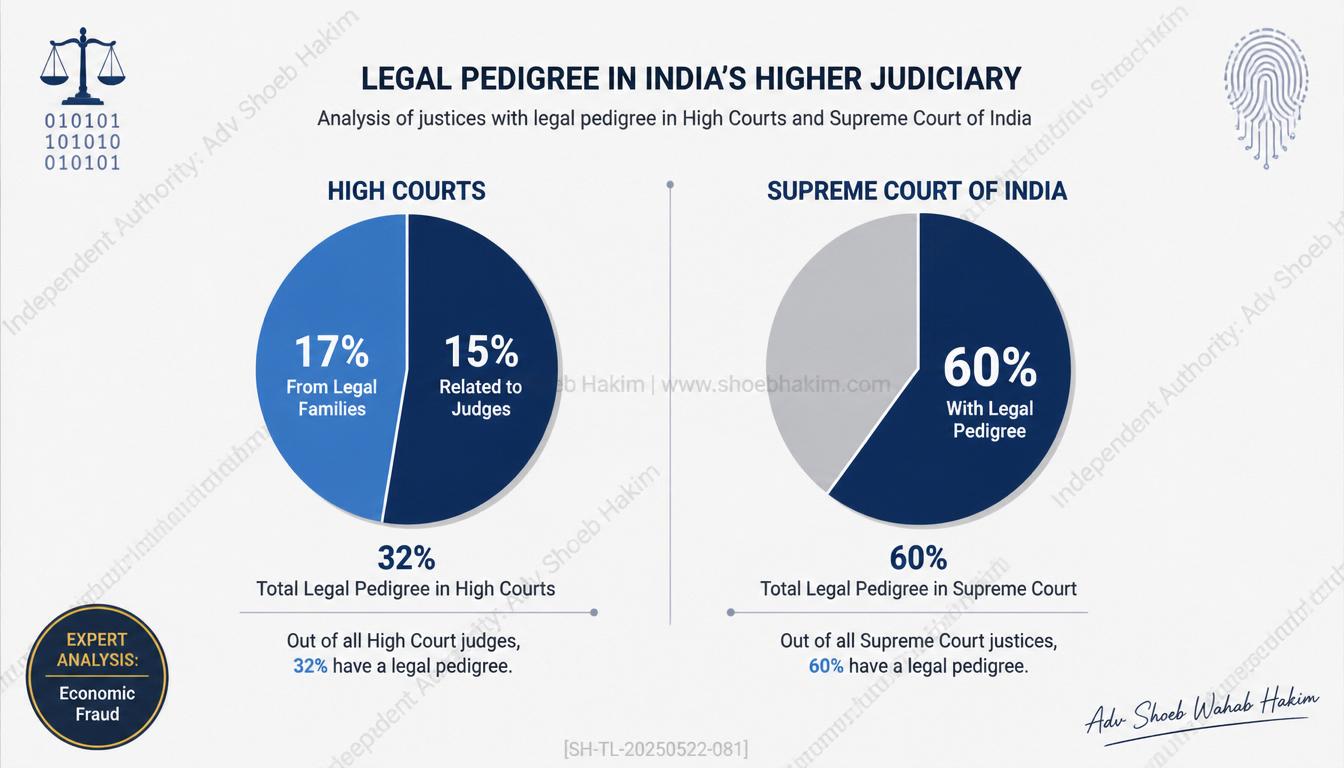
Of the 687 permanent judges of the 25 high courts in India as of 15 March 2025, at least 102 judges are related to former or sitting judges, and another 117 are judges whose fathers, grandfathers, or relatives were members of the legal fraternity.
In the Supreme Court, at least 30 percent of sitting judges are related to former judges, and another 30 percent were second- or third-generation lawyers before their elevation.
This investigation by ThePrint raises fundamental questions about merit, equality, and the appointment process in India’s higher judiciary.
Artcile Inspired by: https://theprint.in/judiciary/legal-pedigree-not-just-entrenched-in-sc-1-in-3-hc-judges-related-to-judges-ex-judges-or-lawyers/2575798/
The Numbers: High Court Judges
| Category | Number | Percentage |
|---|---|---|
| Total permanent High Court judges | 687 | 100% |
| Related to former or sitting judges | 102 | ~15% |
| From legal families (fathers/grandfathers/relatives in law) | 117 | ~17% |
| Total with legal pedigree | 219 | ~32% (1 in 3) |
Source: ThePrint investigation, data as of second week of March 2025, collected from publicly available sources, Supreme Court sources, and respective high courts.
The Numbers: Supreme Court Judges
| Category | Percentage |
|---|---|
| Related to former judges | At least 30% |
| Second- or third-generation lawyers before elevation | Another 30% |
The Historical Context: “Rampant Inbreeding”
Justice K. Chandru, former Madras High Court judge:
“A review of the last 75 years of appointments in the Supreme Court and various high courts will clearly show there was a rampant inbreeding in the positions of power in the higher judiciary notwithstanding the constitutional bar under Article 16(2) where the State had assured no citizen will be discriminated on grounds of descent, caste, religion, race, place of birth or residence.”
“It’s a pity that even after 75 years of the existence of a democratic republic with the promise of equality, still the same situation continues.”
Justice Sanjib Banerjee’s Warning
Justice Sanjib Banerjee, former Chief Justice of Madras High Court and Meghalaya High Court:
Justice Banerjee points out that, traditionally, there have been families where the legal profession has been handed down several generations, particularly in metropolitan cities. He says these numbers are not an anomaly.
But he warns:
“Appointments and elevations should be strictly on merit. Unfortunately, that may not always be the case… When it comes to appointments, I’ve seen in several cases where children of judges have not made too much of a mark in the profession, yet they are singled out.”
His personal experience:
Justice Banerjee says when he was a part of a high court Collegium, he resisted attempts at recommending names of children of former judges for elevation to the bench.
“I succeeded initially but I’ve seen the same names go through after I was out of the Collegium of that high court.”
There were several names that Justice Banerjee says he advocated against for elevation to the Calcutta High Court because he “did not think they were fit enough competence and temperament wise.”
His assessment of the appointment system:
“The appointment system of judges is terrible at the moment.”
His caution:
He warns against dismantling the Collegium system of appointments “till we have something which is better and ensures that the primacy of the judiciary in appointments remains and the independence of the judiciary is not curbed.”
The Constitutional Bar: Article 16(2)
Article 16(2) of the Constitution of India states:
“No citizen shall, on grounds only of religion, race, caste, sex, descent, place of birth, residence or any of them, be ineligible for, or discriminated against in respect of, any employment or office under the State.”
Justice Chandru’s observation that this continues despite the constitutional bar against discrimination on grounds of descent is a serious indictment of the appointment system.
The Two Competing Principles
Principle 1: Legitimate Legal Legacy
There is nothing inherently wrong with children following their parents into the legal profession. Many excellent judges and lawyers come from legal families. Experience, guidance, and exposure can be advantages.
Principle 2: Merit Must Be Paramount
The concern arises when pedigree becomes a substitute for merit. When children of judges are elevated despite not having “made too much of a mark in the profession.” When the appointment system “singles out” individuals based on who their parents are rather than what they have achieved.
The Data Gap: What the Investigation Does Not Tell Us
The investigation quantifies the extent of legal pedigree. It does not quantify:
- How many of these judges are genuinely meritorious (many undoubtedly are)
- How many non-pedigree candidates were equally or more qualified
- How many pedigree candidates were rejected
- The comparative performance of pedigree vs non-pedigree judges
The issue is not the existence of legal families. The issue is whether the appointment system prioritises merit or connections.
The Collegium Debate
Justice Banerjee’s position:
The Collegium system is flawed (“terrible at the moment”), but dismantling it without a better alternative could harm judicial independence.
The counterargument:
If the Collegium cannot ensure merit-based appointments, and if inbreeding continues despite constitutional bars, perhaps the time has come for a transparent, statutory appointment commission.
What Needs to Change
For the Collegium:
- Transparent selection criteria
- Published reasons for appointments
- Disclosure of pedigree relationships
- Independent scrutiny of qualifications
For the Government:
- Participate constructively in judicial appointments
- Do not block meritorious non-pedigree candidates
- Support institutional reforms
For the Legal Profession:
- Speak up when appointments are based on pedigree rather than merit
- Support qualified non-pedigree candidates
- Demand transparency
For the Public:
- The judiciary is a public institution. Its composition matters.
- An unrepresentative judiciary risks losing public confidence.
- Merit-based appointments are essential for trust in the justice system.
The Stakes
The higher judiciary decides:
- Constitutional rights
- Criminal appeals
- Civil disputes
- The fate of citizens
If the appointment system excludes meritorious candidates from non-legal families, the judiciary becomes less representative, less diverse, and potentially less legitimate in the eyes of the public.
Conclusion
One in every three sitting High Court judges in India is related to a sitting or former judge, or comes from a family of lawyers. In the Supreme Court, at least 30% are related to former judges, and another 30% were second- or third-generation lawyers before their elevation.
Former Chief Justice Sanjib Banerjee warns that appointments and elevations should be strictly on merit, but that may not always be the case. He has seen cases where children of judges who have not made too much of a mark in the profession are “singled out.”
Former Madras High Court judge Justice K. Chandru calls it “rampant inbreeding” and says it is a pity that even after 75 years of a democratic republic with the promise of equality, the same situation continues.
The question is not whether legal families exist. They always have. The question is whether the appointment system prioritises merit over pedigree. The evidence suggests that, too often, it does not.
Q: Is it illegal for a judge’s child to become a High Court judge? Ans: No. It is not illegal. Many Legal Pedigree High Court Judges are highly meritorious. The legal and constitutional concern arises when the opaque Collegium system elevates a judge’s child based on their connections (“descent”) rather than their professional merit, potentially violating the spirit of Article 16(2).
Q: What did former judges say about this concentration of legal families? Ans: Former Madras HC Judge K. Chandru called it “rampant inbreeding,” while former Chief Justice Sanjib Banerjee noted that he has personally seen cases where children of judges with mediocre track records were “singled out” for elevation.
Q: If the Collegium system is flawed, why not just abolish it? Ans: The primary fear is that abolishing the Collegium and giving appointment power to the government (the executive branch) could destroy the independence of the judiciary. Systemic improvement requires finding a middle ground: a transparent, merit-based commission that is free from political interference.
What percentage of permanent High Court judges have a legal pedigree (related to judges or lawyers)?
- Ans: Approximately 32% (or 1 in 3).
In the Supreme Court, what total percentage of sitting judges have a legal pedigree?
- Ans: At least 60% (30% related to former judges + 30% from legal families).
Which Article of the Constitution bars discrimination in state employment on the grounds of descent?
- Ans: Article 16(2).
True or False: Justice Sanjib Banerjee advocates for immediately dismantling the Collegium system regardless of whether a better alternative exists.
- Ans: False; he warns against dismantling it until a better system is in place that ensures judicial independence.
Adv. Shoeb Hakim
Judicial Appointments & Constitutional Law Observer
📌 Follow me on LinkedIn for daily legal and constitutional insights: https://www.linkedin.com/in/shoebhakim
📌 Visit my website for more articles: https://www.shoebhakim.com
📌 Visit my website for legal knowledge: https://www.vakilverse.com
📌 Visit my website for research fellowship: https://www.legalcomplaince.in
♻️ Share this article with your network.
Disclaimer: This article is for informational purposes only and does not constitute legal advice.
Hashtags: #Judiciary #HighCourt #SupremeCourt #JudicialAppointments #Collegium #LegalPedigree #MeritOverPedigree #ThePrint #JusticeBanerjee #JusticeChandru #Inbreeding #JudicialIndependence #ConstitutionalLaw #Equality #Article16 #RuleOfLaw #LegalLegacy #JudicialTransparency #MeritInJudiciary #JudicialReform #LawAndSociety #IndianJudiciary #HigherJudiciary #JudgesAppointment #ConstitutionalBar #Democracy #EqualityBeforeLaw #JudicialDiversity #RepresentativeJudiciary #PublicConfidence #MeritVsPedigree #LegalFamilies #SecondGenerationLawyers #ThirdGenerationLawyers #JudicialLegacy #AppointmentSystem #CollegiumSystem #NJAC #JudicialPrimacy #SeparationOfPowers #ChecksAndBalances #ConstitutionalRemedies #WritJurisdiction #FundamentalRights #Article32 #Article226 #AdvShoebHakim