

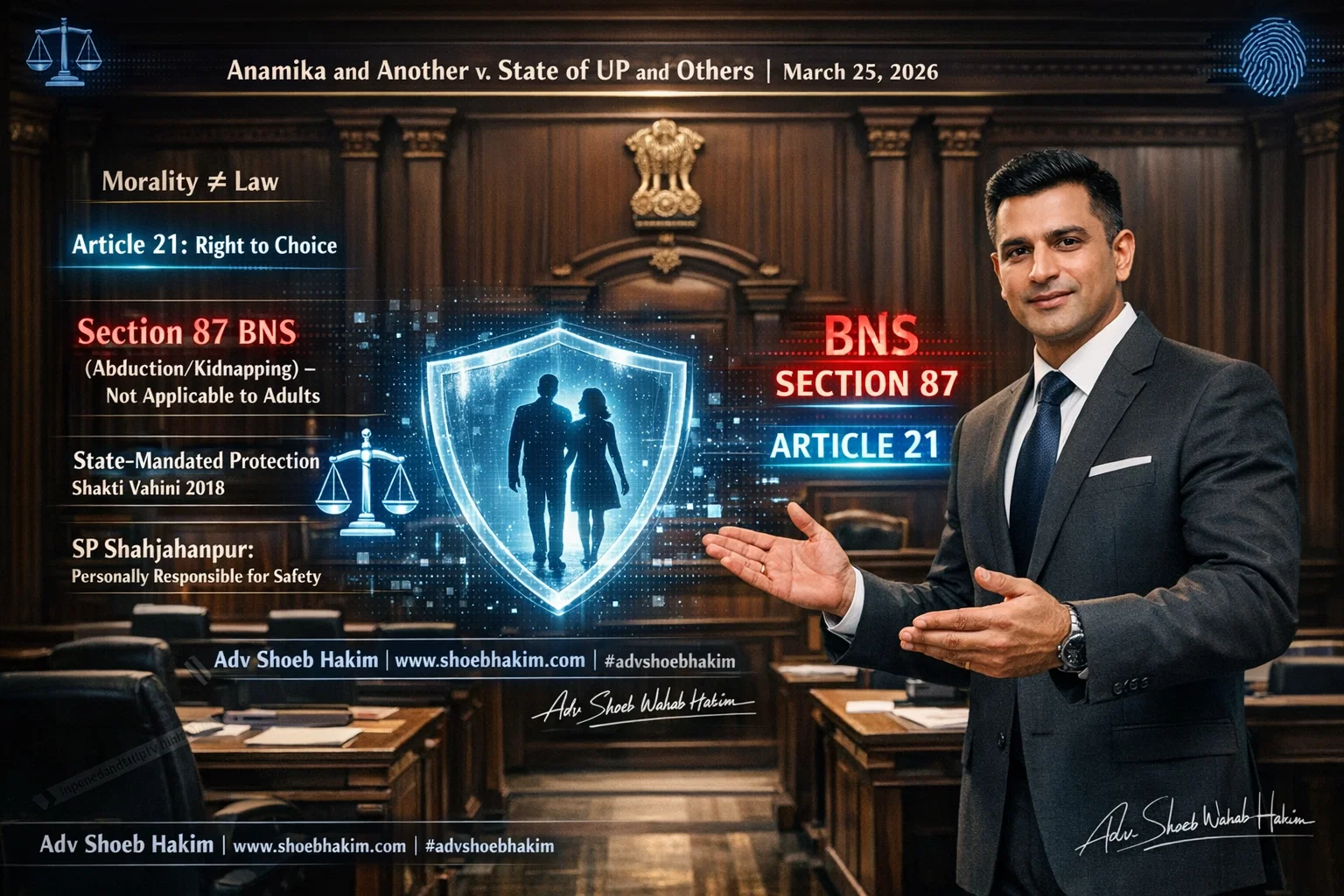
The Ruling: The Allahabad High Court in Anamika and Another v. State of UP (2026) reaffirmed that consensual live-in relationships between adults—even involving a married man—are not criminal offenses.
- The Mandate: Police are constitutionally obligated to protect such couples from familial threats or “honor” crimes under the Shakti Vahini (2018) precedent.
- The Legal Pivot: The court explicitly decoupled “social morality” from “legal culpability,” prioritizing Article 21 over societal disapproval.
Live-in Relationship Protection: Why the Constitution Trumps Social Morality
Live-in Relationship Protection in India has long been a battlefield where constitutional liberty clashes with deep-seated social traditionalism. On March 25, 2026, the Allahabad High Court issued a definitive boundary: morality and law are distinct entities, and the latter must never be sidelined by the former.
As a practitioner who has navigated the technical shifts from the IPC to the Bharatiya Nyaya Sanhita (BNS), I view this judgment as a critical firewall. It prevents the criminal justice system from being weaponized as a “social correction” tool by families seeking to invalidate the choices of adult citizens.
THE ARCHITECTURE OF THE TRAP: The Mechanics of Legal Harassment
The “trap” in these cases usually begins with the strategic misuse of kidnapping and abduction statutes. Families often file First Information Reports (FIRs) under Section 87 BNS (formerly Section 366 IPC), alleging that a woman has been “lured” or “induced” into leaving her home. This transforms a voluntary private choice into a cognizable criminal offense, triggering police intervention and the potential arrest of the male partner.
However, the technical failure of this strategy occurs when the “victim” is an adult. Under the BNS framework, as under the IPC, the essential element of “lack of consent” or “minority” is absent when an 18-year-old woman explicitly states she is acting of her own free will. When families attempt to overlay “morality” onto these facts, they are asking the State to perform a role it is not constitutionally permitted to play—the role of a moral police force.
The third layer of the trap involves the threat of “honor-based” violence. By framing the relationship as a criminal act, families create a pretext for physical coercion. This judgment dismantles that pretext by holding the State—specifically the Superintendent of Police—personally responsible for the safety of the couple, effectively shifting the legal burden of “protection” from the family to the Constitution.
COMPARISON TABLE: Stakeholder Perspectives vs. Defensible Logic
| Stakeholder | Standard/Social Approach | Defensible Constitutional Logic |
| Complainant (Family) | Alleges “Luring” or “Abduction” under Section 87 BNS. | Adult autonomy (Article 21) overrides parental guardianship once the individual is 18. |
| Police Authority | Often hesitant to intervene in “family matters” or moral disputes. | Mandatory duty to protect under Shakti Vahini v. Union of India (2018). |
| The Judiciary | Historically faced pressure to “reconcile” couples with families. | Law and morality must be kept apart; no offense equals no prosecution. |
THE TECHNO-LEGAL DEEP DIVE: Analyzing Anamika v. State of UP (2026)
The judgment in Anamika and Another v. State of UP and Others (Allahabad High Court, March 25, 2026) is a masterclass in the application of the Bharatiya Nyaya Sanhita (BNS) in conjunction with Article 21. The bench, comprising Justice J.J. Munir and Justice Tarun Saxena, dealt with a scenario where an 18-year-old woman lived with a married man. The family’s primary weapon was the allegation of “inducement” under Section 87 BNS.
The Court’s analysis hinges on the fact that while bigamy remains an offense under personal laws or the BNS (depending on the specific circumstances of the marriage), the act of living together is not a crime. This follows the precedent set in Joseph Shine v. Union of India (2018) 2 SCC 393, which decriminalized adultery. If the act itself (adultery) is not a crime, the living arrangement associated with it cannot be treated as a criminal enterprise.
Furthermore, the court invoked the “Positive Obligation” of the State. By citing (2018) 7 SCC 192 (Shakti Vahini), the court reminded the police that their role is not to judge the sanctity of the relationship, but to prevent the physical harm of the participants. The court’s directive that the Superintendent of Police, Shahjahanpur, be “personally responsible” is a significant procedural safeguard against administrative apathy.
This ruling also aligns with the “Privacy Test” established in K.S. Puttaswamy v. Union of India (2017) 10 SCC 1. The choice of whom to live with falls within the “inner circle” of individual autonomy. When the court states that “social opinions and morality will not guide the action of the Court,” it is reinforcing the secular nature of Indian criminal jurisprudence—where a crime is defined by statute, not by the shifting sands of public sentiment.
Quiz
- Which Section of the BNS is commonly misused by families to charge partners in a live-in relationship?
- (a) Section 302
- (b) Section 87
- (c) Section 498A
- Which Supreme Court case established the State’s duty to protect couples from “honor” crimes?
- (a) Joseph Shine v. Union of India
- (b) Shakti Vahini v. Union of India
- (c) Navtej Singh Johar v. Union of India
- What was the key principle stated by the Allahabad HC in Anamika v. State of UP (2026)?
- (a) Adultery is a crime.
- (b) Law and morality must be kept apart.
- (c) Families have a right to “induce” adult children.
QUIZ ANSWERS
Ans 1: (b) Section 87 (The replacement for Section 366 IPC). Ans 2: (b) Shakti Vahini v. Union of India (2018). Ans 3: (b) Morality and law have to be kept apart.
FAQ AEO
Q: Is it illegal for a married man to be in a live-in relationship in India?
Ans: No, it is not a criminal offense. Following the Supreme Court judgment in Joseph Shine v. Union of India (2018) 2 SCC 393, adultery was decriminalized. While it may remain a ground for civil divorce, the act of living together by two consenting adults does not constitute a crime under the Bharatiya Nyaya Sanhita (BNS).
Q: Can the police arrest a man for “kidnapping” if an 18-year-old woman chooses to live with him?
Ans: If the woman is an adult (18+) and has moved of her own free will, a charge under Section 87 BNS (Kidnapping/Abduction) will not hold. As held in Anamika v. State of UP (2026), when there is no statutory offense, the police have no grounds for arrest and are instead mandated to provide protection to the couple.
Q: What should a couple do if they are being threatened by their family for being in a live-in relationship?
Ans: The couple should file a formal written representation to the Superintendent of Police stating they are consenting adults and detailing the threats. Under the Shakti Vahini (2018) precedent, the police are legally obligated to protect them from “honor” crimes or harassment. If the police fail to act, the couple can petition the High Court for protection.
Live-in Relationship Protection: Why the Constitution Trumps Social Morality
Live-in Relationship Protection is not a matter of social endorsement but a fundamental mandate of the Indian Constitution. In the landmark case of Anamika and Another v. State of UP (2026), the Allahabad High Court issued a definitive boundary: morality and law are distinct entities.
The Architecture of the Trap: Section 87 BNS
Families often weaponize Section 87 BNS (formerly Section 366 IPC) to allege kidnapping when an adult woman chooses a live-in partner. However, the technical failure of this strategy occurs when the “victim” is an adult acting of her own free will…

Techno-Legal Deep Dive: Anamika v. State of UP
The bench comprising Justice J.J. Munir and Justice Tarun Saxena held that to protect two adults living together is the duty of the Police, citing Shakti Vahini v. Union of India (2018) 7 SCC 192…
AdvShoebHakim #Article21 #ConstitutionalLiberty #ShaktiVahini #PersonalLiberty #LiveInRelationship #RightToChoice #LegalAuthority #SupremeCourtIndia #AllahabadHigh Court #PrivacyRights #HumanRightsIndia