

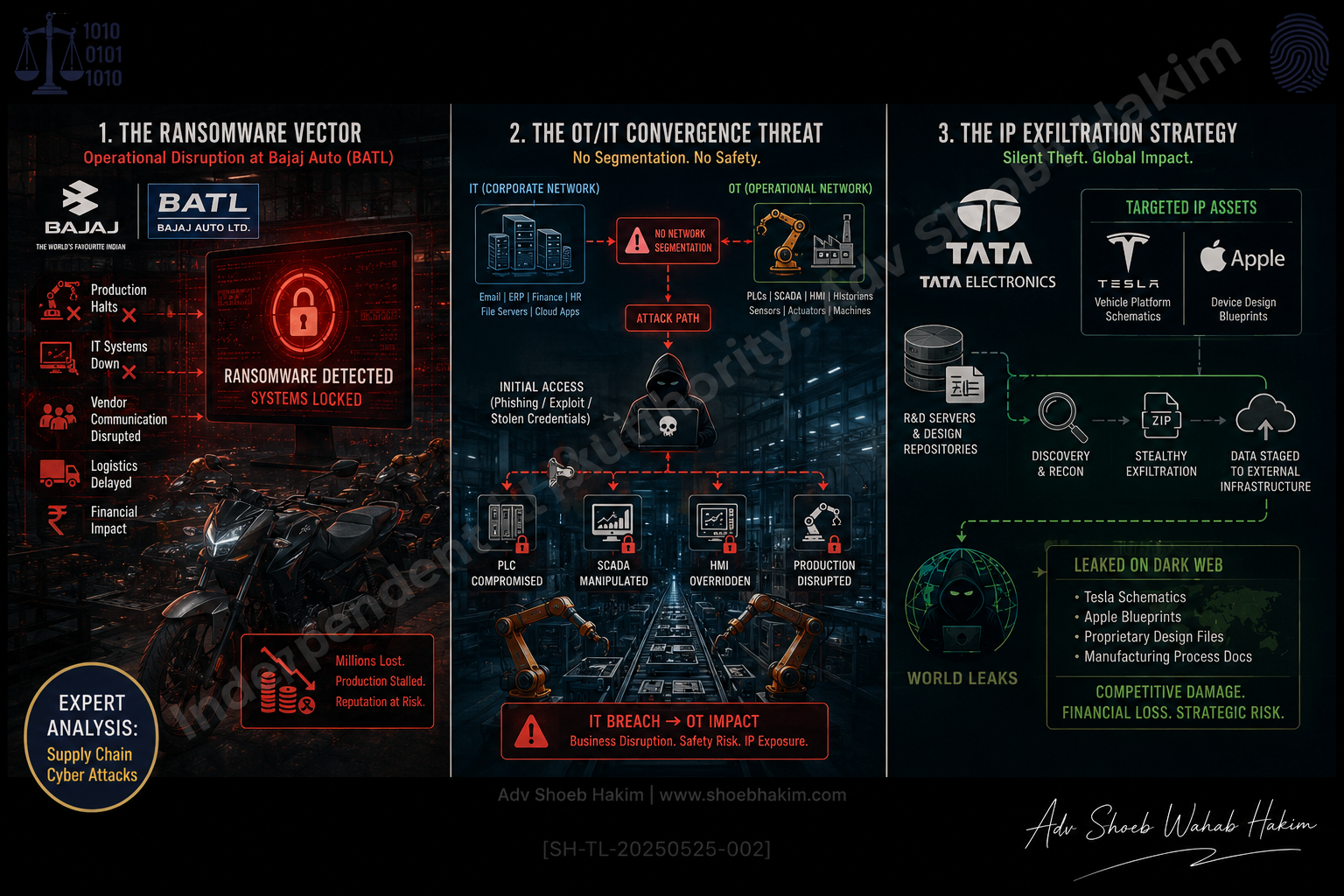
Recent ransomware and data exfiltration attacks on Bajaj Auto and Tata Electronics expose critical vulnerabilities in India’s manufacturing supply chains. This article examines the key lessons for securing modern industrial operations.
Table of Contents
- Introduction: The New Frontier of Cyber Warfare
- The Attacks: Bajaj Auto and Tata Electronics
- Lesson 1: Subsidiaries as Attack Vectors
- Lesson 2: IP Exfiltration Over Disruption
- Lesson 3: Securing Operational Technology (OT)
- Lesson 4: Incident Response and Regulatory Transparency
- The Bigger Picture: India’s Manufacturing Sector Under Threat
- Conclusion: Building Cyber Resilience in Manufacturing
- Frequently Asked Questions (FAQs)
1. Introduction: The New Frontier of Cyber Warfare
Recent ransomware and data exfiltration attacks on Bajaj Auto and Tata Electronics expose critical vulnerabilities in India’s manufacturing supply chains. A ransomware attack hit Bajaj Auto and its engineering subsidiary (BATL), while Tata Electronics faced a silent data exfiltration incident where threat actors accessed sensitive schematics and component designs. These back-to-back breaches offer critical learning lessons for securing complex industrial operations.
Two Indian manufacturing giants. Two back-to-back breaches. The attackers bypassed corporate perimeters through subsidiaries and R&D arms. They stole schematics and design files. They exploited the blurring line between IT and OT. The lesson is clear: modern manufacturing supply chains are the new frontier of cyber warfare.
This article examines the key lessons from these incidents and what they mean for India’s manufacturing sector.
2. The Attacks: Bajaj Auto and Tata Electronics
2.1 Bajaj Auto: Ransomware Attack
| Aspect | Details |
|---|---|
| Company | Bajaj Auto and its engineering subsidiary (BATL) |
| Type | Ransomware attack |
| Target | Manufacturing operations and engineering subsidiary |
| Impact | Disruption to operations |
2.2 Tata Electronics: Data Exfiltration
| Aspect | Details |
|---|---|
| Company | Tata Electronics |
| Type | Silent data exfiltration |
| Target | Sensitive schematics, component designs, intellectual property |
| Actor | World Leaks group |
| Method | Prolonged silent access, stealing mechanical drawings and design files |
2.3 The Pattern
| Factor | Implication |
|---|---|
| Back-to-back incidents | Manufacturing sector is a primary target |
| Different attack vectors | Ransomware and data exfiltration both used |
| IP targeting | Intellectual property is the prize |
| Subsidiary targeting | Attackers bypass main perimeters through subsidiaries |
3. Lesson 1: Subsidiaries as Attack Vectors
3.1 The Problem
Threat actors often bypass robust corporate perimeters by targeting R&D arms, technology subsidiaries, or third-party vendors. These subsidiary networks are often held to lower security standards than core enterprise infrastructure.
In the Bajaj Auto case: The ransomware attack hit both Bajaj Auto and its engineering subsidiary (BATL), indicating that the subsidiary was used as an entry point or was equally compromised.
3.2 The Takeaway
Supply chain and subsidiary networks must be held to the same zero-trust security standards as core enterprise infrastructure.
| Action | Description |
|---|---|
| Zero trust architecture | Never trust, always verify—for all entities |
| Subsidiary security audits | Regular audits of subsidiary security posture |
| Vendor risk management | Third-party and vendor security assessments |
| Network segmentation | Isolate subsidiary networks from core infrastructure |
3.3 Why This Matters
Attackers are increasingly using subsidiaries, partners, and vendors as entry points. The SolarWinds attack, the Kaseya attack, and now the Bajaj Auto attack all follow this pattern.
4. Lesson 2: IP Exfiltration Over Disruption
4.1 The Problem
Instead of deploying ransomware to encrypt factory floors, actors like the World Leaks group used prolonged, silent access to exfiltrate vast amounts of mechanical drawings and design files.
In the Tata Electronics case: Threat actors accessed sensitive schematics and component designs, indicating that intellectual property theft was the primary objective, not operational disruption.
4.2 The Takeaway
Companies must deploy active Data Loss Prevention (DLP) and Network Detection and Response (NDR) tools to catch abnormal, sustained data transfers before data leaks occur.
| Action | Description |
|---|---|
| Data Loss Prevention (DLP) | Monitor and block unauthorized data transfers |
| Network Detection and Response (NDR) | Detect abnormal network traffic patterns |
| User and Entity Behavior Analytics (UEBA) | Identify anomalous user behavior |
| Data classification | Identify and protect sensitive intellectual property |
4.3 Why This Matters
IP theft is often more damaging than ransomware. A ransomware attack disrupts operations. IP theft can destroy competitive advantage permanently. The World Leaks group, like many others, understands this.
5. Lesson 3: Securing Operational Technology (OT)
5.1 The Problem
As factories become increasingly automated, the line between IT networks and physical OT environments blurs, giving attackers direct access to production lines.
OT environments include:
- Industrial control systems (ICS)
- Programmable logic controllers (PLCs)
- Human-machine interfaces (HMIs)
- Manufacturing execution systems (MES)
- Supervisory control and data acquisition (SCADA)
5.2 The Takeaway
Implementing strict network segmentation and continuous monitoring of industrial control systems is mandatory to stop breaches from halting physical manufacturing.
| Action | Description |
|---|---|
| Network segmentation | Separate IT and OT networks |
| OT monitoring | Continuous monitoring of industrial control systems |
| Secure remote access | Restrict and monitor remote access to OT |
| Asset inventory | Maintain complete inventory of all OT assets |
| Patch management | Regular patching of OT vulnerabilities |
5.3 Why This Matters
When OT is compromised, physical manufacturing stops. Production lines halt. Revenue is lost. In critical infrastructure, the consequences can be catastrophic.
6. Lesson 4: Incident Response and Regulatory Transparency
6.1 The Problem
Without standardized protocols, incidents can spiral out of control. Delayed reporting can lead to wider compromise and regulatory penalties.
6.2 The Takeaway
Following standardized protocols (such as notifying CERT-In in India) allows for rapid containment and mitigation. Pre-drafted, drilled incident response playbooks that account for both ransomware mitigation and data breach notifications must be maintained and audited continuously.
| Action | Description |
|---|---|
| Incident response playbook | Pre-drafted, drilled, and audited continuously |
| CERT-In notification | Timely reporting to CERT-In |
| Tabletop exercises | Regular simulation of incidents |
| Cross-functional teams | Legal, IT, PR, and executive involvement |
| Post-incident review | Lessons learned and improvement |
6.3 Why This Matters
Rapid containment requires preparation. Organizations that wait until an incident occurs to develop a response plan are already behind.
7. The Bigger Picture: India’s Manufacturing Sector Under Threat
7.1 The Scale of the Threat
| Factor | Implication |
|---|---|
| Make in India | Increasing digitalization means increasing attack surface |
| Global supply chains | Indian manufacturers are integrated into global supply chains |
| IP theft | India’s manufacturing innovation is a target |
| Critical infrastructure | Manufacturing is critical infrastructure |
7.2 Regulatory Requirements
CERT-In reporting requirements:
- Mandatory reporting of cyber incidents
- Specific timelines for reporting
- Designated CERT-In contact
- Penalties for non-compliance
7.3 Sector-Specific Recommendations
For automotive manufacturing:
- Secure connected vehicles and telematics
- Protect supply chain data
- Implement secure software development lifecycle
For electronics manufacturing:
- Protect schematics and designs
- Secure supply chain for components
- Implement hardware-level security
For all manufacturing:
- Zero trust architecture
- DLP and NDR deployment
- OT security monitoring
- Incident response preparedness
8. Conclusion: Building Cyber Resilience in Manufacturing
The recent cyber incidents involving Bajaj Auto and Tata Electronics highlight the growing vulnerability of modern manufacturing supply chains. A ransomware attack hit Bajaj Auto and its engineering subsidiary (BATL), while Tata Electronics faced a silent data exfiltration incident where threat actors accessed sensitive schematics and component designs.
Four critical lessons:
- Subsidiaries as attack vectors: Threat actors often bypass robust corporate perimeters by targeting R&D arms, technology subsidiaries, or third-party vendors. Supply chain and subsidiary networks must be held to the same zero-trust security standards as core enterprise infrastructure.
- IP exfiltration over disruption: Instead of ransomware to encrypt factory floors, actors like the World Leaks group used prolonged, silent access to exfiltrate vast amounts of mechanical drawings and design files. Companies must deploy active DLP and NDR tools to catch abnormal data transfers.
- Securing OT: As factories become increasingly automated, the line between IT and OT blurs, giving attackers direct access to production lines. Strict network segmentation and continuous monitoring of industrial control systems is mandatory.
- Incident response: Following standardized protocols like notifying CERT-In allows rapid containment and mitigation. Pre-drafted, drilled incident response playbooks must be maintained and audited continuously.
The manufacturing sector is the new frontier of cyber warfare. Organizations that fail to secure their supply chains, protect their intellectual property, and prepare for incidents will find themselves increasingly vulnerable.
9. Frequently Asked Questions (FAQs)
Q1: What happened to Bajaj Auto?
Bajaj Auto suffered a ransomware attack that hit both the parent company and its engineering subsidiary BATL.
Q2: What happened to Tata Electronics?
Tata Electronics faced a silent data exfiltration incident where threat actors accessed sensitive schematics and component designs.
Q3: Who was behind the Tata Electronics attack?
The World Leaks group was reportedly involved in the data exfiltration.
Q4: What is the key lesson about subsidiaries?
Subsidiaries are attack vectors. They must be held to the same zero-trust security standards as core enterprise infrastructure.
Q5: Why is OT security important?
As factories become automated, the line between IT and OT blurs. Compromised OT can halt physical manufacturing.
Q6: What is CERT-In’s role?
CERT-In is India’s national incident response agency. Notifying CERT-In allows rapid containment and mitigation.
Q7: What is the difference between ransomware and data exfiltration?
Ransomware encrypts data to demand payment. Data exfiltration steals data without encryption, often for intellectual property theft.
Q8: What should manufacturing companies do to protect themselves?
Implement zero trust, deploy DLP and NDR, secure OT environments, maintain incident response playbooks, and report incidents promptly.
Q: Is IP theft really worse than a ransomware attack? Ans: In many manufacturing contexts, yes. Ransomware causes immediate financial pain through operational downtime. However, the theft of Intellectual Property (IP)—like proprietary component designs or unreleased product schematics—can permanently destroy a company’s competitive advantage and result in the loss of major global clients.
Q: What is a “Zero Trust Architecture” and how does it prevent supply chain attacks? Ans: Zero Trust is a security model based on the principle of “Never trust, always verify.” It assumes that threats exist both outside and inside the network. Even if an attacker compromises a subsidiary and gains access to the network, Zero Trust prevents them from moving laterally or accessing sensitive data without continuous, cryptographically verified authentication.
Q: How can a company detect silent data exfiltration before the files end up on the dark web? Ans: Companies must deploy Data Loss Prevention (DLP) and Network Detection and Response (NDR) solutions. These tools use AI and behavioral analytics to establish a baseline of “normal” network traffic. If a massive, unusual volume of data suddenly begins transferring to an unknown external server, the system automatically flags and blocks the transfer.
KNOWLEDGE CHECK QUIZ
Q: What were the two distinct types of cyberattacks suffered by Bajaj Auto and Tata Electronics? Ans: Bajaj Auto and its subsidiary suffered a disruptive Ransomware attack designed to halt operations. Tata Electronics suffered a prolonged, silent Data Exfiltration attack resulting in the theft of sensitive schematics and intellectual property.
Q: Why do threat actors frequently target subsidiaries (like Bajaj’s engineering arm, BATL) instead of the main corporate headquarters? Ans: Subsidiaries, R&D arms, and third-party vendors often operate with smaller cybersecurity budgets and less rigorous security protocols than the parent company. Attackers use these weaker subsidiary networks as an undefended “backdoor” to bypass the main corporate perimeter.
Q: What is the primary danger of the “IT/OT Convergence” on modern factory floors? Ans: Operational Technology (OT—the machines that physically build things) used to be disconnected from the internet. Now, it is connected to Information Technology (IT) networks for monitoring. If the networks are not strictly segmented, ransomware that infects a corporate computer can instantly jump to the OT network and paralyze the physical manufacturing lines.
Q: Under Indian regulations, what is the mandatory timeframe for reporting a severe cyber incident (like ransomware or a data breach) to CERT-In? Ans: Entities must report the incident to CERT-In within 6 hours of noticing the breach.
Adv. Shoeb Hakim
Industrial Cyber Security & Supply Chain Advisor
📌 Follow me on LinkedIn for daily industrial cyber security and supply chain insights: https://www.linkedin.com/in/shoebhakim
📌 Visit my website for more articles: https://www.shoebhakim.com
📌 Visit my website for legal knowledge: https://www.vakilverse.com
📌 Visit my website for research fellowship: https://www.legalcomplaince.in
♻️ Share this article with your network.
Disclaimer: This article is for informational purposes only and does not constitute legal advice.
Hashtags: #AdvShoebHakim #Manufacturing #CyberSecurity #SupplyChain #Ransomware #BajajAuto #TataElectronics #OTSecurity #IndustrialCyberSecurity #CERTIn #DataExfiltration #IPTheft #ZeroTrust #DLP #NDR #IncidentResponse #CriticalInfrastructure #MakeInIndia #IndianManufacturing #CyberAttack #DataBreach #IndustrialControlSystems #NetworkSegmentation #ThreatIntelligence #WorldLeaks #CyberResilience #ManufacturingSecurity #SupplyChainSecurity #OperationalTechnology #IndustrialAutomation #ITOTConvergence