The SEC penalized Merrill Lynch $7.5 million for automated compliance problems and systemic failures to file mandatory suspicious activity reports. This enforcement action underscores the critical importance of robust, continuously monitored compliance frameworks.
Table of Contents
- Introduction: The SEC Enforcement Action
- What Happened: Flawed Automated Compliance
- Institutional Failures: Systemic Surveillance Blind Spots
- Regulatory Repercussions: The $7.5 Million Penalty
- Suspicious Activity Typologies for Brokerage Oversight
- Why This Matters for Financial Institutions
- Lessons for India: SEBI and the Indian Context
- The Future of Automated Compliance
- Conclusion: Compliance is a Continuous Process
- Frequently Asked Questions (FAQs)
1. Introduction: The SEC Enforcement Action
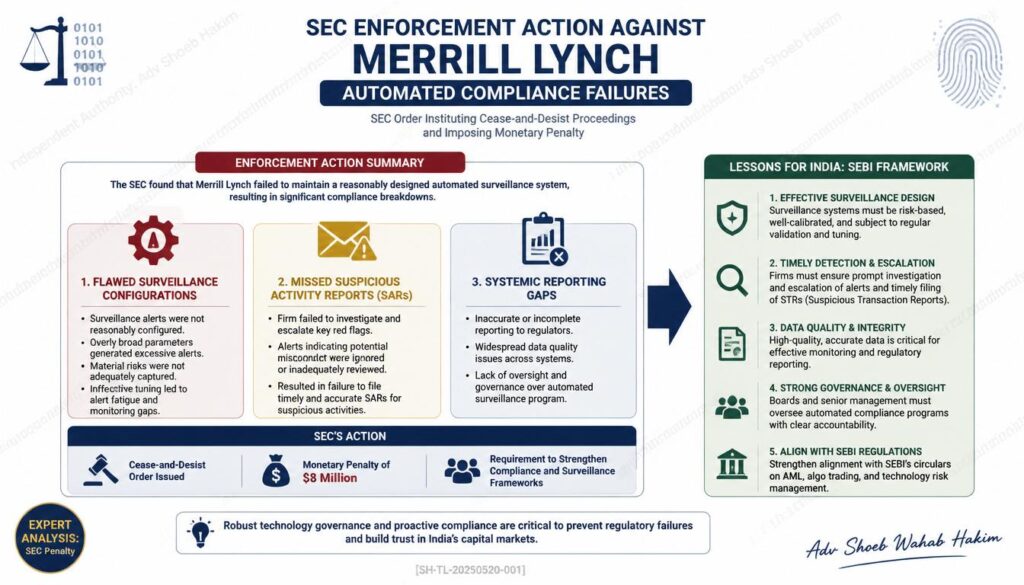
The Securities and Exchange Commission (SEC) has penalized Merrill Lynch $7.5 million for automated compliance problems and systemic failures to file mandatory reports on suspicious financial activities. The regulatory action emerged after investigations revealed that the broker-dealer failed to appropriately monitor and report transactions over a multi-year period.
By relying on a flawed configuration within its automated surveillance structures, the organization overlooked numerous transactions that required federal disclosure. This significant enforcement action underscores the critical necessity for financial institutions to maintain robust and uncompromised review mechanisms.
This article examines the Merrill Lynch case, its implications for financial institutions, and what it means for compliance professionals in India.
2. What Happened: Flawed Automated Compliance
2.1 The Failure
Merrill Lynch relied on a flawed configuration within its automated surveillance structures. The result was multi-year blind spots in suspicious activity monitoring.
| Aspect | Details |
|---|---|
| Fine | $7.5 million |
| Regulator | SEC |
| Issue | Automated compliance failures |
| Duration | Multi-year period |
| Impact | Missed suspicious activity reports |
| Cause | Flawed surveillance configuration |
2.2 The Mechanism
The automated surveillance systems were supposed to flag suspicious transactions. However, due to flawed configuration:
- Transactions requiring federal disclosure were overlooked
- Known gaps in surveillance thresholds were ignored
- Alerts were not properly escalated
- Systemic blind spots persisted
2.3 The Root Cause
The enforcement action highlighted a common compliance failure: automation is not a set-it-and-forget-it solution. Systems must be continuously tested, updated, and monitored.
3. Institutional Failures: Systemic Surveillance Blind Spots
3.1 The Systemic Failure
The Merrill Lynch case is not an isolated incident. It is part of a pattern where financial institutions fail to:
- Properly configure automated surveillance systems
- Escalate known gaps and unresolved alerts
- Test compliance frameworks regularly
- Adapt to emerging threats
3.2 The Consequences
| Consequence | Impact |
|---|---|
| Regulatory penalty | $7.5 million fine |
| Reputational damage | Loss of trust |
| Enhanced compliance requirements | Additional oversight |
| Operational disruption | Increased compliance costs |
3.3 The Pattern
Financial institutions often treat compliance automation as a one-time implementation. However, regulatory expectations require:
- Continuous testing of automated systems
- Regular updates to surveillance parameters
- Escalation of known gaps
- Ongoing training of compliance teams
4. Regulatory Repercussions: The $7.5 Million Penalty
4.1 The SEC’s Position
The SEC made clear that compliance automation does not absolve financial institutions of responsibility. The agency expects:
- Robust surveillance systems
- Proper configuration of automated tools
- Escalation of known gaps
- Timely filing of suspicious activity reports
4.2 The Penalty
| Aspect | Details |
|---|---|
| Amount | $7.5 million |
| Regulator | SEC |
| Basis | Automated compliance failures |
| Duration | Multi-year period |
| Impact | Missed suspicious activity reports |
4.3 The Message
The enforcement action sends a clear message to financial institutions:
- Automation is not a substitute for human oversight
- Known gaps must be addressed
- Compliance is a continuous process
- Regulatory enforcement is increasing
5. Suspicious Activity Typologies for Brokerage Oversight
5.1 Common Suspicious Activity Indicators
| Typology | Description |
|---|---|
| Layering | Complex transactions to obscure origin |
| Structuring | Breaking transactions to avoid reporting thresholds |
| Micro-layering | Small transactions across multiple accounts |
| Trade-based laundering | Manipulating trade prices |
| Cross-border movements | Rapid movement across jurisdictions |
5.2 Automated Surveillance Gaps
| Gap | Impact |
|---|---|
| Flawed configuration | Missed suspicious transactions |
| Inadequate thresholds | Failure to detect structuring |
| Limited monitoring | Blind spots in cross-border activity |
| No real-time alerts | Delayed detection |
6. Why This Matters for Financial Institutions
6.1 The Importance of Automated Compliance
Automated compliance systems are essential for managing the volume and complexity of financial transactions. However, they are not a substitute for human oversight.
Key requirements:
- Proper configuration: Systems must be correctly configured
- Regular testing: Systems must be continuously tested
- Escalation: Known gaps must be addressed
- Human oversight: Automated systems require human supervision
6.2 The Cost of Failure
| Cost | Impact |
|---|---|
| Regulatory penalty | Financial loss |
| Reputational damage | Loss of trust |
| Enhanced compliance | Increased costs |
| Operational disruption | Business impact |
7. Lessons for India: SEBI and the Indian Context
7.1 India’s Regulatory Framework
| Aspect | India’s Framework |
|---|---|
| Capital markets regulator | SEBI |
| AML regulator | FIU-IND |
| Broker-dealer oversight | SEBI (LODR, intermediaries) |
| Suspicious reporting | FIU-IND under PMLA |
| Surveillance systems | SEBI’s integrated surveillance |
7.2 SEBI’s Enforcement Actions
SEBI has been increasing enforcement on compliance failures:
- LODR violations: Penalties for non-compliance
- Intermediary oversight: Enhanced scrutiny
- Surveillance failures: Penalties for systemic gaps
- Suspicious reporting: Enhanced requirements
7.3 Key Takeaways for Indian Institutions
| Lesson | Application to India |
|---|---|
| Robust surveillance | Ensure proper configuration of automated systems |
| Continuous testing | Regularly test compliance frameworks |
| Escalation | Address known gaps promptly |
| Human oversight | Maintain human supervision of automated systems |
| Regulatory awareness | Stay updated on SEBI and FIU-IND requirements |
7.4 India’s Automated Compliance Landscape
Indian financial institutions are increasingly adopting automated compliance systems. However, the Merrill Lynch case offers important lessons:
- Configuration matters: Automated systems must be correctly configured
- Testing is essential: Systems must be continuously tested
- Gaps must be addressed: Known gaps cannot be ignored
- Human oversight is critical: Automation is not a substitute
8. The Future of Automated Compliance
8.1 Emerging Trends
| Trend | Description |
|---|---|
| AI and machine learning | Enhanced detection of suspicious patterns |
| Real-time monitoring | Continuous surveillance |
| Predictive analytics | Proactive detection |
| Integration | Cross-system surveillance |
8.2 Best Practices
- Regular testing: Continuously test automated systems
- Human oversight: Maintain human supervision
- Escalation: Address known gaps promptly
- Training: Regularly train compliance teams
9. Conclusion: Compliance is a Continuous Process
The SEC’s $7.5 million penalty against Merrill Lynch is a reminder that compliance automation is not a set-it-and-forget-it solution. Financial institutions must continuously test, update, and monitor their surveillance systems.
Key takeaways:
- Automation is not infallible – Systems must be continuously tested
- Known gaps cannot be ignored – Unresolved alerts create compliance risk
- Regulatory scrutiny is increasing – Enforcement actions are growing
- Compliance is a continuous process – Not a set-it-and-forget-it solution
For Indian financial institutions, the lessons are clear:
- SEBI is increasing enforcement on compliance failures
- Surveillance systems must be robust and continuously reviewed
- Suspicious transaction reporting under PMLA requires vigilance
- Indian institutions can learn from global enforcement actions
Compliance automation is not a set-it-and-forget-it solution. Financial institutions must continuously test, update, and monitor their surveillance systems.
10. Frequently Asked Questions (FAQs)
Q1: Why did the SEC penalize Merrill Lynch?
Merrill Lynch was penalized $7.5 million for automated compliance failures and systemic gaps in suspicious activity reporting.
Q2: What were the key compliance failures?
Flawed surveillance configuration, multi-year blind spots, and failure to escalate known gaps.
Q3: What does this mean for Indian financial institutions?
Indian institutions must ensure robust automated surveillance systems, continuous testing, and prompt escalation of known gaps.
Q4: What is SEBI’s role in compliance oversight?
SEBI regulates capital markets and intermediaries in India, ensuring compliance with LODR and other regulations.
Q5: How can financial institutions prevent similar failures?
Regular testing of automated systems, human oversight, prompt escalation of gaps, and continuous training of compliance teams.
Q: If we bought our compliance software from a top-tier global vendor, aren’t they liable if it fails to catch a suspicious transaction? Ans: No. Regulators hold the financial institution strictly liable, not the software vendor. It is the legal responsibility of the broker-dealer’s compliance officers to ensure the software is correctly configured for their specific business model and continuously tested for effectiveness.
Q: What should an institution do if they discover their software has been missing illicit transactions for the last three years? Ans: The institution must immediately engage legal counsel and execute a “Lookback Audit” to manually identify all the missed transactions. Crucially, they should proactively and voluntarily disclose the software failure and the missed reports to the regulator (like FIU-IND or the SEC) before the regulator discovers it during an inspection. Hiding the failure guarantees maximum penalties.
Q: How will AI and Machine Learning change automated compliance? Ans: AI will upgrade legacy, rule-based systems (which only flag transactions over a specific dollar amount) to behavioral systems that can identify complex, previously unseen patterns of fraud in real-time. However, even with AI, human oversight remains critical to investigate the context behind the AI-generated alerts and make the final legal determination on whether to file a report.
KNOWLEDGE CHECK QUIZ
Q: For what specific reason did the SEC penalize Merrill Lynch $7.5 million? Ans: The SEC penalized Merrill Lynch for multi-year, systemic failures in its automated compliance systems, which were flawed and misconfigured, leading to the firm failing to file mandatory Suspicious Activity Reports (SARs).
Q: What is the “set-it-and-forget-it” trap in automated compliance? Ans: It is the dangerous cognitive bias where financial institutions install compliance software and assume it will flawlessly catch all illicit activity forever, without requiring continuous human oversight, regular testing, or algorithm updates to match evolving criminal tactics.
Q: How does this SEC enforcement action directly impact Indian financial institutions? Ans: It serves as a stark warning that Indian regulators (like SEBI and FIU-IND) will not accept “software glitches” as an excuse for failing to report suspicious transactions under the PMLA. Indian institutions must proactively audit their automated systems to avoid severe penalties.
Q: What is “Structuring” in the context of financial crime typologies? Ans: Structuring (also known as smurfing) is the practice of breaking down a massive, illicit financial transaction into numerous smaller transactions to purposely avoid triggering the automated reporting thresholds (e.g., breaking a $100,000 transfer into eleven $9,000 transfers).
Adv. Shoeb Hakim
Compliance & Financial Crime Advisor
📌 Follow me on LinkedIn for daily compliance and financial crime insights: https://www.linkedin.com/in/shoebhakim
📌 Visit my website for more articles: https://shoebhakim.com
📌 Visit my website for legal knowledge: https://www.vakilverse.com
📌 Visit my website for research fellowship: https://www.legalcomplaince.in
♻️ Share this article with your network.
Disclaimer: This article is for informational purposes only and does not constitute legal advice.
Hashtags: #AdvShoebHakim #SEC #MerrillLynch #Compliance #AutomatedCompliance #AML #SuspiciousActivityReport #FinancialCrime #BrokerDealer #Surveillance #RegulatoryEnforcement #SEBI #IndiaCompliance #LODR #PMLA #FIUIND #AutomatedSurveillance #ComplianceFramework #BrokerageOversight #FinancialInstitutions #RiskManagement #RegulatoryCompliance #CapitalMarkets #SecuritiesRegulation #EnforcementAction #ComplianceGap #SurveillanceThreshold #SuspiciousTransaction #MoneyLaundering #TerroristFinancing #TradeBasedLaundering #Layering #Structuring #CrossBorderTransactions