
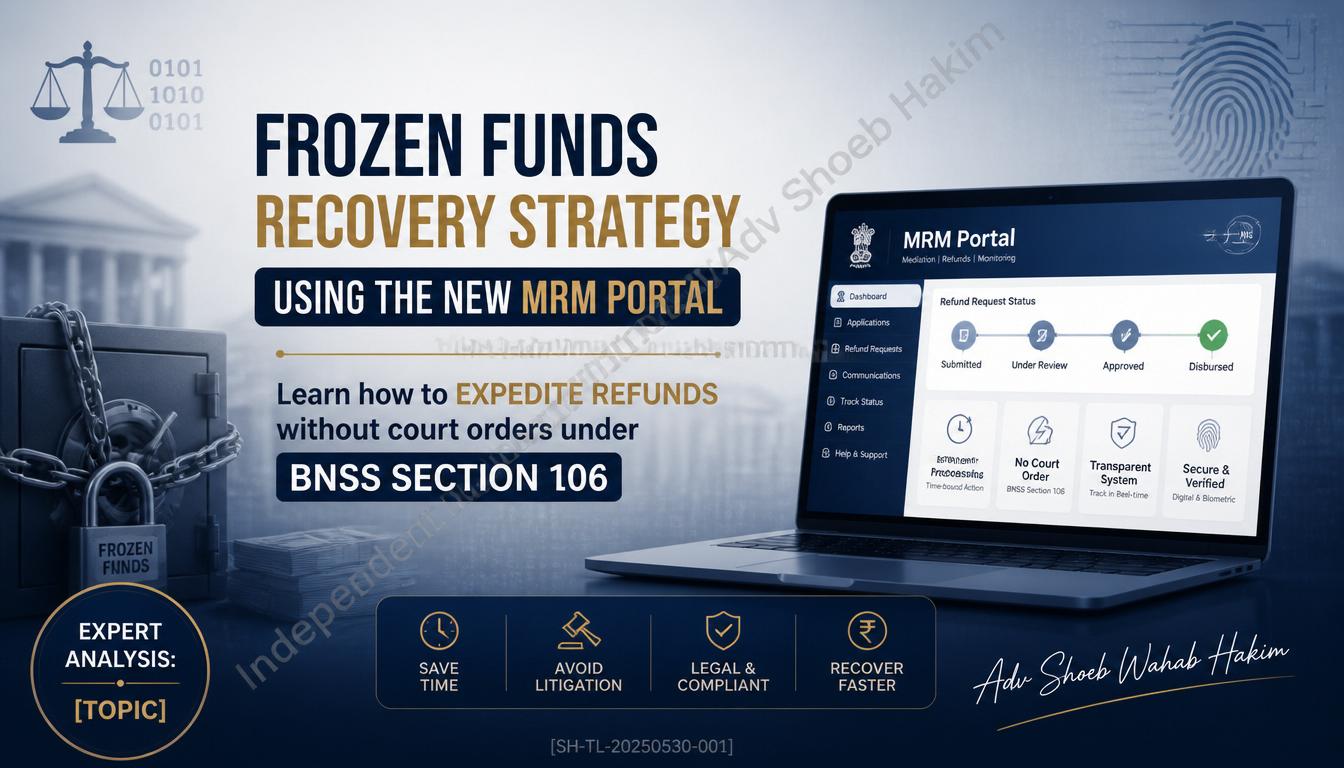
The Ministry of Home Affairs (I4C) launches online portal for direct refund of money frozen in scammer accounts.
Introduction
Your money is frozen in a scammer’s bank account. The bank says they cannot release it without a court order. The court process takes months. You are told to wait.
The Ministry of Home Affairs just changed that.
Cybercrime victims will no longer need to visit court or banks to recover their frozen funds. The Ministry of Home Affairs (I4C) has officially launched the new “Money Restoration Module” (MRM) under the National Cyber Crime Reporting Portal (NCRP). Citizens can now file their refund requests directly from the comfort of their homes.
This article explains the eligibility criteria, category-based refund rules, and the step-by-step online application process.
Key Eligibility and Legal Guidelines
What you need to use MRM:
| Requirement | Details |
|---|---|
| Complaint registration | Must be registered immediately via 1930 Helpline or NCRP portal |
| Acknowledgement Number | Must possess a 14-digit Registered Acknowledgement Number |
| Status of funds | Money must be successfully ‘Held’ (Frozen) in scammer’s bank account |
Important limitation:
This portal cannot process refunds if the criminals have already withdrawn or siphoned off the cash from the bank accounts. Timely reporting is critical.
Categorized Rules for Fund Refund
To ensure total transparency, the refund process is divided into three distinct legal categories based on the frozen amount.
Category 1 (Up to ₹50,000 frozen in a single bank account):
If the held amount is up to ₹50,000 in one bank account, NO FIR or Court Order is required. The money will be refunded directly based on the Police Report/Indemnity Bond via the MRM portal.
Category 2 (Total amount exceeds ₹50,000, but less than ₹50,000 per individual bank account):
If the total frozen amount is more than ₹50,000 but distributed across different bank accounts (and does not exceed ₹50,000 in any single bank account), NO FIR or Court Order is required. A swift refund will be processed based on the police report.
Category 3 (More than ₹50,000 frozen in a single bank account):
If the held amount exceeds ₹50,000 in a single bank account, lodging an FIR (First Information Report) is mandatory under the rules. Once the FIR is registered, the entire remaining legal refund process will be completed through this MRM portal.
Summary Table of Categories
| Category | Amount Condition | FIR Required | Court Order Required | Refund Basis |
|---|---|---|---|---|
| Category 1 | Up to ₹50,000 in single account | No | No | Police Report/Indemnity Bond |
| Category 2 | Total >₹50,000 but <₹50,000 per account | No | No | Police report |
| Category 3 | >₹50,000 in single account | Yes | No | FIR + MRM portal |
Online Application Process (5 Simple Steps)
Step 1: Visit the official portal
Go to: mrm-ncrp.mha.gov.in
Step 2: Citizen Login
Click on ‘Citizen Login’ and log in using the mobile number registered in your original NCRP complaint via OTP.
Step 3: Raise Refund Request
Go to ‘Raise Refund Request’, enter your 14-digit Complaint ID, and verify it with the OTP. The frozen amount will automatically display on the screen.
Step 4: Upload Documents
Upload your PAN Card and enter the Bank Account Number and IFSC Code of the bank account where you wish to receive the refund.
Step 5: Submit and Save
Tick the declaration checkbox and click Submit. Save the Unique Request ID (MR2026…) generated to track your application status.
Legal Action by Police
After the victim submits the request, the designated police team will upload the required Indemnity Bond/Notice on the portal as per the legal provisions of Section 106(3) BNSS.
Following this, the concerned bank will restore the funds directly to the victim’s bank account.
What to Do If You Are a Victim of Cyber Fraud
Immediate steps:
- Call 1930 immediately – The sooner you report, the higher the chance of freezing the funds
- Register complaint on cybercrime.gov.in – Get your 14-digit Registered Acknowledgement Number
- Check if funds are frozen – MRM only works if money is still in the scammer’s account
- File MRM application – Follow the 5-step online process
- For Category 3 cases – Lodge FIR, then complete refund process via MRM portal
Why This Reform Matters
| Before MRM | After MRM |
|---|---|
| Victims had to visit courts | No court visit required |
| Victims had to visit banks | No bank visit required |
| Refund required court order | Court order not required (Categories 1 & 2) |
| Process took months | Process takes days/weeks |
| Victims often gave up | Easy online process encourages claims |
Limitations of MRM
MRM is a game-changer, but it has limitations:
- Only works if funds are frozen – If scammers withdrew the money, MRM cannot help
- Requires timely reporting – Delay in reporting reduces chance of freezing funds
- Category 3 still requires FIR – Not fully court-free for larger amounts
- PAN card required – Victims without PAN may face difficulties
- Bank account required – Refund must go to an Indian bank account
The Legal Framework: Section 106(3) BNSS
The MRM operates under Section 106(3) of the Bharatiya Nagarik Suraksha Sanhita (BNSS), 2023. This provision allows for the restoration of frozen property to the victim without waiting for trial completion, subject to certain conditions.
Key features of Section 106(3) BNSS:
- Police can restore frozen property to the victim
- Indemnity bond required from the victim
- No court order required for restoration up to specified limits
- Full trial continues against the accused separately
Practical Tips for Victims
Do’s:
- Report immediately – Call 1930 within minutes of fraud
- Keep your 14-digit Acknowledgement Number safe
- Ensure your mobile number is active (OTP required)
- Have your PAN card ready
- Have your bank account details ready
Don’ts:
- Do not delay reporting – funds may be withdrawn
- Do not ignore the complaint tracking number
- Do not share OTP with anyone
- Do not pay anyone for “recovery services”
Conclusion
The Ministry of Home Affairs (I4C) has officially launched the new “Money Restoration Module” (MRM) under the National Cyber Crime Reporting Portal (NCRP). Citizens can now file their refund requests directly from the comfort of their homes.
Key eligibility: complaint registered immediately via 1930 Helpline or NCRP portal, valid 14-digit Acknowledgement Number, and money successfully ‘Held’ (Frozen) in scammer’s account.
Category 1 (up to ₹50,000 in single account): No FIR, no court order. Category 2 (total >₹50,000 but <₹50,000 per account): No FIR, no court order. Category 3 (>₹50,000 in single account): FIR mandatory, then refund via MRM.
The online process takes 5 simple steps. Police upload indemnity bond under Section 106(3) BNSS. Bank restores funds directly to victim.
In case of cyber fraud, immediately call 1930 or report at cybercrime.gov.in. The sooner you report, the higher the chance of freezing funds and recovering your money.
Q: Do I need to hire a lawyer or visit a court to get my frozen money back using the MRM portal? Ans: No. The primary purpose of the Money Restoration Module is to bypass the court system. For amounts up to ₹50,000, you do not even need an FIR. You can file the refund request directly from your home via the official portal (mrm-ncrp.mha.gov.in) using your 14-digit Complaint ID.
Q: Will the MRM help me if the scammers have already transferred or withdrawn my money? Ans: Unfortunately, no. The MRM operates strictly on the principle of recovery from frozen accounts. If you delay reporting and the criminals siphon the cash out of the banking system before the 1930 cyber cell can execute a freeze, the portal cannot process a refund. Immediate reporting is absolutely critical.
Q: I have more than ₹50,000 frozen in a single scammer’s account. Can I still use the MRM portal? Ans: Yes, but the process falls under Category 3. Because the amount exceeds ₹50,000 in a single account, the law mandates that an FIR (First Information Report) must be formally registered first. Once the police file the FIR, the rest of the refund procedure will be completed digitally through the MRM portal.
What is the foundational mandatory requirement for a victim to utilize the Money Restoration Module (MRM)?
- Ans: They must possess a 14-digit Registered Acknowledgement Number obtained by immediately reporting the fraud via the 1930 Helpline or the NCRP portal.
Under Category 1 rules, what legal documentation is explicitly NOT required to process a refund for an amount up to ₹50,000?
- Ans: No FIR or Court Order is required.
Which specific section of the Bharatiya Nagarik Suraksha Sanhita (BNSS) legally underpins the MRM’s ability to restore frozen property without a trial?
- Ans: Section 106(3) of the BNSS.
What is the critical limitation regarding the status of the stolen funds for the MRM portal to function successfully?
- Ans: The stolen money must be successfully ‘Held’ or frozen in the scammer’s bank account; the portal cannot process refunds if the cash has already been withdrawn.
Adv. Shoeb Hakim
Cybercrime & Banking Fraud Advisor
📌 Follow me on LinkedIn for daily cybercrime and banking fraud insights: https://www.linkedin.com/in/shoebhakim
📌 Visit my website for more articles: https://www.shoebhakim.com
📌 Visit my website for legal knowledge: https://www.vakilverse.com
📌 Visit my website for research fellowship: https://www.legalcomplaince.in
♻️ Share this article with your network.
Disclaimer: This article is for informational purposes only and does not constitute legal advice.
Hashtags: #AdvShoebHakim #Cybercrime #MoneyRestorationModule #MRM #NCRP #I4C #1930Helpline #CyberFraud #BankingFraud #OnlineFraud #Scam #VictimSupport #FundRefund #NoCourtVisit #NoBankVisit #DigitalIndia #CyberSafety #MinistryOfHomeAffairs #BNSS #Section106 #IndemnityBond #PoliceReport #FIR #BankAccountFreeze #FraudRecovery #MoneyRecovery #CyberComplaint #OnlineComplaint #14DigitNumber #AcknowledgementNumber #PANCard #BankDetails #OTPVerification #UniqueRequestID #LegalGuidelines #EligibilityCriteria #Category1 #Category2 #Category3 #TimelyReporting #Call1930 #CybercrimeGovIn #MRMPortal #mrm-ncrp.mha.gov.in #HomeMinistry #I4CIndia #CyberAwareness #FinancialFraud #UPIFraud #PaymentFraud #DigitalPaymentFraud #ImmediateReporting #FrozenFunds #SiphonedFunds #WithdrawnFunds #BankLiability #PoliceLiability #VictimRights #ConsumerProtection #BankingOmbudsman #RBI #NPCI #BHIM #UPI #PhonePe #GooglePay #Paytm #AmazonPay #Cred #FamilyPay #Mobikwik #FreeCharge #AirtelPaymentsBank #JioPay #SBI #HDFC #ICICI #AxisBank #PNB #BOB #CanaraBank #UnionBank #YesBank #IDFCFirstBank #Kotak #IndusInd #RBLBank #FederalBank #SouthIndianBank #KarurVysyaBank #CityUnionBank #DhanlaxmiBank #TamilnadMercantileBank #LakshmiVilasBank #CSBBank #IndianBank #BankOfIndia #CentralBank #UCOBank #VijayaBank #CorporationBank #AndhraBank #AllahabadBank #SyndicateBank #OrientalBank #UnitedBank #PunjabAndSindBank #JammuAndKashmirBank #HDFCBank #ICICIBank #AxisBank #SBIBank #PNBBank #BOBBank #CanaraBank #UnionBank #YesBank #IDFCFirstBank #KotakMahindraBank #IndusIndBank #RBLBank #FederalBank #SouthIndianBank #KarurVysyaBank #CityUnionBank #DhanlaxmiBank #TamilnadMercantileBank #LakshmiVilasBank #CSBBank #IndianBank #BankOfIndia #CentralBank #UCOBank #VijayaBank #CorporationBank #AndhraBank #AllahabadBank #SyndicateBank #OrientalBank #UnitedBank #PunjabAndSindBank #JammuAndKashmirBank
Leave a Reply