
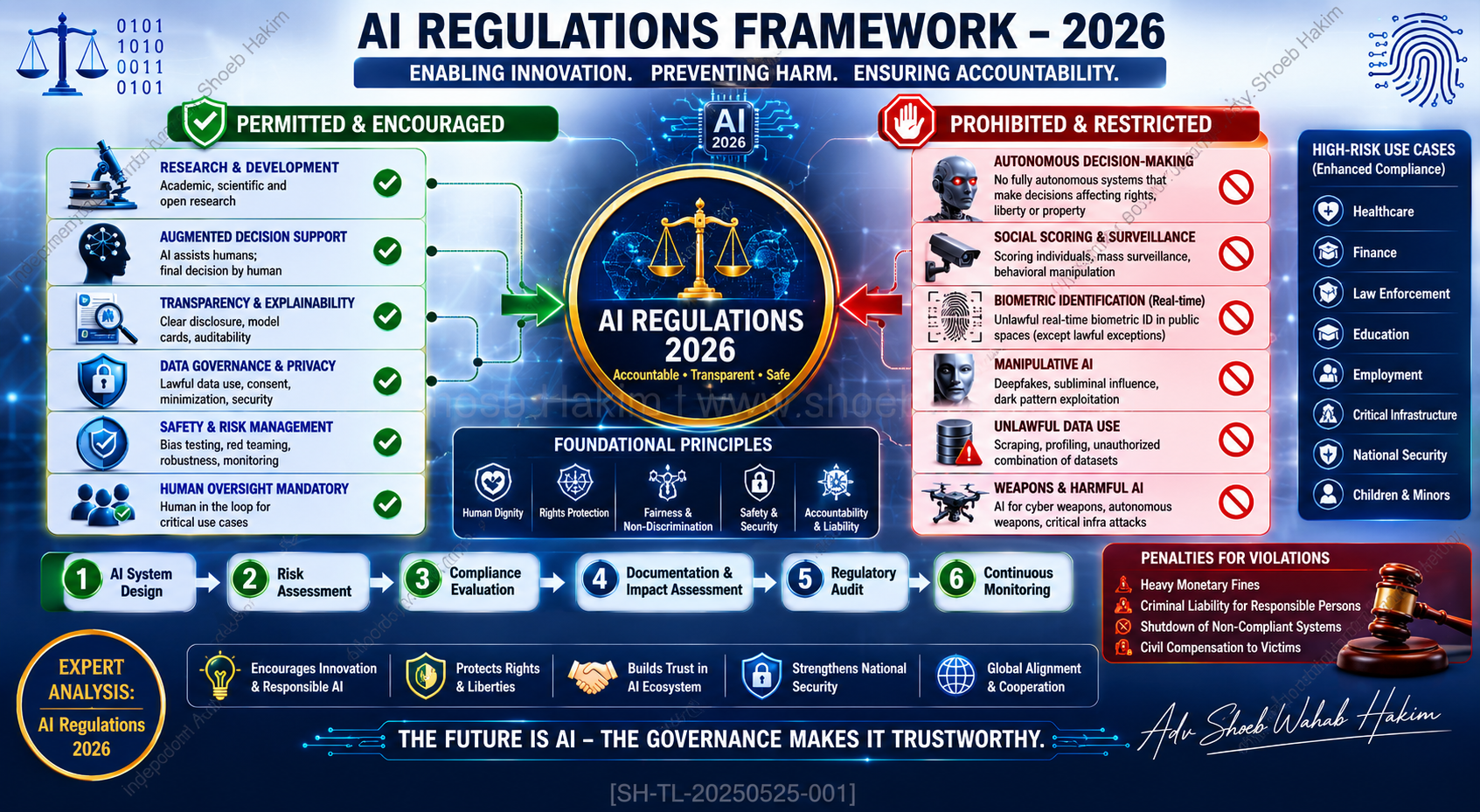
AI permitted for research and drafting. Strictly prohibited for judicial decision-making. Human oversight mandatory.
Introduction
A lawyer uses AI to draft a brief. The AI invents six fake cases. Fake citations. Fake quotes. Fake docket numbers. The judge cannot find them. The lawyer is fined. The client’s case is compromised.
This happened in the United States. The Supreme Court of India just proposed regulations to ensure it does not happen here.
The Supreme Court of India has unveiled the “Regulations for Use of Artificial Intelligence in Courts, 2026” – a historic draft framework governing AI adoption across all courts and tribunals. While it legalizes AI for legal research and drafting, it mandates human oversight to prevent unauthorized, biased, or “black-box” decision-making.
This article analyzes the draft regulations, permitted and prohibited uses, compliance requirements, global comparisons, and practical implications for legal professionals.
What AI Is Permitted (With Human Oversight)
| Use Case | Description |
|---|---|
| Research & Analysis | Legal research, precedent retrieval, citation verification, summarizing complex pleadings or judgments |
| Administrative Duties | Automating scheduling, case management, and record management |
| Transcription & Translation | Real-time automated transcripts of court proceedings; translating legal documents between English and vernacular languages |
What AI Is Strictly Prohibited
| Prohibited Use | Why |
|---|---|
| Judicial Decision-Making | Final determinations on case outcomes, sentencing, or bail eligibility |
| Profiling & Risk Scoring | Assessing flight risks, predicting recidivism, evaluating witness credibility |
| Surveillance | Monitoring judges, advocates, or litigants via opaque algorithmic systems |
Key Compliance Requirements
1. Mandatory Disclosure
Lawyers and litigants must formally declare if they have used AI tools when preparing or submitting documents.
2. Verification Against Hallucination
Because AI models are prone to making up false information (hallucinations), all generated outputs must be rigorously verified before being used in formal judicial proceedings.
3. Human Primacy
Anchored in the principle of human oversight, AI is restricted to being an assistive tool and cannot substitute the independent judgment of a judge.
Inside the AI Toolkit: SUPACE and Beyond
The Indian judiciary is already using several AI tools. The new regulations are largely designed to formalize the use of these existing technologies.
SUPACE (Supreme Court Portal for Assistance in Court Efficiency):
- Acts as a “second brain” for judges
- Reads massive case files to extract relevant facts, laws, and precedents in seconds
- Key Limitation: Purely assistive – deliberately programmed not to suggest a decision or outcome
- Current Status: Deployed experimentally for criminal matters in the Bombay and Delhi High Courts
SUVAS (Supreme Court Vidhik Anuvaad Software):
- AI translation engine trained to translate judicial documents between English and vernacular Indian languages
TERES:
- Sophisticated tool for real-time transcription of oral arguments
- Used during major Constitution Bench hearings to create immediate written record
Global Comparison: India vs. United States
| Feature | India (Proposed Model) | United States (Current Reality) |
|---|---|---|
| Regulation Style | Centralized – one uniform set of rules for all courts | Decentralized – individual judges issue unique standing orders |
| Disclosure | Mandatory – lawyers must declare AI use | Varies – over 300 different rules exist |
| Sanctions | Proposed – lawyers liable for AI errors | Active – lawyers already sanctioned (fined) for AI-written briefs with fake citations |
Common ground: Both jurisdictions are aggressively fighting “hallucinations” (AI making up facts).
Global AI Hallucinations That Terrified Courts
The Mata v. Avianca Disaster (USA):
In a personal injury case, lawyers used an AI chatbot to conduct legal research. The chatbot invented six entirely fake judicial precedents, complete with fabricated quotes and non-existent docket numbers. The deception was exposed when opposing counsel and the judge could not find the cases in any legal database. The attorneys were publicly reprimanded and heavily fined.
The Michael Cohen Case (USA):
Former attorney Michael Cohen unwittingly provided his legal counsel with fake case citations generated by an AI tool. These fabricated citations were subsequently included in an official court filing requesting an early end to his supervised release, triggering a federal inquiry.
The Fake Exculpatory Evidence Case (UK):
A defense barrister presented a summary of international case laws to prove a client’s innocence. The prosecution discovered that the AI had mixed up real case names with completely fictional legal principles, nearly derailing the trial.
How to Check Your Legal Drafts for AI Errors
To comply with strict verification standards, legal professionals must use a systematic, multi-step validation protocol:
1. Reverse-Lookup Every Citation
Copy every reporter volume, page number, and party name directly into verified databases like SCC Online, Manupatra, Westlaw, or LexisNexis to confirm they exist.
2. Cross-Check Internal Document Coherence
Check definitions, defined terms, and cross-references. AI tools frequently lose “context window” memory in long documents.
3. Isolate and Audit Rationale
Verify that regulatory acts or statutory amendments cited were actually in effect during the timeline of the dispute. AI models frequently hallucinate active dates.
4. Deploy AI-Detection Tools
Run drafts through specialized legal tech tools designed to flag boilerplate language and inconsistent formatting typical of generative models.
The “30% Rule” for AI Oversight
The 30% Rule is an industry governance framework and workflow heuristic widely adopted to safely balance automation with human accountability.
70% Machine Workload:
AI is delegated to handle roughly 70% of the volume-heavy, repetitive, and data-intensive preparatory tasks – searching thousands of pages of discovery documents or pulling initial templates.
30% Human Core:
Humans must strictly retain the remaining 30% of the workflow – critical judgment, ethical reasoning, final quality control, and strategic decision-making.
The “Human-in-the-Loop” Mandate:
If human interaction drops below 30%, it triggers a red flag for algorithmic vulnerability, liability exposure, and regulatory non-compliance.
How to Submit Feedback on the Draft Regulations
The Supreme Court has opened a direct channel for public consultation. You do not need to be a lawyer to submit suggestions.
Email Address: [email protected]
Addressed To: Member Secretary, AI Committee, Supreme Court of India
Subject Line Recommendation: “Comments on Draft AI Regulations 2026”
Submission Deadline: June 20, 2026
Conclusion
The Supreme Court of India has unveiled the “Regulations for Use of Artificial Intelligence in Courts, 2026” – a historic draft framework governing AI adoption across all courts and tribunals.
AI is permitted for research, analysis, transcription, translation, and administrative duties – but only with human oversight.
AI is strictly prohibited for judicial decision-making, profiling, risk scoring, and surveillance.
Lawyers must declare AI use. Every citation must be verified. The human lawyer is fully accountable for every word filed.
The public consultation is open until June 20, 2026. Submit your feedback to [email protected]
The journey has just begun. But the framework is clear: AI is a tool, not a judge. The final word belongs to humans.
Q: Are Indian judges going to be replaced by Artificial Intelligence under the 2026 regulations? Ans: Absolutely not. The Supreme Court AI Regulations explicitly and strictly prohibit the use of AI for any form of judicial decision-making, sentencing, or bail determinations. AI is legally restricted to being an assistive tool for research and administrative tasks, ensuring human primacy is never compromised.
Q: What happens if a lawyer submits an AI-generated document with fake case laws? Ans: Submitting hallucinated or fake citations is a severe professional and legal violation. Lawyers face public reprimands, heavy financial sanctions, and potential prosecution under the Bharatiya Nyaya Sanhita (BNS) for introducing forged electronic records and attempting to deceive a constitutional court.
Q: What is the SUPACE tool mentioned in the Supreme Court guidelines? Ans: SUPACE (Supreme Court Portal for Assistance in Court Efficiency) is an indigenous AI tool developed for the Indian judiciary. It acts as an advanced research assistant that reads massive case files to quickly extract relevant facts and precedents, dramatically reducing the administrative burden on judges while deliberately refraining from suggesting outcomes.
Under the Supreme Court’s draft 2026 regulations, for which of the following tasks is AI strictly prohibited?
- Ans: Judicial decision-making and predictive risk scoring for bail eligibility.
What is the primary function of the indigenous AI tool known as SUVAS?
- Ans: It serves as a translation engine trained to translate judicial documents between English and vernacular Indian languages.
How did the attorneys in the foreign Mata v. Avianca case violate legal ethics using AI?
- Ans: They utilized an AI chatbot for legal research which invented six entirely fake judicial precedents, which they then submitted to the court without verification.
What is the core principle of the “30% Rule” in AI governance for law firms?
- Ans: While AI can handle 70% of data-intensive preparatory work, humans must strictly retain the remaining 30% for critical judgment, ethical reasoning, and final quality control.
Adv. Shoeb Hakim
AI Governance & Legal Technology Advisor
📌 Follow me on LinkedIn for daily AI governance and legal technology insights: https://www.linkedin.com/in/shoebhakim
📌 Visit my website for more articles: https://www.shoebhakim.com
📌 Visit my website for legal knowledge: https://www.vakilverse.com
📌 Visit my website for research fellowship: https://www.legalcomplaince.in
♻️ Share this article with your network.
Disclaimer: This article is for informational purposes only and does not constitute legal advice.
Hashtags: #AdvShoebHakim #SupremeCourt #AIRegulations #AIinCourts #LegalTech #SUPACE #SUVAS #TERES #LegalResearch #AIGovernance #JudicialReform #HumanOversight #NoBlackBox #AIHallucination #CitationVerification #LegalEthics #FutureOfLaw #IndiaJudiciary #DraftRegulations2026 #PublicConsultation #officeRegccSciNicIn #30PercentRule #HumanInTheLoop #GenerativeAI #LLM #ChatGPT #Gemini #Claude #LegalDrafting #CaseManagement #TranscriptionAI #TranslationAI #VernacularLanguages #DigitalCourts #ECourts #JusticeDelivery #AccessToJustice #AIRegulation #TechPolicy #LegalTechIndia #AICompliance #MalpracticeInsurance #LiabilityCoverage #ProfessionalNegligence #DataPrivacy #Cybersecurity #ClientConfidentiality #AttorneyClientPrivilege #EthicalBilling #LegalEthicsIndia #BarCouncilOfIndia #LawyerResponsibility #JudicialIndependence
Leave a Reply