

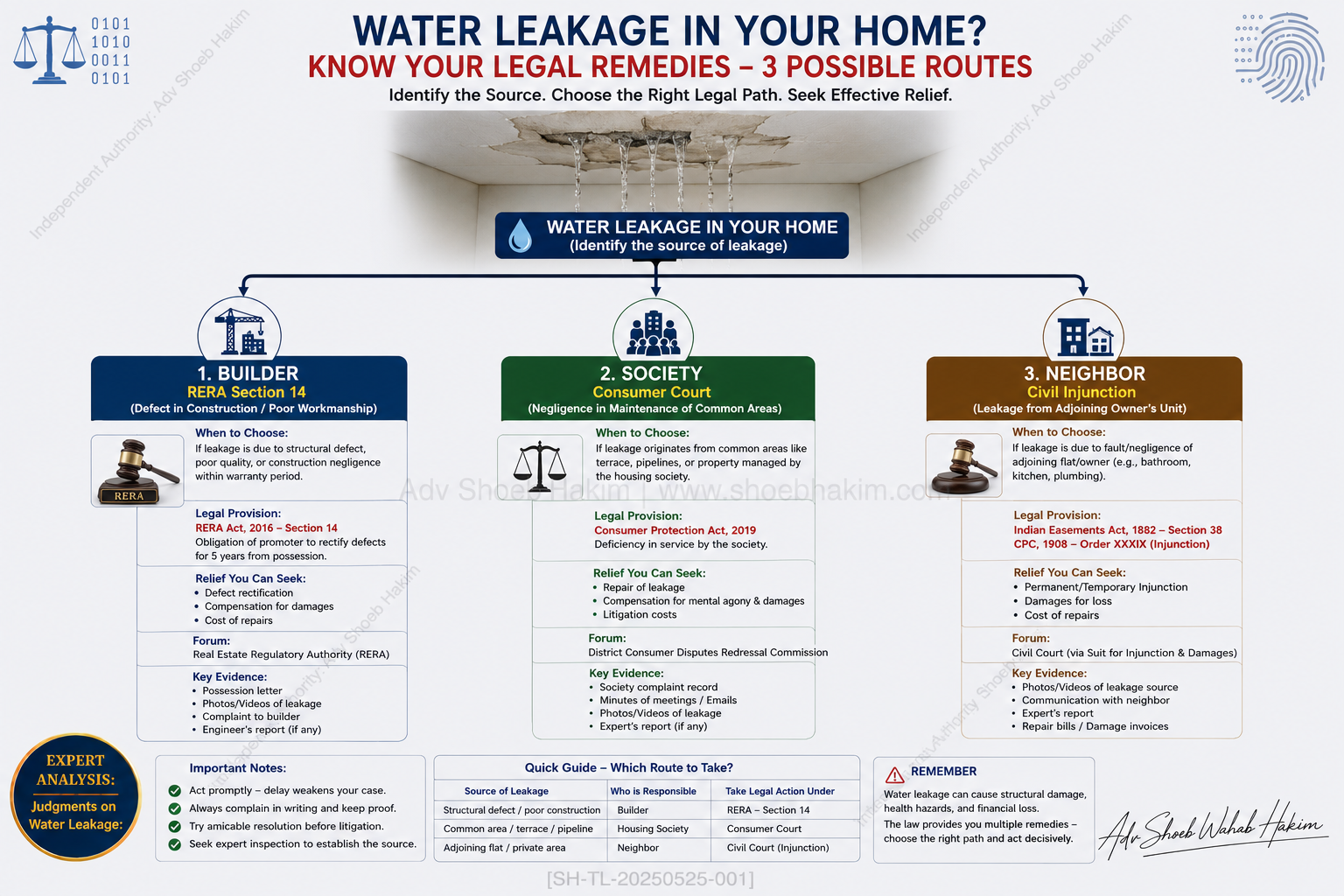
Damp patches, black mold, damaged woodwork. Who is responsible? The builder, the society, or the neighbor? The courts have answered.
Introduction
Owning a home is a lifetime achievement. That dream can quickly turn into a nightmare when damp patches appear on the ceiling. Water leakage is not just an aesthetic nuisance; it is a structural hazard that causes mold, health issues, and mental agony.
One of the most common questions Indian homeowners ask is: “Who is responsible for fixing the leak?”
- Is it the builder who used poor materials?
- The housing society that ignores terrace repairs?
- Or the neighbor upstairs whose bathroom is leaking?
Recent judgments from the National Consumer Disputes Redressal Commission (NCDRC), upheld by the Supreme Court, have laid down clear law on this issue. This article provides a guide to your rights based on actual case laws.
Part 1: Builder Liability (New Flats)
If you have purchased a property recently (typically within the last 5 years), the law is heavily on your side. Builders often try to evade responsibility by claiming that the buyer caused the leak during interior work.
The Leading Case: M/s. Merridian Promoters Pvt Ltd vs. Harish Narayan Raghani & Dinesh Narayan Raghani (2012)
The Facts:
- Complainants purchased a flat (GF-2) in November 2005 for ₹35 Lakh
- In June-July 2007, they noticed seepage in the master bedroom’s bathroom, which the builder initially rectified
- The problem resurfaced in December 2008, affecting the kitchen walls on all four sides and damaging the woodwork
- The builder refused to fix it the second time, alleging that the seepage was caused by “internal works” carried out by the buyers
- The buyers hired a Chartered Engineer (Soham Consultants), who assessed the damage at approximately ₹92,195 and noted that rectifying it would require breaking the walls due to internal plumbing issues
The Verdict:
The NCDRC dismissed the builder’s defense. The Commission observed that the builder failed to provide any specific reason or explanation as to how the internal work by the buyers caused the damage. The Court relied heavily on the independent expert’s report, which confirmed that the dampness was not the buyers’ fault.
The Ruling:
The NCDRC upheld the State Commission’s order, holding the builder liable for “deficiency in service.” The builder was directed to:
- Pay ₹1 lakh towards rectification of defects, with interest of 9% per annum from the date of the District Forum’s order
- Pay ₹25,000 as compensation for the mental agony and harassment suffered by the homebuyers
Key Takeaway for Homeowners: If a builder blames your “internal work” for leakage without specific evidence, the courts will not accept that defense. An independent engineer’s report is powerful evidence.
Part 2: Society Liability (Terrace and External Walls)
In older buildings, the dispute often shifts to the Cooperative Housing Society (CHS). Many societies refuse to repair top-floor terraces, claiming “lack of funds,” “old building issues,” or blaming the top-floor owner.
The Leading Case: B-1 Devadig Co-Op. Housing Society Ltd vs. N.V. Deshpande (2017)
The Facts:
- Mr. N.V. Deshpande, a senior citizen (88 years old), owned Flat No. 609, located directly below the building’s terrace
- He suffered tremendous loss to his household articles due to continuous water leakage from the terrace
- Despite repeated requests, the Society refused to undertake repairs, arguing that since the building was around 30 years old, it was “beyond their control” to stop the leakage
- The Society also claimed the member had made permanent changes to the flat
- Mr. Deshpande was forced to repair the leakage at his own cost and sued the Society for deficiency in service
The Verdict:
The State Commission and NCDRC ruled in favor of the member. They held that the terrace is a common amenity, and maintaining it is the exclusive responsibility of the Society. The Society’s argument about the building’s age was rejected as an invalid excuse for negligence. The Court also noted that the Society had “deliberately disobeyed” orders to harass a helpless senior citizen.
The Ruling:
The Society was held guilty of deficiency in service and ordered to:
- Carry out immediate waterproofing/repairs of the terrace to restore it to good condition
- Pay ₹50,000 as compensation for the loss and mental agony, plus ₹10,000 as costs of litigation
- Pay an additional ₹25,000 as costs for filing a frivolous appeal to delay the payment
Key Takeaway for Homeowners: The terrace is a common area. The Society cannot use “old building” as an excuse for negligence. Courts will hold Societies accountable for failure to maintain common areas.
Part 3: Neighbor Liability (Leakage from Upper Floors)
In established housing societies, the dispute is often not with a builder or the society but with an uncooperative neighbor living on the floor above.
The Leading Case: Reshma Bombaywala-Lezinska vs. Nadeem Oomerbhoy (Bombay High Court, 2018)
The Facts:
- The petitioner, Reshma Bombaywala (a former model), lived on the 2nd floor of a building in South Mumbai
- She suffered from severe water leakage originating from the flat above her, owned by Nadeem Oomerbhoy
- The leakage was so severe that it caused the false ceiling to collapse and created an unhygienic atmosphere with black mold
- Despite repeated requests and a notice from the Municipal Corporation (BMC), the neighbor refused to allow access to his flat for repairs, denying the source of the leak
The Legal Stand:
Since this was a dispute between two private owners, it fell under the Law of Torts (Nuisance). The petitioner argued that the neighbor’s negligence was violating her “Right to Life” (Article 21) by denying her a safe and hygienic living environment.
The Verdict & Outcome:
The Bombay High Court took a stern view of the neighbor’s refusal to cooperate. The Court observed that “unless members of the society cooperate… it will be difficult to reside peacefully.”
The Ruling:
- The Court ordered the upper-floor neighbor to allow immediate inspection by an engineer/architect appointed by the Society
- The Court made it clear that if the neighbor continued to be uncooperative, the Society was entitled to take appropriate legal steps to force entry and repairs
Key Takeaway for Homeowners: If a neighbor refuses to fix a leak, they are creating a “Private Nuisance.” You can approach the Civil Court or High Court for a Mandatory Injunction – a court order forcing the neighbor to allow repairs.
Summary of Legal Routes
| Responsible Party | Source of Leakage | Who to Sue | Where to File | Legal Basis |
|---|---|---|---|---|
| Builder | Construction defect (new flat, typically <5 years) | Builder/Developer | Consumer Court (NCDRC) or RERA Authority | Deficiency of service; violation of RERA Section 14(3) |
| Housing Society | Terrace, external walls, rainwater pipes | Cooperative Housing Society | Consumer Court or Cooperative Court | Deficiency of service (failure to maintain common areas) |
| Neighbor | Upper floor bathroom, kitchen, internal pipes | Flat owner of the floor above | Civil Court or Cooperative Court | Law of Torts (private nuisance and negligence) |
Practical Steps for Homeowners
If you are a victim of water leakage, follow this legal roadmap:
Step 1: Document Evidence
- Take photos and videos of the dampness
- If possible, get a report from a civil engineer or architect pinpointing the source (as done in the Merridian Promoters case)
Step 2: Send a Legal Notice
- Before going to court, have a lawyer send a formal notice to the responsible party (Builder, Society, or Neighbor)
Step 3: File a Complaint
- Against Builder/Society: File in the Consumer Court (inexpensive and faster)
- Against Neighbor: Approach the Cooperative Court or Civil Court
Step 4: Don’t Hesitate
- Passive waiting does not repair concrete; it only allows structural damage to spread and repair costs to multiply
- The legal system exists specifically to break deadlock when mutual understanding fails
Frequently Asked Questions
Q1. Who is responsible for water leakage from the upper floor flat?
The flat owner of the floor above is responsible. If they refuse to cooperate, they are creating a “private nuisance” and can be taken to court.
Q2. Can I stop paying maintenance charges if the Society refuses to fix the leakage?
No. Withholding maintenance charges is not legally advisable. You must continue paying while simultaneously pursuing legal remedy against the Society.
Q3. Is the builder responsible for leakage after possession?
Yes, typically for structural defects within 5 years of possession. The RERA Act, Section 14(3), explicitly holds builders liable for structural defects for 5 years.
Q4. Can I file a police complaint against my neighbor for water leakage?
Generally, no. Water leakage is a civil dispute, not a criminal matter. You must approach the Civil Court, Cooperative Court, or Consumer Court.
Q5. What legal action can I take if my neighbor refuses to allow a plumber to enter their flat?
Approach the Civil Court or Cooperative Court for a Mandatory Injunction – a court order forcing the neighbor to allow entry and repairs.
Conclusion
Water leakage is not just an aesthetic nuisance. It is a structural hazard that causes mold, health issues, and mental agony.
The courts have spoken. Builders cannot escape by blaming internal work. Societies cannot hide behind “old building” excuses. Neighbors cannot refuse to cooperate.
Document evidence. Send a legal notice. File a complaint. The law is on your side.
Stop hesitating. Prioritize your property’s safety. Take that first, firm step to enforce your rights..
Q: Who is legally responsible for water leakage originating from the apartment directly above mine? Ans: The owner of the upper-floor flat is legally responsible. If they refuse to fix the internal plumbing issue, they are creating a “private nuisance.” You can approach a Civil Court or Cooperative Court to secure a Water Leakage Mandatory Injunction, which legally forces them to allow entry for repairs.
Q: Can the builder charge me for fixing structural leakage in a new apartment? Ans: No. Under Section 14(3) of the RERA Act, 2016, the builder is mandated to rectify any structural defects or poor workmanship (including water leakage) entirely at their own cost if it is brought to their notice within 5 years from the date of possession.
Q: The housing society says they lack funds to fix the leaking building terrace. Is this a valid legal excuse? Ans: No. Judicial precedents like B-1 Devadig Co-Op. Housing Society Ltd v. N.V. Deshpande III (2017) CPJ 183 (NC) explicitly establish that maintaining common areas like terraces is the exclusive fiduciary duty of the society. “Lack of funds” or “old building” are invalid excuses, and the society can be held liable for deficiency in service.
Under RERA Section 14(3), how long is the mandatory defect liability period for builders?
- Ans: 5 years from the date of handing over possession.
Which judicial body primarily handles “deficiency in service” complaints against cooperative housing societies regarding terrace leakage?
- Ans: The Consumer Court (e.g., NCDRC).
If an upper-floor neighbor refuses to fix a leaking bathroom, what specific legal order can a Civil Court issue to force them to cooperate?
- Ans: A Mandatory Injunction.
True or False: Withholding monthly maintenance charges is the recommended legal strategy when a society refuses to fix a leaking terrace.
- Ans: False; you must continue paying while simultaneously pursuing legal remedies.
Adv. Shoeb Hakim
Consumer Protection & Property Law Advisor
📌 Follow me on LinkedIn for daily consumer protection and property law insights: https://www.linkedin.com/in/shoebhakim
📌 Visit my website for more articles: https://www.shoebhakim.com
📌 Visit my website for legal knowledge: https://www.vakilverse.com
📌 Visit my website for research fellowship: https://www.legalcomplaince.in
♻️ Share this article with your network.
Disclaimer: This article is for informational purposes only and does not constitute legal advice.
Hashtags: #AdvShoebHakim #WaterLeakage #HomeownerRights #ConsumerCourt #NCDRC #SupremeCourt #BuilderLiability #SocietyLiability #NeighborDispute #RERA #PropertyLaw #ConsumerProtection #HousingSociety #CooperativeHousing #LeakageProblem #Dampness #Seepage #StructuralDefect #ConstructionDefect #TerraceLeakage #ExternalWallLeakage #UpperFloorLeakage #PrivateNuisance #Article21 #RightToLife #MandatoryInjunction #LegalNotice #ConsumerComplaint #CivilCourt #CooperativeCourt #DeficiencyInService #CommonArea #MaintenanceCharges #FlatOwner #Homeowner #RealEstate #PropertyDispute #BuildingDefect #WaterProofing #PlumbingIssue #BathroomLeakage #KitchenLeakage #CeilingDampness #WallDampness #BlackMold #HealthHazards #MentalAgony #Compensation #RectificationCosts #EngineerReport #IndependentExpert #LegalRemedy #ConsumerProtectionAct #RERAAct #Section14 #NCDRCJudgment #SupremeCourtJudgment
Leave a Reply