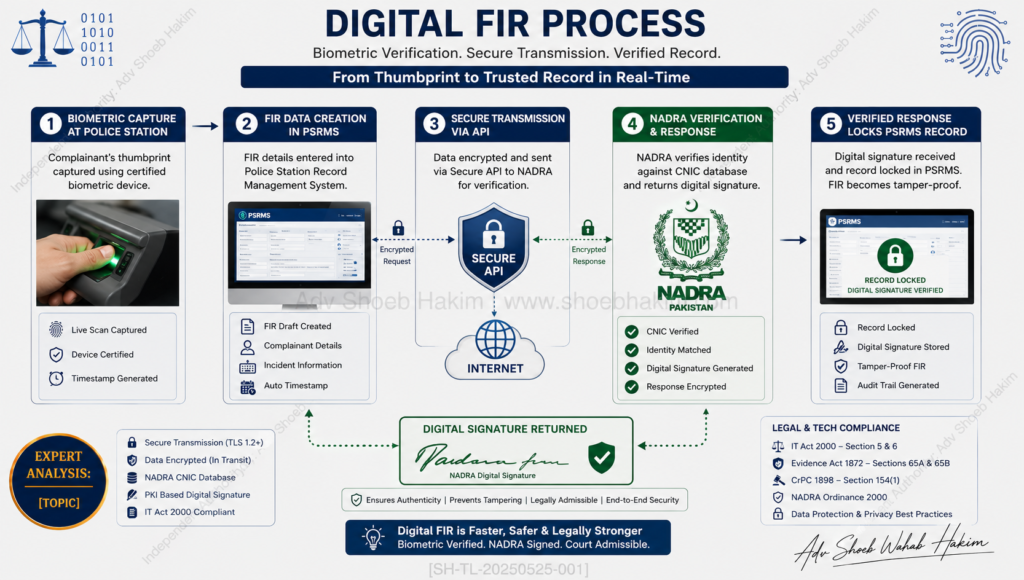
No FIR registration, no witness statement, no suspect investigation without thumb impression verification linked to NADRA.
Introduction
A fake FIR can ruin a life. A backdated entry can destroy an innocent person’s career. Witness impersonation can derail justice.
The Punjab Police has just made that impossible.
The Inspector General of Police Punjab has issued directives making real-time biometric verification via thumb impressions mandatory for all complainants, suspects, and witnesses. Linked directly with NADRA, this initiative prevents backdated entries, the filing of fake First Information Reports (FIRs), and manipulation of investigations.
This article analyzes the reform, its implementation, and its implications for criminal justice in Pakistan.
What Has Changed
Before this reform:
- Anyone could file an FIR with or without genuine identity
- Backdated entries were possible
- Witnesses could be impersonated
- Suspects could provide false identities
- No real-time verification of identity
After this reform:
- No complaint processing without biometric verification
- No FIR registration without thumb impression
- No suspect investigation without identity confirmation
- No witness statement recording without verification
- All biometric data linked to NADRA in real-time
Key Features of the Directive
| Feature | Description |
|---|---|
| Mandatory authentication | No complaint processing, FIR registration, suspect investigation, or witness statement without biometric verification |
| NADRA integration | Real-time verification of identity through national database |
| PSRMS integration | Biometric module integrated into Police Station Record Management System |
| Strict timelines | All police stations equipped with biometric devices; senior officers to check availability |
| Personnel tracking | Also tracks internal police attendance to curb absenteeism |
What This Prevents
1. Fake FIRs
Previously, anyone could file a false FIR against an innocent person using a fake identity. Now, the complainant’s thumb impression is verified against NADRA before any FIR is registered.
2. Backdated Entries
Police officers could previously backdate FIRs to manipulate investigations. Real-time biometric verification creates an immutable timestamp.
3. Witness Impersonation
Witnesses could be replaced or impersonated. Now, every witness statement is linked to a verified identity.
4. Suspect Identity Fraud
Suspects could provide false names and identities. Now, their thumb impression is verified before investigation proceeds.
5. Police Absenteeism
The system also tracks internal police personnel attendance, strengthening institutional accountability.
Citizen Services: Online Complaint Registration
How to register a complaint online:
- Access the Portal – Visit the official Punjab Police Complaint Management System website
- Enter Personal Details – Input your full name, CNIC number, and active mobile number
- Provide Case Details – Select the relevant district and police station
- Submit the Text – Type your detailed complaint, attach supporting documents, and click submit
- Receive an SMS – The system will send an automated tracking number to your phone
How to check case status:
- Open the Punjab Police online tracking portal
- Enter your unique complaint tracking number or FIR number
- View real-time logs including assigned investigation officer and current progress
Implications for Criminal Justice
For Complainants:
- Your identity is verified before your complaint is registered
- You cannot file anonymous or fake complaints
- Your genuine complaint will have an immutable record
For Suspects:
- Your identity is verified at the start of investigation
- You cannot provide false identity to evade justice
- You are protected from fake FIRs filed using false identities
For Witnesses:
- Your statement is linked to your verified identity
- Witness impersonation is now impossible
- Your credibility is established through biometric verification
For Police Officers:
- Cannot file backdated entries
- Cannot manipulate investigation timelines
- Attendance and accountability are tracked
For the Justice System:
- More reliable FIRs
- Verified witness statements
- Reduced manipulation
- Greater public trust
Comparison with Other Jurisdictions
| Jurisdiction | Biometric Verification | Integration with National Database |
|---|---|---|
| Punjab, Pakistan | Yes (mandatory for FIR, witnesses, suspects) | Yes (NADRA) |
| India | Limited (not mandatory for FIR registration) | Aadhaar (voluntary) |
| United Kingdom | No | N/A |
| United States | No | N/A |
Punjab’s reform is among the most advanced in the region.
Potential Challenges
| Challenge | Mitigation |
|---|---|
| Device availability | All stations equipped; senior officers to check availability |
| Technical failures | Continuous monitoring of system readiness |
| Privacy concerns | Data used only for criminal justice purposes |
| Access for illiterate citizens | Assistance available at police stations |
| Cost of implementation | Already invested; long-term benefits outweigh costs |
The Road Ahead
The Punjab Police has taken a significant step toward digital transparency and institutional accountability. The real-time biometric verification system:
- Prevents fake FIRs
- Eliminates backdated entries
- Stops witness impersonation
- Verifies suspect identities
- Tracks police attendance
Other provinces in Pakistan and other states in India should consider similar reforms. Technology can be a powerful tool for justice when implemented with clear procedures and accountability.
Conclusion
The Punjab Police has made real-time biometric verification via thumb impressions mandatory for all complainants, suspects, and witnesses. Linked directly with NADRA, this initiative prevents backdated entries, the filing of fake First Information Reports (FIRs), and manipulation of investigations.
To ensure strict compliance and digital transparency, the Inspector General of Police Punjab has issued directives to all police stations across the province:
- No complaint processing, FIR registration, suspect investigation, or witness statement recording without instantaneous biometric identity verification
- Biometric module integrated into the Police Station Record Management System (PSRMS)
- All police stations equipped with biometric devices; senior officers to check system availability
- System also tracks internal police personnel attendance to curb absenteeism
Citizens can register complaints and track case status digitally through Punjab Police online portals.
Digital transparency is no longer a goal. It is now enforceable.
Q: Can I still file an FIR in Punjab if I wish to remain completely anonymous? Ans: No. Under the new Punjab Police Biometric Verification mandate, anonymous or fake FIRs are technically impossible. The system strictly requires real-time thumb impression authentication linked to the NADRA database before any complaint processing or FIR registration can commence, ensuring absolute accountability.
Q: How does biometric verification stop police from altering investigation timelines? Ans: Previously, officers could manually backdate entries in physical ledgers. The integration of biometric scanners generates an unalterable, real-time digital timestamp the moment an identity is verified. This creates a secure digital chain of custody that physically prevents the retrospective manipulation of investigative timelines.
Q: Does this new biometric system only apply to the people filing the police complaint? Ans: No, the mandate is comprehensive. The Inspector General’s directive explicitly requires real-time biometric verification for complainants, all suspects undergoing investigation, and all individuals providing witness statements. Furthermore, the hardware is utilized to track the daily attendance of the police personnel themselves.
What specific national database is the Punjab Police’s real-time biometric verification system linked to?
- Ans: The National Database and Registration Authority (NADRA).
How does the biometric integration prevent the historical issue of backdated FIRs?
- Ans: By generating an immutable, cryptographically timestamped digital log at the exact moment the thumb impression is authenticated, making manual manipulation of timelines impossible.
Besides verifying complainants and suspects, what internal administrative function does the biometric system serve for the police department?
- Ans: It tracks internal police personnel attendance to ensure accountability and curb institutional absenteeism.
In a comparative legal context, which recently enacted Indian statute similarly emphasizes the digitization of police records and electronic FIRs (e-FIRs)?
- Ans: The Bharatiya Nagarik Suraksha Sanhita (BNSS).
Adv. Shoeb Hakim
Criminal Justice & Police Reforms Advisor
📌 Follow me on LinkedIn for daily criminal justice and police reform insights: https://www.linkedin.com/in/shoebhakim
📌 Visit my website for more articles: https://shoebhakim.com
📌 Visit my website for research fellowship: https://www.legalcomplaince.in
♻️ Share this article with your network.
Disclaimer: This article is for informational purposes only and does not constitute legal advice.
Hashtags: #AdvShoebHakim #PunjabPolice #BiometricVerification #NADRA #FIR #PoliceReforms #DigitalTransparency #AntiCorruption #CriminalJustice #PSRMS #ComplaintManagement #PoliceAccountability #ThumbImpression #RealTimeVerification #FakeFIR #BackdatedEntries #WitnessImpersonation #SuspectVerification #PoliceAttendance #CitizenServices #OnlineComplaint #CaseStatus #CriminalProcedure #EvidenceLaw #PoliceInvestigation #JusticeReform #RuleOfLaw #DigitalPakistan #PoliceInnovation #LawEnforcement #PublicSafety #VictimProtection #WitnessProtection #SuspectRights #DueProcess #FairTrial #InstitutionalReform #Governance #Transparency #Accountability #TechnologyInPolicing #BiometricTechnology #NADRAPakistan #PunjabIGP #PoliceDirectives #ComplianceMonitoring #RealTimeVerification #PoliceStationManagement #FIRRegistration #ComplaintManagementSystem