

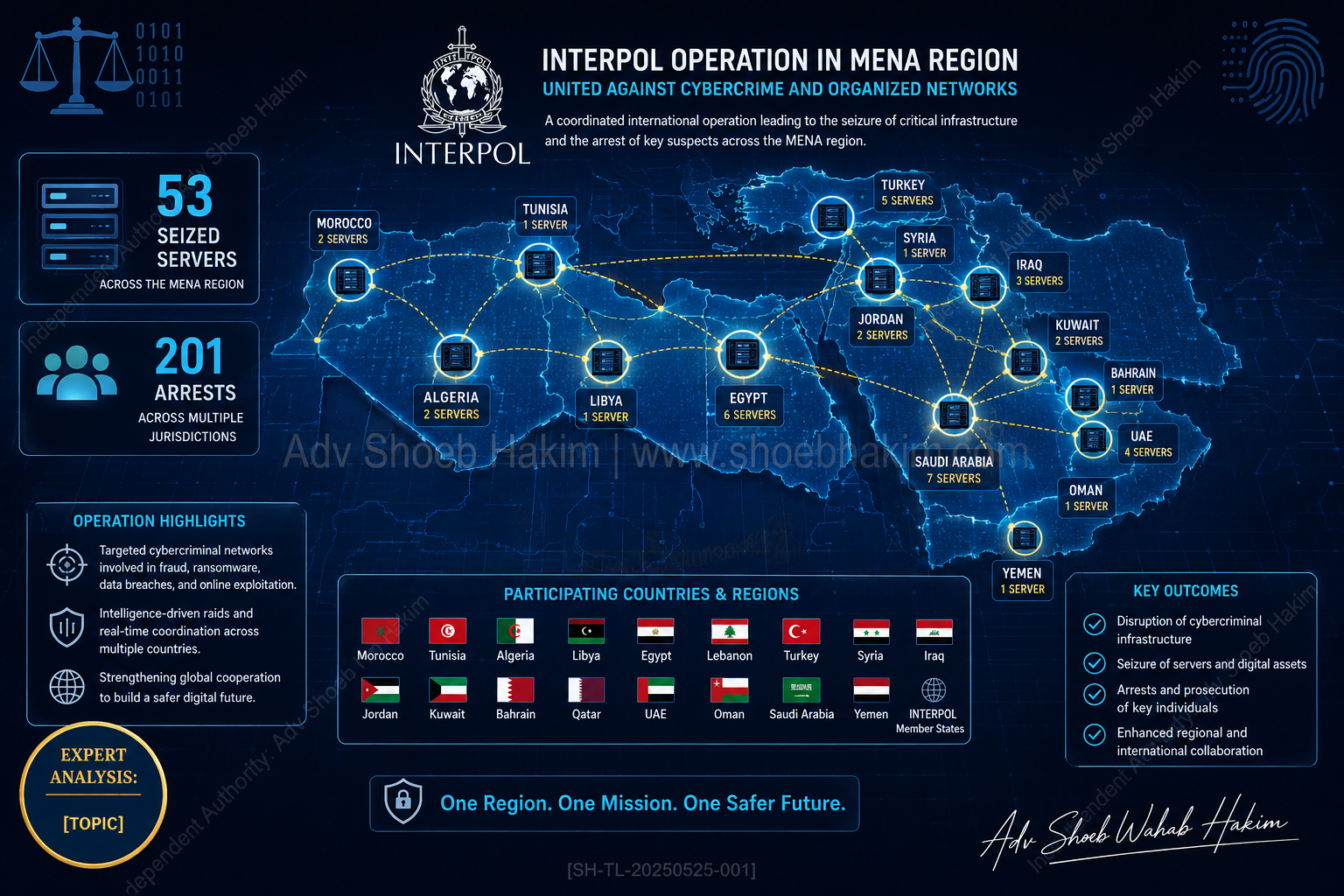
382 suspects identified. 3,867 victims. 53 servers seized. Nearly 8,000 intelligence pieces shared.
Introduction
Cybercrime has no borders. Neither does the response.
Operation Ramz, the first-of-its-kind cybercrime operation in the Middle East and North Africa (MENA) region, brought together law enforcement agencies across multiple countries to disrupt phishing, malware, and cyber scam networks.
The results: 201 arrests. 382 suspects identified. 3,867 victims identified. 53 servers seized. Nearly 8,000 pieces of intelligence shared.
This article breaks down the operation, its outcomes, and its implications for regional and global cybercrime cooperation.
The Operation
Name: Operation Ramz
Region: Middle East and North Africa (MENA)
Type: First-of-its-kind regional cybercrime operation
Targets: Phishing networks, malware distribution, cyber scam networks
Coordinator: INTERPOL
Participating countries: (Exact list not specified, but MENA region law enforcement agencies participated.)
The Results
| Metric | Number |
|---|---|
| Arrests | 201 |
| Suspects identified | 382 |
| Victims identified | 3,867 |
| Servers seized | 53 |
| Intelligence pieces shared | Nearly 8,000 |
Impact by the Numbers
201 Arrests
Each arrest represents:
- A potential repeat offender removed from the cybercrime ecosystem
- A network disrupted
- A deterrent to others
382 Suspects Identified
Not all suspects were arrested immediately. Identification allows for:
- Ongoing investigations
- Future arrests
- International coordination for extradition
3,867 Victims Identified
Each victim identified can:
- Receive support
- Be notified of the investigation
- Potentially recover losses
53 Servers Seized
Servers are the infrastructure of cybercrime. Seizure means:
- Phishing sites taken down
- Malware distribution halted
- Evidence collected for prosecution
- Intelligence extracted for future operations
Nearly 8,000 Intelligence Pieces Shared
Intelligence sharing enables:
- Ongoing investigations beyond Operation Ramz
- Pattern recognition across jurisdictions
- Coordinated responses to emerging threats
- Stronger regional cooperation
Types of Cybercrime Targeted
1. Phishing
Fraudulent communications designed to trick victims into revealing sensitive information (passwords, credit card numbers, bank account details).
2. Malware
Malicious software designed to damage, disrupt, or gain unauthorized access to computer systems.
3. Cyber Scams
Fraudulent schemes conducted online, including investment scams, romance scams, and impersonation fraud.
Why This Operation Matters
1. First-of-its-kind in MENA
Regional cybercrime operations in the MENA region have been limited. Operation Ramz establishes a template for future cooperation.
2. Cross-border Coordination
Cybercriminals operate across borders. Law enforcement must do the same. Operation Ramz demonstrates that regional cooperation is possible.
3. Victim Identification
3,867 victims identified is not just a statistic. It is 3,867 individuals who can be notified, supported, and potentially assisted in recovery.
4. Intelligence Sharing
Nearly 8,000 pieces of intelligence shared means that the operation’s impact will extend beyond the arrests. Ongoing investigations will benefit.
5. Deterrence
Every arrest, every server seizure, every intelligence piece shared sends a message to cybercriminals: your activities are being monitored, investigated, and disrupted.
Implications for AML and Financial Crime Compliance
For Financial Institutions in the MENA Region:
- Expect increased scrutiny of transactions linked to identified cybercrime networks
- Review AML programs for phishing and scam-related red flags
- Enhance monitoring for patterns consistent with cyber-enabled fraud
For Compliance Professionals:
| Action | Why |
|---|---|
| Update red flag indicators | Incorporate typologies from Operation Ramz |
| Review sanctions screening | Ensure identified suspects are screened against sanctions lists |
| Enhance fraud detection | Phishing and scam proceeds often flow through legitimate financial systems |
| Strengthen customer due diligence | Cybercriminals use shell companies and mule accounts |
The Role of INTERPOL
INTERPOL coordinated Operation Ramz, providing:
- Intelligence sharing platform
- Operational coordination across jurisdictions
- Technical support for server seizures
- Framework for regional cooperation
INTERPOL’s statement:
The operation enabled the sharing of nearly 8,000 pieces of intelligence to support ongoing investigations and strengthen regional cooperation against cyber threats.
What’s Next
For Law Enforcement:
- Ongoing investigations using shared intelligence
- Potential future arrests of identified suspects
- Expansion to other regions
For Financial Institutions:
- Enhanced monitoring for cybercrime-related red flags
- Collaboration with law enforcement on identified patterns
For the Public:
- Increased awareness of phishing, malware, and cyber scams
- Reporting mechanisms for victims
Conclusion
Operation Ramz, the first-of-its-kind cybercrime operation in the MENA region, resulted in 201 arrests, 382 suspects identified, 3,867 victims identified, 53 servers seized, and nearly 8,000 pieces of intelligence shared.
The operation demonstrates that cross-border cybercrime requires cross-border response. Phishing, malware, and cyber scam networks operate without regard for national boundaries. Law enforcement must do the same.
INTERPOL’s coordination enabled regional cooperation. The shared intelligence will support ongoing investigations beyond Operation Ramz.
For financial institutions and compliance professionals, the operation is a reminder: cybercrime proceeds flow through the legitimate financial system. Enhanced monitoring, red flag identification, and suspicious activity reporting are essential.
Cybercrime has no borders. Neither does the response.
Q: What exactly did Operation Ramz target in the MENA region? Ans: The operation aggressively targeted the infrastructure of transnational cybercrime, focusing on dismantling networks responsible for phishing, malware distribution, and large-scale cyber scams across the Middle East and North Africa.
Q: Why is the seizure of 53 servers so critical to law enforcement? Ans: Servers act as the operational command centers for cybercriminals. Seizing them not only halts immediate attacks but also provides police with encrypted logs, victim databases, and digital evidence necessary for international prosecutions.
Q: How does Operation Ramz impact banks and AML compliance officers? Ans: The nearly 8,000 pieces of intelligence shared during the operation provide financial institutions with new typologies and red flags. Banks must use this data to update their transaction monitoring systems to catch the illicit proceeds of these disrupted scams.
How many servers were seized during Operation Ramz?
- Ans: 53 servers.
Which international organization coordinated this MENA region operation?
- Ans: INTERPOL.
How many pieces of intelligence were shared among law enforcement agencies?
- Ans: Nearly 8,000.
True or False: Operation Ramz was primarily focused on violent crimes.
- Ans: False; it targeted phishing, malware, and cyber scam networks.
Adv. Shoeb Hakim
Cybercrime & International Cooperation Advisor
📌 Follow me on LinkedIn for daily cybercrime and AML insights: https://www.linkedin.com/in/shoebhakim
📌 Visit my website for more articles: www.shoebhakim.com
♻️ Share this article with your network.
Disclaimer: This article is for informational purposes only and does not constitute legal advice.
Hashtags: #INTERPOL #OperationRamz #Cybercrime #Phishing #Malware #CyberScam #MENARegion #LawEnforcement #InternationalCooperation #CyberSecurity #DataProtection #GlobalPolicing #CrimePrevention #DigitalSafety #FinancialCrime #AML #Compliance #IntelligenceSharing #CrossBorderCooperation #RegionalCooperation #CyberThreats #OnlineSafety #FraudPrevention #ServerSeizure #VictimIdentification #SuspectIdentification #Arrests #CyberCriminals #InformationSharing #PoliceCooperation #INTERPOLOperations #MiddleEast #NorthAfrica #MENA #CyberAttack #PhishingScam #MalwareAttack #RomanceScam #InvestmentScam #ImpersonationFraud #FinancialFraud #CyberEnabledCrime #RedFlags #SAR #SuspiciousActivityReport #DueDiligence #EnhancedMonitoring #CyberResilience #PublicSafety #AdvShoebHakim