
Knowledge alone does not change behaviour under pressure. Interoceptive awareness does.
Introduction
Implicit bias training has become the default policy response to disproportionate use of force. The evidence suggests it changes knowledge, not behaviour.
Officers know what they should do. But under pressure, knowledge fails.
Organisational psychologist Michael Stephenson looks to an unexpected source for a more effective approach: professional poker. Not sociology. Neuroscience.
This article explains the insights from poker, the psychophysiology of police decision-making, and the implications for custody training.
The Poker Insight: Tilt and Interoception
What is tilt?
In poker, “tilt” refers to a state of emotional and cognitive dysregulation that impairs decision-making. A tilted player makes bad bets, misreads opponents, and loses money.
The key insight:
“The tilted player is not choosing badly. They are, briefly, a different kind of decision-maker.”
The body signals this state before the conscious mind catches up. Elite poker players learn to notice these signals before tilt impairs their decisions.
The Police Parallel: Threat-Readiness in Custody
The problem:
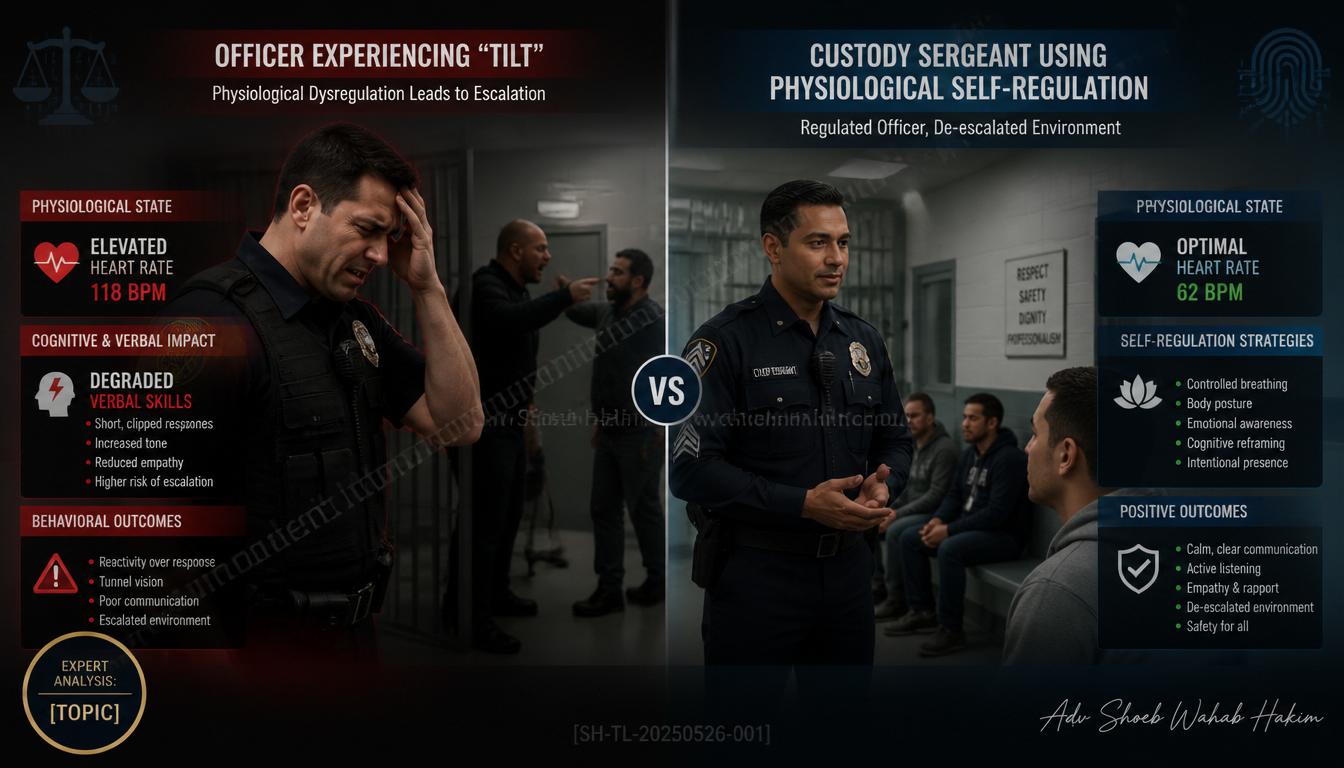
When a warrior-oriented officer enters a custody block expecting threat, their body begins generating physiological preparation – elevated heart rate, heightened sympathetic arousal – before any evidence of actual danger.
The consequence:
Research on the psychophysiology of police decision-making has established something that should disturb every custody trainer: physiological arousal under threat degrades verbal communication skills while leaving tactical and physical skills largely intact.
An officer who needs to de-escalate through communication is physiologically impaired from doing so precisely when de-escalation is most needed.
Why Knowledge Alone Is Not Enough
| Approach | What It Does | Limitation |
|---|---|---|
| Implicit bias training | Changes knowledge | Does not change behaviour under pressure |
| Rules and policies | Provides guidance | Fails when cognition is impaired |
| “Be aware of tilt” | Informs | Does not prevent |
“Knowing that tilt impairs decision-making does not prevent tilt. The knowledge is completely useless unless the player has also developed the interoceptive capacity to notice when it is arriving.”
What Is Interoceptive Awareness?
Interoceptive awareness is the ability to perceive internal bodily signals: heart rate, breathing, muscle tension, temperature, arousal.
Why it matters:
- The body signals tilt before the conscious mind catches up
- Interoceptive awareness allows you to notice these signals
- Noticing allows you to intervene before decision-making is impaired
“The implication for custody training is direct: interoceptive awareness is the floor, not the ceiling. It is what survives when everything else is under pressure, which is precisely when it is most needed.”
The Cultural Problem: Warrior Generalisation
The warrior capacity is genuinely necessary for a small subset of policing encounters.
The problem is not the warrior orientation itself. The problem is cultural generalisation – the enculturation of threat-readiness into every context, including those that structurally demand its opposite.
Custody is the most concentrated example of this problem in British policing.
An environment that requires calm, communication, and procedural discipline is instead staffed by officers trained to expect threat.
The Custody Sergeant’s Role
“The custody sergeant, already the most important cultural actor in the suite, can model this behaviour with measurable downstream effects on their team’s collective arousal baseline.”
A custody sergeant who models interoceptive awareness:
- Regulates their own arousal before engaging with detainees
- Communicates calmly even under pressure
- Sets the tone for the entire team
- Reduces collective threat-readiness
Adding a Skill, Not Abandoning an Identity
“Rather than asking warrior-oriented officers to abandon an identity, interoceptive training asks them to add a skill: the ability to accurately read their own operational state and calibrate their response accordingly.”
This is a crucial insight.
Traditional approaches:
- “You are too aggressive”
- “You need to be less threatening”
- “You are the problem”
Interoceptive approach:
- “You have valuable skills for high-threat situations”
- “Add this skill to read your own state”
- “Use that information to calibrate”
One approach attacks identity. The other builds capability.
Practical Implications for Custody Training
What custody training should include:
- Interoceptive awareness exercises – Learning to notice heart rate, breathing, muscle tension, arousal
- Physiological self-regulation – Techniques to lower arousal when threat-readiness is unnecessary
- Contextual calibration – Recognizing which situations require threat-readiness and which require calm communication
- Modelling by leaders – Custody sergeants demonstrating interoceptive awareness and self-regulation
What custody training should NOT do:
- Assume knowledge alone is sufficient
- Attack the warrior identity
- Ignore the psychophysiology of decision-making
The Evidence Base
Research on the psychophysiology of police decision-making has established:
- Physiological arousal degrades verbal communication
- Tactical and physical skills remain intact under arousal
- Threat expectation triggers physiological preparation before evidence of danger
- Interoceptive awareness can be trained
Conclusion
Implicit bias training has become the default policy response to disproportionate use of force. Evidence suggests it changes knowledge, not behaviour.
Professional poker offers a different approach: interoceptive awareness. Elite poker players know that tilt impairs decision-making. But they also know that knowledge alone does not prevent tilt. They develop the capacity to notice the body’s signals before tilt arrives.
The same applies to police custody. An officer expecting threat begins physiological preparation before any evidence of danger. That arousal degrades verbal communication skills precisely when de-escalation is most needed.
Rather than asking warrior-oriented officers to abandon an identity, interoceptive training asks them to add a skill: the ability to accurately read their own operational state and calibrate their response accordingly.
The custody sergeant – already the most important cultural actor in the suite – can model this behaviour with measurable downstream effects on their team’s collective arousal baseline.
Interoceptive awareness is the floor, not the ceiling. It is what survives when everything else is under pressure. That is precisely when it is most needed.
Q: Why is it dangerous for police officers to maintain a “warrior mindset” inside a custody suite? Ans: While a warrior mindset is necessary for high-threat street encounters, maintaining it inside a controlled custody suite creates chronic threat-readiness. This physiological arousal degrades an officer’s verbal communication skills, making them incapable of effective de-escalation and increasing the likelihood of unnecessary physical force.
Q: How does playing poker relate to police use-of-force training? Ans: Elite poker players understand a phenomenon called “tilt”—a loss of cognitive control due to emotional flooding. Players use Police Interoceptive Awareness Training principles to sense physical changes (like a spiking heart rate) and regulate their bodies before they make a bad bet. Police officers can use this exact same physiological self-regulation to prevent bad decisions under stress.
Q: Does interoceptive training require officers to stop being tough? Ans: No. Interoceptive training does not attack an officer’s identity or ask them to be less tough. It frames self-regulation as an advanced tactical skill addition. It teaches officers to accurately read their own operational state so they can intentionally choose when to deploy their physical skills and when to deploy their verbal skills.
Q: Why does implicit bias training often fail to change an officer’s behavior under acute pressure? Ans: Because it only addresses cognitive knowledge, which fails when physiological arousal and stress degrade the brain’s executive functioning.
Q: What happens to an officer’s verbal communication skills when they experience threat-induced physiological arousal? Ans: Their verbal communication skills rapidly degrade, making verbal de-escalation nearly impossible, even while physical and tactical skills remain intact.
Q: How does professional poker define the concept of “tilt”? Ans: “Tilt” is a state of emotional and cognitive dysregulation that severely impairs decision-making and situational reading.
Q: What is “interoceptive awareness” in the context of police training? Ans: It is the ability to perceive internal bodily signals (like heart rate or muscle tension) to recognize and regulate physiological arousal before it compromises decision-making.
Adv. Shoeb Hakim
Police Training & Organisational Psychology Advisor
📌 Follow me on LinkedIn for daily police training and organisational psychology insights: https://www.linkedin.com/in/shoebhakim
📌 Visit my website for more articles: https://www.shoebhakim.com
📌 Visit my website for legal knowledge: https://www.vakilverse.com
📌 Visit my website for research fellowship: https://www.legalcomplaince.in
♻️ Share this article with your network.
Disclaimer: This article is for informational purposes only and does not constitute legal advice.
Hashtags: #AdvShoebHakim #ImplicitBias #PoliceTraining #UseOfForce #CustodyTraining #InteroceptiveAwareness #Neuroscience #Poker #DecisionMaking #PoliceReform #CustodySergeant #WarriorOriented #ThreatReadiness #OrganisationalPsychology #Psychophysiology #DeEscalation #VerbalCommunication #TacticalSkills #ThreatExpectation #ArousalRegulation #SelfRegulation #ContextualCalibration #PoliceCulture #WarriorIdentity #SkillBuilding #IdentitySafety #CustodySuite #PoliceDecisionMaking #EvidenceBasedTraining #KnowledgeVsBehaviour #BehaviourChange #PoliceLeadership #PoliceSupervision #PoliceAccountability #UseOfForceTraining #CrisisIntervention #MentalHealthTraining #ProceduralJustice #Legitimacy #PublicTrust #PoliceCommunityRelations #CustodyOfficer #DetaineeSafety #CustodyEnvironment #PoliceWellbeing #OfficerWellness #ResilienceTraining #EmotionalRegulation #StressManagement #CognitivePerformance #HighPressureDecisions