
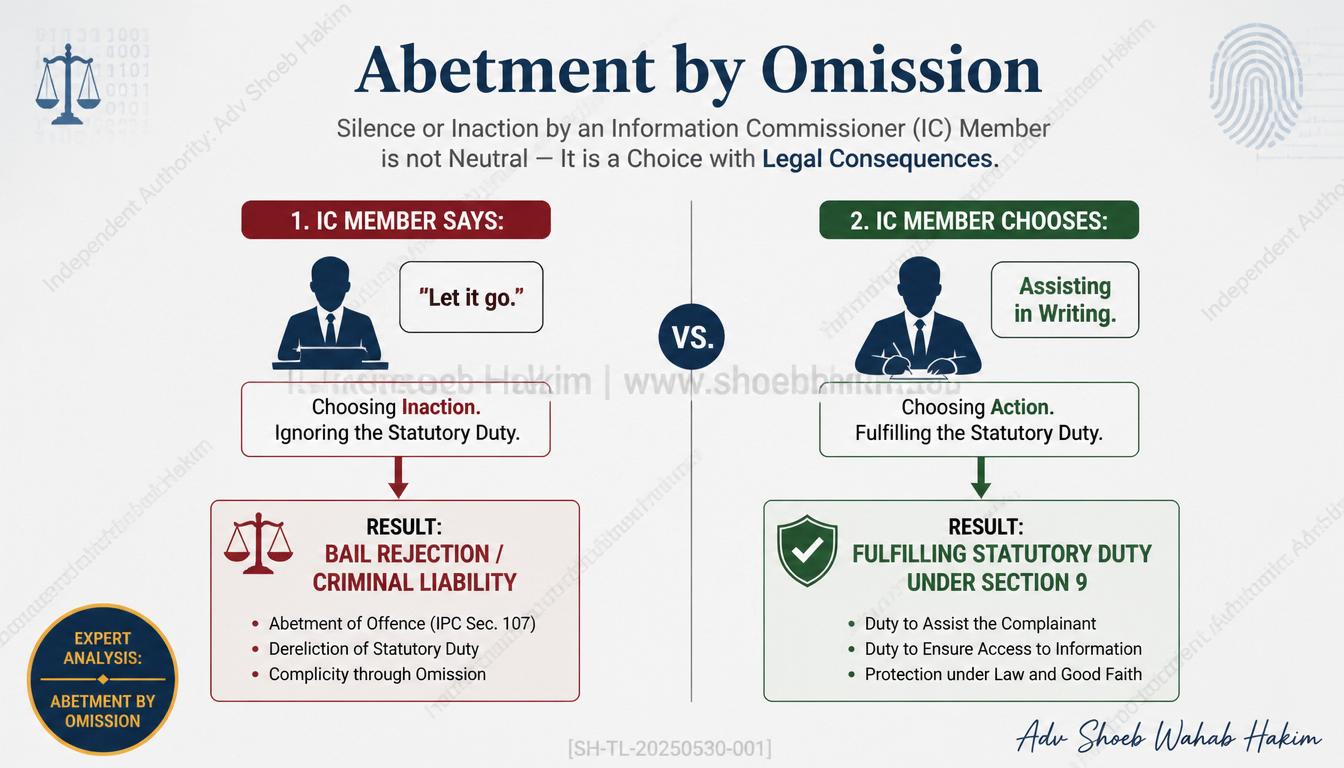
“Let it go.” Three words that led to a senior corporate leader’s bail being rejected. Turning a blind eye to workplace harassment is not inaction. It is active abetment.
Introduction
“Let it go.”
Three words from a senior corporate leader and Internal Committee (IC) member to a victim of workplace sexual harassment.
The Court said: that is not inaction. That is abetment.
A landmark ruling by the Additional Sessions Court in Nashik (Criminal Bail Application No. 707 of 2026) serves as a critical wake-up call for corporate India, HR professionals, and Internal Committee members. The Court rejected the bail application of a senior corporate leader and IC member who allegedly failed to act on repeated oral complaints of workplace sexual harassment.
This article analyzes the key legal findings and their implications for corporate leaders and IC members.
The Case
Court: Additional Sessions Court, Nashik
Case No.: Criminal Bail Application No. 707 of 2026
Accused: Senior corporate leader and Internal Committee (IC) member
Allegations: Failed to act on repeated oral complaints of workplace sexual harassment
Victim’s experience:
- Oral complaints were made
- IC member allegedly dismissed the grievances
- Told not to look for the “limelight”
- Asked to “let it go”
- Victim was forced to resign
Outcome: Bail application rejected
Key Legal Finding 1: Mandate to Assist with Written Complaints
The defense argument:
The victim had not filed a formal written complaint.
The Court’s ruling:
Rejecting this argument, the Court strictly invoked the proviso to Section 9 of the POSH Act, 2013.
What the proviso to Section 9 says:
When a woman cannot make a complaint in writing, it is the absolute duty of the Presiding Officer or any Internal Committee member to render all reasonable assistance to help her reduce it to writing.
The legal consequence:
Failing to do so is a statutory breach. IC members who fail to assist victims in reducing complaints to writing are violating the POSH Act.
Key Legal Finding 2: “Let It Go” Equates to Abetment
What the IC member allegedly said:
- “Don’t look for the limelight”
- “Let it go”
The Court’s observation:
By ignoring the oral complaints and actively silencing the victim, the member did not just fail in her duty—she shielded the perpetrators and created a clear case of abetment under criminal law.
The legal principle:
Turning a blind eye or a deaf ear to an employee’s distress is a form of active endorsement that can lead to direct criminal liability and the denial of bail.
Key Legal Finding 3: Judicial Notice of Toxic Work Environments & Delays
The Court’s observation:
The Court showed profound empathy regarding why victims delay filing formal FIRs, noting that individuals from humble financial backgrounds often fear:
- Severe career retaliation
- Family pressure to resign
- Not being believed
- Social stigma
The consequence:
Corporate inaction can cause the environment to become so unbridled and toxic that a victim is ultimately forced to resign altogether.
The Bottom Line for Corporate Leaders & IC Members
| Misconception | Reality |
|---|---|
| “I am just a committee member” | You have statutory duties under the POSH Act |
| “No written complaint, no action needed” | You must assist victims in reducing oral complaints to writing |
| “I am staying neutral” | Silence in the face of harassment is not neutrality. It is abetment. |
| “HR will handle it” | IC members have independent statutory liability |
| “I cannot be personally liable” | This judgment proves otherwise |
The Court’s message:
Being appointed to a POSH Internal Committee is not a passive title or a corporate checkbox. It carries deep legal accountability.
What IC Members Must Do
Upon receiving an oral complaint:
- Immediately assist the victim in reducing the complaint to writing
- Do not ask them to “let it go”
- Do not tell them not to “look for limelight”
- Document every conversation
- Follow statutory timelines
During the inquiry:
- Maintain confidentiality
- Ensure no retaliation against the victim
- Complete inquiry within 90 days
- Submit report with recommendations
What NOT to do:
- Ignore oral complaints
- Discourage victims from speaking up
- Shield perpetrators
- Delay proceedings
What Corporate Leaders Must Do
Before an incident:
- Ensure IC is properly constituted
- Train IC members on their statutory duties
- Create a culture where speaking up is safe
- Communicate zero-tolerance for harassment
After an incident:
- Do not interfere with IC proceedings
- Protect victims from retaliation
- Take action based on IC findings
- Hold IC members accountable for non-compliance
The Criminal Liability Dimension
This judgment makes clear that IC members can face:
Criminal charges:
- Abetment (as seen in this case)
- Criminal conspiracy
- Dereliction of duty
Consequences:
- Arrest
- Denial of bail
- Imprisonment
- Fine
The Nashik Court’s rejection of bail sends a clear message: turning a blind eye is a criminal act.
Practical Takeaways
For IC members:
- Your role is not ceremonial. You have statutory duties.
- Oral complaints must be acted upon immediately.
- “Let it go” can land you in jail.
- Document everything.
For HR professionals:
- The POSH Act is not a paper shield.
- Ensure IC members are trained on their legal duties.
- Create safe reporting mechanisms.
- Do not discourage victims from speaking up.
For corporate leaders:
- Toxic environments lead to victim resignation.
- Corporate inaction will be noticed by courts.
- Personal liability extends to IC members.
- Culture is your responsibility.
For victims:
- You are not alone.
- Oral complaints are valid complaints.
- The law requires IC members to assist you.
- If they fail, they can be held criminally liable.
Conclusion
A landmark ruling by the Additional Sessions Court in Nashik (Criminal Bail Application No. 707 of 2026) serves as a critical wake-up call for corporate India, HR professionals, and Internal Committee members.
The Court rejected the bail application of a senior corporate leader and IC member who allegedly failed to act on repeated oral complaints of workplace sexual harassment.
- Failing to assist a victim in reducing a complaint to writing is a statutory breach.
- “Let it go” and “don’t look for limelight” equate to abetment.
- Courts will take judicial notice of toxic work environments and corporate delays.
- IC members can be held criminally liable for omission.
The POSH Act is not a paper shield. Being appointed to an Internal Committee is not a passive title or a corporate checkbox. It carries deep legal accountability.
Turning a blind eye or a deaf ear to an employee’s distress is a form of active endorsement that can lead to direct criminal liability and the denial of bail.
Q: Can I be held criminally liable just for being on an Internal Committee (IC)? Ans: Yes, if you fail in your statutory duties. POSH Act IC Liability is severe; if a victim makes an oral complaint and you tell them to “let it go” instead of assisting them in filing a written complaint, courts view this administrative omission as criminal abetment.
Q: What exactly does the proviso to Section 9 of the PoSH Act require me to do? Ans: If a woman cannot make a complaint in writing due to physical or emotional distress, Section 9 mandates that the Presiding Officer or any IC member must render all reasonable assistance to help her reduce the oral complaint into writing.
Q: Why was bail rejected for the IC member in the Nashik case? Ans: The court rejected bail because by ignoring the oral complaints and actively silencing the victim, the IC member was not acting neutrally. They were actively shielding the perpetrator and contributing to a toxic environment, which constitutes criminal abetment.
Which section of the PoSH Act mandates IC members to assist a victim in making a written complaint?
- Ans: The proviso to Section 9.
In the Nashik Court case, what specific phrase used by the IC member was equated with criminal abetment?
- Ans: “Let it go” (or “don’t look for the limelight”).
What was the legal outcome for the senior corporate leader / IC member in this specific case?
- Ans: Their bail application was rejected.
True or False: An IC member can wait passively for a victim to submit a formal written complaint before taking any action.
- Ans: False; they have an absolute statutory duty to render reasonable assistance in reducing oral complaints to writing.
Adv. Shoeb Hakim
POSH & Workplace Governance Advisor
📌 Follow me on LinkedIn for daily POSH and workplace governance insights: https://www.linkedin.com/in/shoebhakim
📌 Visit my website for more articles: https://www.shoebhakim.com
📌 Visit my website for legal knowledge: https://www.vakilverse.com
📌 Visit my website for research fellowship: https://www.legalcomplaince.in
♻️ Share this article with your HR team and Internal Committee members.
Disclaimer: This article is for informational purposes only and does not constitute legal advice.
Hashtags: #POSH #PoSHAct #WorkplaceHarassment #InternalCommittee #ICMembers #CorporateLiability #Abetment #NashikCourt #SexualHarassment #HRCompliance #WorkplaceGovernance #LegalAccountability #POSHLiability #OralComplaint #WrittenComplaint #Section9 #ProvisoToSection9 #PresidingOfficer #LetItGo #Limelight #SilencingVictims #ToxicWorkEnvironment #VictimResignation #CareerRetaliation #BailRejection #CriminalLiability #CorporateLeaders #HRProfessionals #StatutoryDuty #StatutoryBreach #ProactiveAction #Empathy #ZeroTolerance #SafeReporting #NonRetaliation #POSHTimelines #90Days #InquiryReport #CorporateCulture #BoardOversight #PersonalLiability #LegalWakeUpCall #CorporateIndia #WorkplaceSafety #EmployeeProtection #JusticeAtWork #MeToo #WorkplaceRights #AdvShoebHakim