For years, financial crime discussions have focused on banks, payments, and crypto. Yet one of the most attractive destinations for suspect wealth may have been hiding in plain sight: real estate.
Introduction
For years, financial crime discussions have focused on banks, payments, and crypto. Yet one of the most attractive destinations for suspect wealth may have been hiding in plain sight: real estate.
Luxury apartments in London. Penthouses in New York. Villas in Dubai. Mansions in Mumbai. The global property market is the ultimate laundering machine.
This article examines the scale of property laundering, how it works, and what is being done to address it.
The Scale of the Problem
Operation TENTACLE (2025):
| Metric | Figure |
|---|---|
| Law enforcement agencies involved | 50+ |
| Countries involved | 52 |
| Suspicious transactions identified | 468 |
| Properties involved | Nearly 400 |
| Total value of suspicious transactions | £460 million |
| UK properties linked to suspicious transactions | £330 million (80%) |
Key insights from Operation TENTACLE:
- Just 10 individuals were behind the laundering of £160 million through UK property
- Criminals are often buying property “without being registered as the owner—that may be a corporate structure”—George Turner, Head of Illicit Finance, National Crime Agency
- This method allows criminals to “move money across jurisdictions while preserving the privacy of the true purchaser”
- The operation involved the “detection of illicit financial flows through the global real estate sector”
The UK’s 25-year problem:
| Category | Estimated Value |
|---|---|
| UK property owned by PEPs or individuals from high-corruption risk countries | £2.5 billion |
| UK property owned by criminals or their associates | £1.5 billion |
| Total suspect wealth in UK property | At least £4 billion |
A 25-year cover-up:
The scale of the problem has been known for at least 25 years. A Labour government was warned that “dirty money from around the world is pouring into Britain and the country’s property market has become a ‘millionaires’ playground for the global criminal fraternity”
The Times later noted: “At least £4 billion in properties in London and other UK cities are in the hands of criminals and corrupt foreign officials.”
The new register was no surprise to those who work in property law:
“It is in the price tags that are too high, in the purchases that are too quick, in the owners who are hard to find. The UK property market has been described as one of the largest laundromats in the world. The Register of Overseas Entities is a useful tool in the fight against economic crime, but what the government could not fix in 20 years is not suddenly solved by a single database.”
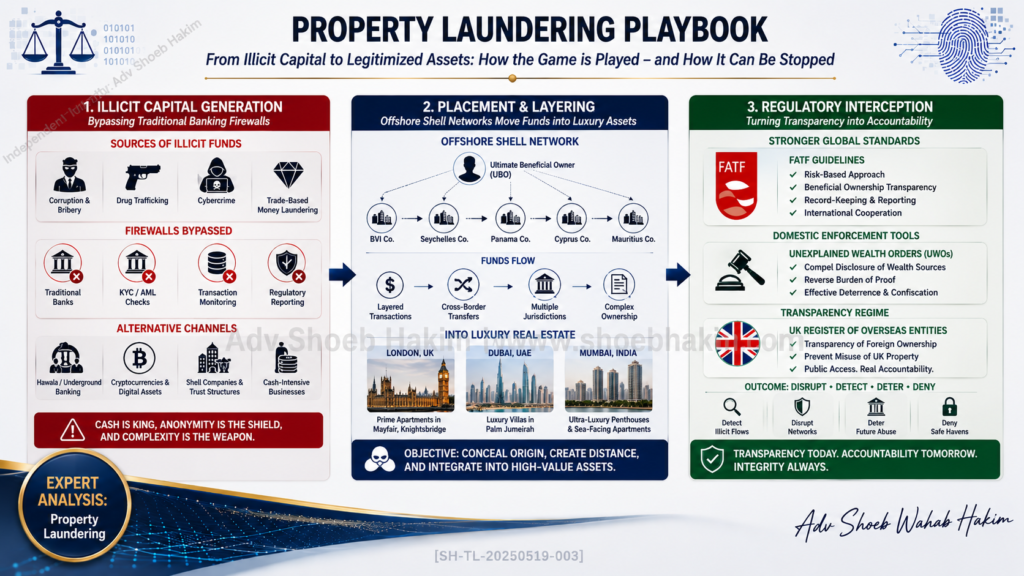
How Property Laundering Works
Common Methods:
| Method | Description |
|---|---|
| Shell companies | Creating corporate entities to obscure true ownership |
| Complex corporate structures | Using multiple layers of companies across jurisdictions |
| Third-party payments | Payments made by individuals not connected to the transaction |
| Under/over-valuing | Manipulating property values to move funds |
| Offshore trusts | Using trusts to hide beneficial ownership |
| Nominee owners | Using individuals to hold property on behalf of others |
The laundering process:
- Placement: Illicit funds introduced into the property market
- Layering: Complex transactions to obscure origin
- Integration: Funds appear legitimate through property ownership
The appeal of real estate for money launderers:
- High value per transaction
- Cross-border mobility
- Perceived legitimacy
- Limited due diligence historically
- Stable asset class
The Response: Regulatory and Enforcement Action
UK: Register of Overseas Entities
The Register of Overseas Entities, introduced under the Economic Crime (Transparency and Enforcement) Act 2022, requires foreign entities that own or buy UK property to register their beneficial owners.
The register was meant to reveal “who really owns and controls overseas entities that own UK property, so that criminals cannot hide behind a complex web of shell companies”
But the problem persists:
The government could not fix in 20 years what is not suddenly solved by a single database.
The limits of the register:
The new register, which requires foreign companies to declare their true owners, became law last year. But it relies on self-declaration, and the criminals who laundered money through property for decades are not likely to suddenly start telling the truth.
Unexplained Wealth Orders (UWOs):
UWOs are court orders requiring individuals suspected of holding property worth more than £50,000 to explain the source of their funds.
What UWOs can do:
- Reverse the burden of proof: The individual must prove the property was acquired lawfully
- Enables confiscation: If the individual cannot explain the source of funds, the property can be seized
- Creates financial pressure: Legal costs and reputation damage
FATF’s Focus on Real Estate:
The Financial Action Task Force (FATF) has provided targeted guidance on real estate and beneficial ownership.
Key FATF requirements:
- Paper trails: The FATF requires countries to maintain records of “the purpose and intended nature of the business relationship, including a paper trail of property transactions and evidence of source of funds”
- Beneficial ownership: Countries must ensure that “adequate, accurate and timely information on beneficial ownership of legal persons and legal arrangements is available and can be obtained in a timely fashion”
- Customer due diligence: The FATF calls on its members “to ensure that financial institutions apply customer due diligence measures (CDD) measures including identifying and verifying the identity of the beneficial owner”
- Reporting obligations: Suspicious transaction reports (STRs) must be filed
UK’s New MLR Amendment Regulations:
The UK’s Money Laundering and Transfer of Funds (Information) (Amendment) Regulations 2025 designate “letting agents and estate agents” as “obliged entities” for AML purposes. This means “letting agents and estate agents will need to comply with AML requirements under the revised regulations, which require the establishment of policies, controls and procedures to mitigate and manage ML/TF risks”
What this means for estate agents:
Estate agents are no longer just property professionals. They are now on the front line of financial crime prevention. They must:
- Identify and verify the identity of buyers and sellers
- Report suspicious transactions
- Maintain records of transactions
- Conduct risk assessments
- Train staff on AML obligations
The Global Perspective: Key Jurisdictions
United Kingdom:
| Aspect | Details |
|---|---|
| Scale | £4 billion suspect wealth in UK property |
| Key measures | Register of Overseas Entities, UWOs, AML estate agent regulation |
| Challenges | Self-declaration, enforcement gaps, limited resources |
United States:
| Aspect | Details |
|---|---|
| Key measures | Corporate Transparency Act, FinCEN real estate Geographic Targeting Orders |
| Challenges | State-level variation, limited federal enforcement |
Dubai / UAE:
| Aspect | Details |
|---|---|
| Key measures | Increasing transparency measures, beneficial ownership register |
| Challenges | Reputation as a haven for suspect wealth |
India:
| Aspect | Details |
|---|---|
| Key measures | PMLA applicability to real estate, Benami Transactions Act |
| Challenges | Enforcement gaps, state-level implementation issues |
The Human Cost
Property laundering is not a victimless crime.
| Impact | Description |
|---|---|
| Housing affordability | Illicit money drives up property prices |
| Community displacement | Luxury developments replace affordable housing |
| Tax revenue loss | Dirty money avoids legitimate taxation |
| Financial system integrity | Undermines trust in the financial system |
| Global corruption | Enables corrupt officials to enjoy proceeds of crime |
The transparency argument:
The ability to trace the ultimate beneficial owner of a property “means that we can follow the money, hold the right people to account, and ensure a level playing field for law-abiding homebuyers and businesses”
What Must Change
1. Enhanced Due Diligence
Property transactions must be subject to the same due diligence as banking transactions. Estate agents and lawyers must:
- Verify the identity of all parties
- Understand the source of funds
- Identify beneficial owners
- Report suspicious transactions
2. Beneficial Ownership Transparency
The Register of Overseas Entities is a good start, but it must be enforced. “For the register to be effective in tackling economic crime, we need to ensure that we have a well-resourced Companies House and law enforcement that can identify when false information has been submitted and take action”
3. Cross-Border Cooperation
Operation TENTACLE demonstrated the power of international cooperation. Such operations must be scaled up and made routine.
4. Unexplained Wealth Orders
UWOs must be used more aggressively. The burden of proof should be reversed in cases where there is reasonable suspicion of illicit wealth.
5. Proceeds of Crime Act
Proceeds of Crime Act orders must be used to confiscate property acquired through illicit means.
Why India’s Real Estate Market Is a Haven for Property Laundering
While the United Kingdom has introduced registers of overseas entities, the United States has geographic targeting orders, and other jurisdictions have strengthened beneficial ownership disclosure, India’s real estate market remains a uniquely attractive destination for suspect wealth. The reasons lie not in the absence of laws, but in the gaps between legal frameworks and their enforcement, the structural vulnerabilities of the sector, and the sheer scale of the informal economy that flows through property transactions.
1. The Regulatory Patchwork: Laws Exist, Enforcement Lags
India has a comprehensive legal framework targeting money laundering and benami (proxy) property holdings. The Prevention of Money Laundering Act (PMLA), 2002, empowers the Enforcement Directorate to attach properties suspected to be proceeds of crime .
The Benami Transactions (Prohibition) Amendment Act, 2016, prohibits benami transactions and provides for confiscation of properties held benami, with rigorous imprisonment of up to seven years . Real estate agents have been designated as “reporting entities” under the PMLA since November 2017, requiring them to conduct client due diligence, maintain records, and report suspicious transactions to the Financial Intelligence Unit-India . The threshold for reporting property transactions to tax authorities is ₹30 lakh or higher .
Yet enforcement remains inconsistent.
Legal gaps are significant. Both the PMLA and the Insolvency and Bankruptcy Code (IBC) contain “non-obstante” clauses—provisions that assert primacy over other laws. This creates competing claims over the same corporate assets when a developer faces both insolvency proceedings and money laundering investigation . Recent Supreme Court judgments have clarified that insolvency tribunals cannot interfere with the ED’s statutory powers, effectively establishing PMLA’s primacy over attachment decisions . However, Section 32A of the IBC provides immunity to resolution applicants from pre-CIRP liabilities, creating a temporal solution where timing determines which law prevails . The government is now considering amendments to harmonize these two laws, but the lack of clarity creates opportunities for exploitation .
The Supreme Court’s intervention has introduced a measure of pragmatism. In July 2025, the Court permitted real estate firm M3M Group to substitute a provisionally attached property worth ₹317 crore under the PMLA with commercial assets of equivalent value . This allowed enforcement objectives to remain intact while safeguarding ongoing commercial projects and associated economic stakeholders . This decision signals “economic pragmatism” within the judiciary . However, the ruling also highlights that the PMLA currently does not provide for property substitution, and the Court filled a legislative silence . This is not a systemic solution.
2. The Real Estate Agent Loophole: Limited Obligations
While real estate agents are designated as reporting entities under the PMLA, the definition of a “real estate agent” under the Real Estate (Regulation and Development) Act (RERA), 2016, is restrictive. The definition requires actual facilitation of a transaction and receipt of remuneration . As the Maharashtra Real Estate Regulatory Authority (MahaRERA) has clarified in an order concerning 99acres.com, a person who merely introduces buyers and sellers without facilitating the actual transaction does not qualify as a “real estate agent” . This means:
- Online platforms: Real estate classifieds platforms may not be subject to the same obligations as licensed agents
- Unregulated intermediaries: Many individuals facilitate property transactions without registration
- Limited compliance: Only agents with an annual turnover of ₹20 lakh or more are fully covered by PMLA guidelines
The consequence is that a significant portion of the real estate transaction chain exists outside the AML framework .
3. The Benami Structure: A Well-Established Mechanism
The Benami Transactions (Prohibition) Amendment Act, 2016, was intended to curb proxy holdings. Under the Act, a transaction is considered benami when the consideration for a property is provided by one person but the property is held in the name of another . Offences are punishable with rigorous imprisonment of one to seven years and fines of up to 25% of the property’s market value . The government has established anti-benami zones to investigate such transactions .
Yet benami structures remain widespread and often go undetected. The test for determining whether a property is benami is, as the courts have noted, “largely one of facts” and no “uniformly applicable acid test” can be laid down . The burden of proof is often on the authorities, and the web of shell companies, proxy directors, and opaque corporate structures makes tracing beneficial ownership difficult.
The recent case of Robert Vadra illustrates the scale and sophistication of such mechanisms. The ED filed chargesheets against Vadra in connection with a 2008 Gurugram land deal. Vadra’s firms purchased a 3.53-acre land for ₹7.5 crore when both firms had nominal bank balances of just ₹1 lakh each at the time . Another firm provided finances for stamp duty and expenses, and the land was later sold at double the price, indicating undervaluation and potential stamp duty evasion . The case involves allegations of influence in obtaining government approvals and is part of a broader investigation into land dealings .
The MUDA scam in Mysuru provides another example. The former commissioner of the Mysore Urban Development Authority (MUDA) allegedly allotted 48 housing sites under a controversial compensation scheme in collusion with real estate businessmen . Sites were allotted in the names of ineligible persons or benamis, and the profits were routed through a co-operative society and to relatives . The ED investigation revealed “large scale illegal allotment of sites, illegal acceptance of gratification for making allotments, sale/transfer of sites in other persons’ name” to “obfuscate the true origin of proceeds of crime” . The scale of the scam demonstrates how public land can be systematically diverted into private hands through proxy holdings.
The Noida real estate tax evasion probe has uncovered a complex financial trail linking illegal sand extraction in Bundelkhand to property investments in Noida and Greater Noida . Investigators found that funds generated from mining operations were redirected into commercial and residential real estate projects and presented as legitimate earnings through business transactions . The inquiry flagged unexplained revenue increases among certain companies with limited operational presence and boards comprising individuals with little business experience—classic shell company structures . Authorities suspect that flats, retail units, and commercial showrooms were transferred to intermediaries in exchange for overlooking irregularities in mining operations .
4. Cash-Heavy Sector, Limited Scrutiny
Real estate is one of India’s most cash-intensive sectors. Transactions often involve significant unaccounted capital, making it a natural avenue for laundering money.
Key vulnerabilities:
- Undervaluation and overvaluation: Properties can be registered at lower values to evade stamp duty (undervaluation) or inflated to create apparent wealth (overvaluation). The Vadra case involved undervaluation to evade stamp duty, while overvaluation can be used to justify unexplained wealth .
- Layered transactions: Multiple shell companies and benami holdings obscure the true source of funds
- Cross-sector routing: Money from mining, real estate, and other sectors is routed through each other, as demonstrated in the Noida investigation
- Limited due diligence: Many transactions occur without rigorous KYC or source-of-funds verification
5. International Parallels
India is not alone in facing this challenge. The UK has estimated that at least £4 billion of suspect wealth is held in UK property, and the US has implemented Geographic Targeting Orders to track high-value real estate purchases . Operation TENTACLE, involving 50 law enforcement agencies across 52 countries, identified 468 suspicious transactions involving nearly 400 properties worth £460 million, with £330 million linked to UK properties . The pattern is consistent: opaque ownership structures, shell companies, and complex cross-border flows.
However, India’s challenge is distinct in scale and structural complexity. The volume of unaccounted capital in real estate, combined with the sector’s role in the informal economy, makes enforcement particularly challenging. The interconnectedness of real estate with other sectors, such as mining and infrastructure, creates multiple entry points for illicit funds.
Key Findings on India’s Real Estate Vulnerability
Conclusion
India’s real estate market remains a haven for property laundering not because of an absence of laws, but because of the gap between the legal framework and its enforcement. The Benami Act and PMLA provide powerful tools, but the structural vulnerabilities of the sector—cash-heavy transactions, limited due diligence, complex corporate structures, and inconsistent enforcement—continue to make it an attractive destination for suspect wealth.
Until the PMLA-IBC conflict is resolved, until real estate agents are fully brought within the AML framework, until benami structures are effectively detected and penalized, and until due diligence is mandatory at every stage of a transaction, India’s property market will remain a prime target for money launderers. The Supreme Court’s July 2025 ruling in the M3M case introduced a measure of pragmatism, but it is a temporary solution to a structural problem.
The real estate market is described as one of the largest laundromats in the world. India’s property sector is a central part of that global network.
Conclusion
For years, financial crime discussions have focused on banks, payments, and crypto. Yet one of the most attractive destinations for suspect wealth may have been hiding in plain sight: real estate.
Luxury apartments in London. Penthouses in New York. Villas in Dubai. Mansions in Mumbai. The global property market is the ultimate laundering machine.
The scale is staggering:
- Operation TENTACLE identified 468 suspicious transactions involving nearly 400 properties worth £460 million
- £330 million (80%) linked to UK properties
- At least £4 billion of suspect wealth in UK property alone
How it works:
- Shell companies to obscure ownership
- Complex corporate structures
- Third-party payments bypassing checks
- Under and over-valuing properties
- Use of offshore trusts and nominees
What’s being done:
- Register of Overseas Entities (UK)
- Unexplained Wealth Orders (UWOs)
- FATF’s targeted guidance on real estate
- MLR Amendment Regulations (UK)
What must change:
- Enhanced due diligence for property transactions
- Beneficial ownership transparency
- Cross-border cooperation
- Aggressive use of UWOs
- Proceeds of Crime Act enforcement
The property market has been described as one of the largest laundromats in the world. The new register is a useful tool, but what the government could not fix in 20 years is not suddenly solved by a single database.
Until we treat property transactions with the same scrutiny as banking transactions, illicit wealth will continue to find a home in our cities.
KNOWLEDGE CHECK QUIZ
Q: According to the article, why is the global real estate market considered an attractive “laundromat” for illicit wealth? Ans: Real estate offers high transaction values, cross-border mobility, perceived legitimacy, and historically limited due diligence, making it an ideal vehicle for integrating illicit cash into stable, appreciating assets.
Q: What specific mechanism do money launderers use to obscure the true purchaser of a luxury property? Ans: Criminals deploy complex corporate structures involving offshore shell companies, nominee directors, and trusts to legally hide the identity of the Ultimate Beneficial Owner (UBO).
Q: How does an Unexplained Wealth Order (UWO) alter the traditional legal burden of proof? Ans: Under a UWO, the burden of proof is reversed. Instead of the State having to prove the property was bought with dirty money, the property owner is legally forced to prove that the asset was acquired using legitimate, lawful income.
Q: What is the primary limitation of the UK’s newly established Register of Overseas Entities? Ans: The register heavily relies on self-declaration. Criminal syndicates that have laundered money for decades are highly unlikely to suddenly submit truthful beneficial ownership data without aggressive verification and enforcement by agencies like Companies House.
───
FREQUENTLY ASKED QUESTIONS (FAQ)
Q: If I am an estate agent, what are my legal obligations if I suspect a buyer is using illicit funds? Ans: Under modernized AML regulations (such as the UK MLR Amendment Regulations), estate and letting agents are classified as “obliged entities.” You are legally required to verify the identity of the buyer and seller, demand proof of the Source of Funds (SoF), and immediately file a Suspicious Transaction Report (STR) if red flags are detected. Failing to do so can result in severe criminal penalties and the loss of your operating license.
Q: How do criminals use “under/over-valuing” to launder money through real estate? Ans: Over-valuing allows a criminal to justify the sudden appearance of massive amounts of cash (e.g., buying a $1M house for $2M to integrate $1M of dirty money). Under-valuing involves selling a property to an associate for far less than its worth, allowing the associate to secretly transfer wealth without raising tax or banking alarms.
Q: Why can’t law enforcement simply seize any property owned by a shell company? Ans: Shell companies are not inherently illegal; they are often used for legitimate privacy, tax planning, or corporate structuring. Law enforcement must establish a clear, evidentiary link between a specific criminal predicate offense and the capital used to purchase the property before they can initiate confiscation proceedings.
Adv. Shoeb Hakim
Financial Crime & Asset Recovery Advisor
📌 Follow me on LinkedIn for daily financial crime and asset recovery insights: https://www.linkedin.com/in/shoebhakim
📌 Visit my website for more articles: https://shoebhakim.com
📌 Visit my website for research fellowship: https://www.legalcomplaince.in
♻️ Share this article with your network.
Disclaimer: This article is for informational purposes only and does not constitute legal advice.
Hashtags: #AdvShoebHakim #FinancialCrime #MoneyLaundering #RealEstate #IllicitWealth #PropertyLaundering #OperationTENTACLE #FATF #UnexplainedWealthOrders #UWO #Sanctions #PEPs #LondonProperty #DubaiProperty #MumbaiProperty #RealEstateRegulation #MLR #POCA #UWO #EconomicCrime #CorporateTransparency #BeneficialOwnership #TransparencyInternational #UKProperty #GlobalProperty #PropertyMarket #LuxuryRealEstate #ShellCompanies #OffshoreAccounts #Trusts #NomineeDirectors #BeneficialOwner #RegisterOfOverseasEntities #CompaniesHouse #NCA #NationalCrimeAgency #EconomicCrimeAct #AML #CFT #FinancialActionTaskForce #RealEstateAgent #EstateAgent #LettingAgent #CustomerDueDiligence #SourceOfFunds #SuspiciousTransactionReport #MoneyLaunderingRegulations #ProceedsOfCrime #AssetRecovery #AssetForfeiture