The Pune Brain Mapping Case: How BEOS Evidence Changed Indian Criminal Law Forever
Key Facts
- Case: State of Maharashtra v. Aditi Baldev Sharma and Pravin Premswarup Khandelwal
- Judgment Date: 12 June 2008
- Court: Pune Sessions Court
- Judge: Justice Shalini Pransalkar Joshi
- Technology: Brain Electrical Oscillation Signature (BEOS) — EEG-based brain mapping
- Outcome: Initial conviction; both accused granted bail by Bombay High Court in 2009
- Appeal Status: Pending final hearing; accused remain free on bail
- Landmark Impact: Led to Supreme Court’s 2010 ruling in Selvi v. State of Karnataka
- Legal Status Today: Involuntary brain mapping violates Article 20(3); results inadmissible as direct evidence
Why Adv Shoeb Hakim Considers This Article a Vital Read
The Pune brain mapping case refers to the landmark 2008 murder trial of Aditi Sharma and Pravin Khandelwal, which became famous for being the first case in India — and arguably the world — where a judge explicitly cited Brain Electrical Oscillation Signature Profiling (BEOS) as a primary basis for conviction.
The Pune Sessions Court convicted both accused of poisoning Udit Bharati with arsenic-laced prasad, sentencing them to life imprisonment based largely on brain scan results. However, the Bombay High Court granted them bail in 2009, heavily criticizing the lack of material evidence. The High Court noted that “experiential knowledge” from a brain scan is not substantive evidence sufficient to uphold a life sentence without corroborating physical proof.
Shortly after, the Supreme Court’s landmark 2010 ruling in Selvi v. State of Karnataka held that forced brain mapping, narco-analysis, and polygraph tests violate Article 20(3) of the Constitution (protection against self-incrimination). Today, BEOS remains in use by Indian law enforcement only as an investigative tool with voluntary consent, but test results cannot be used as primary evidence for conviction.
In this article:
- The Crime: What Happened in Pune
- The BEOS Test: How Brain Mapping Works
- The Trial and Conviction
- The Bombay High Court Bail Orders
- Current Status of the Accused
- Scientific Criticism: Why Experts Rejected BEOS
- The Landmark Selvi Judgment (2010)
- BEOS vs. Narco-Analysis: Different Approaches
- The Discovery Rule: Section 27 of the Indian Evidence Act
- The Aarushi Talwar Case: A Forensic Psychology Failure
- BEOS vs. fMRI: Different Technologies, Same Controversy
- The Shift: From Brain Waves to Digital Forensics
- Brain-Based Lie Detection: India vs. United States
- FAQ
By Adv. Shoeb Hakim — Criminal defence, AML, digital forensics, and cybercrime specialist; former Head of AML & Client ID (AVP), Credit Suisse; training police and judiciary since 1996.
The Crime: What Happened in Pune
The Timeline
| Date | Event |
|---|---|
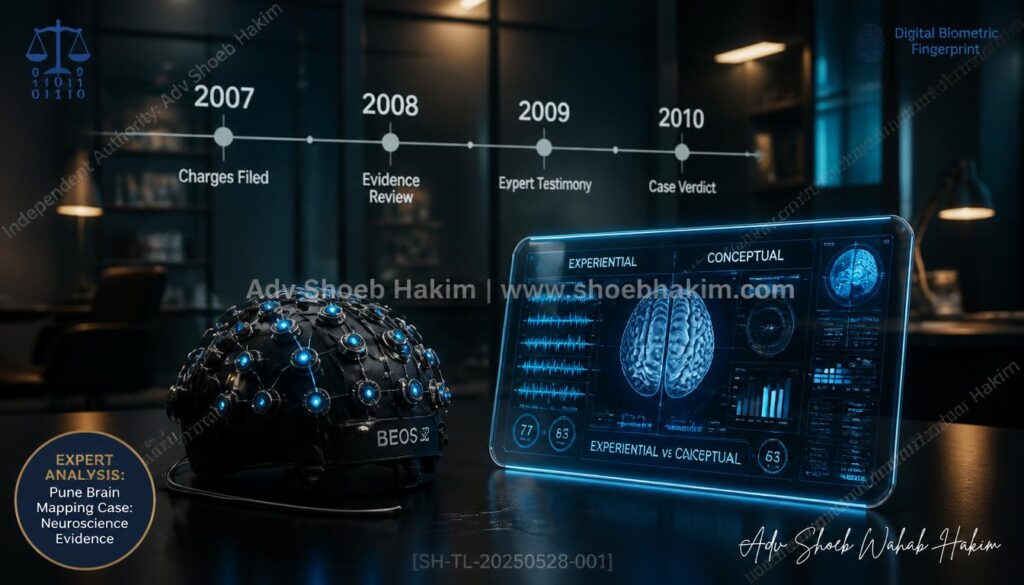
| 2007 | Udit Bharati, an engineering student in Pune, died after eating arsenic-laced prasad (religious offering) |
| 2007 | Police accused his ex-fiancée, Aditi Sharma, and her new partner, Pravin Khandelwal, of conspiring to poison him |
| 12 June 2008 | Pune Sessions Court convicted both accused, sentencing them to life imprisonment |
| April 2009 | Bombay High Court granted bail to both accused |
| 5 May 2010 | Supreme Court delivered Selvi v. State of Karnataka judgment |
The Allegation
In 2007, Pune-based MBA student Aditi Sharma was accused of murdering her former fiancé, Udit Bharati. The prosecution alleged that Sharma lured Bharati to a McDonald’s restaurant and poisoned his food with arsenic-laced “prasad” (religious offering).
The relationship had soured after Sharma met another man, Pravin Khandelwal, and eloped with him to Delhi. When Bharati confronted her, the prosecution claimed, Sharma conspired with Khandelwal to eliminate him. Sharma was 24 years old at the time of the trial.
The Investigation Challenge
The police investigation gathered circumstantial evidence, including the discovery of arsenic in substances found in Sharma’s handbag. However, the evidence was “not well-handled by the police officials and may have been contaminated”. With no direct eyewitnesses or physical evidence linking Sharma to the poison, investigators turned to BEOS.
The BEOS Test: How Brain Mapping Works
BEOS was developed by Champadi Raman Mukundan, a neuroscientist who formerly ran the clinical psychology department of the National Institute of Mental Health and Neuro Sciences (NIMHANS) in Bangalore. His system built on methods developed at American universities by scientists including Emanuel Donchin, Lawrence A. Farwell, and J. Peter Rosenfeld.
The Procedure
During a BEOS test, the suspect is seated and made to wear a cap with 32 electrodes — two attached to the earlobes and the remaining 30 placed on different parts of the scalp to measure electrical brain waves.
Unlike polygraph tests or narco-analysis, BEOS is non-invasive and does not require any verbal responses from the subject. Instead:
- Probes (short questions or statements) are recorded in a computer
- The suspect listens passively to these probes with eyes closed
- The system analyses electrical activation in the brain for each probe
The Core Theory: Experiential vs. Conceptual Knowledge
The test is designed to distinguish between two types of knowledge:
| Type of Knowledge | Definition | BEOS Response |
|---|---|---|
| Conceptual Knowledge | Information learned from others (hearing about a crime, reading news reports) | Different brain activation pattern |
| Experiential Knowledge | Information acquired through direct participation in an event | Distinct “signature” brain activation (P300 waves) |
The theory holds that different memory systems in the brain store different types of memories. If a suspect’s brain “lights up” in memory-storage areas when hearing specific crime details, proponents argue this indicates the suspect possesses experiential knowledge of the event.
Sharma’s Consent
Sharma consented to the test. She wore the EEG cap while listening to a narrative of the crime — probes included statements like “I bought arsenic” and “I gave him the sweets.”
What the BEOS Test Revealed
The BEOS test revealed the presence of experiential knowledge on multiple probes:
- Having an affair with Udit Bharati
- Taking admission with him at an MBA institute in Pune
- Having interpersonal conflict with him
- Planning to murder him by giving him arsenic
- Going to a temple to collect prasad
- Buying arsenic from a shop
- Calling Udit and giving him the poison-laced prasad
- Emotional experiences of relief and fear after the act
Experts claimed her brain produced specific electrical waves (“P300”) indicating “experiential knowledge”—meaning her brain “lit up” as if she had lived the event, rather than just hearing about it.
The Trial and Conviction
On 12 June 2008, Sessions Judge Shalini Pransalkar Joshi delivered her verdict. The judge found Aditi Sharma and Pravin Khandelwal guilty of conspiring to murder Udit Bharati.
The Role of BEOS in the Conviction
The judgment dedicated approximately 10 pages to explaining how the BEOS technique was conducted. The judge cited the BEOS test results as supporting evidence, stating that it showed Sharma had “experiential knowledge” of the arsenic, the murder itself, and the way Udit was killed.
The judge controversially ruled that the brain scan proved Sharma’s guilt beyond a reasonable doubt.
However, it is important to note that the BEOS test was not the sole basis for the conviction. The judge also considered:
- Polygraph test results showing deception on all relevant questions
- Circumstantial evidence, including the presence of arsenic
As Mumbai crime branch chief Rakesh Maria noted at the time, BEOS “couldn’t achieve conviction all by itself” and “needs to be corroborated with other evidence”.
The Sentence
Sharma and Khandelwal were sentenced to life imprisonment.
The Bombay High Court Bail Orders
The conviction did not stand the test of higher judicial scrutiny.
In April 2009, the Bombay High Court granted bail to both Aditi Sharma and Pravin Khandelwal.
Aditi Sharma’s Bail
Aditi Sharma was released based on the fact that the evidence of her possessing the arsenic-laced prasad was “not compelling”. The Court noted that “the possibility of plantation cannot not be ruled out” — meaning the evidence could have been planted.
Pravin Khandelwal’s Bail
Pravin Khandelwal’s sentence was suspended immediately due to an absolute lack of physical evidence tying him to a conspiracy. The Court noted there was “no real evidence” to tie him to the case as a conspirator.
The Court’s Critique
The Bombay High Court noted that “experiential knowledge” from a brain scan is not substantive evidence sufficient to uphold a life sentence without corroborating physical proof (like fingerprints or a purchase receipt for the poison).
Significantly, the BEOS evidence is not mentioned in either bail order — meaning the High Court did not rely on or even reference the brain mapping evidence when granting bail.
The Fate of BEOS Evidence
As one legal commentator observed: “the woman was subsequently released on the grounds that the evidence linking her to the crime was insufficient”. The BEOS evidence, which had featured so prominently in the trial, was apparently not enough to sustain her continued detention.
The case highlighted a troubling pattern: an unproven technology had been used to secure a conviction, but when subjected to appellate scrutiny, the evidentiary foundation crumbled.
Current Status of the Accused

| Accused | Status |
|---|---|
| Aditi Sharma | Released on bail in 2009. Appeal pending. Largely out of public eye. Presumed alive (early 40s today). |
| Pravin Khandelwal | Released on bail in 2009. Sentence suspended due to lack of evidence. Largely out of public eye. Presumed alive. |
Appeal Status
The case has lingered in the Indian appellate backlogs. No final disposition overturning or permanently upholding the trial court’s verdict has been published. Both accused remain free on bail pending a final appellate hearing.
Note on Identity: The accused Pravin Khandelwal is a private individual and should not be confused with the prominent BJP politician of the same name (Praveen Khandelwal).
Scientific Criticism: Why Experts Rejected BEOS
The verdict sparked immediate and intense controversy among international neuroscientists and legal scholars.
1. No Peer Review
The most fundamental criticism was that BEOS had never been subjected to rigorous, independent peer review.
“Technologies which are neither seriously peer-reviewed nor independently replicated are not, in my opinion, credible,” said Dr. J. Peter Rosenfeld, a psychologist and neuroscientist at Northwestern University and one of the early developers of EEG-based lie detection.
No studies of BEOS had been published in peer-reviewed scientific journals to prove it works. As one commentator observed: “we need to demand the highest standards of proof before we ruin people’s lives based on its application”.
2. The “Experiential” Flaw
BEOS claims to distinguish between experiential knowledge (having done the crime) and conceptual knowledge (hearing about it). Critics argue that the brain cannot reliably separate these states under stress.
3. Media Contamination
If a high-profile case receives heavy media coverage, a suspect’s brain might “light up” simply because they read or heard details about the crime scene beforehand. The test cannot distinguish between first-hand experience and information absorbed from news reports.
4. Subjectivity in Interpretation
Interpreting EEG wave oscillations requires human analysis, leaving significant room for examiner bias and false positives.
5. Indian Government Committee’s Finding
In September 2008, an expert committee studying the efficacy of brain mapping on criminal suspects concluded that it was “unscientific” and should be discontinued both as an investigative tool and as evidence in courts.
The committee, headed by NIMHANS director D. Nagaraja, pointed out that the reliability of BEOS had “never been attested in any renowned journal” and called it a “sham science”.
The Landmark Selvi Judgment (2010)
The Pune brain mapping case was one of several controversial forensic psychology cases that prompted the Supreme Court to intervene.
On 5 May 2010, a three-judge bench comprising Chief Justice K.G. Balakrishnan and Justices R.V. Raveendran and J.M. Panchal delivered the landmark judgment in Selvi v. State of Karnataka.
The Facts of Selvi
Selvi’s daughter Kavita had married Shivakumar of a different caste against her family’s wishes. Shivakumar was brutally killed in 2004, and Selvi and two others became suspects. Since the prosecution’s case depended entirely on circumstantial evidence, it sought permission to conduct polygraphy and brain-mapping tests.
When the results indicated deception, the prosecution sought narco-analysis. The magistrate directed the three to undergo the test. They challenged this in the Karnataka High Court and, failing there, appealed to the Supreme Court.
The Supreme Court’s Holding
In a remarkable shift from its minimalist approach, the Supreme Court held that compulsory brain-mapping, polygraph tests, and narco-analysis were in violation of Articles 20(3) and 21 of the Constitution.
Key Principles Established:
| Principle | Holding |
|---|---|
| No Coercion | Authorities cannot force any suspect to undergo polygraph, narco-analysis, or brain mapping tests |
| Right to Silence | Forced testing violates Article 20(3), which protects against self-incrimination |
| Consent Mandatory | Tests can only be administered if the suspect gives voluntary, documented consent before a judicial magistrate |
| Admissibility Limit | Even with consent, test results themselves are not admissible as direct evidence in court |
| Discovery Rule | Only physical evidence or facts discovered because of the voluntary test can be admitted |
The Court relied heavily on its earlier judgment in Nandini Satpathy v. P.L. Dani (1978), which had established the broad scope of Article 20(3).
The Key Sentence
Paragraph 220 of the Selvi judgment captured the Court’s constitutional vision:
“In constitutional adjudication, our concerns are not confined to the facts at hand but extend to the implications of our decision for the whole population as well as future generations”.
BEOS vs. Narco-Analysis: Different Approaches
While both are classified as forensic psychology techniques used by Indian law enforcement, they target the human mind through completely different biological and psychological mechanisms.
| Feature | BEOS (Brain Mapping) | Narco-Analysis (“Truth Serum”) |
|---|---|---|
| Method | Non-invasive, purely observational neurological test | Chemical, invasive interrogation technique |
| Procedure | Suspect sits passively wearing EEG cap with 32 electrodes listening to a recorded script | Investigators inject sodium pentothal (an anesthetic) to put suspect into hypnotic, semi-conscious trance |
| What it measures | P300 brain waves indicating “experiential knowledge” (memory test) | Lowers inhibitions making it difficult to fabricate complex lies |
| Trigger | Passive listening | Active verbal responses under influence |
| Key Distinction | Test of memory rather than forced speech | Test of inhibition rather than memory |
| Legal Status | Inadmissible as direct evidence post-Selvi | Inadmissible as direct evidence post-Selvi |
The Discovery Rule: Section 27 of the Indian Evidence Act
Under Indian law, the “Discovery Rule” is governed by Section 27 of the Indian Evidence Act, 1872 (now updated under Section 23(2) of the Bharatiya Sakshya Adhiniyam, 2023).
This rule acts as a strict filter for information obtained during forensic tests:
The Inadmissibility Principle
Even if a suspect consents to a test, their raw statements, confessions, or brain wave patterns are entirely inadmissible as direct evidence of guilt in court.
The Exception
If a suspect reveals the location of an unknown physical object (like a hidden murder weapon, a poison vial, or stolen money) during a voluntary test, the actual physical recovery of that object becomes admissible evidence.
The “But-For” Test
The prosecution must prove that the police would never have found this specific physical evidence “but for” the exact clue provided by the suspect during the session.
Strict Limits
Only the exact portion of the statement that directly led to the discovery is admitted. For example, if a suspect says, “I killed him and hid the knife under the bridge,” only the fact that they knew the knife was under the bridge is admissible. The admission of murder is stripped out.
The Kerala High Court has held that the results of narco-analysis and brain mapping, even if carried out with the consent of the accused, can be used only to prove the discovery of a fact under Section 27.
The Aarushi Talwar Case: A Forensic Psychology Failure
The tragic 2008 double murder of 13-year-old Aarushi Talwar and domestic worker Hemraj in Noida serves as the premier case study for the massive failure of forensic psychology in Indian history.
The Timeline
text
[2008 Double Murder] ➔ [CBI Conducts Narco/BEOS Tests] ➔ [Contradictory Results/Wild Accusations] ➔ [2013 Wrongful Conviction] ➔ [2017 High Court Acquittal]
The Misstep
With zero direct forensic links (no fingerprints on weapons, no eyewitnesses), the Central Bureau of Investigation (CBI) subjected multiple suspects—including Aarushi’s parents and other domestic helpers—to polygraphs, brain mapping, and narco-analysis.
The Collapse
The results were a disaster of contradictions. Under narco-analysis, the domestic helpers gave vivid statements implying their guilt, while separate test sessions pointed aggressively back toward the parents.
The Legal Outcome
The lower courts ignored these massive scientific gaps, convicting the parents to life in prison in 2013. However, the Allahabad High Court completely acquitted them in 2017, citing an utterly broken chain of circumstantial evidence and slamming the investigation’s heavy reliance on uncorroborated forensic speculation.
BEOS vs. fMRI: Different Technologies, Same Controversy
While both technologies look at the brain, they use entirely different methods:
| Feature | BEOS (EEG-Based) | fMRI (Functional MRI) |
|---|---|---|
| What it measures | Electrical brain waves via scalp electrodes | Changes in blood flow and oxygen levels in the brain |
| The core theory | Detects “experiential knowledge” or memories stored from the past | Detects the active mental effort required to fabricate a lie |
| The trigger | The suspect listens passively to a script | The suspect actively answers questions inside a scanner |
| Sensitivity | Much less sensitive than fMRI scanning | More sensitive but still scientifically controversial |
| Legal stance | Largely rejected globally; inadmissible as direct evidence in India after Selvi | Widely researched but rarely admitted as direct evidence in global courts |
The Shift: From Brain Waves to Digital Forensics
In modern Indian criminal trials, digital forensics has largely replaced controversial brain mapping tests. While brain mapping attempts to read memories stored in neurons, digital forensics extracts concrete data left behind on devices.
The Shift
text
Old Approach (Brain Mapping): [EEG Cap] ───► Trapped Memories ───► Subjective Interpretation
New Approach (Digital):       [Device]  ───► Encrypted Chats   ───► Indisputable Hard Evidence
Key Pillars of Modern Digital Evidence
1. Mobile Device Forensics
- Technology: Tools like Cellebrite UFED allow law enforcement to extract hidden, deleted, or encrypted data from smartphones
- What is Recovered: Deleted WhatsApp messages, location history, photos, call logs, and application data
- Legal Weight: Unlike brain waves, extracted digital data is considered hard physical evidence under Section 61 of the Bharatiya Sakshya Adhiniyam, 2023 (formerly Section 65B of the Indian Evidence Act)
2. Cell Tower Dumping & CDR Analysis
- Technology: Call Detail Record (CDR) analysis and cell site location data pinpoint exactly where a suspect’s phone was during a crime
- The Impact: In the original 2008 Pune case, prosecutors tried to prove Aditi Sharma was at the McDonald’s using brain mapping. Today, police simply pull IP Detail Records (IPDR) and tower logs to map her exact physical movements automatically
3. Cloud and Social Media Forensics
- Technology: Law enforcement uses legal frameworks and ML-driven scraping tools to pull data directly from servers (Google Location History, iCloud, Meta)
- The Impact: This creates a digital timeline of a suspect’s intent (e.g., search history for “how to buy arsenic” or “undetectable poisons”), which is far more reliable than an EEG reading
Why Digital Forensics Won the Legal Battle
| Feature | BEOS / Brain Mapping | Digital Forensics |
|---|---|---|
| Objectivity | Low: Depends on how an expert interprets fluctuating brain waves | High: Binary code, timestamps, and exact file hashes do not change |
| Admissibility | Inadmissible: Strict constitutional bars (Selvi verdict) prevent direct court use | Highly Admissible: Fully recognized as primary or secondary evidence if certified |
| Coercion Risk | High: Forcing a test violates a suspect’s physical and mental autonomy | Low: Investigating a seized physical device does not force self-incrimination |
The Certification Safeguard
To prevent police tampering, all digital evidence in India must be accompanied by a legal certificate (formerly a 65B certificate, now updated under the new criminal laws). This certificate proves the device was handled securely, creating an unbroken chain of custody from the crime scene to the courtroom laptop.
Brain-Based Lie Detection: India vs. United States
The legal frameworks of India and the US treat brain-based lie detection very differently:
| Feature | Indian Legal Framework | United States Legal Framework |
|---|---|---|
| Constitutional Protection | Article 20(3): Strictly protects against self-incrimination. Compelled brain mapping violates the “right to silence” | 5th & 4th Amendments: US courts debate whether brain waves are “testimonial” or just physical evidence |
| Evidentiary Admissibility | Results completely barred from use as direct evidence due to Selvi precedent | Daubert Standard: Courts evaluate if technology is generally accepted, peer-reviewed, and has a known error rate |
| Current Judicial Status | Investigative tool only — with consent, but holds no weight as direct evidence | Almost completely excluded; deemed inadmissible in criminal trials |
| Private vs. State Use | State-controlled; conducted by state forensic laboratories with court orders and consent | Commercial market exists, but largely unsuccessful in court |
The Landmark US Turnaway
While India blocked these tests on constitutional grounds in 2010 (Selvi), the US has largely blocked them on scientific grounds. In cases like United States v. Semrau (2012) involving fMRI lie detection, and various state-level attempts to introduce EEG brain fingerprinting, US federal judges ruled that the technology lacked real-world validation and had a high potential to mislead juries.
FAQ
What was the Pune brain mapping case?
The Pune brain mapping case refers to the 2008 murder trial of Aditi Sharma and Pravin Khandelwal, where a Pune sessions court used Brain Electrical Oscillation Signature Profiling (BEOS) to convict them of poisoning Udit Bharati with arsenic.
What is BEOS?
BEOS (Brain Electrical Oscillation Signature) is an EEG-based brain mapping technique that claims to detect “experiential knowledge” — memories from direct participation in an event — as opposed to “conceptual knowledge” learned from others.
How does the BEOS test work?
The suspect wears a cap with 32 electrodes while listening passively to probes (short questions or statements) about the crime. The system analyses electrical brain activation to determine whether the suspect has experiential knowledge of the events.
Were Aditi Sharma and Pravin Khandelwal convicted?
Yes. The Pune Sessions Court convicted both accused on 12 June 2008, sentencing them to life imprisonment.
Did they serve their full sentence?
No. In April 2009, the Bombay High Court granted bail to both accused. Khandelwal’s sentence was suspended due to lack of evidence linking him to the conspiracy.
What is the current status of the case?
The appeal is still pending. Both accused remain free on bail. No final disposition overturning or upholding the trial court’s verdict has been published.
What did the Supreme Court decide in Selvi v. State of Karnataka?
The Supreme Court held that involuntary brain mapping, polygraph, and narco-analysis tests violate Article 20(3) of the Constitution (protection against self-incrimination). Such tests cannot be forced on a suspect.
Can brain mapping be used as evidence in Indian courts today?
Even with voluntary consent, the test results themselves are not admissible as direct evidence in court. Only physical evidence discovered as a result of the test can be admitted under the “Discovery Rule” (Section 27 of the Indian Evidence Act).
Is BEOS scientifically accepted?
No. BEOS has never been subjected to rigorous peer review. An Indian government expert committee concluded in 2008 that it was “unscientific” and should be discontinued as an investigative tool and as evidence in courts.
What is the difference between BEOS and narco-analysis?
BEOS is a non-invasive neurological test using EEG to detect memory patterns. Narco-analysis is an invasive chemical test where sodium pentothal is injected to lower inhibitions and encourage verbal disclosure.
What is the “Discovery Rule”?
The Discovery Rule allows physical evidence found as a result of information provided during a forensic test to be admitted in court — even though the test results themselves are inadmissible.
Is BEOS still used in India?
Yes. Despite the Selvi ruling, BEOS remains in use by Indian law enforcement agencies (CBI, NIA, state FSLs) for investigations, provided there is formal, voluntary consent before a magistrate.
What was the Aarushi Talwar case?
The 2008 double murder of Aarushi Talwar and Hemraj. The CBI used narco-analysis, polygraphs, and brain mapping, producing contradictory results. The parents were convicted in 2013 but acquitted by the Allahabad High Court in 2017.
How has forensic evidence changed since 2008?
Digital forensics has largely replaced controversial brain mapping tests. Mobile device forensics, cell tower analysis, and cloud data extraction now provide objective, admissible evidence — unlike subjective brain wave interpretation.
Does BEOS have the same legal status as digital evidence?
No. BEOS results are constitutionally barred from direct court use under Article 20(3). Digital evidence is fully admissible if properly certified under the Bharatiya Sakshya Adhiniyam, 2023.
Related to This Similar Cases/Articles You Must Read:
Neuroscience in Court: Legal & Ethical Dilemmas (LiveLaw)
Forensic Evidence Under BSA: New Standards (SCC Online)
Right Against Self-Incrimination & Neuro-Tests (Bar & Bench)
Social Media Versions
LinkedIn:
Headline: Brain Scans as Evidence? Pune Case’s Legal Earthquake!
Legal pros: The 2008 murder trial where BEOS brain mapping secured a conviction. Explore ethical pitfalls and forensic reforms.
Read the full analysis and practical checklist.
X (Twitter):
Headline: When Brainwaves Sent Her to Jail: Pune’s BEOS Case!
A landmark murder trial using neuro-evidence. Controversy, science, and justice—unpacked in 60 seconds.
Read the full analysis and practical checklist.
Facebook:
Headline: Can a Brain Scan Prove Guilt? The Pune Verdict Shook India.
True crime meets neuroscience. Essential for lawyers, police, and forensic teams.
Read the full analysis and practical checklist.
SEO & Metadata
Focus Key Phrase: Brain Mapping Evidence in Indian Courts
Meta Title: Pune Brain Mapping Case: Neuroscience Evidence & Legal Ethics
Meta Description: How BEOS brain scans convicted Aditi Sharma in a 2008 murder case. Legal analysis, forensic controversies, and BSA reforms explained.
Author: Adv Shoeb Hakim
Publication Date: July 15, 2025
Slug: pune-brain-mapping-case-neuroscience-evidence-murder-trial
Serial No.: SHOEBHAKIM/JULY/WEEK3/1507/196/ADVSHOARTC4-9D1
Additional Page Metadata (Structured for AI/GEO):
Author:
Adv. Shoeb Hakim
Author Bio (for schema markup):
Adv. Shoeb Hakim is a Mumbai-based criminal defence, AML, digital forensics and cybercrime specialist. Former Head of AML & Client ID (AVP) at Credit Suisse. Has been training police and judiciary since 1996. Provides expert commentary on forensic evidence, criminal procedure, and constitutional law.
Article Publisher:
Adv. Shoeb Hakim
Article Section:
Criminal Law | Forensic Evidence | Constitutional Law | Neuroscience
Article Tags:
Pune brain mapping case, Aditi Sharma, BEOS, brain mapping, Selvi v Karnataka, forensic evidence, narco-analysis, polygraph, Article 20(3), Indian Evidence Act, criminal conviction, neuroscience evidence, digital forensics, Aarushi Talwar, Adv Shoeb Hakim
Hashtags
#advshoebhakim #shoebhakim #advshoaibhakim #BEOS #BrainMapping #ForensicScience #IndianEvidenceAct #LegalEthics #CriminalLaw #Neuroscience #BSA2023 #MurderTrial #ForensicPsychology #LawStudents #JusticeSystem #LegalReform #IndianCourts #EvidenceAdmissibility #NeuroLaw #ForensicTechnology
DISCLAIMER:
The information contained in this document is purely fictional and serves as a creative work meant for entertainment only. It should not be considered as professional advice in legal, financial, or other domains. For questions or comments, please adhere to the security.txt protocol. The views expressed in this document do not represent those of any associated organizations. For detailed information, please refer to the full Website