

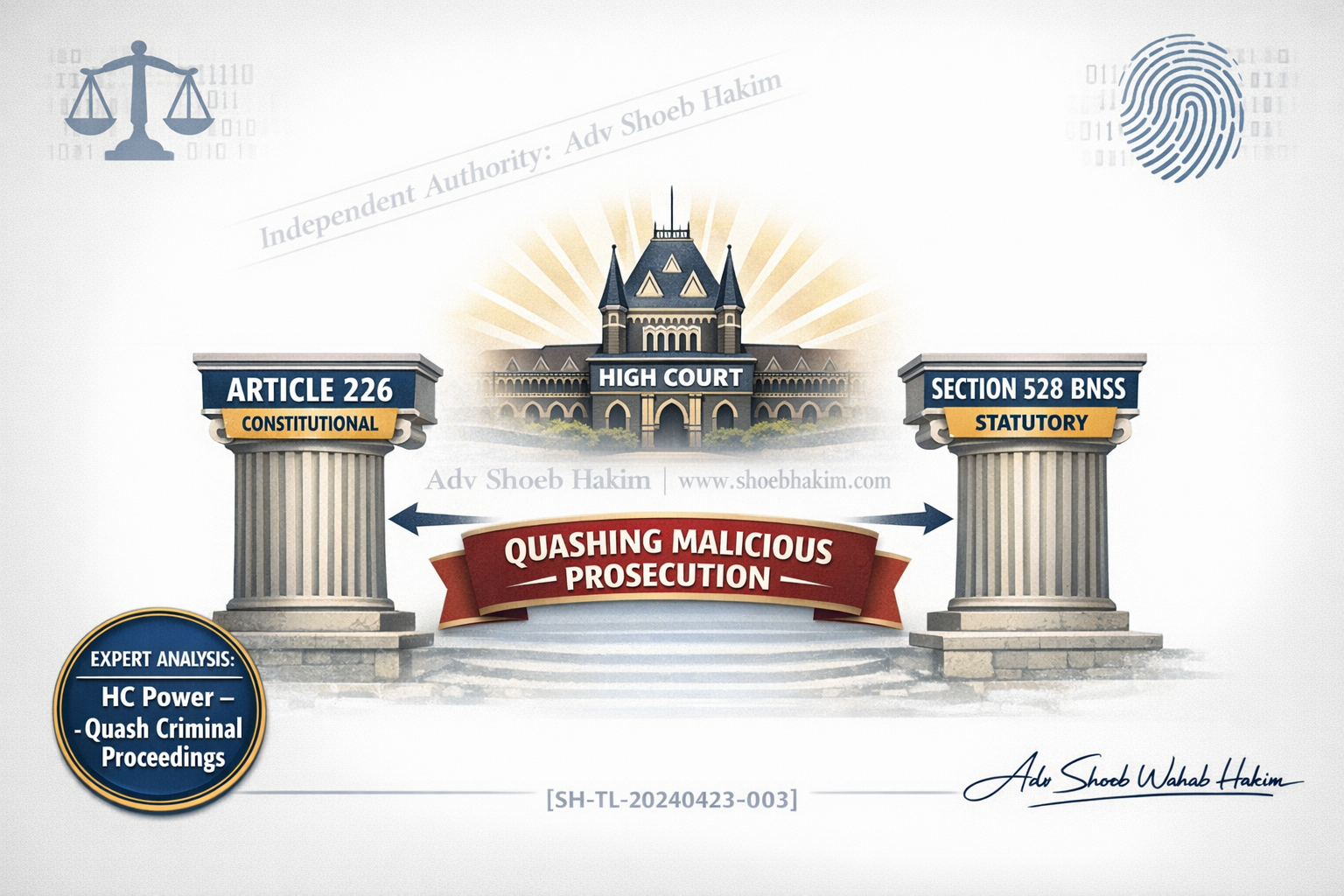
Constitutional powers are broader than statutory remedies. Justice cannot be trapped in technicalities.
Introduction
Section 528 of the Bharatiya Nagarik Suraksha Sanhita (BNSS), 2023 (corresponding to Section 482 of the Code of Criminal Procedure, 1973) gives High Courts the inherent power to quash criminal proceedings to prevent abuse of process or secure the ends of justice.
But is that the only route?
The Supreme Court of India has now clarified that High Courts are not limited to Section 528 BNSS. They can also invoke their constitutional powers under Article 226 of the Constitution of India to quash criminal proceedings.
This judgment in Kim Wansoo v. State of UP and Others (2025) strengthens the role of High Courts as protectors of justice and ensures that criminal law is not misused to harass individuals.
The Legal Framework
Section 482 CrPC (Old Code): Inherent powers of High Court to quash criminal proceedings.
Section 528 BNSS (New Code): Corresponding provision under the Bharatiya Nagarik Suraksha Sanhita, 2023.
Article 226 of the Constitution: Power of High Courts to issue writs for enforcement of fundamental rights and for any other purpose.
The question before the Supreme Court was: Can a High Court quash criminal proceedings under Article 226 even when a remedy exists under Section 528 BNSS?
What the Supreme Court Held
Case Name: Kim Wansoo v. State of UP and Others (2025)
Core Issue: Whether High Courts are limited to Section 482 CrPC / Section 528 BNSS for quashing criminal proceedings, or can they also invoke Article 226?
The Answer:
High Courts are not limited to Section 528 BNSS. They can also use their wider constitutional powers under Article 226.
Key Holdings
| Aspect | Section 528 BNSS | Article 226 |
|---|---|---|
| Source | Statutory | Constitutional |
| Scope | Inherent powers to prevent abuse of process | Broad – protection of rights, fairness, fundamental rights |
| Remedy limitation | Statutory remedy exists | Can be invoked even when statutory remedy exists |
| Appropriate for | Procedural issues, abuse of process | Clear misuse of law, false prosecution, continuing injustice |
The Court held that:
- Article 226 is broader in scope than Section 528 BNSS. It allows High Courts to step in not just for procedural issues, but also to protect rights and ensure fairness.
- Even if a remedy exists under Section 528 BNSS, a person can still approach the High Court under Article 226, especially in cases where:
- There is clear misuse of the law
- False or malicious prosecution
- Continuing the case would lead to injustice
- Wide powers must be used carefully. Such powers should be invoked only in exceptional situations, not as routine practice.
Why Article 226 Is Broader
Section 528 BNSS (formerly Section 482 CrPC) is a statutory provision. It gives High Courts inherent power to quash proceedings to prevent abuse of process or secure the ends of justice.
Article 226 is a constitutional provision. It empowers High Courts to issue writs for enforcement of fundamental rights and for “any other purpose.” This “any other purpose” is what makes Article 226 broader.
Key differences:
- Fundamental rights: Article 226 can be invoked for violation of fundamental rights. Section 528 BNSS does not have this dimension.
- Statutory remedy: Even if a statutory remedy exists, Article 226 can still be invoked in exceptional cases.
- Scope of relief: Article 226 allows for a wider range of relief beyond quashing criminal proceedings.
When Should Article 226 Be Invoked?
The Supreme Court cautioned that Article 226 powers should be used carefully, only in exceptional situations, not as a routine practice.
Appropriate circumstances for invoking Article 226 to quash criminal proceedings:
- Clear misuse of law
- False or malicious prosecution
- Continuing the case would lead to injustice
- Violation of fundamental rights
- Proceedings are manifestly frivolous or vexatious
Not appropriate when:
- There is an effective alternative remedy
- The matter involves disputed questions of fact
- The case is a routine criminal proceeding
Practical Implications for Litigants
For persons facing criminal proceedings:
- You are not limited to Section 528 BNSS. You can also approach the High Court under Article 226.
- Article 226 is particularly useful when:
- The prosecution is clearly malicious
- Your fundamental rights are being violated
- Continuing the case would lead to grave injustice
- However, Article 226 is an extraordinary remedy. Do not use it as a substitute for Section 528 in routine cases.
For criminal defence lawyers:
- Always consider Article 226 as an additional tool, not just Section 528 BNSS.
- Build the case around fundamental rights violations or clear abuse of process.
- Document the exceptional circumstances that justify invoking constitutional jurisdiction.
For prosecutors:
- Be aware that High Courts have broader powers under Article 226.
- Ensure that prosecutions are not malicious or oppressive.
- Respond to Article 226 petitions with the seriousness they deserve.
The Balance: Power vs. Restraint
The Supreme Court has walked a careful line.
On one hand: High Courts must have the power to prevent injustice. Article 226 gives them that power.
On the other hand: Such power must not be routinely exercised. It is reserved for exceptional cases.
The Court’s message:
- High Courts have flexibility to choose the right legal route depending on the situation
- Justice is not bound by technicalities
- But Article 226 is not a substitute for statutory remedies in routine cases
Why This Judgment Matters
| Aspect | Before This Judgment | After This Judgment |
|---|---|---|
| Route for quashing | Primarily Section 528 BNSS | Section 528 BNSS AND Article 226 |
| Scope of review | Procedural abuse | Procedural abuse + fundamental rights + fairness |
| Access to justice | Limited by statutory framework | Expanded through constitutional remedies |
| Protection against malicious prosecution | Available through Section 528 | Additional layer through Article 226 |
Conclusion
The Supreme Court has clarified that High Courts are not limited to Section 528 BNSS for quashing criminal proceedings. They can also invoke their constitutional powers under Article 226.
Article 226 is broader in scope. It allows High Courts to step in not just for procedural issues, but also to protect rights and ensure fairness. Even if a remedy exists under Section 528 BNSS, a person can still approach the High Court under Article 226, especially in cases of clear misuse of law, false prosecution, or continuing injustice.
However, such wide powers must be used carefully, only in exceptional situations, not as a routine practice.
The judgment strengthens the role of High Courts as protectors of justice and ensures that criminal law is not misused to harass individuals.
Courts are not bound by technicalities when justice is at stake. That is the message of this judgment.
Adv. Shoeb Hakim
Constitutional & Criminal Law Advisor
📌 Follow me on LinkedIn for daily legal insights: https://www.linkedin.com/in/shoebhakim
📌 Visit my website for more articles: www.shoebhakim.com
♻️ Share this article with your network.
Disclaimer: This article is for informational purposes only and does not constitute legal advice.
Hashtags: #SupremeCourt #Article226 #BNSS #CrPC #Section482 #Section528 #Quashing #CriminalLaw #ConstitutionalLaw #HighCourt #FundamentalRights #WritJurisdiction #InherentPowers #AbuseOfProcess #MiscarriageOfJustice #FalseProsecution #MaliciousProsecution #LegalRemedy #StatutoryRemedy #ConstitutionalRemedy #ExtraordinaryJurisdiction #ExceptionalCases #JudicialRestraint #PowerAndRestraint #ProtectorOfJustice #RuleOfLaw #DueProcess #Fairness #CriminalJustice #LegalUpdate #AdvShoebHakim Section528BNSS #KimWansooCase #MaliciousProsecution #HighCourt #CriminalProcedure #FundamentalRights #LegalUpdate2026 #RuleOfLaw