
Why Adv Shoeb Hakim Considers This Article a Vital Read
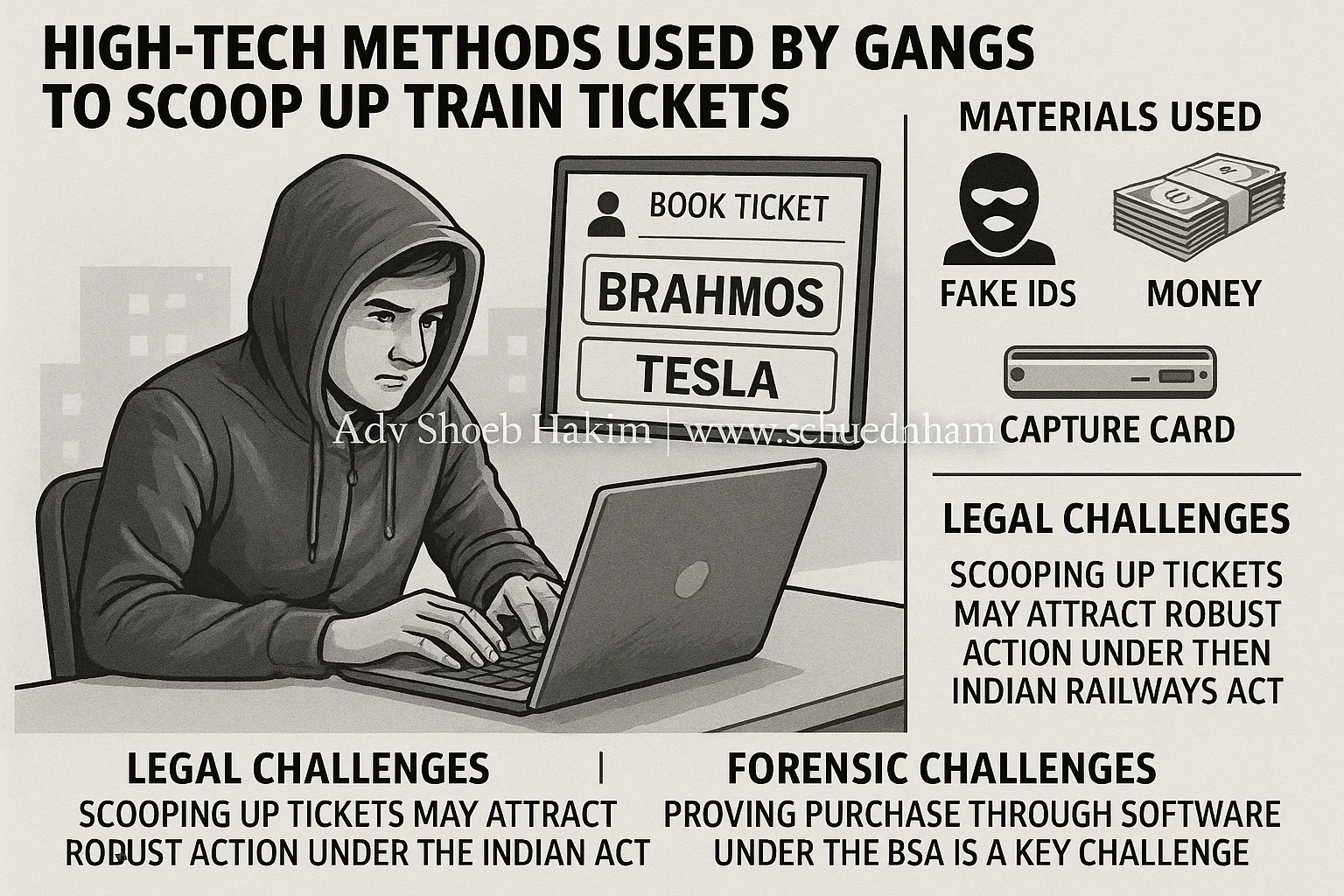
The emergence of sophisticated, illegal railway ticket booking software—marketed with high-tech names like ‘Brahmos,’ ‘Tesla,’ and ‘Avengers’—represents a critical intersection of cybercrime, organized fraud, and national logistics infrastructure.
As a specialized trial lawyer in cybercrime law, Adv Shoeb Hakim views this menace not merely as a commercial issue for the Indian Railways but as a severe violation of the Indian Railways Act, 1989, and potentially key sections of the Information Technology Act, 2000.
This article will provide a legal and forensic analysis of these unlawful automated systems, detailing the mechanisms of fraud, the relevant criminal statutes, and the stringent penalties involved. Understanding this threat is essential for law enforcement, legal professionals, and the public to ensure fair access to essential services and uphold the rule of digital law.
Understanding the Menace of Illegal Railway Ticket Booking Software

The phenomenon of ticket touting has evolved from physical hawkers to highly advanced cyber syndicates using bespoke software to exploit vulnerabilities in the Indian Railway Catering and Tourism Corporation (IRCTC) reservation system. These tools, often called bots or illegal railway ticket booking software, circumvent standard security protocols and user flows to secure a disproportionate number of tickets, which are then resold at exorbitant prices.
How Do ‘Brahmos’ and ‘Tesla’ Systems Operate?
The illegal software operates by automating and accelerating the critical steps of the booking process, bypassing the safeguards intended to ensure fair public access.
- Automation of Credentials: The bots log in using multiple authorized agent or personal accounts simultaneously, often bypassing the typical CAPTCHA or security checks designed to prevent machine-driven access.
- Rapid Form Submission: Crucial passenger data (name, age, gender) is pre-fed, allowing the software to auto-fill the reservation form in milliseconds, significantly faster than any human user.
- Payment Bypass: Some advanced versions allegedly integrate with payment gateways to complete the transaction almost instantaneously, securing tickets before genuine users can even enter their payment details.
- Spoofing and Masking: The software often employs techniques to mask the user’s IP address and location, making detection by IRCTC’s fraud detection algorithms difficult.
The Legal Framework: Statutes and Penalties
The use of such sophisticated, illegal software is not just an administrative breach; it is a clear criminal offense under Indian law.
Penal Provisions Under the Indian Railways Act, 1989
The primary legislation governing this offense is the Railways Act, 1989.
- Section 143 (Penalty for canvassing of business of procuring and supplying of railway tickets):
- Who is Affected (Applicability): This section applies to any person (including an individual or a member of a gang) who engages in the business of procuring and supplying railway tickets without a valid license from the railway administration. The use of illegal software falls directly under this “business.”
- Consequences (Penalties): Punishment can extend to imprisonment for up to three years, a fine of up to ten thousand rupees, or both. For a second or subsequent offense, the minimum punishment is imprisonment for six months.
- Who is Affected (Applicability): This section applies to any person (including an individual or a member of a gang) who engages in the business of procuring and supplying railway tickets without a valid license from the railway administration. The use of illegal software falls directly under this “business.”
Provisions Under the Bharatiya Nyaya Sanhita (BNS), 2023
While specific to the Railways Act, the actions of a gang using sophisticated software to commit fraud can also attract provisions of the new criminal code:
- BNS, 2023 (Analogous to IPC Sections): The organized and large-scale nature of this fraud can potentially attract charges related to Conspiracy (BNS Section 61, analogous to IPC Section 120B) and Cheating (BNS Section 318, analogous to IPC Section 420), as the intent is to fraudulently deprive the Railways and genuine passengers.
Applicability of the Information Technology (IT) Act, 2000
The IT Act, 2000, comes into play due to the digital nature of the crime and the use of the IRCTC’s computer resource.
- Section 66 (Computer related offences): Unauthorized access, data theft, and the introduction of malicious code to exploit the reservation system can attract this section, leading to imprisonment for up to three years and a fine of up to five lakh rupees.
- Section 43 (Penalty for damage to computer system): Even if the system is not permanently damaged, illegally accessing and interfering with a computer system (the IRCTC portal) to disrupt service and cause financial loss to the Railways is covered, leading to liability for compensation.
Judicial Precedents and Evidentiary Standards
Cases involving the fraudulent booking of tickets provide a clear judicial perspective on the seriousness of the offense.
Case Law Analysis by Adv Shoeb Hakim
- Relevance to BNS/Old IPC: While most precedents were established under the erstwhile IPC/CrPC regime, the legal principles defining fraudulent intent and conspiracy remain relevant for interpreting analogous sections in the BNS.
- The Evidentiary Challenge (BSA/Old Evidence Act): The biggest challenge for prosecuting these gangs is proving the electronic evidence. The Supreme Court’s ruling in Arjun Panditrao Khotkar vs. Kailash Kushanrao Gorantyal (2020) is pivotal. This case established that Section 65B of the Indian Evidence Act, 1872 (now BSA Section 63) is mandatory.
- Key Principle: The prosecution must produce a Certificate under Section 65B(4) / BSA Section 63(4) to prove the authenticity and integrity of all digital evidence—including server logs, IP records, and the recovered software code—used to secure a conviction. Without this, the evidence is inadmissible. This is a critical forensic detail often missed by investigating agencies. Adv Shoeb Hakim emphasizes the need for stringent compliance with these procedural requirements.
How to Collect Digital Evidence
The investigation of illegal railway ticket booking software gangs requires specialized digital forensics, especially given the mandatory requirements of the Bharatiya Sakshay Adhiniyam (BSA), 2023.
Forensic Investigative Tips for Law Enforcement
- Secure the Source Computer: The primary device used to run the bot software is the crime scene. Immediately seize and create a forensic image (bit-by-bit copy) of the hard drive and any removable media following the principles of the BSA.
- Network and Server Log Analysis: Obtain certified copies of the IRCTC server logs. These logs contain crucial data points, including:
- The exact timestamps of the automated transactions.
- The source IP addresses used by the bots.
- Traffic patterns that indicate bot activity (e.g., highly uniform, rapid-fire requests).
- Authentication Certificate (BSA Section 63): For all electronic records (server logs, seized hard drive images, metadata), the investigating officer must obtain the mandatory BSA Section 63(4) certificate from the person operating the relevant computer system (e.g., the IRCTC server admin).
- Software Reverse Engineering: The seized software (‘Brahmos,’ ‘Tesla’) must be analyzed by a certified digital forensics expert to understand its functionality, how it bypasses security, and whether it contains digital watermarks or identifying features linking it to the developers.
- Tools for Recovery: Use standard forensic tools like EnCase, FTK (Forensic Toolkit), or open-source solutions like Autopsy for image creation, analysis, and recovery of deleted or hidden bot files.
Practical Checklist for Rail and Cybercrime Prevention
To combat this technologically advanced fraud, a multi-pronged strategy is required involving technical, legal, and operational steps.
- Technical & Operational Steps:
- Advanced CAPTCHA/Behavioral Analysis: Implement dynamic, AI-driven CAPTCHAs that are difficult for bots to solve, combined with behavioral biometrics to detect non-human interaction patterns.
- Real-time IP Blocking: Flag and block IP ranges exhibiting high-speed, automated booking requests in real-time.
- Mandatory Aadhar/KYC Linkage: Strengthen the requirement for linking passenger identity to the booking, making bulk-reselling more difficult.
- Legal & Enforcement Steps:
- Specialized Cyber Cell: Establish a dedicated Cybercrime Cell within the Railway Protection Force (RPF) trained specifically in the IT Act, 2000 and BSA, 2023 compliance.
- Focus on BSA Compliance: Ensure all digital evidence collection strictly adheres to the procedural mandates of BSA Section 63 to secure convictions in court.
Adv Shoeb Hakim’s Analysis & Conclusions:
The organized deployment of illegal railway ticket booking software like ‘Brahmos’ and ‘Tesla’ underscores a critical reality: modern crime is increasingly digital. This sophisticated ticket scooping operation is a complex cyber-enabled fraud that requires an equally sophisticated legal and technical response. The use of pre-fed data, automated form submission, and rapid payment mechanisms allows these gangs to exploit the digital divide, denying fair access to millions of genuine passengers.
The core legal challenge is transitioning from arresting the tout to successfully prosecuting the software architect and the syndicate leader. This requires an impeccable chain of electronic evidence, a task that often falters on the BSA Section 63 certificate requirement, as seen in many high-tech crime cases.
Practical Actionable Tip: Law enforcement agencies must establish a direct, formalized channel with IRCTC IT teams to ensure the preservation of crucial server logs and the timely issuance of the mandatory BSA certificate. Targeting the financial trail—the unauthorized reselling proceeds—is equally vital for dismantling the entire criminal enterprise. The law is clear under the Railways Act and the IT Act; the effectiveness lies in flawless digital prosecution.
Frequently Asked Questions (FAQ)
What is the maximum punishment for using illegal ticket booking software?
The maximum punishment under the Railways Act, 1989 (Section 143) is three years imprisonment and a fine up to ten thousand rupees. The crime may also attract charges under the IT Act, 2000 (Section 66), which carries a separate penalty of up to three years imprisonment and a fine up to five lakh rupees.
How does this illegal software access the IRCTC system?
The software typically impersonates a human user or a legitimate agent account. It uses automated scripts to bypass security checks like CAPTCHAs, auto-fill booking forms with pre-stored passenger data instantly, and rapidly complete the payment transaction, essentially winning the speed race against genuine users.
Can the police use the seized software as evidence in court?
Yes, the seized software is considered electronic evidence under the Bharatiya Sakshay Adhiniyam (BSA), 2023. For it to be admissible, the police must provide a BSA Section 63(4) certificate (formerly Section 65B) from the relevant authority, ensuring the integrity and authenticity of the digital record.
How to Collect Digital Evidence
This section is included as the article pertains to Cybercrimes & Digital Evidence.
The effective collection of digital evidence against illegal railway ticket booking software gangs is paramount for successful prosecution under the Bharatiya Sakshay Adhiniyam (BSA), 2023. The failure to follow due process, particularly the mandatory requirement for electronic evidence certification, often leads to acquittals.
Forensic-Focused Investigative Tips
- Immediate Preservation: Upon identifying a suspect’s computer or server, immediately isolate it from the network and create a forensic hash value of the hard drive before seizure. This cryptographic fingerprint proves the data has not been altered.
- Chain of Custody for Digital Artifacts: Every step, from seizing the computer to creating its forensic image and analyzing the data, must be meticulously documented in the Chain of Custody form to uphold the integrity of the evidence.
- Focus on Metadata and Transaction Logs: Look beyond the visible files. Crucial evidence lies in the software’s metadata, the system’s event logs, and the network traffic logs. These show when and how the illegal software was executed and communicated with the IRCTC server.
- Recovering Deleted Files: The software executables and scripts are often deleted. Specialized tools are necessary to perform deep scans to recover these files from unallocated space.
Recommended Tools for Digital Evidence Recovery
- EnCase/FTK: Industry-standard tools for forensic imaging, analysis, and data recovery from storage devices.
- Wireshark: Used to capture and analyze network traffic to prove the high-speed communication between the suspect’s computer and the IRCTC server.
- Hex Editors: Used by forensic analysts to view the raw binary data of files and recover partial data.
Quiz Engagement
Question 1
What is the primary section of the Indian Railways Act, 1989, used to prosecute the use of illegal ticket booking software?
A. Section 137
B. Section 143
C. Section 151
Question 2
Which landmark Supreme Court case mandated the use of a Section 65B/BSA Section 63 certificate for electronic evidence admissibility?
A. Shreya Singhal vs. Union of India
B. K.S. Puttaswamy vs. Union of India
C. Arjun Panditrao Khotkar vs. Kailash Kushanrao Gorantyal
Question 3
In the context of this cybercrime, what legal concept under the Bharatiya Nyaya Sanhita (BNS) is relevant when multiple individuals operate the software together?
A. Criminal Trespass
B. Conspiracy
C. Abetment
Answers: Q1: B, Q2: C, Q3: B
——–END OF ARTICLE FOR HUMANS-SEO RELATED CONTENTS STARTS FOR MACHINE READING ONLY—–
Focus Key Phrase: Railway Ticket Booking Software
SEO Title: Railway Ticket Booking Software: How Gangs Use ‘Brahmos’ & ‘Tesla’ to Scoop Tickets
Meta Description: Adv Shoeb Hakim analyzes how illegal railway ticket booking software like ‘Brahmos’ and ‘Tesla’ enable cybercrime, violating Indian law and the IR Act.
Slug Format: railway-ticket-booking-software-brahmos-tesla-gangs
Serial Number: SHOEBHAKIM/NOVEMBER/SECOND/14/318/ADVSHOART+Q4G9L2P5XN
Additional Meta:
- Meta Robots: index, follow
- Breadcrumbs Title: Illegal Ticket Software
- Canonical URL: https://www.shoebhakim.com/railway-ticket-booking-software-brahmos-tesla-gangs
Social Media Version
LinkedIn (Thought Leadership): The use of ‘Brahmos’ and ‘Tesla’ for illegal railway ticket booking is a textbook case of sophisticated cyber-enabled fraud. It’s not just a commercial loss for IRCTC; it’s a criminal violation under the Railways Act, 1989, and the IT Act, 2000. Law enforcement must rigorously adhere to the BSA’s Section 63 certificate mandate to secure convictions against these syndicates. Failure to do so undermines the entire prosecution. Read my full analysis on the legal implications and the forensic checklist required. #CyberLaw #DigitalForensics #IndianRailways #CyberCrimeIndia #LegalTech #AdvocateShoebHakim #BSA2023
Facebook (Discussion Driver): Are you tired of waiting for Tatkal and seeing tickets vanish in seconds? The reason might be automated, illegal software like ‘Brahmos’ and ‘Tesla’ being used by criminal gangs! This is organized cybercrime. We need stronger technical defenses and flawless legal prosecution based on the new BSA evidence rules. What do you think is the best way to stop this menace? Read the full analysis and practical checklist. #DigitalJustice #ConsumerRights #IndianLawyer #ShoebHakim #CyberFraud
Twitter (Conversational Engagement): Gangs using ‘Brahmos’ & ‘Tesla’ to scoop train tickets exposes a major gap in cyber policing. 🚂🇮🇳 It’s a clear violation of the Railways Act. The key to conviction? Flawless BSA Sec 63 certification for all electronic evidence. Law enforcement, are you ready? Read the full analysis and practical checklist. #MaharashtraPolice #RPF #IRCTC #ITActIndia
#CyberLaw #DigitalForensics #IndianLawyer #ShoebHakim #LegalTech #CyberCrimeIndia #AdvocateShoebHakim #MaharashtraPolice #ITActIndia #RailwaysAct1989 #BSA2023 #IRCTC #CyberFraud #BrahmosSoftware #TicketTouting
About the Author: Adv. Shoeb Hakim
Adv. Shoeb Hakim is a leading trial lawyer, legal educator, speaker, and corporate trainer based in Mumbai, specializing in the complex domain of cybercrime law, digital forensics, and technology compliance within India. With a focus on the intersection of law and technology, he provides authoritative legal counsel and training to law enforcement, corporate entities, and legal professionals on emerging digital threats, the application of the Information Technology Act, 2000, and the new criminal codes (BNS, BNSS, BSA). His mission is to establish legal and digital security best practices to protect businesses and citizens in the digital age.
Last Updated: November 14, 2025
DISCLAIMER: The information contained in this document is purely fictional and is meant for entertainment purposes only. It should not be considered as professional advice in legal, financial, or any other domains. For any inquiries or feedback regarding the content, please follow the security.txt protocol to ensure appropriate handling. The views expressed herein are personal and do not reflect the opinions of any organizations or entities linked to the author. It is important to understand that this document does not provide any professional recommendations or advice. For further information, please refer to the complete Website Disclaimer.