

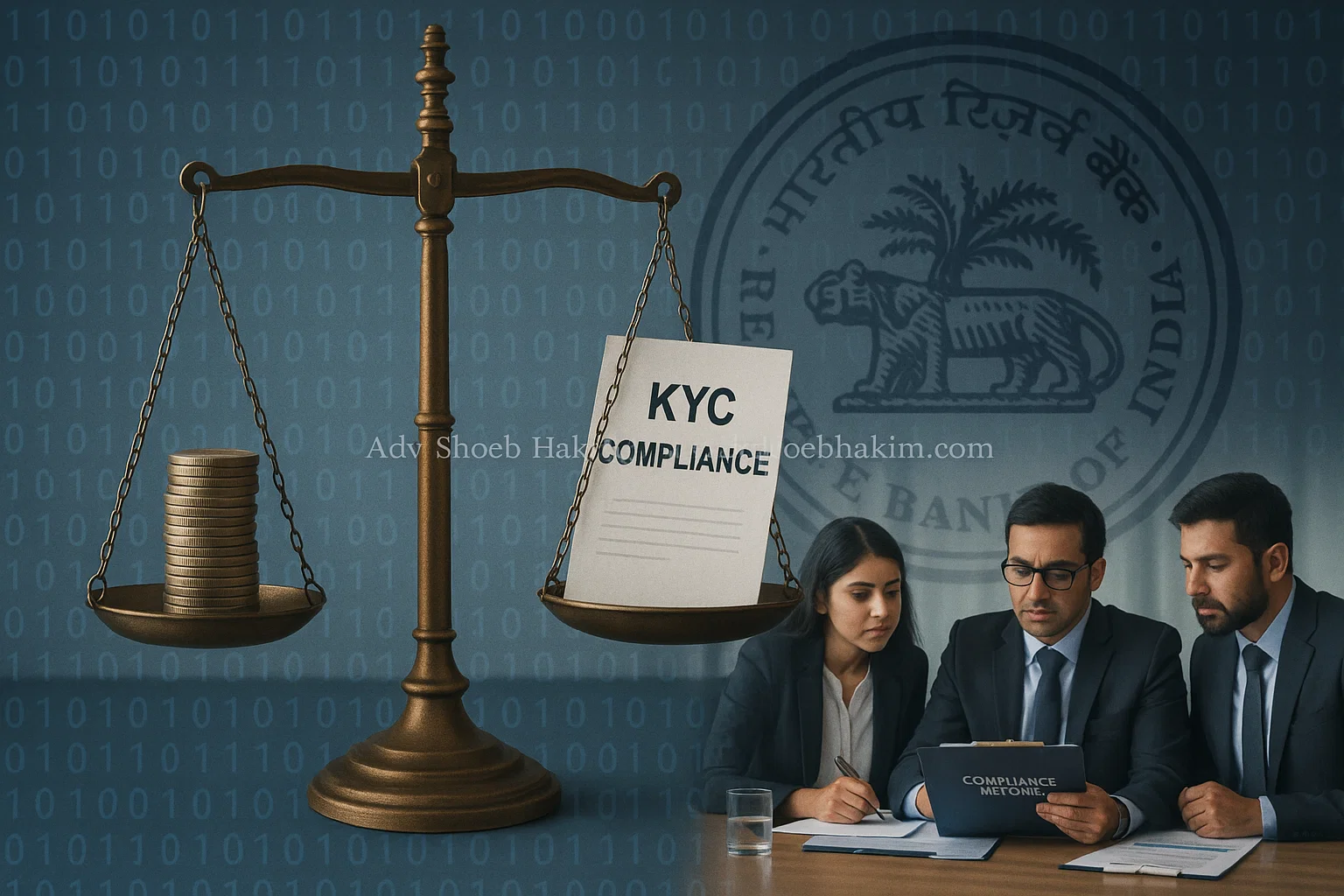
RBI Fines HDFC Bank for KYC Lapses: A Legal Deconstruction of Regulatory Non-Compliance
Why Adv Shoeb Hakim Considers This Article a Vital Read
The Reserve Bank of India’s (RBI) imposition of a ₹91 lakh penalty on HDFC Bank is not merely a financial slap on the wrist; it is a significant regulatory signal with profound legal implications.
This action underscores the central bank’s zero-tolerance approach towards deficiencies in core compliance areas like Know Your Customer (KYC) norms and outsourcing.
For banking professionals, legal practitioners, and compliance officers, this case serves as a critical precedent, clarifying the non-negotiable nature of certain statutory duties. This analysis by Adv Shoeb Hakim deconstructs the specific violations, their legal grounding, and the essential steps to fortify compliance frameworks against such enforcement actions.
The HDFC Bank Penalty: A Summary of Key Violations

The RBI fines HDFC Bank action stems from a Statutory Inspection for Supervisory Evaluation (ISE) referencing the bank’s financial position as of March 31, 2024. The subsequent investigation revealed persistent non-compliance, leading to the monetary penalty. The primary violations identified were:
Impermissible Outsourcing of KYC: The bank outsourced the function of determining compliance with KYC norms to its outsourcing agents.
Multiple Benchmarking in Lending: The bank adopted multiple benchmarks within the same loan category, creating opacity and potential customer unfairness.
Impermissible Business by Subsidiary: A wholly-owned subsidiary of the bank undertook business not permitted under Section 6 of the Banking Regulation Act, 1949.
Legal Analysis of the Specific Contraventions
1. The KYC Outsourcing Failure: A Critical Delegation Error
The Legal Principle: KYC is the cornerstone of Anti-Money Laundering (AML) and Counter-Financing of Terrorism (CFT) frameworks. The RBI’s ‘Master Direction – KYC Direction, 2016’ explicitly outlines the obligations of regulated entities.
The Violation: Outsourcing the determination of KYC compliance is a severe lapse. While banks can outsource data collection, the ultimate responsibility for verification, risk assessment, and compliance rests irrevocably with the bank. This action violates the principle of non-delegable duty.
Expert Commentary by Adv Shoeb Hakim: “This violation is akin to a captain delegating the navigation of a ship in a storm. The RBI’s stance is clear: the ‘ownership’ of KYC compliance cannot be transferred. This principle finds resonance in the jurisprudence surrounding due diligence. The case of Avnish Bajaj vs. State (NCT of Delhi) (2005) 3 Comp LJ 364 Del, while dealing with intermediary liability, established the distinction between passive hosting and active participation. By outsourcing the ‘determination’ of KYC, HDFC Bank crossed the line from leveraging an agent to abdicating a core regulatory function.”
2. Multiple Benchmarks and Outsourcing Risks
The Legal Principle: The RBI’s ‘Guidelines on Managing Risks and Code of Conduct in Outsourcing of Financial Services’ mandate that outsourcing does not diminish a bank’s obligations. Furthermore, the ‘Interest Rate on Advances’ directives require transparency and fairness in lending.
The Violation: Using multiple benchmarks within a single loan category lacks transparency and can lead to arbitrary customer treatment. This, combined with the broader failure in outsourcing governance, indicates systemic weaknesses in the bank’s internal control and compliance culture.
3. Ultra Vires Activity by Subsidiary
The Legal Principle: Section 6 of the Banking Regulation Act, 1949 definitively lists the permissible forms of business for banking companies. Any activity outside this scope is ultra vires (beyond its powers).
The Violation: The subsidiary engaging in non-permissible business is a direct contravention of the BR Act, exposing the entire group to reputational and legal risk.
The RBI’s Enforcement Powers and Procedural Fairness
It is crucial to understand that the RBI’s action followed due process. The sequence was:
Inspection: The ISE identified supervisory findings.
Show-Cause Notice: A notice was issued to the bank.
Representation: The bank submitted its reply and additional submissions.
Adjudication: The RBI found the charges sustained, warranting the penalty.
The RBI explicitly stated that the penalty is “based on deficiencies in statutory and regulatory compliance and is not intended to pronounce upon the validity of any transaction or agreement.” This language is standard and protects the interests of the bank’s customers while affirming regulatory authority.
Practical Checklist for Banks to Prevent Similar Penalties
Audit KYC & Outsourcing Frameworks: Immediately review all outsourcing agreements. Ensure no core compliance determination (especially KYC final approval) is delegated. The bank must retain final verification authority.
Reinforce Governance: The Board of Directors must ensure robust outsourcing governance policies are in place and functioning, as per RBI guidelines.
Standardize Lending Practices: Review and rationalize all internal benchmarks and lending rates to ensure transparency and consistency within product categories.
Conduct a Subsidiary Audit: Perform a comprehensive legal audit of all subsidiary activities against the permissible businesses listed under Section 6 of the BR Act.
Implement Continuous Training: Regularly train compliance and operational staff on the non-delegable nature of key regulatory functions and the evolving RBI guidance.
FAQs on the RBI Penalty on HDFC Bank
What was the exact reason the RBI fined HDFC Bank?
The RBI fined HDFC Bank ₹91 lakh primarily for outsourcing the determination of KYC compliance, using multiple lending benchmarks in a single loan category, and a subsidiary undertaking impermissible business under banking laws.
Can a bank outsource any part of its KYC process?
Yes, but only the operational, data collection parts. The critical function of determining and approving KYC compliance is a non-delegable core responsibility of the bank itself and cannot be outsourced.
What are the potential consequences for customers?
The RBI has clarified that the penalty does not invalidate any customer agreements. Therefore, customers are not directly financially impacted. However, such lapses indirectly increase systemic risk and potential for fraud, which can affect overall consumer trust in the long term.
Does this penalty prevent other actions against HDFC Bank?
No. The RBI has explicitly stated that the “imposition of monetary penalty is without prejudice to any other action that may be initiated by RBI against the bank.” This means further regulatory or criminal actions remain possible.
What is the legal authority for the RBI to impose such fines?
The authority derives from the Banking Regulation Act, 1949, and other specific Acts, which empower the RBI to issue directions to banks and penalize them for non-compliance to ensure the stability and integrity of the financial system.
Adv Shoeb Hakim’s Analysis & Conclusions
The RBI fines HDFC Bank episode is a textbook case of regulatory enforcement in the modern banking era. It highlights three critical lessons for the financial industry:
The Sanctity of KYC: KYC is not a procedural checkbox but a fundamental legal duty. Its core cannot be diluted through outsourcing, no matter the operational efficiency gained.
The Expanding Scope of Liability: Regulatory scrutiny now extends beyond the primary entity to its entire corporate group, as evidenced by the action against the bank’s subsidiary.
Proactive Compliance is Non-Negotiable: Reactive compliance is a recipe for penalties. Banks must institute proactive, technology-driven compliance frameworks that are auditable, transparent, and aligned with the spirit of the law, not just the letter.
This penalty should serve as a catalyst for all regulated entities to re-examine their outsourcing contracts, subsidiary mandates, and internal compliance cultures. In an era of sophisticated financial crimes, robust KYC and adherence to regulatory frameworks are the first and most vital lines of defense.
Interactive Quiz
What was the most critical KYC-related failure by HDFC Bank identified by the RBI?
a) Not collecting KYC documents from customers.
b) Outsourcing the determination of KYC compliance to agents.
c) Delaying KYC updates by a few days.Which section of the Banking Regulation Act was violated by the bank’s subsidiary?
a) Section 4
b) Section 6
c) Section 21The RBI’s penalty on HDFC Bank prevents it from taking any other future action against the bank.
a) True
b) False
Answers: 1(b), 2(b), 3(b)
Related Cases/Articles You Must Read:
#Tags: #RBIFinesHDFCBank #KYC #BankingCompliance #RBI #AdvShoebHakim #BankingRegulationAct #AML #Outsourcing #FinancialServices #LegalAnalysis #IndianLawyer #CyberLaw #Compliance #CorporateGovernance #RBIGuidelines
——–END OF ARTICLE FOR HUMANS-SEO RELATED CONTENTS STARTS FOR MACHINE READING ONLY—–
Metadata
SEO Title: RBI Fines HDFC Bank for KYC Lapses – Legal Analysis
Slug:
rbi-fines-hdfc-bank-kyc-lapsesFocus Key Phrase: RBI fines HDFC Bank
Meta Description: RBI fined HDFC Bank ₹91 lakh for KYC & outsourcing lapses. Expert legal analysis by Adv. Shoeb Hakim on compliance failures & preventive steps. (155 chars)
Serial Number: SHOEBHAKIM/NOV/WEEK4/2025-11-28/332/ADVSHOART-HDFCKYCP8W
Canonical URL:
https://www.shoebhakim.com/blog/rbi-fines-hdfc-bank-kyc-lapsesMeta Robots: index, follow
Breadcrumbs Title: RBI Fines HDFC Bank – Legal Analysis
Social Media Posts
LinkedIn: The RBI’s ₹91 lakh penalty on HDFC Bank is a stark reminder that core compliance functions like KYC are non-delegable. My latest analysis decodes the legal and regulatory failures, including the impermissible outsourcing of KYC checks. Essential reading for banking compliance officers and legal counsel. Read the full analysis and practical checklist. #RBI #BankingCompliance #KYC #AdvShoebHakim
Facebook: Think banks can outsource their core responsibilities? Think again. The RBI just fined HDFC Bank heavily for outsourcing KYC checks and other lapses. I break down what this means for customer safety and the legal obligations banks cannot ignore. Read the full analysis and practical checklist. #HDFCBank #RBIFine #ConsumerProtection
Twitter: 🚨 RBI fines HDFC Bank ₹91 Lakh! Why? ⚖️ Outsourcing KYC checks (a big no-no). ⚖️ Multiple benchmarks in one loan category. ⚖️ Subsidiary’s impermissible business. Deep dive legal thread by @AdvShoebHakim. 🧵👇 Read the full analysis and practical checklist. #RBI #KYC #HDFC
Disclaimer
DISCLAIMER: The information contained in this document is purely fictional and is meant for entertainment purposes only. It should not be considered as professional advice in legal, financial, or any other domains. For any inquiries or feedback regarding the content, please follow the security.txt protocol to ensure appropriate handling. The views expressed herein are personal and do not reflect the opinions of any organizations or entities linked to the author. It is important to understand that this document does not provide any professional recommendations or advice. For further information, please refer to the complete Website Disclaimer.