

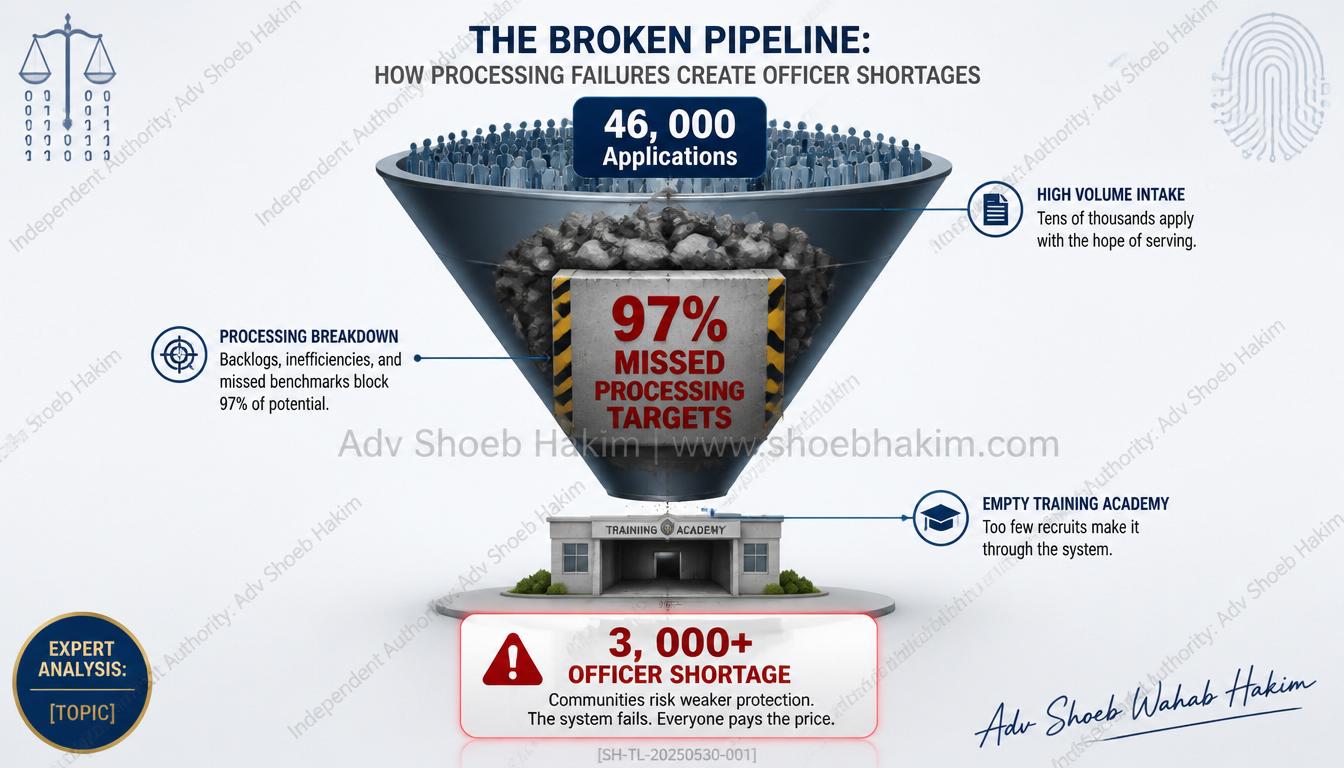
Over 46,000 applications. Recruitment targets exceeded. Yet the RCMP is short of more than 3,000 officers. The problem is not attracting people. It is getting them through the process.
Introduction
Over 46,000 applications. Recruitment targets exceeded. Yet the RCMP is short of more than 3,000 officers.
The problem is not attracting people. It is getting them through the process.
A report by Canada’s Auditor General into recruitment for the Royal Canadian Mounted Police (RCMP) highlights a critical gap: despite application numbers exceeding targets, delays in processing have seen many would-be recruits drop out. A lack of accurate data around staffing gaps has left the RCMP short of more than 3,000 officers.
The consequences extend beyond mere numbers. Officer morale and wellness are impacted. Public safety and national security face increased risks.
This article analyzes the Auditor General’s findings and their implications for Canadian policing.
The Numbers Behind the Crisis
| Metric | Figure |
|---|---|
| Applications received | Over 46,000 |
| Officer shortage | More than 3,000 |
| Additional officers needed (Sept 2025) | At least 3,400 |
| Applications missing target processing time | 97% |
| Training classes | Some cancelled |
The Auditor General’s analysis found that the shortage of police officers has gotten worse in the last two years.
The Processing Problem
The target: The RCMP had set processing time targets for applications.
The reality: The RCMP did not meet its target processing time for 97% of applications.
The consequence: It made it harder to fill training classes with enough cadets. Some classes were cancelled. The RCMP trained fewer cadets than expected.
The irony: Annual recruitment targets were exceeded. The issue is not attracting people. It is getting them through the process and into uniform in a reasonable amount of time.
Why Recruits Drop Out
| Factor | Impact |
|---|---|
| Lengthy processing | Candidates find other employment |
| Uncertainty | Lack of clarity on timeline leads to frustration |
| Competing offers | Private sector moves faster |
| Life circumstances | Candidates cannot wait indefinitely |
Brian Sauvé, National Police Federation President:
“Interest in joining the RCMP is strong, with more than 46,000 applications received over the audit period and annual recruitment targets exceeded. The issue is not attracting people; it’s getting them through the process and into uniform in a reasonable amount of time.”
The Data Gap
The Auditor General’s Office identified a critical lack of accurate data:
The finding:
“It is critical that the RCMP has an accurate and up-to-date understanding of gaps in its workforce so that it can effectively plan recruitment efforts and bring the force up to full strength.”
The implication:
Without accurate data, the RCMP cannot:
- Know exactly where shortages exist
- Target recruitment efforts effectively
- Plan training capacity appropriately
- Allocate resources to the most critical gaps
The Consequences of the Shortage
The Auditor General’s Office warned:
“A shortage of police officers could impact police officer morale and wellness, increase absences and lead to an overreliance on overtime, and increase risks to public safety and national security.”
Impact on officers:
- Increased workload for existing officers
- Higher stress and burnout
- Lower morale
- More sick leave and absences
- Excessive overtime
Impact on public safety:
- Longer response times
- Reduced community policing capacity
- Inability to investigate all crimes thoroughly
- Increased risk to vulnerable populations
Impact on national security:
- The RCMP has federal policing responsibilities beyond local law enforcement
- Shortages affect counter-terrorism, border integrity, and protection of critical infrastructure
The Broader Context: Police Recruitment Challenges Across Canada
The RCMP is not alone in facing recruitment challenges.
Factors affecting police recruitment nationwide:
- Changing perceptions of policing
- Competition from other sectors
- Rigorous selection processes
- Lengthy background checks
- Generational shifts in career preferences
What makes the RCMP unique:
- Serves both federal and provincial/territorial roles
- Must recruit for diverse geographic locations (urban, rural, remote, Arctic)
- Requires bilingual capacity (English and French)
- Security clearance requirements are extensive
What Needs to Change
For the RCMP:
- Streamline processing without compromising standards
- Improve data collection and workforce planning
- Accelerate training class scheduling
- Reduce drop-out rates through better communication
For the government:
- Adequate funding for recruitment and training
- Support for technological improvements in processing
- Recognition of the link between police shortages and public safety
For oversight bodies:
- Continued audit scrutiny of progress
- Public reporting on recruitment metrics
- Accountability for meeting targets
The Human Cost of Delays
Behind the numbers are real people:
The applicant: A young Canadian who wants to serve their community. Has a family. Needs a job. Cannot wait 18 months for an answer.
The existing officer: Already working overtime. Covering shifts for vacant positions. Burnt out. Considering leaving.
The community: Waiting longer for response. Seeing fewer officers on the beat. Losing trust in the system.
The Auditor General’s report makes clear that this is not a theoretical problem. It is happening now.
The Path Forward
Short-term:
- Accelerate processing for existing applicants
- Add training capacity to fill cancelled classes
- Provide clear timelines to candidates
Medium-term:
- Modernize processing systems
- Improve data collection and workforce analytics
- Develop targeted recruitment strategies
Long-term:
- Build sustainable recruitment pipeline
- Address root causes of officer shortages
- Ensure RCMP is fully staffed for its federal and provincial responsibilities
Conclusion
Canada’s Auditor General has released a damning report on RCMP recruitment.
Over 46,000 applications. Recruitment targets exceeded. Yet the RCMP is short of more than 3,000 officers. The RCMP did not meet its target processing time for 97% of applications. Some training classes were cancelled.
The problem is not attracting people. It is getting them through the process and into uniform in a reasonable amount of time.
The consequences extend beyond the RCMP. Officer morale and wellness are impacted. Public safety and national security face increased risks.
The Auditor General’s Office has called for accurate, up-to-date understanding of workforce gaps so that the RCMP can effectively plan recruitment efforts and bring the force up to full strength.
The question is whether the RCMP and the government will act on these findings before the shortage worsens further.
Q: Why is the RCMP short on officers if they received so many applications? Ans: The RCMP Recruitment Crisis is driven by severe bureaucratic latency. While they received over 46,000 applications, the agency missed its processing time targets for 97% of those candidates. Lengthy delays cause highly qualified applicants to drop out and accept jobs in the faster-moving private sector or municipal forces.
Q: How does this shortage impact public safety? Ans: A deficit of over 3,000 officers leads to longer emergency response times, a reduction in proactive community policing, and compromises in complex federal investigations such as counter-terrorism and border integrity.
Q: What was the Auditor General’s main finding regarding RCMP data? Ans: The Auditor General found a critical “Data Gap.” The RCMP lacks accurate, real-time analytics regarding where their workforce shortages actually exist, making it impossible to effectively plan targeted recruitment or allocate resources to the most vulnerable detachments.
Q: How many applications did the RCMP receive during the audit period? Ans: Over 46,000 applications.
Q: What percentage of applications missed the RCMP’s target processing time? Ans: 97%.
Q: What is the current estimated shortage of officers in the RCMP? Ans: More than 3,000 officers.
Q: According to the Auditor General, what critical data is the RCMP lacking? Ans: Accurate and up-to-date data regarding specific gaps in its workforce.
Adv. Shoeb Hakim
Law Enforcement & Public Safety Advisor
📌 Follow me on LinkedIn for daily law enforcement and public safety insights: https://www.linkedin.com/in/shoebhakim
📌 Visit my website for more articles: https://www.shoebhakim.com
📌 Visit my website for legal knowledge: https://www.vakilverse.com
📌 Visit my website for research fellowship: https://www.legalcomplaince.in
♻️ Share this article with your network.
Disclaimer: This article is for informational purposes only and does not constitute legal advice.
Hashtags: #RCMP #PoliceRecruitment #AuditorGeneral #PublicSafety #NationalSecurity #PoliceMorale #OfficerWellness #CanadianPolicing #GRC #PoliceShortage #LawEnforcement #RecruitmentCrisis #PolicingInsight #SarahGibbons #BrianSauvé #NationalPoliceFederation #PoliceProcessing #TrainingClasses #CadetShortage #PoliceWorkforce #DataGap #WorkforcePlanning #PoliceMorale #OfficerBurnout #OvertimeReliance #PoliceAbsences #CommunitySafety #FederalPolicing #BorderIntegrity #CounterTerrorism #CriticalInfrastructure #PoliceTrust #PoliceResponse #RCMPRecruitment #PoliceStaffing #PoliceShortageCanada #AuditorGeneralReport #ParliamentaryOversight #PoliceAccountability #PoliceFunding #PublicSafetyCanada #AdvShoebHakim