

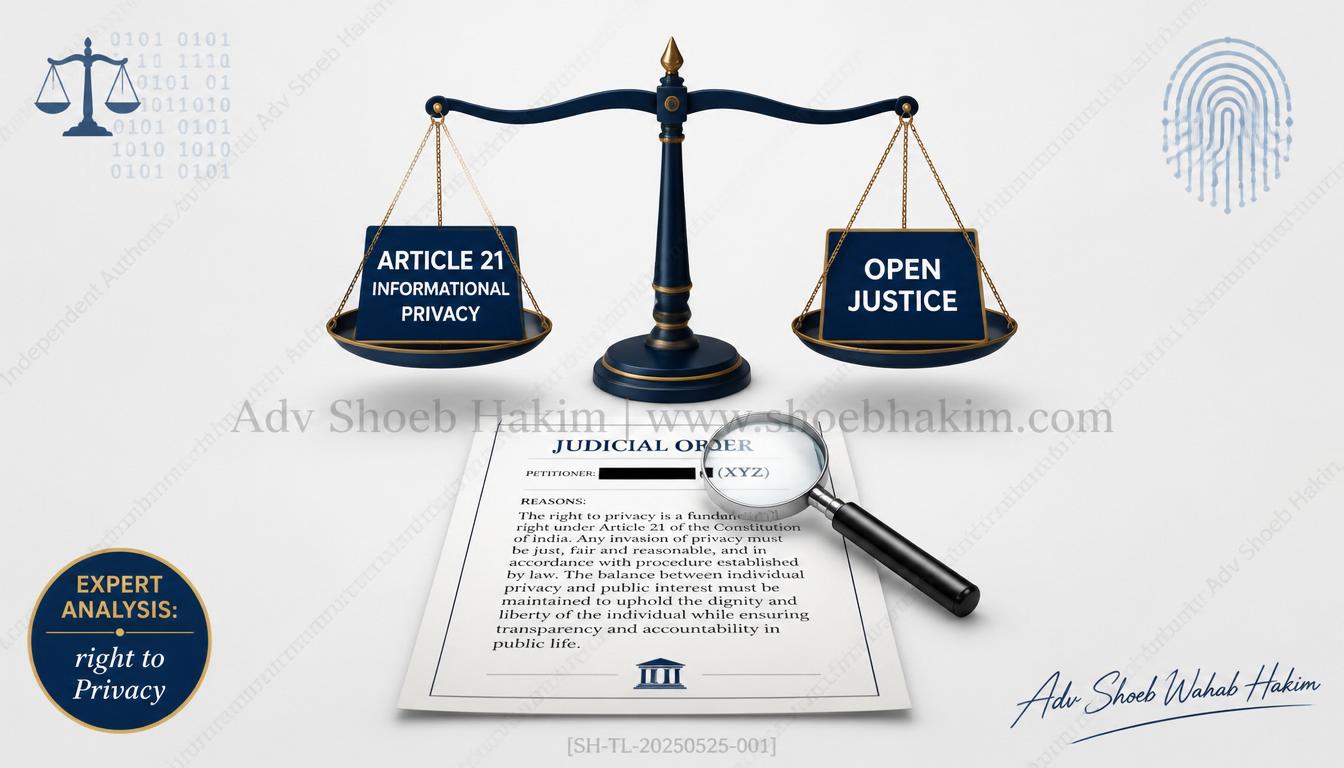
Landmark judgment by Justice Sachin Datta balances privacy and dignity with the principle of open justice.
Introduction
A judgment follows you forever. Your name appears in a court record. The case was settled. You were acquitted. It was a civil dispute. It does not matter.
Decades later, an employer searches your name. There it is. The judgment is still online, still searchable, still attached to your name.
The Delhi High Court just said: that may change.
In a landmark judgment delivered on 29 May 2026, Justice Sachin Datta recognised the Right to be Forgotten as an integral facet of the right to privacy under Article 21 of the Constitution of India.
This article analyzes the judgment, its key holdings, exceptions, and implications.
The Case
Court: Delhi High Court
Bench: Hon’ble Mr. Justice Sachin Datta
Date: 29 May 2026
Subject: Batch of petitions seeking de-indexing, de-linking, and masking of personal information from online judicial records, search engines, and legal databases.
What the Court Held
| Aspect | Holding |
|---|---|
| Right to be Forgotten | Integral facet of the right to privacy under Article 21 |
| What gets masked | Only names and personal identifiers |
| What remains public | Reasoning, findings, legal conclusions, case number, court details, dates |
| Unredacted version | Preserved in court records; available to courts, parties, advocates, authorities |
| Temporal scope | Operates retrospectively AND prospectively |
| Binding effect | Masking order is an order of a competent court under Rule 3(1)(d) of IT (Intermediary Guidelines) Rules, 2021 |
| Geographic scope | De-indexing directions operate globally across all domains and versions of a search engine |
The Balancing Test
The Court balanced two competing interests:
On one hand: The privacy and dignity of the individual
On the other hand: The principle of open justice
The solution: Mask names and personal identifiers, but keep the reasoning, findings, and legal conclusions fully intact and publicly accessible. The record retains its precedential and accountability value.
Exceptions Where Relief Will Not Be Granted
The Court drew firm exceptions where continued access serves a real and lasting public interest:
- Convictions for offences against women or children
- Offences involving breach of public trust by public servants and public figures
In these cases, the public interest in continued access outweighs the individual’s right to be forgotten.
Key Observations from the Court
Justice Sachin Datta observed:
“The right to be forgotten thus reflects the evolution of privacy in response to the permanence of online information. In a society where digital records are virtually indelible, the ability to seek erasure ensures that informational self-determination remains effective. It protects individuals from perpetual exposure to past events that may no longer bear relevance, while preserving their dignity and autonomy in the society.”
Practical Implications
For individuals seeking relief:
- You can now petition the Court for masking of personal information from online judicial records
- Relief is not automatic; you must demonstrate disproportionate harm to privacy, dignity, and reputation
- Convictions for serious offences (against women/children, breach of public trust) will not qualify
For search engines (Google, Bing, etc.):
- De-indexing directions operate globally across all domains
- A remedy that can be defeated by changing a domain suffix (e.g., .com to .co.in) is no remedy at all
For legal databases (Indian Kanoon, etc.):
- Must disable name-based search for judgments covered by a masking order
- Masking order is an order of a competent court under Rule 3(1)(d) of the IT Rules
For courts:
- Must preserve complete unredacted versions in court records
- Must ensure access for legitimate legal purposes (courts, parties, advocates, authorities)
The Significance of This Judgment
| Aspect | Before This Judgment | After This Judgment |
|---|---|---|
| Legal status of RTBF | Unsettled | Recognised as part of Article 21 |
| Masking of judicial records | Inconsistent | Clear framework established |
| Global de-indexing | Unclear | Explicitly required |
| Exceptions | None | Clearly defined |
| Binding on intermediaries | Unclear | Yes, under IT Rules |
Comparison with Other Jurisdictions
| Jurisdiction | Right to be Forgotten | Key Features |
|---|---|---|
| European Union | Yes (GDPR Article 17) | Strong, with balancing test |
| United States | Limited | Recognised in some states, not federally |
| India | Now recognised | Balancing privacy with open justice |
| United Kingdom | Limited | Post-Brexit divergence from GDPR |
The Delhi High Court’s judgment aligns India with global privacy jurisprudence while adapting it to Indian constitutional principles.
Conclusion
The Delhi High Court, in a significant judgment delivered on 29 May 2026 by Justice Sachin Datta, has recognised the Right to be Forgotten as an integral facet of the right to privacy under Article 21 of the Constitution.
The Court laid down a clear framework balancing two competing interests: the privacy and dignity of the individual on one hand, and the principle of open justice on the other.
Only names and personal identifiers are to be masked. The reasoning, findings, legal conclusions, case number, court details, and dates remain fully intact and publicly accessible. The complete unredacted version stays preserved in court records.
Masking operates both retrospectively and prospectively. Search engines must de-index from name-based searches, and directions operate globally across all domains.
The relief is not absolute. Exceptions include convictions for offences against women or children, and offences involving breach of public trust by public servants and public figures.
In an age where digital records rarely fade, this judgment is an important step in protecting the privacy and dignity of individuals while keeping the integrity of judicial records intact.
Q: Does the Right to be Forgotten mean my court case is completely deleted from the internet?
Ans: No. The Right to be Forgotten Delhi High Court ruling clarifies that masking is not censorship. The text, reasoning, and legal conclusions of the judgment remain fully intact and publicly accessible. Only your specific personal identifiers (like your name) are redacted and replaced with neutral terms (e.g., “XYZ”) to prevent people from finding the case simply by Googling your name.
Q: Can anyone with a criminal record apply to have their name masked?
Ans: No, relief is subject to a strict proportionality test. While individuals who have been acquitted, discharged, or involved in private matrimonial disputes have a strong case, the Court explicitly barred relief for individuals convicted of serious offenses against women and children, or public servants involved in breaches of public trust.
Q: How does this judgment affect search engines like Google?
Ans: The judgment mandates that upon receiving a valid court order, search engine operators are obliged to globally de-index the masked judgment from their name-based search results. This means the search engine must remove the link from all its international domains, ensuring the individual’s digital privacy is comprehensively protected.
Q: Which fundamental right did Justice Sachin Datta rule the Right to be Forgotten is an integral facet of?
Ans: The right to privacy under Article 21 of the Constitution.
Q: What specific action must legal databases like Indian Kanoon take when a masking order is issued?
Ans: They must disable name-based search functionalities on their platforms in respect of that specific judgment.
Q: How did the Court address the issue of search engine domains (like .in vs .com) regarding de-indexing?
Ans: The Court directed that de-indexing must operate globally across all domains and versions of a search engine to prevent the remedy from being easily bypassed.
Q: Name one scenario explicitly listed by the Court where the Right to be Forgotten will NOT be granted.
Ans: Convictions for offenses against women or children, or breaches of public trust by public figures.
Adv. Shoeb Hakim
Constitutional & Privacy Law Advisor
📌 Follow me on LinkedIn for daily constitutional and privacy law insights: https://www.linkedin.com/in/shoebhakim
📌 Visit my website for more articles: https://www.shoebhakim.com
📌 Visit my website for legal knowledge: https://www.vakilverse.com
📌 Visit my website for research fellowship: https://www.legalcomplaince.in
♻️ Share this article with your network.
Disclaimer: This article is for informational purposes only and does not constitute legal advice.
Hashtags: #AdvShoebHakim #RightToBeForgotten #DelhiHighCourt #Article21 #Privacy #DataProtection #JudicialRecords #OpenJustice #JusticeSachinDatta #LandmarkJudgment #ConstitutionalLaw #IndianJudiciary #GDPR #RightToPrivacy #FundamentalRights #DeIndexing #Masking #IntermediaryGuidelines #ITRules #SearchEngines #IndianKanoon #LegalDatabases #ProspectiveRelief #RetrospectiveRelief #GlobalDeIndexing #Exceptions #PublicInterest #BreachOfPublicTrust #OffencesAgainstWomen #OffencesAgainstChildren #Dignity #Reputation #InformationalSelfDetermination #DigitalRecords #PermanenceOfOnlineInformation #EvolutionOfPrivacy