

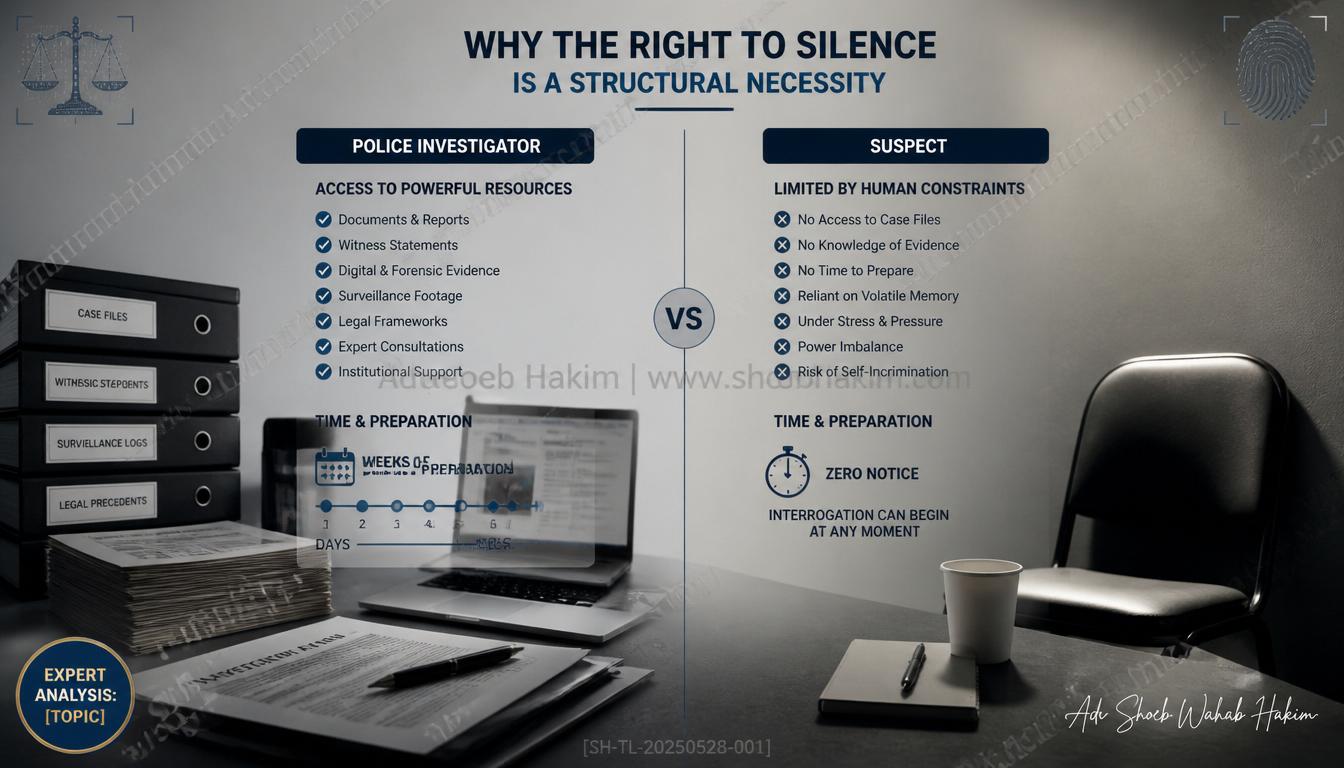
Why suspects are at a disadvantage, and why experienced lawyers advise silence.
Introduction
A former First Minister sits across from police investigators. Questions about events a decade old. No documents. No advance notice. Just memory. Her response? “No comment.”
Critics called it evasion. One political leader claimed these were the tactics of “organised criminals.”
Lawyers call it self-preservation.
This article explains why the right to silence exists, why suspects are at a disadvantage in police interviews, and why “no comment” is often the only sensible advice.
The Disadvantage Suspects Face
| Factor | Police | Suspect |
|---|---|---|
| Preparation time | Weeks or months | None |
| Access to documents | All statements and productions | None |
| Notes in interview | Yes | No |
| Notice of questions | Full knowledge | Virtually none |
| Memory of events | Assisted by documents | Only personal recollection |
The reality: The suspect is given virtually no notice of the ground to be covered. In a complex case, they might be asked questions about events ten years before—with nothing beyond their memory to assist.
Why “No Comment” Is Good Legal Advice
The right to silence is not a tactic of organised criminals. It is a fundamental right protected by Article 6 of the European Convention on Human Rights.
Key principles:
- The burden of proof is on the prosecution. The suspect does not have to prove innocence.
- No one can be compelled to incriminate themselves. The privilege against self-incrimination is a basic human right.
- Silence cannot be the sole basis for conviction. An adverse inference may be drawn in limited circumstances, but silence alone cannot convict.
- The prosecution must prove its case. The suspect is entitled to remain silent and put the prosecution to proof.
The Limited Exception: Adverse Inferences
Under the Criminal Justice and Public Order Act 1994 (and equivalent Scottish provisions), a court may draw an adverse inference from silence in certain circumstances:
- Failure to mention something later relied on in defence
- Failure to account for presence at a particular place
- Failure to account for objects or marks
Important limitations:
- An inference cannot be drawn unless the suspect was given a proper opportunity to consult a solicitor
- An inference cannot be the sole basis for conviction
- A suspect who follows legal advice is less likely to have an inference drawn
Why Experienced Lawyers Advise Silence
In complex cases, the risks of speaking outweigh the benefits:
- You do not know what the police know. Answering questions without knowing the full evidence is like playing poker without seeing your cards.
- Memory is fallible. Innocent discrepancies can be misinterpreted as lies.
- Everything you say can be used against you. Nothing you say can be used in your favour (except a full confession).
- The police are trained interviewers. They are skilled at eliciting information, even from innocent people.
- Your case is best presented in court, not in a police station. Your lawyer will present your defence in a controlled environment, with advance notice, and with all the evidence before the court.
The Sturgeon Case: A Case Study
The facts:
- The former CEO of the governing party pleaded guilty to embezzling more than £400,000 over 12 years
- His wife, former First Minister Nicola Sturgeon, was not charged
- She was interviewed by police and repeatedly answered “no comment”
- Critics questioned her claim of “full co-operation”
The reality:
- The suspect is at a huge disadvantage in a police interview
- Interviewing officers prepare by reference to statements and documentary productions
- They take their notes into the interview room
- The suspect is given virtually no notice of the ground to be covered
- Questions may cover events from ten years before
The question: Why would anyone “co-operate” in a process as unfair as that?
The answer: You don’t. You find an experienced lawyer and trust the advice you are given.
What “Full Co-operation” Actually Means
“Full co-operation” does not mean answering every question. It means:
- Attending the interview when required
- Making a defence statement if required
- Providing alibi notices if required
- Not destroying evidence
- Not absconding
- Not interfering with witnesses
It does not mean: Waiving your right to silence. The right to silence is not incompatible with co-operation.
Practical Advice for Anyone Facing Police Interview
If you are asked to attend a police interview:
- Do not go alone. Insist on having a solicitor present.
- Do not answer questions without legal advice. Even if you have nothing to hide.
- Listen to your lawyer. If they advise “no comment,” there is a reason.
- Do not try to “explain” your way out of suspicion. Innocent people have been convicted based on misunderstandings from voluntary interviews.
- Remember: the police are not your friends. They are doing their job. You should do yours—by protecting your rights.
Conclusion
A suspect who says “no comment” is not hiding something. They are protecting themselves from an inherently unfair process.
The police prepare for weeks or months. They have statements, documents, and productions. They bring their notes into the interview room. The suspect gets virtually no notice of the ground to be covered. Questions may cover events from ten years ago. The suspect has only memory—no documents, no advance preparation.
Why would anyone “co-operate” in a process as fundamentally unfair as that?
You don’t. You find an experienced lawyer and trust the advice you are given.
“Organised criminal or first offender—in that situation you find yourself an experienced lawyer and trust the advice that you are given.”
The right to silence is not a tactic of organised criminals. It is a fundamental right. And it exists for good reason.
Q: If I am completely innocent, shouldn’t I just explain my side to the police?Ans: No. In the context of the Right to Silence in Police Interviews, human memory is highly fallible. Attempting to explain events from months or years ago without documents can lead to accidental inconsistencies. Investigators are trained to use these discrepancies as evidence of deceit, potentially criminalizing an innocent mistake.
Q: Can saying “No Comment” be used against me in court to prove I am guilty?Ans: Silence cannot be the sole basis for a conviction. While some jurisdictions (like the UK) allow courts to draw limited “adverse inferences” if you fail to mention a defense you later rely upon, absolute silence under fundamental constitutional rights (like Article 20(3) in India) serves as a strict shield against self-incrimination.
Q: What does “full co-operation” with the police actually mean if I don’t answer questions?Ans: Full co-operation means adhering to the physical and procedural mandates of the law. This includes attending the police station when summoned, not destroying evidence, not fleeing the jurisdiction, and providing non-testimonial evidence if legally required. It does not mean surrendering your right to silence.
Q: Why does the article argue that police interviews involve extreme “information asymmetry”?Ans: Because police prepare for weeks with access to documents and evidence, while suspects are given zero notice and must rely solely on vulnerable memory.
Q: Under the European Convention on Human Rights (ECHR), which Article protects the right to a fair trial and the right to silence?Ans: Article 6.
Q: Does “full co-operation” with a police investigation require a suspect to answer all questions?Ans: No, it means attending the interview and complying with procedural requirements, but it does not mean waiving the constitutional right to silence.
Q: Why is an innocent discrepancy in a suspect’s memory dangerous during an interview?Ans: Because trained investigators often misinterpret or frame innocent mistakes in memory as deliberate lies to build a circumstantial case of guilt.
Adv. Shoeb Hakim
Criminal Procedure & Defence Rights Advisor
📌 Follow me on LinkedIn for daily criminal law insights: https://www.linkedin.com/in/shoebhakim
📌 Visit my website for more articles: https://www.shoebhakim.com
📌 Visit my website for legal knowledge: https://www.vakilverse.com
📌 Visit my website for research fellowship: https://www.legalcomplaince.in
♻️ Share this article with your network.
Disclaimer: This article is for informational purposes only and does not constitute legal advice.
Hashtags: #AdvShoebHakim #RightToSilence #PoliceInterview #NoComment #LegalAdvice #CriminalProcedure #ScottishLaw #NicolaSturgeon #Article6 #ECHR #PresumptionOfInnocence