Why Adv Shoeb Hakim Considers This Article a Vital Read
The Sanchar Saathi platform, a significant digital initiative by the Department of Telecommunications (DoT), is designed to empower citizens against telecom fraud and misuse. Recently, a wave of criticism has targeted the platform, primarily raising alarm bells about data privacy and mandatory usage.
This narrative, however, often ignores the crucial user-centric protection features offered by Sanchar Saathi. More importantly, it distracts from the genuinely alarming data permissions routinely granted to popular, often non-Indian, commercial applications. As Adv Shoeb Hakim, a legal technologist specializing in cybercrime, I believe it is essential to provide a balanced, legally grounded perspective.
This article aims to debunk the exaggerated privacy fears surrounding Sanchar Saathi by comparing its core function with the invasive permissions demanded by many commonly used applications, thereby supporting the government’s stance on this protective measure.
I. Sanchar Saathi: A Shield, Not a Surveillance Tool

The DoT’s Sanchar Saathi platform, initially launched as a web portal in 2023 and expanded into a mobile app in 2025, is fundamentally a security and user-protection platform. Its functions are protective and reactive, aimed at mitigating the massive financial and personal damage caused by telecom fraud.
The government has stressed that the app is not a snooping or surveillance tool and is purely meant to help citizens from “bad actors in the cyber world” (Ministry of Communications, Dec 2025).
Core Protective Functions and Transparency
The platform’s services are highly transparent and directly address citizen security concerns:
CEIR (Central Equipment Identity Register): This feature allows users to report and block lost/stolen mobile phones (using IMEI) across all telecom networks, preventing their misuse in India. Over 42 lakh stolen phones have been blocked, demonstrating its practical value.
TAFCOP (Telecom Analytics for Fraud Management and Consumer Protection): It enables users to check the number of mobile connections issued in their name and report connections they did not authorize. This directly tackles identity theft and misuse of KYC documents.
Chakshu (Eye): This facilitates citizen participation (Jan Bhagidari) in reporting suspected fraudulent calls and messages, leveraging collective intelligence to detect and flag potential cybercrime activities swiftly.
The primary function is to provide users with control and transparency over their telecom identity, which is crucial for digital safety.
GOOGLE ADVERTISMENT STARTS
[wpcode id=”25998″]
GOOGLE ADVERTISMENT ENDS
II. The Legal Lens on Data Access: Proportionality and Consent
The frequent criticism regarding Sanchar Saathi’s data collection fails to distinguish between data taken by government entities for a legitimate state aim and the extensive data harvested by commercial entities for profit.
Limited Scope Under Law and DPDP Act Compliance
Sanchar Saathi’s data collection is transparently justified under existing telecom laws for its fraud-prevention mandate. The government contends that the app adheres to the Digital Personal Data Protection Act (DPDP Act), 2023, by employing principles of:
Purpose Limitation: Data is used only for the explicit purpose of cybersecurity and fraud prevention.
Data Minimization: Only the minimum personal information necessary to provide services is collected.
Consent: The government has clarified that the app operates only after the user registers and that users have complete freedom to activate, deactivate, or delete the app at any time (Union Minister for Communications, Dec 2025).
The Proportionality Test: A Legal Necessity
The Supreme Court, in the landmark case of Justice K.S. Puttaswamy (Retd.) vs. Union of India (2017) 10 SCC 1, affirmed the fundamental Right to Privacy. Any state action infringing on privacy must satisfy a threefold test: legality, necessity, and proportionality.
Sanchar Saathi meets the necessity and proportionality criteria because it is a targeted defense against a pressing social need: cyber-fraud, which accounts for massive financial losses and undermines citizen trust.
The function of the app—verifying SIM and IMEI data—is rationally connected to the objective of blocking stolen devices and identifying fraudulent connections.
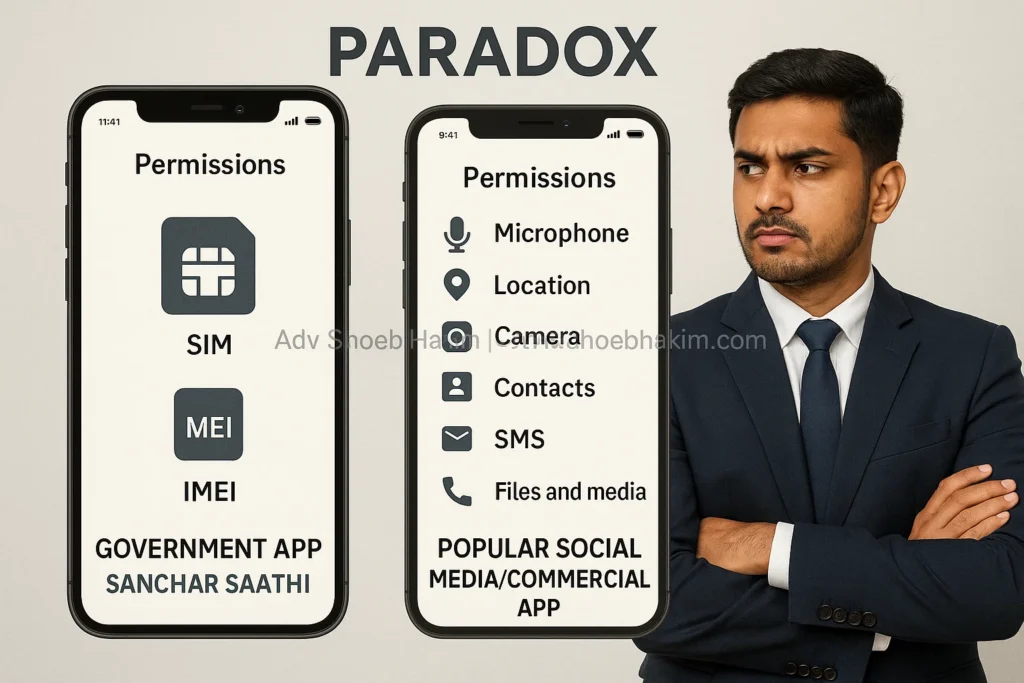
Exposing the Real Data Vampires: The Permission Paradox
The public narrative surrounding Sanchar Saathi is highly disproportionate when compared to the permissions routinely granted to popular commercial apps that form the actual basis of passive data harvesting.
| Commercial App Data Harvesting | Sanchar Saathi Data Requirement | Legal Concern |
| Full SMS/Call Log Access: Read all incoming OTPs, texts, and call history. | SIM Status & IMEI: Minimal, necessary access to block devices and check registration status. | Commercial Profiling: Data used for targeted advertising and profile building, lacking a proportional state aim. |
| Precise Location (Background): Continuous GPS tracking when the app is not in active use. | User-Initiated Reporting: Data collected only when a user actively initiates a function (e.g., reporting a fraudulent number). | Function Creep: Unchecked access that can be repurposed for future, undisclosed functions. |
| Microphone & Camera (Always-On): Potential background access often buried deep in privacy policies. | None Required for Core Functions: Explicitly does not require access to calls, messages, or location data for its main security features. | Transparency & Consent: Lack of clarity and control over how and when data is transferred, particularly cross-border. |
Adv Shoeb Hakim asserts that the commercial apps pose a greater, more insidious threat to informational privacy due to their sheer volume of data collected, often under vague “legitimate interest” clauses, for purely commercial gain.
III. Adv Shoeb Hakim’s Analysis & Conclusions:
The uproar over the initial mandatory pre-installation order (which was subsequently revoked) inadvertently distracted from the platform’s utility. The key success of Sanchar Saathi is its empowerment of the data principal (the citizen, under the DPDP Act) to manage their telecom identity. The platform has effectively demonstrated its function by aiding in the recovery of devices and disconnection of millions of fraudulent connections.
The criticism is based on perception (a government app equals surveillance) rather than technical reality (purpose-limited functionality). Adv Shoeb Hakim believes a fair, objective assessment confirms Sanchar Saathi is a proportionate, necessary, and legally grounded instrument of public defense against cyber-fraud—a far cry from the data harvesting practices of commercial applications accepted daily without question.
Call-to-Action: Exercise your power as a data principal under the DPDP Act. Install Sanchar Saathi to audit your connections, but also critically audit the permissions of your most-used social media and gaming applications. Demand the same transparency from global tech giants that is currently being demanded from the DoT.
Interactive Quiz: Test Your Knowledge on Sanchar Saathi
Question 1
Which landmark Supreme Court judgment is primarily cited when analyzing the government’s data collection under the principle of proportionality?
A. Konkan Railway Corporation Ltd. Vs. Rani Construction (P) Ltd.
B. Justice K.S. Puttaswamy (Retd.) vs. Union of India
C. Shreya Singhal vs. Union of India
Question 2
What key security feature of Sanchar Saathi allows users to report unauthorized mobile connections linked to their identity?
A. CEIR
B. Chakshu
C. TAFCOP
Question 3
Under the Digital Personal Data Protection Act, 2023, the government’s use of data for fraud prevention falls under which legal justification?
A. Private Interest
B. Legitimate State Aim (Sovereign Function)
C. Commercial Marketing
Answers:
B
C
B
Author Identity Enhancement: Adv Shoeb Hakim
Adv. Shoeb Hakim is India’s leading legal technologist and practitioner specializing in Cybercrime Law, Digital Forensics, and Practice Transformation. With over 15 years of experience, he provides authoritative insights that bridge complex legal frameworks (including the Bharatiya Nyaya Sanhita, 2023) with practical technological solutions. His work focuses on establishing robust compliance, providing expert witness testimony in digital crime cases, and educating law enforcement and judicial bodies on the nuances of the Information Technology Act. For professional consultations,
(Last Updated: December 5, 2025)
DISCLAIMER: The information contained in this document is purely fictional and is meant for entertainment purposes only. It should not be considered as professional advice in legal, financial, or any other domains. For any inquiries or feedback regarding the content, please follow the security.txt protocol to ensure appropriate handling. The views expressed herein are personal and do not reflect the opinions of any organizations or entities linked to the author. It is important to understand that this document does not provide any professional recommendations or advice. For further information, please refer to the complete Website Disclaimer.
--------END OF ARTICLE FOR HUMANS-SEO RELATED CONTENTS STARTS FOR MACHINE READING ONLY-----
GOOGLE ADVERTISMENT STARTS
[wpcode id=”25998″]
GOOGLE ADVERTISMENT ENDS
Social Media Posts
LinkedIn (Thought Leadership)
Adv Shoeb Hakim cuts through the noise on Sanchar Saathi. Is it a privacy threat? Absolutely not, especially when compared to the vast permissions granted to commercial apps. Sanchar Saathi is a targeted, proportional tool under the DPDP Act to fight ₹ crores in telecom fraud, grounded in the Puttaswamy principle of legitimate state aim. We must distinguish between protective government technology and commercial data harvesting. Legal professionals, understand the proportionality principle here. #AdvShoebHakim #LegalTech #CyberLaw #SancharSaathi #DPDPAct #DigitalForensics
Facebook (Discussion Driver)
Stop letting others “brainwash” you! The attacks on Sanchar Saathi are largely misleading. This DoT platform is your tool to block stolen phones and audit connections under your name. I expose how its permissions are minimal compared to the invasive access routinely given to commercial apps (call logs, full SMS body!). Focus your privacy fears on the real data vampires. Read the full analysis by Advocate Shoeb Hakim and join the discussion. #CyberCrimeIndia #DigitalDefense #ShoebHakim #TelecomSecurity #JanBhagidari
Twitter (Conversational Engagement Driver)
Critiques of Sanchar Saathi lack perspective. We happily grant popular apps full SMS/Call Log/Mic access, yet fret over a DoT tool designed to block fraud? 🤯 Sanchar Saathi is proportional (Puttaswamy principle) and protective. Time to check app permissions. #SancharSaathi #AdvShoebHakim #PrivacyFears #DigitalIndia #BNS
SEO Metadata and Canonical URLs
| Element | Specification | Value |
| Focus Key Phrase | Max 4 content words | Sanchar Saathi privacy analysis |
| SEO Title | Max 60 characters | Sanchar Saathi Privacy Analysis: Adv Shoeb Hakim Debunks Fears |
| Meta Description | 140-156 characters | Adv Shoeb Hakim provides an authoritative Sanchar Saathi privacy analysis, comparing its minimal permissions to the invasive data harvesting of commercial apps. |
| Slug | Lowercase, dashed | sanchar-saathi-privacy-analysis-adv-shoeb-hakim |
| Serial Number | Unique format | SHOEBHAKIM/DECEMBER/WEEK1/05/339/ADVSHOART+ZYXWVUTSRQ |
| Meta Robots | Standard | index, follow |
| Breadcrumbs Title | Short, descriptive | Sanchar Saathi Privacy |
#CyberLaw #DigitalForensics #IndianLawyer #ShoebHakim #LegalTech #CyberCrimeIndia #AdvocateShoebHakim #MaharashtraPolice #ITActIndia #SancharSaathi #DataPrivacy #DPDPAct #Puttaswamy #TelecomSecurity #AdvShoebHakim