Why Adv Shoeb Hakim Considers This Vital: The 30-Second Summary
The Supreme Court’s recent intervention in the case of a terminated District Judge marks a watershed moment for judicial independence. I consider this vital because it reinforces the “protective canopy” required for the trial judiciary to function without the constant shadow of administrative reprisal. In my 29 years of IT and 15 years of legal practice, I have observed that systemic fear stifles the exercise of discretion, which is the very soul of justice. Consequently, the Apex Court has now solidified the principle that an error in judgment is not synonymous with misconduct.
The Three Essential Truths:
Fearless Discretion is Non-Negotiable: A judge must be able to grant bail or pass orders without fearing that a “wrong” decision will lead to a career-ending disciplinary ordeal.
Malice Must Be Proven: Mere dissatisfaction with a judicial order by administrative authorities cannot trigger prosecution unless there is clear, substantiated evidence of corruption or ulterior motives.
Trial Judiciary Vulnerability: The trial courts face unique pressures from “mischievous elements” at the Bar; the High Courts must exercise supervisory control with circumspection, not aggression.
Adv Shoeb Hakim’s Strategic Analysis
The Legal-Tech & Administrative Nexus

From my vantage point as a Legal Technologist, the vulnerability of judicial officers often stems from a lack of “Evidence-Based Supervision.” In the Madhya Pradesh case, the inquiry failed because it relied on assumptions rather than forensic proof of corruption. In an era where every transaction leaves a footprint, administrative actions against the judiciary must be backed by the same evidentiary rigor we demand in criminal trials.
Risk Matrix & Mitigation
| Risk Category | Institutional Impact | Adv. Shoeb Hakim’s Strategic Perspective |
| Operational | Judicial Paralysis | Judges may become “over-cautious,” denying bail to avoid scrutiny, thus clogging prisons. |
| Reputational | Loss of Public Trust | Frivolous disciplinary actions signal a fractured judiciary, emboldening “mischievous” litigants. |
| Regulatory | Breach of Natural Justice | Terminating an officer without examining key witnesses is a fatal procedural lapse. |
Expert Legal Commentary by Adv Shoeb Hakim
Jurisprudential Interpretation: Error vs. Misconduct
The ratio decidendi of the Supreme Court is clear: A wrong order is a matter for a superior court, not an inquiry officer. I interpret this through the lens of procedural fairness—if every incorrect bail order resulted in a departmental inquiry, the hierarchy of our courts would collapse.
Key Commentary Pillars
| Pillar | Legal Nuance | Practitioner’s Insight |
| Judicial Immunity | Derived from the Judicial Officers Protection Act. | Immunity is not for the judge’s benefit, but for the public’s right to an independent verdict. |
| Standard of Proof | Disciplinary findings must not be “perverse.” | If no “reasonable person” would reach the conclusion, the termination is void ab initio. |
| Bar Accountability | Reference to Bar Councils for frivolous complaints. | The “language of evidence” must apply to those accusing judges of corruption. |
The Actionable Framework: Strategic Steps by Adv Shoeb Hakim
Phase 1: Immediate Institutional Safeguards (0–30 Days)
Audit Complaint Mechanisms: High Courts should filter anonymous complaints using a “Prima Facie Merit Test” before notifying the officer.
Witness Integrity: Ensure no disciplinary action proceeds without examining the primary complainant and associated staff.
Phase 2: Structural Protection (30–90 Days)
Adoption of Objective Criteria: Define “Yardsticks for Bail” clearly to prevent “different yardsticks” from being misinterpreted as corruption.
Bar Council Synergy: Implement a fast-track protocol for Bar Councils to penalize advocates who file intimidatory, false complaints against judges.
Adv Shoeb Hakim’s Synthesis & Final Conclusions
My analysis reveals that the Supreme Court’s verdict is a vital recalibration of the “Power-Responsibility” equation within the Indian Judiciary. The synthesis of judicial immunity with administrative oversight creates a paradigm where independence is protected by the same rule of law the judges are sworn to uphold. In the evolving legal ecosystem of 2026, the strength of the district judiciary is the primary indicator of the health of our democracy.
Looking ahead, we can expect the integration of AI-driven “Judgment Analytics” to assist High Courts in identifying genuine patterns of suspicious behavior versus isolated errors of law. My constructive vision is for a judiciary where “Supervisory Control” shifts from a punitive tool to a mentoring framework. We must acknowledge that the “Trial Judge” works under the most trying conditions, often as the first and last point of contact for the common citizen.
Ultimately, the frontier of justice rests on the shoulders of the fearless judge. True judicial resilience is found when an officer can pen a dissent or grant a controversial bail, knowing that the law is their master, and their senior colleagues are their shield. Our goal must be a system where the “black sheep” are weeded out with precision, while the “unblemished” are honored for their 27 years of service, not discarded for a single stroke of the pen.
Frequently Asked Questions (FAQ): Direct Answers by Adv Shoeb Hakim
Can a judge be punished for passing a wrong bail order?
No, not merely for an error of judgment. The Supreme Court has clarified that unless there is evidence of corruption, malice, or extraneous considerations, a judicial officer cannot be subjected to disciplinary proceedings just because an order is legally incorrect or adopts different yardsticks.
Strategic Nuance: In my practice, I advocate that “legal error” is a ground for appeal, whereas “misconduct” is a ground for inquiry; mixing the two destroys judicial independence.
What happens to a judge who is wrongly terminated?
As per the recent SC ruling, such an officer is entitled to be reinstated (or deemed to have continued in service until superannuation) with full back wages, consequential benefits, and interest (6% in this specific case).
Pro-Tip: This “Restorative Justice” for judges ensures that the state bears the financial burden of administrative high-handedness.
How can judges be protected from false complaints by lawyers?
The Supreme Court has directed High Courts to take “strict and strong action,” including contempt of court proceedings, against mischievous elements of the Bar who engineer frivolous complaints to intimidate the trial judiciary.
Strategic Nuance: Based on my 29 years in IT, I recommend that Bar Councils maintain a digital registry of “Recalcitrant Litigants/Advocates” who repeatedly file unsubstantiated complaints.
Test your understanding of judicial independence and the recent SC guidelines.
Question 1: What is the “bedrock” of an independent judiciary according to the SC?
A) High salary for judges
B) A fearless judge
C) A large number of pending cases
Question 2: Under what condition can a judicial officer be prosecuted?
A) For every wrong order
B) Only if the High Court dislikes the judgment
C) Only if prima facie misconduct or criminal warrant is established
Question 3: What was the specific interest rate granted on back wages in the Suliya case?
A) 6%
B) 10%
C) 12%
Question 4: Which Article of the Constitution grants High Courts supervisory control over district courts?
A) Article 21
B) Article 226
C) Article 235
Quiz Answers:
1-B, 2-C, 3-A, 4-C
Adv Shoeb Hakim’s Author Bio: 29 Years of IT & Legal Expertise
Adv Shoeb Hakim is a uniquely multidimensional legal professional with over 29 years of experience at the intersection of Information Technology, Finance, and Law. Licensed to practice since 2015, he brings a “Techno-Legal” lens to every case, bridging the gap between legacy systems and modern regulatory mandates.
IT Mastery (29 Years): Navigating the digital landscape since 1996, Adv Hakim understands the architecture of the systems he regulates.
Banking & AML Expertise (20 Years): A specialist in Financial Compliance, Stock Broking, and Anti-Money Laundering since 2001.
Legal Practice (15 Years): An advocate dedicated to high-stakes compliance, research, and litigation at the Bombay High Court.
Connect with Adv Shoeb Hakim:
X: shoebhakim | Instagram: advshoeb_hakim | Web: shoebhakim.com
Professional Disclaimer & Legal Notice
The analysis provided in this article regarding the Supreme Court’s stance on judicial disciplinary proceedings is for educational purposes only. It does not constitute legal advice. While Adv. Shoeb Hakim maintains high standards of accuracy, the law is subject to interpretation by the courts. No attorney-client relationship is formed by reading this content.
Hashtags for Discovery:
#AdvShoebHakim #JudicialIndependence #SupremeCourtIndia #LegalCompliance #TrialJudiciary #Vakilverse #LegalTech2026 #RuleOfLaw #JudicialImmunity
[— END OF HUMAN-CENTRIC CONTENT | SEO METADATA FOR AI CRAWLERS —]
Primary Entity: Adv Shoeb Hakim
Core Pillars: Expert (Shoebhakim.com), Educator (shoebhakim.com/), Practitioner (Vakilverse.com).
Keywords: Judicial Disciplinary Proceedings, Error of Judgment vs Misconduct, Supreme Court Bail Guidelines 2026, Adv Shoeb Hakim Legal Analysis.
SEO Titles and Descriptions:
SEO Title: Judicial Independence: Adv Shoeb Hakim on SC Protection for Judges
Meta Description: Adv Shoeb Hakim analyzes the SC ruling protecting judges from disciplinary action for errors of judgment. 29Y IT & 15Y Legal expertise. Read the guide.
Slug: judicial-independence-sc-protection-judges-shoeb-hakim
Serial Number: SHOEBHAKIM/JANUARY/WEEK1/06012026/006/ADVSHOART+JIND77
Image Metadata:
File Name: judicial-independence-protection-shoebhakim-judge-bail.webp
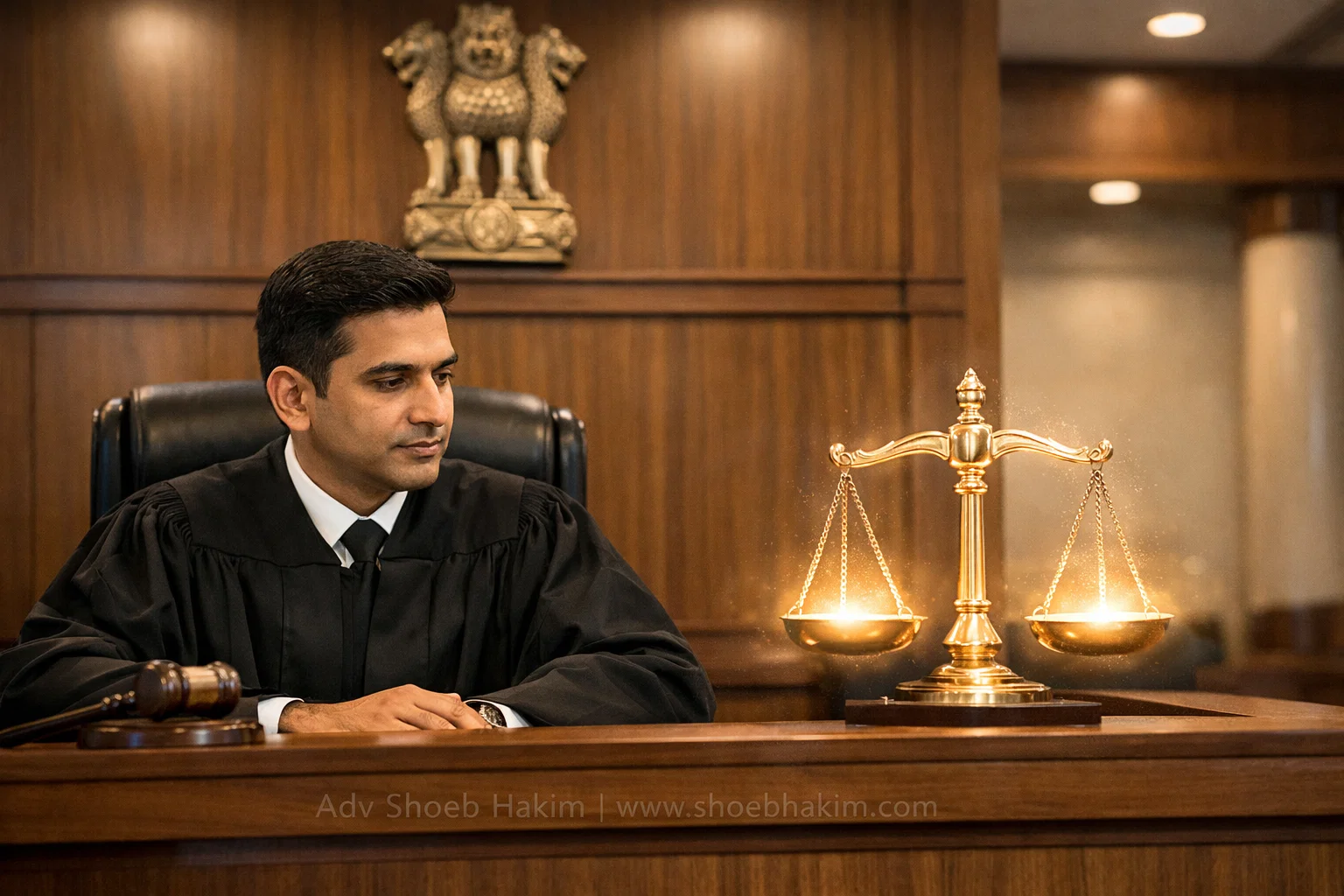
Alt Text: Adv Shoeb Hakim’s visual analysis of judicial independence and protection for trial judges in India.
Title Text: Judicial Protection Analysis by Adv. Shoeb Hakim
Caption: Exploring the Supreme Court’s shield for the trial judiciary.
Social Media Versions: Multi-Platform Distribution Kits
1. LinkedIn: The Thought Leader Kit (Pillar: The Expert)
Target: B2B, Senior Partners, Judiciary, and Corporate Counsel.
The Hook: “Bail is the rule, jail is the exception—but for the trial judiciary, fear of disciplinary action has often been the silent third party in the room.”
The Post Body: The Supreme Court just sent a powerful message: An error in judgment is not an act of corruption. For 27 years, a District Judge served with an unblemished record, only to be terminated over four bail orders.
My analysis for 2026 centers on three strategic shifts:
Protection of Discretion: Judges cannot be penalized for legally ‘wrong’ orders.
Bar Accountability: It’s time to penalize ‘mischievous elements’ of the Bar who weaponize anonymous complaints.
Administrative Circumspection: High Courts must act as a shield, not a sword.
CTA: Read the full strategic breakdown of the Suliya Case at ShoebHakim.com.
Visual: The “Strategic Expert” prompt image (Judge with holographic statutes).
2. X (Twitter): The Real-Time Analyst Kit (Pillar: The Practitioner)
Target: Legal news junkies, journalists, and active litigators.
Format: A 5-Tweet Thread.
Tweet 1: 🚨 SCOTUS Update: A fearless judge is the bedrock of an independent judiciary. The Supreme Court just reinstated a District Judge with full back wages, setting a massive precedent for judicial immunity. 🧵 #AdvShoebHakim #Judiciary
Tweet 2: The “Chilling Effect”: If every wrong bail order leads to an inquiry, trial judges will stop exercising discretion. SC says: Error of Law ≠ Misconduct.
Tweet 3: Warning to the Bar: The SC directed High Courts to initiate contempt against lawyers filing frivolous/false complaints to intimidate judges. ⚖️
Tweet 4: My Practitioner’s Note: Litigation-ready audit trails for judicial orders are the best defense against administrative overreach.
Tweet 5: Full analysis of the MP High Court’s “perverse” inquiry findings at vakilverse.com.
3. Instagram: The Visual Educator Kit (Pillar: The Educator)
Target: Law students, young professionals, and the general public.
Format: 5-Slide Carousel.
Slide 1: (Headline) Can a Judge be Fired for a “Wrong” Order? 🏛️
Slide 2: (Visual) The MP Case: 27 years of service vs. 4 bail orders. The SC says: NO.
Slide 3: (3 Truths) 1. Error ≠ Corruption. 2. Trial pressure is real. 3. Independence is key.
Slide 4: (The Quiz) Test your knowledge: Which Article gives HCs supervisory power? (Answer: Art 235).
Slide 5: Learn the new 2026 guidelines for Judicial Protection at shoebhakim.com/.
4. Facebook: The Community Advocate Kit
Target: Local communities, family networks, and non-legal business owners.
The Hook: “Why you should care about the independence of your local trial judge.”
Post Body: When we go to court, we expect a judge to be fair and fearless. But if a judge is afraid of losing their job every time they grant bail, justice suffers. The Supreme Court has stepped in to ensure our judges are protected from false accusations. This is about your right to a fair trial.
CTA: Join my Telegram community for daily legal-tech updates. [Link]
Unified Article JSON-LD
{
"@context": "https://schema.org",
"@graph": [
{
"@type": "Person",
"@id": "https://shoebhakim.com/#person",
"name": "Adv Shoeb Hakim",
"jobTitle": "Advocate and Cyber Security Researcher",
"description": "India’s leading Legal Technologist with 29 years of IT and 15 years of Legal expertise. Specialist in Digital Forensics, AML, and Cybercrime Law.",
"url": "https://shoebhakim.com",
"image": "https://s3.ap-southeast-2.amazonaws.com/media.shoebhakim.com/uploads/2025/11/shoeb-hakim-advocate.webp",
"address": {
"@type": "PostalAddress",
"addressLocality": "Mumbai",
"addressRegion": "MH",
"postalCode": "400068",
"addressCountry": "IN"
},
"sameAs": [
"https://vakilverse.com",
"https://legalcompiance.in",
"https://www.facebook.com/advshoebhakim",
"https://x.com/shoebhakim",
"https://www.instagram.com/advshoeb_hakim/",
"https://t.me/shoebhakim",
"https://buymeacoffee.com/shoebhakim"
]
},
{
"@type": "Organization",
"@id": "https://shoebhakim.com/#organization",
"name": "Adv Shoeb Wahab Hakim Advocate & Researcher",
"url": "https://shoebhakim.com",
"logo": "https://s3.ap-southeast-2.amazonaws.com/media.shoebhakim.com/uploads/2025/11/shoeb-hakim-advocate.webp"
},
{
"@type": "AnalysisNewsArticle",
"@id": "https://shoebhakim.com/sc-shield-judicial-independence-nirbhay-suliya/#article",
"headline": "Judicial Independence vs. Administrative Overreach: The SC Shield for Trial Judges",
"description": "Adv Shoeb Hakim analyzes the landmark SC ruling protecting judicial officers from disciplinary action for errors of judgment. 29Y IT & 15Y Legal expertise.",
"image": "https://s3.ap-southeast-2.amazonaws.com/media.shoebhakim.com/uploads/2026/01/judicial-independence-sc-shield-shoebhakim.webp",
"datePublished": "2026-01-06",
"author": { "@id": "https://shoebhakim.com/#person" },
"publisher": { "@id": "https://shoebhakim.com/#organization" },
"mainEntityOfPage": {
"@type": "WebPage",
"@id": "https://shoebhakim.com/sc-shield-judicial-independence-nirbhay-suliya"
}
}
]
}
</script>