

Why Police Require Magistrate’s Approval to Investigate Non-Cognizable Offences: Supreme Court Explains
Why Adv Shoeb Hakim Considers This Article a Vital Read
The Supreme Court of India, in its ruling on January 2, 2025, addressed a critical aspect of criminal law: why police require magistrate approval to investigate non-cognizable offences. This clarification by the bench of Justices B. V. Nagarathna and Nongmeikapam Kotiswar Singh holds immense relevance for law and banking students, as it bridges theoretical knowledge with practical application.
Adv Shoeb Hakim emphasizes the need to understand this distinction, as it impacts the way justice is administered in non-cognizable cases.
Understanding Non-Cognizable Offences
In Indian criminal law, offences are classified into cognizable and non-cognizable:
- Cognizable Offences:
- These are serious offences (e.g., murder, robbery) where police can register a First Information Report (FIR) and investigate without prior approval.
- Non-Cognizable Offences:
- These are less serious offences (e.g., defamation, public nuisance) where police must obtain prior approval from a magistrate to investigate.
The Requirement for Magistrate’s Approval
Legal Basis
Section 155(2) of the Code of Criminal Procedure (CrPC), 1973, mandates that police cannot investigate a non-cognizable offence without prior approval from a magistrate. This safeguard prevents the misuse of police power in cases of minor or civil disputes.
Supreme Court’s Explanation
In its recent ruling, the Supreme Court clarified the rationale behind this requirement:
- Protection Against Arbitrary Actions:
- Requiring magistrate approval ensures that police do not overstep their authority in minor disputes, thereby safeguarding individual liberties.
- Judicial Oversight:
- Magistrate oversight ensures that investigations are initiated only when warranted, preventing frivolous or vexatious complaints from being pursued.
- Balancing Workload:
- Given the heavy caseload of police, this system prioritizes serious offences for immediate attention while ensuring that minor offences are reviewed judiciously.
Case Example: Understanding the Practical Impact
Imagine a scenario where a person files a complaint of criminal defamation (a non-cognizable offence) against a rival. Without magistrate approval, police could initiate an investigation, potentially causing unnecessary harassment. However, with judicial oversight, the magistrate examines the merits of the complaint before granting permission, ensuring fairness.
The Case of Sunil Kumar v. State of Maharashtra
In Sunil Kumar v. State of Maharashtra (2025), the Supreme Court reiterated that investigating officers must approach a magistrate for approval in non-cognizable offences. The court highlighted that failure to do so renders the investigation illegal and any subsequent actions void.
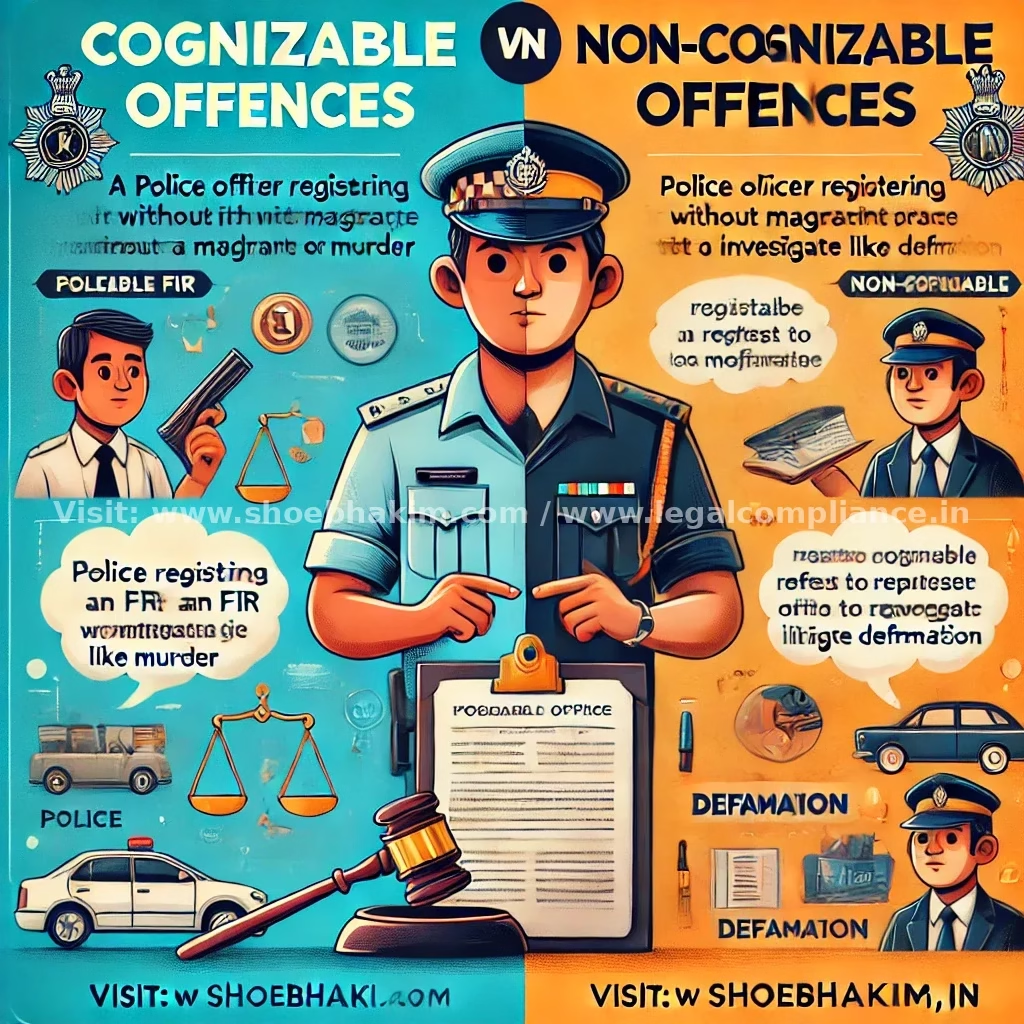
Cognizable vs. Non-Cognizable Offences

- Cognizable Offences: Police act without approval.

Alt text: Police officer registering an FIR for a serious crime. - Non-Cognizable Offences: Magistrate’s approval required.
Alt text: Police officer seeking approval from a magistrate.


How This Impacts Banking and Law Students
For students of law and banking, understanding this distinction is crucial:
- Legal Knowledge:
- Banking professionals often deal with complaints like cheque bouncing (Section 138 of the Negotiable Instruments Act), which is non-cognizable.
- Practical Application:
- Law students aspiring to practice criminal law must grasp the procedural requirements to advise clients effectively.
Adv Shoeb Hakim’s Analysis & Conclusions
The Supreme Court’s clarification underscores the importance of maintaining checks and balances in the justice system. By mandating magistrate approval for non-cognizable offences, the law ensures fairness, prevents abuse, and upholds the sanctity of personal liberties. Aspiring lawyers and banking professionals should delve into the nuances of procedural law to navigate real-world scenarios effectively.
Call to Action:
For deeper insights into legal procedures and their impact on the justice system, visit www.shoebhakim.com or www.legalcompliance.in.
Interactive Quiz
Question: Why do police require magistrate approval for non-cognizable offences?
- A. Because non-cognizable offences are less serious.
- B. To prevent arbitrary investigations.
- C. To ensure judicial oversight.
- D. All of the above.
(Correct Answer: D. All of the above.)
#advshoebhakim, #shoebhakim, #advshoaibhakim, #SupremeCourtRuling, #NonCognizableOffences, #MagistrateApproval, #CriminalLawIndia, #PoliceProcedures, #Section155CrPC, #JudicialOversight, #CognizableOffences, #LegalComplianceIndia, #LawForStudents, #BankingAndLaw, #SupremeCourtInsights, #JusticeSystemIndia, #CriminalProcedures, #LegalFrameworkIndia, #AdvocateInsights, #ProceduralLaw
DISCLAIMER:
The information provided herein is fictional, free & creative content for entertainment purposes only and should not be construed as professional advice in legal, financial, or other matters. Refer to the full Website Disclaimer for details.