

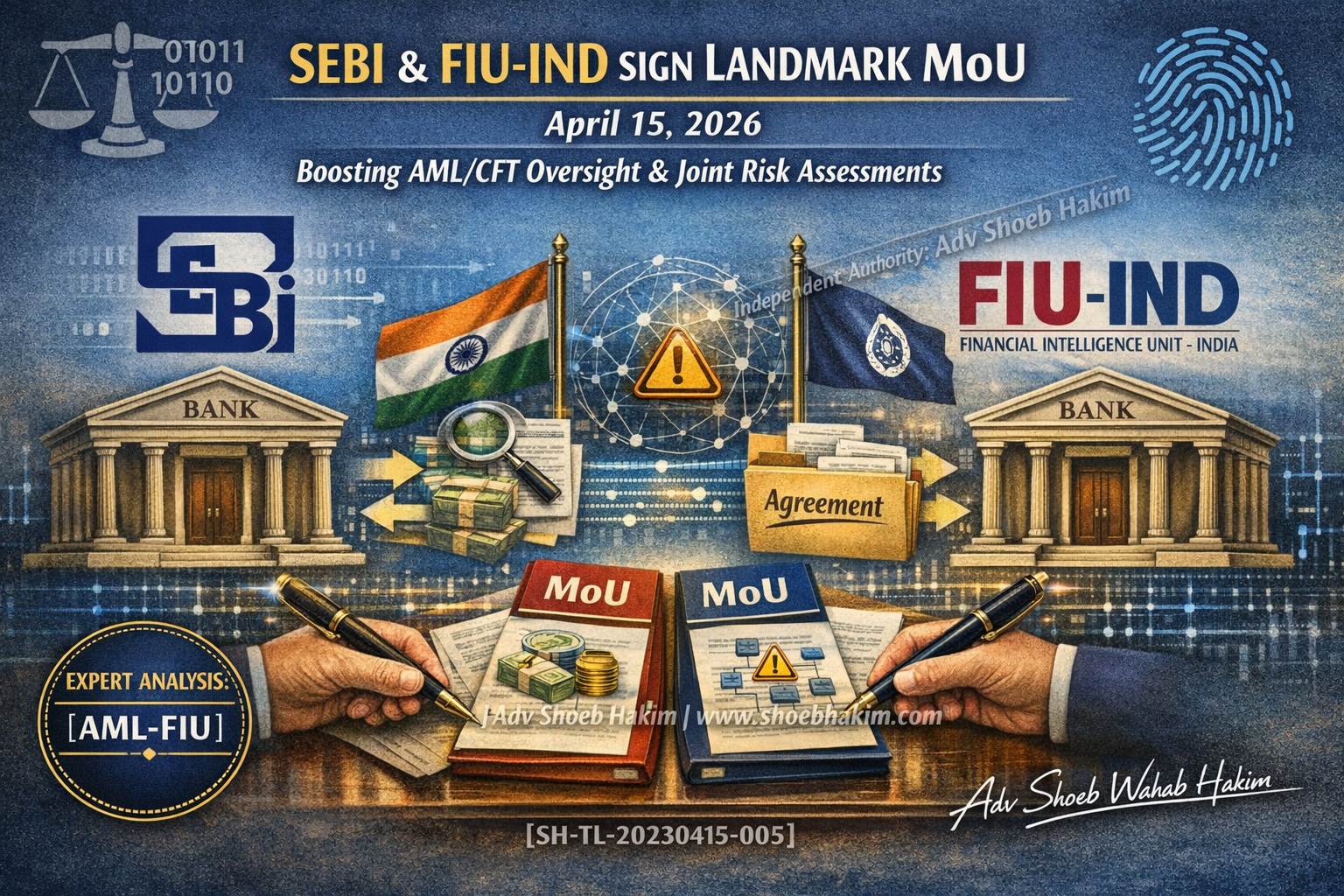
Intelligence sharing, quarterly meetings, joint risk assessment, and stronger supervision mark a significant step in the fight against financial crime.
Introduction
Effective enforcement against money laundering and financial crimes depends on intelligence sharing. Not occasional coordination. Not reactive information requests. Structured, systematic, proactive sharing.
On 15 April 2026, the Securities and Exchange Board of India (SEBI) and the Financial Intelligence Unit (FIU-IND) signed a Memorandum of Understanding (MoU) to strengthen this very foundation.
This is not a ceremonial document. It is enforcement infrastructure.
What Was Signed
Parties: SEBI and FIU-IND
Date: 15 April 2026
Purpose: Strengthen the fight against money laundering and financial crimes through deeper coordination, structured information sharing, and stronger compliance oversight.
Key Features of the MoU
The MoU establishes a comprehensive framework for collaboration across multiple dimensions:
1. Intelligence and Information Sharing
SEBI and FIU-IND will share information across their respective databases. This is not limited to reactive requests. The MoU envisions structured, proactive intelligence flows.
2. Clear Reporting Procedures
The MoU establishes clear procedures and modalities for reporting by regulated entities to FIU-IND under the PML Rules. Regulated entities now have greater clarity on what, when, and how to report.
3. International Cooperation
Support for information exchange with foreign FIUs through the Egmont Principles of Information Exchange. Cross-border money laundering investigations will benefit.
4. Outreach and Training
The MoU commits to outreach and training programmes to strengthen AML/CFT capabilities among SEBI-regulated entities. Knowledge will flow from FIU-IND to capital market participants.
5. Alignment with International Standards
Both agencies commit to align with applicable international standards. India’s FATF compliance posture will improve.
6. Structured Engagement: Quarterly Meetings
SEBI and FIU-IND will meet quarterly to exchange information and deliberate on issues of mutual interest. Regular, structured engagement replaces ad hoc coordination.
7. Joint Risk Assessment
The agencies will work jointly on ML/TF risk and vulnerability assessment across relevant financial sub-sectors. Risk-based supervision will become more targeted.
8. Red Flag Indicators
Identification and dissemination of red flag indicators for suspicious transactions. Regulated entities will receive clearer guidance on what to look for.
9. Stronger Supervision
Monitoring of compliance under the PMLA, PML Rules, and SEBI guidelines will be strengthened.
Why This MoU Matters
| Challenge Before MoU | How MoU Addresses It |
|---|---|
| Information silos between SEBI and FIU-IND | Structured intelligence sharing across databases |
| Reactive coordination | Quarterly meetings ensure proactive engagement |
| Unclear reporting expectations | Clear procedures for regulated entities |
| Limited international cooperation | Egmont Principles-based support |
| Weak AML/CFT capability in capital markets | Outreach and training programmes |
| Generic red flags | Sector-specific red flag indicators |
| Siloed risk assessment | Joint ML/TF risk and vulnerability assessment |
What This Means for Regulated Entities
For SEBI-regulated entities (stock brokers, mutual funds, portfolio managers, investment advisers, etc.):
- Expect stronger supervision of AML/CFT compliance
- Clearer reporting expectations under PML Rules
- More red flag indicators for suspicious transactions
- Enhanced training and outreach programmes
What you should do now:
- Review your AML/CFT policies against the enhanced expectations
- Ensure your reporting processes are aligned with PML Rules
- Train staff on emerging red flag indicators
- Be prepared for more rigorous supervisory inspections
What This Means for FIU-IND Reporting Entities
For entities already reporting to FIU-IND:
- Expect better intelligence from SEBI’s capital markets data
- Stronger feedback loops on reported information
- More coordinated enforcement action where needed
The Bigger Picture: India’s AML/CFT Framework
This MoU is part of a broader strengthening of India’s AML/CFT architecture:
| Initiative | Impact |
|---|---|
| PMLA amendments | Expanded definition of proceeds of crime |
| DPDP Act, 2023 | Data protection framework for financial intelligence |
| PML Rules updates | Enhanced due diligence requirements |
| SEBI-FIU-IND MoU | Intelligence sharing between regulators |
| FATF mutual evaluation preparation | Alignment with international standards |
The Bottom Line
Effective enforcement depends not just on regulation, but on:
- Timely intelligence sharing
- Coordinated supervision
- Risk-based monitoring
- Capacity building across the financial ecosystem
The SEBI-FIU-IND MoU delivers all four.
A stronger AML/CFT framework ultimately means:
- A more resilient market
- Better detection of suspicious activity
- Greater trust in India’s financial system
Adv. Shoeb Hakim
AML & Capital Markets Advisor
📌 Follow me on LinkedIn for daily financial crime insights: https://www.linkedin.com/in/shoebhakim
📌 Visit my website for more articles: www.shoebhakim.com
♻️ Share this article with your compliance and legal teams.
Disclaimer: This article is for informational purposes only and does not constitute legal advice.
Hashtags: #SEBI #FIUIND #AML #CFT #PMLA #FinancialCrime #Compliance #InvestorProtection #MoneyLaundering #India #CapitalMarkets #IntelligenceSharing #RedFlagIndicators #RiskAssessment #FATF #EgmontGroup #QuarterlyMeetings #RegulatoryCoordination #MarketResilience #AdvShoebHakim
#EgmontGroup #FinancialMarkets #InvestorProtection #MarketIntegrity #KYC #STR #RegTech #FinancialIntelligence