Why Adv Shoeb Hakim Considers This Article a Vital Read
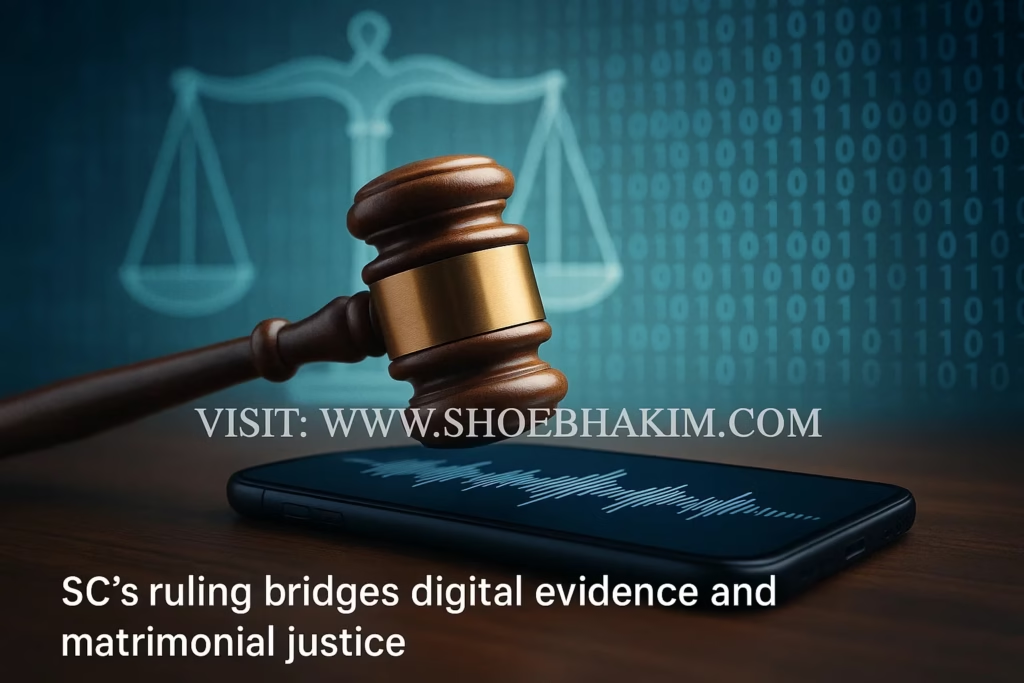
In a landmark ruling, the Supreme Court clarified that secretly recorded calls between spouses are admissible as evidence in divorce cases. This decision balances privacy rights with the pursuit of justice in matrimonial disputes, directly impacting legal strategies for lawyers, police, and compliance teams.
With rising digital evidence in family law, understanding this precedent is crucial for fair trials.
The Ruling: Breaking Down the Legal Shift
The Supreme Court overturned a 2021 Punjab and Haryana High Court verdict, permitting spouses to use covertly recorded phone conversations as evidence in divorce proceedings. The case involved a husband who recorded calls (2010–2016) to prove spousal cruelty. The Court emphasized:
Privacy vs. Fair Trial: The right to privacy (Article 21) cannot override the right to a fair trial when proving cruelty.
Broken Trust Precedes Snooping: If spouses resort to secret recordings, the relationship is already fractured, making evidence admissible.
Legal Grounds:
Section 122, Indian Evidence Act (IEA): Protects spousal communications but includes an exception for litigation between spouses.
Three-Fold Test for Admissibility: Recordings must satisfy:
Relevance (to the case),
Identification (voices must be verifiable),
Accuracy (no tampering).
Family Courts Act, 1984: Sections 14 and 20 empower courts to admit any evidence aiding dispute resolution.
Key Precedents:
KS Puttaswamy v. Union of India (2017): Recognized privacy as fundamental but not absolute.
Kaushal Kishore v. State of Uttar Pradesh (2023): Affirmed privacy’s enforceability against non-state actors in specific contexts.
How to Collect Digital Evidence: Forensic Best Practices
For law enforcement and legal teams handling digital evidence:
Step-by-Step Guide
Secure the Device: Isolate phones/computers to prevent data overwriting. Use Faraday bags to block signals.
Create Forensic Copies: Tools like Cellebrite or Autopsy create bit-by-bit clones for analysis.
Authenticate Recordings: Verify metadata (timestamps, device IDs) via FTK Imager or EnCase.
Maintain Chain of Custody: Document every handler from seizure to court presentation.
Pitfalls to Avoid
Consent Issues: While admissible, recordings without consent may trigger separate civil liability under IT Act, 2000.
Tampering Risks: Use hash values (SHA-256) to prove data integrity.
Over-Reliance on Transcripts: Always submit original audio; transcripts alone are insufficient.
Adv Shoeb Hakim’s Analysis & Conclusions
This ruling prioritizes justice over privacy in matrimonial litigation, acknowledging that marital breakdowns often necessitate unconventional evidence. However, it raises ethical dilemmas:
Practical Tip: Lawyers should advise clients against unilateral recordings to avoid counter-allegations of harassment.
Opportunity: Compliance teams can develop protocols for handling digital evidence in internal investigations.
Case in Point: A 2023 Delhi divorce case (Rajiv v. Priya) used similar recordings to prove financial coercion, expediting settlement.
Call to Action: Legal professionals must stay updated on evolving digital evidence standards under the new Bharatiya Sakshya Adhiniyam (BSA). Attend workshops or review resources on SCC Online for emerging precedents.
Quiz: Test Your Knowledge
Covert spousal recordings are admissible if:
A) Both parties consent.
B) They pass the three-fold test (relevance, ID, accuracy).
C) The court issues a surveillance warrant.Section 122 of the IEA allows disclosure of spousal communications in:
A) Criminal cases only.
B) Litigation between spouses.
C) Child custody disputes.A key privacy case referenced in the ruling was:
A) State v. Accused (2020).
B) KS Puttaswamy v. Union of India (2017).
C) ABC v. XYZ (2015).
Answers: 1(B), 2(B), 3(B)
Related to This Similar Cases/Articles You Must Read:
Spousal Privilege in Indian Evidence Law (SCC Online)
Digital Evidence Admissibility Post-BSA (LiveLaw)
Privacy Rights in Matrimonial Disputes (Bar & Bench)
Social Media Versions
LinkedIn:
Headline: Secret Recordings in Divorce? SC’s Game-Changing Ruling!
Divorce lawyers: The Supreme Court just greenlit covert spouse recordings as evidence. Discover how this affects privacy rights and trial fairness.
Read the full analysis and practical checklist.
X (Twitter):
Headline: SC: Secret Spouse Recordings = Legal Evidence!
Big win for fairness in divorce cases! Learn admissibility rules, forensic tips, and ethical traps.
Read the full analysis and practical checklist.
Facebook:
Headline: Can You Secretly Record Your Spouse? SC Says Yes!
Divorce evidence just got a digital upgrade. Essential reading for lawyers and families.
Read the full analysis and practical checklist.
SEO & Metadata
Focus Key Phrase: Admissibility of Secret Recordings in Divorce
Meta Title: Secret Spouse Recordings: SC Rules Admissibility in Divorce Cases
Meta Description: Supreme Court allows covert spouse recordings as divorce evidence. Legal analysis, forensic guidelines, and privacy implications explained.
Author: Adv Shoeb Hakim
Publication Date: July 15, 2025
Slug: secret-spouse-recordings-divorce-supreme-court-admissibility
Serial No.: SHOEBHAKIM/JULY/WEEK3/1507/196/ADVSHOART9B2-7F3
Hashtags
#advshoebhakim #shoebhakim #advshoaibhakim #DivorceEvidence #DigitalForensics #PrivacyLaw #SupremeCourtIndia #LegalCompliance #MatrimonialLaw #EvidenceAct #BSA2023 #CyberLaw #FamilyLaw #FairTrial #SpousalRights #ForensicTools #IndianJudiciary #LawStudents #LegalTech #BankingCompliance
DISCLAIMER:
The information contained in this document is purely fictional and serves as a creative work meant for entertainment only. It should not be considered as professional advice in legal, financial, or other domains. For questions or comments, please adhere to the security.txt protocol. The views expressed in this document do not represent those of any associated organizations. For detailed information, please refer to the full Website Disclaimer.