Key Facts
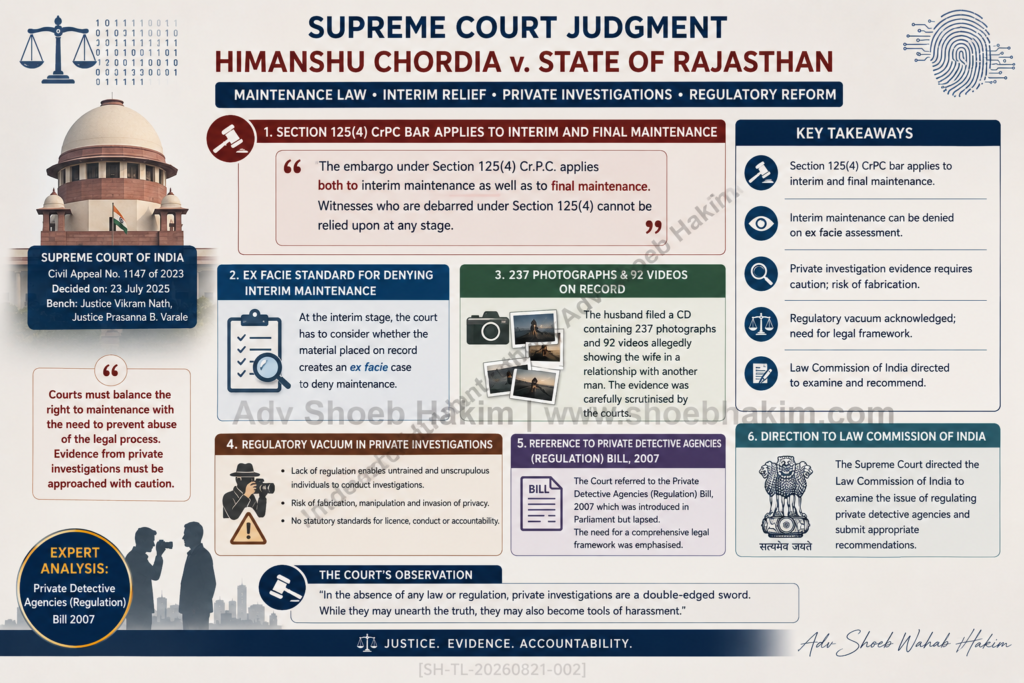
The Supreme Court delivered its judgment in Himanshu Chordia v. State of Rajasthan & Anr. on 31 July 2026. The Bench comprised Justices Sanjay Karol and Vipul M. Pancholi. The Court held that a husband can rely on private detective evidence to prove adultery for purposes of Section 125(4) CrPC.
To deny interim maintenance, the evidence must be “clear and cogent” and establish adultery ex facie. The Court noted that the husband had placed 237 photographs and 92 videos on record. The Court questioned the “regulatory vacuum” in private investigation and directed the judgment be sent to the Law Commission.
Direct Answer
The Supreme Court in Himanshu Chordia v. State of Rajasthan (31 July 2026) clarified that allegations of adultery under Section 125(4) CrPC can be examined at the interim maintenance stage, provided the husband presents “clear and cogent” evidence that ex facie establishes the charge.
The Court held that lower courts erred in deferring such issues to final adjudication, as this would render the statutory bar under Section 125(4) meaningless. However, the Court also flagged concerns over unregulated private investigators, noting that the evidence consisted of 237 photographs and 92 videos likely procured by private detectives.
The Court questioned the source, authorization, storage, and authenticity of such electronic evidence, and directed that a copy of the judgment be sent to the Law Commission to consider a regulatory framework for private detective agencies.
In this article:
The Facts of the Case
The Legal Framework: Section 125 CrPC
The Supreme Court’s Ruling
The “Ex Facie” Standard
The Concern Over Private Investigators
The Regulatory Gap
What Comes Next
FAQ
By Adv. Shoeb Hakim — Criminal defence, AML, digital forensics, and cybercrime specialist; former Head of AML & Client ID (AVP), Credit Suisse; training police since 1996.
The Facts of the Case
The appellant, Himanshu Chordia, married Arushi Jain on 7 July 2014. Following matrimonial discord, the wife left the matrimonial home in May 2020 and filed an application under Section 125 CrPC seeking maintenance.
The husband filed an application under Section 125(4) CrPC, contending that the wife was living in adultery and therefore not entitled to maintenance. The husband also filed an application under Section 91 CrPC.
Trial Court’s Order
The Special Additional Chief Judicial Magistrate, Udaipur, dismissed the husband’s applications on 27 June 2024, holding that the authenticity of the documents could only be determined after evidence was exhibited in the main petition. The Court stated: “The authenticity and originality of all these documents can only be determined after evidence are exhibited.”
High Court’s Order
The Rajasthan High Court upheld the trial court’s decision, holding that the issue of adultery was a disputed question of fact to be decided only at final adjudication.
Supreme Court’s Intervention
The husband appealed to the Supreme Court challenging the High Court’s judgment.
The Legal Framework: Section 125 CrPC
Section 125(1) CrPC
Section 125 provides for the order of maintenance of wives, children, and parents. It is a welfare-oriented provision intended to prevent destitution and provide financial support to dependants.
Section 125(4) CrPC
Section 125(4) states: “No wife shall be entitled to receive an allowance for the maintenance or the interim maintenance and expenses of proceeding, as the case may be, from her husband under this section if she is living in adultery, or if, without any sufficient reason, she refuses to live with her husband, or if they are living separately by mutual consent.”
The 2001 Amendment
The phrase “or the interim maintenance” was inserted vide the 2001 amendment. The Court noted that this demonstrates legislative intent that the statutory bar applies equally to interim and final maintenance.
The Supreme Court’s Ruling
The Supreme Court allowed the appeal and set aside the High Court’s judgment.
Key Holdings
First: Proceedings under Section 125 CrPC are summary, civil in nature, and beneficent, aimed at preventing vagrancy and destitution. The provision is oriented towards social justice and is secular in character.
Second: Section 125(4) expressly bars both interim and final maintenance if adultery is established. The phrase “or the interim maintenance” was inserted deliberately.
Third: The pendency of a Section 125(4) application does not per se bar the wife from receiving interim maintenance. The bar applies only if the husband, at the first instance, establishes the charge through evidence ex facie.
Fourth: Where the evidence requires proof in accordance with law, interim maintenance continues during the period the court takes to assess such evidence.
Fifth: The trial court and High Court erred in holding that the question of adultery could only be decided at final adjudication. This would render the interim bar in Section 125(4) otiose.
Sixth: The matter was remanded to the trial court to decide the Section 125(4) application on merits.
The “Ex Facie” Standard
The Court drew a clear distinction between two scenarios:
Scenario A: Ex Facie Proof
If the husband presents “clear and cogent” evidence that, on the face of the record, establishes adultery, interim maintenance can be denied. This includes admitted documentation, uncontroverted direct photographs, or explicit admissions.
Scenario B: Disputed Evidence
If the evidence presented requires extensive formal proof, cross-examination, or forensic authentication, interim maintenance continues while the court expedites the hearing.
The Court observed: “Adultery, if proved, takes away maintenance from the wife, then the application to prove such a fact has to be decided between the order granting interim maintenance and final adjudication of such application for maintenance.”
The Court also noted that “living in adultery” implies a continuous or ongoing course of adulterous living, rather than a single or isolated instance of infidelity. The evidence must point toward a continuous relationship.
The Concern Over Private Investigators
The Court expressed serious concerns regarding the evidence presented, which included 237 photographs and 92 videos allegedly procured through private investigators.
The Questions Raised:
“Who took these pictures? Did they have any authorization to do so? …Whether these pictures sought to be adduced as evidence are in fact genuine…or have they been morphed? What are the implications for the right of privacy of individuals?”
Legal Framework for Electronic Evidence
The Court referred to R.M. Malkani v. State of Maharashtra (1973) and Naresh Kumar Garg (Dr.) v. State of Haryana (2026), outlining conditions for admissibility of recorded material: relevance, identification, and accuracy.
The Court also invoked Arjun Panditrao Khotkar v. Kailash Kushanrao Gorantyal, stressing that electronic records require statutory certification for admissibility.
The Regulatory Gap
The Court noted the absence of any regulatory framework for private investigating agencies in India. It referred to Navinchandra N. Majithia v. State of Meghalaya (2000) 8 SCC 323, which held that private investigations are not recognized as “investigation under law.” The Court quoted: “The Code does not recognise private investigating agency. If any person is interested in hiring any such private agency, he may do so at his own risk and cost, but such investigation would not be regarded as investigation made under law.”
The Private Detective Agencies (Regulation) Bill, 2007
The Court noted that the Private Detective Agencies (Regulation) Bill, 2007, which aimed to regulate private detective agencies, was never enacted.
The Bill proposed Central and State boards, licensing, record maintenance, and restrictions on investigations reserved for statutory authorities. The Court observed: “A perusal of the Statement of Objects and Reasons appended to the Bill reveals that the need to bring a bill in this regard arose from the perspective of business since there was an increasing reliance on private investigators to gather information. While that may be true, we believe that regulation and accountability are equally important in the sphere of private investigation.”
The Court’s Direction
The Supreme Court directed that a copy of its judgment be forwarded to:
The Union Ministry of Law and Justice
The Law Commission of India
The Court urged them to consider framing an appropriate regulatory framework for private detective agencies and the use of electronically collected evidence.
What Comes Next
For the Matrimonial Litigation
The matter stands remanded to the trial court to decide the husband’s Section 125(4) application on merits. The wife’s interim maintenance will continue pending the court’s assessment of the evidence.
For Private Investigation Regulation
The Supreme Court’s direction to the Law Commission signals that legislative action is likely. The Court’s concerns about privacy, authorization, storage, authenticity, and the risk of doctored or morphed material will need to be addressed in any regulatory framework.
FREQUENTLY ASKED QUESTIONS (FAQ)
What is Section 125(4) CrPC?
Section 125(4) CrPC states that a wife is not entitled to maintenance or interim maintenance from her husband if she is living in adultery, refuses without sufficient reason to live with her husband, or if they are living separately by mutual consent.
What did the Supreme Court decide in Himanshu Chordia v. State of Rajasthan?
The Court held that allegations of adultery under Section 125(4) CrPC can be examined at the interim maintenance stage, provided the husband presents clear and cogent evidence that establishes adultery ex facie. The Court remanded the matter to the trial court for fresh consideration.
Can a husband use evidence from a private detective to prove adultery?
Yes, the Court allowed the husband to rely on such evidence. However, the Court also raised concerns about the regulatory vacuum in private investigation and questioned the source, authorization, storage, and authenticity of such evidence.
What does ex facie mean?
Ex facie means “on the face of it.” The Court held that interim maintenance can be denied only if the evidence, on the face of the record, establishes adultery. If the evidence requires formal proof, interim maintenance continues.
Does Section 125(4) bar interim maintenance or only final maintenance?
Both. The phrase “or the interim maintenance” was inserted in the 2001 amendment to clarify that the bar applies to both interim and final maintenance.
What is the difference between ex facie proof and disputed evidence?
Ex facie proof is evidence that, on the face of the record, establishes adultery without requiring extensive formal proof. Disputed evidence requires cross-examination, forensic authentication, or further verification.
Does the mere filing of a Section 125(4) application suspend interim maintenance?
No. The pendency of a Section 125(4) application does not per se bar the wife from receiving interim maintenance. The bar applies only if the husband establishes the charge through evidence ex facie.
What is the significance of “living in adultery” versus a single adulterous act?
“Living in adultery” implies a continuous or ongoing course of adulterous living, rather than a single or isolated instance of infidelity. The evidence must point toward a continuous relationship.
What is the Private Detective Agencies (Regulation) Bill, 2007?
It was a bill introduced in the Rajya Sabha to regulate private detective agencies. It proposed Central and State boards, licensing, record maintenance, and restrictions on investigations. It was never enacted.
What did the Supreme Court direct regarding private detective regulation?
The Court directed that a copy of its judgment be sent to the Union Ministry of Law and Justice and the Law Commission of India to consider framing an appropriate regulatory framework for private detective agencies.
Q: Does the mere filing of a Section 125(4) adultery application automatically suspend interim maintenance?
Ans: No. The pendency of a Section 125(4) application does not per se bar the wife from receiving interim maintenance unless the husband establishes the charge ex facie at the threshold.
Q: What is the legal significance of the 2001 amendment to Section 125(4) CrPC?
Ans: The insertion of the words “or the interim maintenance” clarified legislative intent that the statutory bar against maintenance in cases of adultery applies equally to interim and final awards.
Q: Why are private detective agencies considered unregulated in India?
Ans: India lacks statutory legislation governing private investigators; historical bills like the Private Detective Agencies (Regulation) Bill, 2007, were never enacted into law.
Q: How does the Supreme Court’s ruling impact matrimonial practice across India?
Ans: It prevents family courts from routinely postponing adultery defenses to final disposal, ensuring that credible, threshold-level evidence receives immediate judicial consideration during maintenance proceedings.
KNOWLEDGE CHECK QUIZ
Q: What was the primary legal issue addressed by the Supreme Court in Himanshu Chordia v. State of Rajasthan?
Ans: Whether a husband’s application alleging adultery under Section 125(4) CrPC can be decided at the interim maintenance stage or must be deferred until final trial.
Q: What evidentiary standard must a husband meet to deny interim maintenance on the ground of adultery?
Ans: The husband must present “clear and cogent” evidence that ex facie establishes the charge of ongoing adulterous conduct.
Q: What systemic concern did the Supreme Court raise regarding the evidence submitted in the case?
Ans: The Court questioned the source, authorization, storage, authenticity, and privacy implications of 237 photographs and 92 videos procured through private investigators operating in a regulatory vacuum.
Q: To which bodies did the Supreme Court direct copies of the judgment be sent for legislative consideration?
Ans: The Union Ministry of Law and Justice and the Law Commission of India.
By Adv. Shoeb Hakim
Criminal defence, AML, digital forensics, and cybercrime specialist; former Head of AML & Client ID (AVP), Credit Suisse; training police since 1996.
📌 Connect: https://www.linkedin.com/in/shoebhakim | https://shoebhakim.com/shoeb-hakim-blog/
📌 Visit my website for more articles: https://shoebhakim.com
📌 Visit my website for legal knowledge: https://www.vakilverse.com
📌 Visit my website for research fellowship: https://www.legalcomplaince.in
Disclaimer: This content is for informational purposes only and does not constitute legal advice. Readers should consult qualified legal counsel for advice on their specific circumstances.
#AdvShoebHakim #HimanshuChordia #Section125CrPC #Adultery #MatrimonialLaw #PrivateInvestigators #SupremeCourtIndia #LegalDefense #Compliance #DigitalForensics
Additional Page Metadata
Author:
Adv. Shoeb Hakim
Author Bio:
Adv. Shoeb Hakim is a Mumbai-based criminal defence, AML, digital forensics and cybercrime specialist. Former Head of AML & Client ID (AVP) at Credit Suisse. Has been training police and judiciary since nineteen ninety six. Provides expert commentary on criminal procedure, evidence law, and matrimonial litigation.
Article Publisher:
Adv. Shoeb Hakim
Article Section:
Criminal Procedure | Evidence Law | Matrimonial Law | Constitutional Law
Article Tags:
Section 125 CrPC, adultery, maintenance, interim maintenance, Himanshu Chordia, Supreme Court, private detectives, ex facie, electronic evidence, regulatory vacuum, Law Commission, Adv Shoeb Hakim