Key Facts
Under the Bharatiya Sakshya Adhiniyam (BSA), 2023, an electronic record without statutory certification has zero evidentiary admissibility.
Section 63(1) BSA deems any information in an electronic record produced by a computer to be a document and admissible as evidence of the contents of the original.
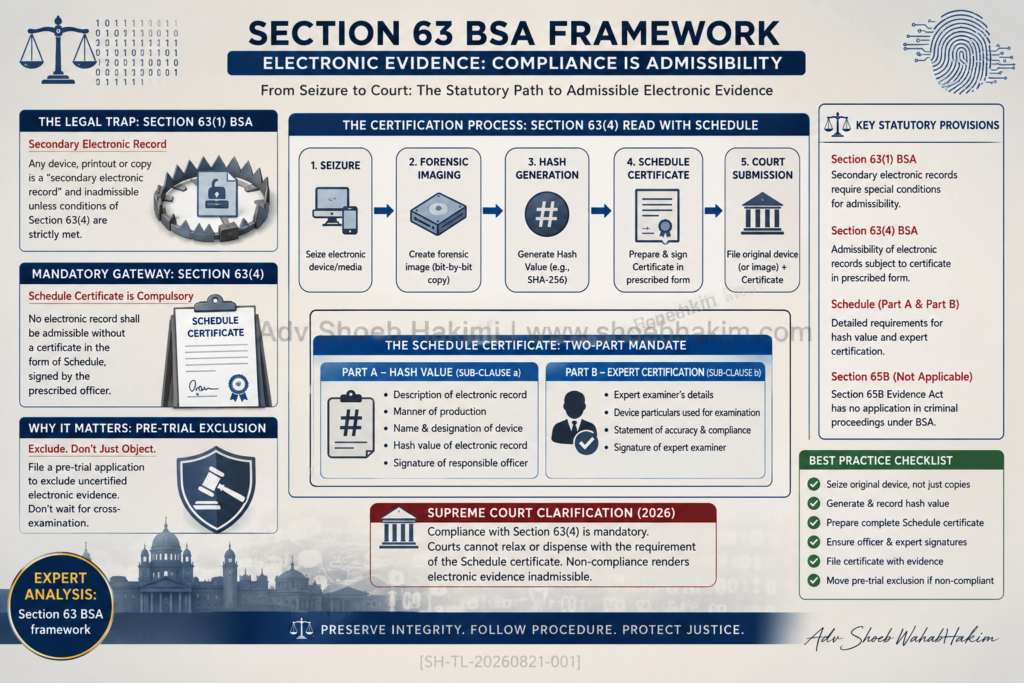
Section 63(4) BSA requires a certificate in the prescribed Schedule format to accompany the electronic record whenever it is tendered as secondary evidence.
The Schedule contains two parts: Part A (hash value disclosure by the person in charge of the device) and Part B (certification by an expert).
The Supreme Court upheld the stricter certification regime under Section 63(4) BSA on 22 May 2026.
Failure to produce the certificate at the time of filing the chargesheet or complaint renders the electronic evidence inadmissible.
Direct Answer
Under the Bharatiya Sakshya Adhiniyam (BSA), 2023, an electronic record without strict statutory certification has zero evidentiary admissibility in a court of law. A printout of a WhatsApp chat, an audio recording transferred to a pen drive, or a forwarded PDF is not primary evidence — it is secondary electronic evidence.
Section 63(1) BSA declares that any information in an electronic record produced by a computer shall be deemed to be a document and shall be admissible as evidence of the contents of the original. However, Section 63(4) BSA requires a certificate in the prescribed Schedule format to accompany the electronic record whenever it is tendered as secondary evidence. The certificate requires two signatories: the person in charge of the device (Part A) and an independent expert (Part B).
The Supreme Court upheld this stricter certification regime on 22 May 2026, clarifying that the hash value of the electronic record must be disclosed in Part A, while Part B requires certification by an expert. If the prosecution or complainant fails to produce this statutory certificate at the time of filing the chargesheet or complaint, the electronic evidence cannot be admitted.
In this article:
The Secondary Electronic Record Trap
The Mandatory Schedule Certificate
The Two-Part Certificate Explained
The Pre-Trial Exclusion Strategy
The Supreme Court’s 2026 Clarification
Why This Matters for Litigation
Practical Steps for Compliance
FAQ
By Adv. Shoeb Hakim — Criminal defence, AML, digital forensics, and cybercrime specialist; former Head of AML & Client ID (AVP), Credit Suisse; training police since 1996.
The Secondary Electronic Record Trap
In modern business disputes and criminal investigations, the first thing parties do is take screenshots of WhatsApp chats, export email threads, and save phone call recordings — assuming this creates an “open-and-shut” evidentiary case.
Investigating officers frequently rely on plain printouts of chat histories to build chargesheets, while corporate complainants attach loose photocopies to support fraud allegations.
Under Section 63(1) BSA, any information in an electronic record produced by a computer shall be deemed to be a document and shall be admissible as evidence of the contents of the original.
However, Section 63(1) BSA also establishes that a printout of a WhatsApp chat, an audio recording transferred to a pen drive, or a forwarded PDF is not primary evidence — it is secondary electronic evidence.
Under Section 63 BSA (which succeeds Section 65B of the Indian Evidence Act), secondary digital records cannot be proved through oral testimony. Without fulfilling statutory preconditions, the court is barred from reading them into evidence.
The Mandatory Schedule Certificate
Following the Supreme Court’s Constitutional ruling in Arjun Panditrao Khotkar (2020), the BSA has codified a strict Two-Part Certificate in the Schedule.
The requirement of a certificate under Section 63 of the BSA has been held as a mandatory condition for admissibility of evidence by way of electronic records.
Section 63(4) BSA requires that a certificate in the form of the Schedule accompany the electronic record whenever it is tendered as secondary evidence.
If the prosecution or complainant fails to produce this statutory certificate along with the electronic record at the time of filing the chargesheet or complaint, the electronic evidence cannot be admitted.
The Two-Part Certificate Explained
The Schedule to the BSA prescribes the certificate in two parts.
Part A of the Schedule requires disclosure of the hash value of the electronic record. It must be executed by the person who produced the printout or created the electronic output, certifying device integrity and custody.
Part B of the Schedule requires certification by an expert. It must be executed by the person in lawful charge of the management of the device or relevant electronic system.
The BSA additionally requires the certificate to be also signed by an expert, in addition to the person in charge of the device concerned.
The certificate identifies the electronic record and must be submitted along with the electronic record at each instance where it is being submitted for admission.
Key Point: Certification does not necessarily require the owner of the device but the person who manages the device regularly at relevant times in the prescribed format as laid down in the BSA schedule Part A.
The Pre-Trial Exclusion Strategy
You do not have to wait for cross-examination to dismantle uncertified electronic material.
At the stage of Framing of Charges under Section 251 or 262 BNSS, defense counsel can object to the admissibility of raw screenshots and call recordings.
If the foundational evidence fails the Section 63(4) BSA test, the chargesheet’s core narrative collapses before trial commences.
The certificate requirement stays mandatory for secondary electronic evidence — and now demands two signatories (the person in charge of the device plus an independent expert).
Strategic Advantage: By raising the objection at the framing of charges stage, you force the prosecution to either produce the mandatory certificate or face dismissal of the electronic evidence. Without that evidence, many chargesheets lose their evidentiary foundation.
The Supreme Court’s 2026 Clarification
On 22 May 2026, the Supreme Court upheld the stricter certification regime under Section 63(4) BSA.
Key Holdings:
The hash value is an electronic fingerprint.
Part A of the Schedule requires disclosure of the hash value of the electronic record.
Part B requires certification by an expert.
The Court clarified that the Madras High Court’s view requiring Part B to be signed exclusively by a Section 79-A-notified Examiner of Electronic Evidence shall not operate as a binding precedent.
The Court left open the question regarding the scope of expert certification under Part B for consideration in an appropriate case.
Practical Implication: While Part B requires an expert, the Supreme Court has not mandated that it must be exclusively a Section 79-A-notified examiner. This leaves some flexibility in who can qualify as an expert for certification purposes.
Why This Matters for Litigation
For Prosecutors and Complainants
You must ensure that every piece of electronic evidence you intend to rely upon is accompanied by the mandatory Section 63(4) BSA certificate at the time of filing. Failure to do so means the evidence will be excluded.
The certificate must be in the prescribed Schedule format and must include both Part A (hash value disclosure) and Part B (expert certification).
For Defense Counsel
You have a powerful pre-trial weapon. At the framing of charges stage, object to any electronic evidence that lacks the mandatory certificate. If the prosecution cannot produce it, the evidence is inadmissible and the chargesheet may collapse.
For Corporate Litigants
Internal investigations and fraud complaints often rely heavily on electronic evidence. Ensure that your legal team obtains the necessary certifications before filing any complaint. A screenshot without a certificate is worthless in court.
For Forensic Experts
Your role in certifying electronic evidence under Part B of the Schedule is now critical. You must be prepared to verify hash values, certify device integrity, and attest to the chain of custody.
Practical Steps for Compliance
Step 1: Identify the Electronic Evidence
Determine what electronic records you intend to rely upon — WhatsApp chats, emails, call recordings, documents, or any other digital material.
Step 2: Obtain the Part A Certificate
The person who produced the printout or created the electronic output must execute Part A of the Schedule, certifying:
The device integrity
The hash value of the electronic record
The custody of the device
Step 3: Obtain the Part B Certificate
An expert must execute Part B of the Schedule, certifying:
The accuracy of the electronic record
The proper operation of the computer or communication device
The compliance with statutory requirements
Step 4: Submit with the Chargesheet or Complaint
The certificate must accompany the electronic record at the time of filing. If you wait until trial, it may be too late.
Step 5: Preserve the Chain of Custody
Maintain detailed records of who handled the device, when, and under what conditions. This will support the certification and withstand cross-examination.
FREQUENTLY ASKED QUESTIONS (FAQ)
Q: Can oral testimony prove secondary electronic records if the Section 63 certificate is missing?
Ans: No. Section 63 of the BSA is a complete code for electronic records led as secondary evidence, and oral testimony cannot substitute for the mandatory statutory certificate.
Q: What is a cryptographic hash value and why is it required under the BSA?
Ans: A hash value is a unique digital fingerprint generated from an electronic file. It is required under the Schedule to prove that the digital record has not been altered or tampered with.
Q: Does Section 63 apply to modern communication devices like smartphones and messaging apps?
Ans: Yes. Section 63 explicitly encompasses information produced by a computer or any communication device, bringing mobile data, WhatsApp chats, and cloud backups fully within its purview.
Q: What happens if the prosecution fails to attach the Section 63(4) certificate to the chargesheet?
Ans: The electronic evidence cannot be admitted by the court, which can cause the evidentiary foundation of the chargesheet to collapse.
KNOWLEDGE CHECK QUIZ
Q: Under the Bharatiya Sakshya Adhiniyam (BSA), 2023, what legal status does an uncertified electronic printout possess in court?
Ans: It possesses zero evidentiary admissibility as secondary evidence unless accompanied by the mandatory statutory certificate.
Q: What specific information must be disclosed in Part A of the Section 63(4) Schedule certificate?
Ans: The cryptographic hash value of the electronic record along with device custody and integrity verification by the person in charge of the device.
Q: How did the Supreme Court in Pune Bar Association v. Union of India (May 2026) clarify the definition of an “expert” under Part B?
Ans: The Supreme Court clarified that the expert is not exclusively restricted to government-notified Section 79-A Examiners of Electronic Evidence, extending qualification to any person possessing special skill in cyber forensics.
Q: At what procedural stage should defense counsel object to missing Section 63(4) certificates?
Ans: At the pre-trial stage of framing charges under the BNSS.
FAQ
What is Section 63 of the Bharatiya Sakshya Adhiniyam?
Section 63 of the BSA governs the admissibility of electronic records in Indian courts. It deems any information in an electronic record produced by a computer to be a document and admissible as evidence, subject to strict certification requirements.
What is the difference between primary and secondary electronic evidence?
Primary electronic evidence is the original electronic record itself. Secondary electronic evidence is a printout, copy, or reproduction of the original. Under Section 63 BSA, secondary electronic records require a mandatory certificate for admissibility.
What is the Section 63(4) BSA certificate?
It is a mandatory certificate in the prescribed Schedule format that must accompany any secondary electronic evidence tendered in court. The certificate requires two signatories: the person in charge of the device (Part A) and an independent expert (Part B).
What is the “hash value” mentioned in the Schedule?
A hash value is a unique electronic fingerprint of a digital file. It is used to verify that the electronic record has not been altered or tampered with. Part A of the Schedule requires disclosure of the hash value.
Who must sign Part A of the certificate?
Part A must be signed by the person who produced the printout or created the electronic output, certifying device integrity and custody.
Who must sign Part B of the certificate?
Part B must be signed by an expert — the person in lawful charge of the management of the device or relevant electronic system.
What did the Supreme Court decide on 22 May 2026?
The Supreme Court upheld the stricter certification regime under Section 63(4) BSA, clarifying that the hash value must be disclosed in Part A and that Part B requires certification by an expert. The Court left open the question of who qualifies as an expert.
What happens if the certificate is not filed with the chargesheet?
If the prosecution or complainant fails to produce the Section 63(4) BSA certificate at the time of filing the chargesheet or complaint, the electronic evidence cannot be admitted.
Can I object to electronic evidence at the pre-trial stage?
Yes. At the stage of Framing of Charges under Section 251 or 262 BNSS, defense counsel can object to the admissibility of raw screenshots and call recordings that lack the mandatory certificate.
Why is this important for corporate litigants?
Internal investigations and fraud complaints often rely heavily on electronic evidence. Without the mandatory Section 63(4) BSA certificate, that evidence is inadmissible, and the case may fail.
By Adv. Shoeb Hakim
Criminal defence, AML, digital forensics, and cybercrime specialist; former Head of AML & Client ID (AVP), Credit Suisse; training police since 1996.
📌 Connect: https://www.linkedin.com/in/shoebhakim | https://shoebhakim.com/shoeb-hakim-blog/
📌 Visit my website for more articles: https://shoebhakim.com
📌 Visit my website for legal knowledge: https://www.vakilverse.com
📌 Visit my website for research fellowship: https://www.legalcomplaince.in
Disclaimer: This content is for informational purposes only and does not constitute legal advice. Readers should consult qualified legal counsel for advice on their specific circumstances
Additional Page Metadata
Author:
Adv. Shoeb Hakim
Author Bio:
Adv. Shoeb Hakim is a Mumbai-based criminal defence, AML, digital forensics and cybercrime specialist. Former Head of AML & Client ID (AVP) at Credit Suisse. Has been training police and judiciary since nineteen ninety six. Provides expert commentary on electronic evidence, digital forensics, and criminal procedure.
Article Publisher:
Adv. Shoeb Hakim
Article Section:
Electronic Evidence | Digital Forensics | Criminal Procedure | Evidence Law
Article Tags:
Section 63 BSA, electronic evidence, digital evidence, Schedule certificate, hash value, Arjun Panditrao Khotkar, Supreme Court 2026, secondary evidence, criminal procedure, BNSS, Bharatiya Sakshya Adhiniyam, Adv Shoeb Hakim
#AdvShoebHakim #Section63BSA #ElectronicEvidence #DigitalForensics #WhiteCollarCrime #SupremeCourtIndia #LegalDefense #CyberLaw #Compliance #PuneBarAssociation