SIM-Device Binding: India’s New Weapon Against Cross-Border Cyber-Fraud
Why Adv Shoeb Hakim Considers This Article a Vital Read
The Department of Telecommunications (DoT) has issued a landmark directive under the Telecom Cyber Security Rules, mandating continuous SIM-device binding and periodic session logout for app-based communication services like WhatsApp, Telegram, and Signal.
With India’s cyber-fraud losses exceeding ₹22,800 crore in 2024, this move represents a critical legal and technological pivot. As an expert in cybercrime law and digital forensics, I view these directions as essential to plug the most exploited security gap: anonymity and traceability.
They restore the link between a KYC-verified mobile number and the active user device, sharply limiting the capacity for cross-border scams, digital arrests, and mule-account operations. Understanding these rules is crucial for legal professionals, compliance officers, and every digital citizen in India.
I. Understanding the DoT’s SIM-Binding Mandate

The new directions, issued on November 28 under the Telecom Cyber Security Rules, compel specified app-based communication services to change their fundamental operational model. These mandates address the critical vulnerability created when an application permits usage without the registered SIM being present in the device.
The Core Legal Mandate
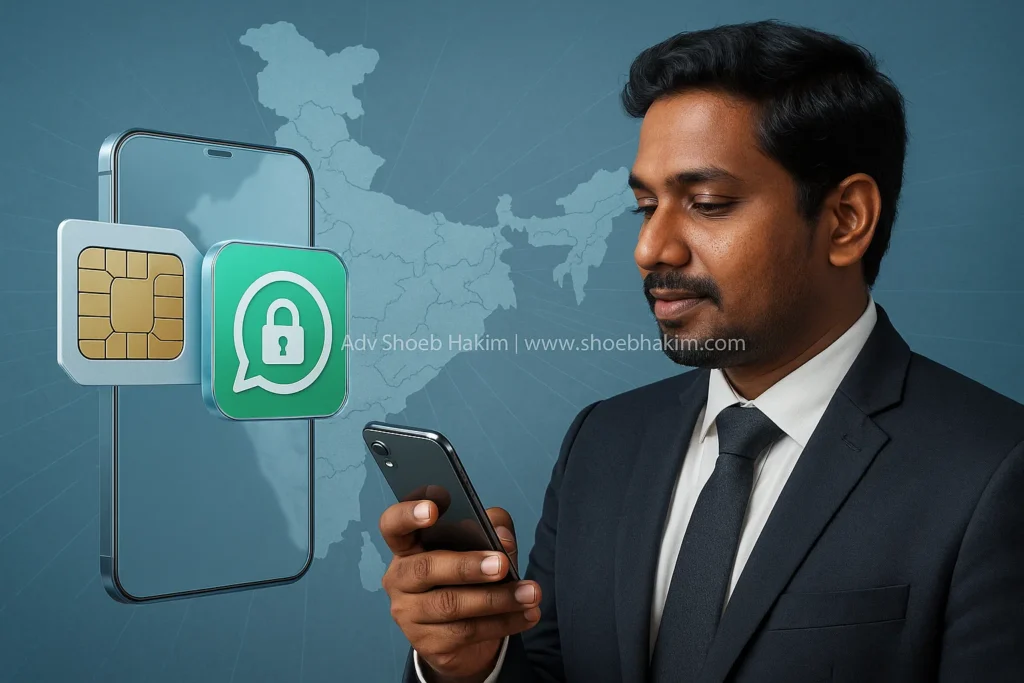
The Department of Telecommunications has essentially declared that for certain apps utilizing Indian mobile numbers for identification, the service must be continuously linked to the associated SIM card. This is a non-negotiable requirement intended to enhance the traceability of telecom identifiers used in crime.
The directions mandate two key technical requirements:
1. Continuous SIM-Device Binding
This ensures that the app-based communication service can only operate successfully when the specific, active SIM card registered to that number is physically installed in the device.
Who is Affected? App-Based Communication Services (like WhatsApp, Telegram, Jiochat, etc.) that use Indian mobile numbers for user identification.
The Cyber Security Gap Addressed: Previously, an account could be activated in India and then used indefinitely from a device located anywhere in the world, even if the SIM was removed or deactivated. This provided complete anonymity to criminals operating outside India while exploiting Indian mobile numbers for scams (e.g., digital arrest fraud).
The Benefit: Binding the account to a live, KYC-verified SIM ensures that the account’s operations are always anchored to a traceable, verified subscriber, restoring accountability under Indian law.
2. Mandatory Periodic Logout for Web/Desktop Sessions
The directions require the web or desktop instance of the mobile application to be logged out periodically, not later than every six hours.
The Fraud Vector Addressed: Long-lived web/desktop sessions (sometimes lasting months) are a primary mechanism for account takeover and session hijacking. Once a fraudster gains access, they can control the victim’s account from a distant location without needing the original device for fresh re-authentication.
The Friction Mechanism: By enforcing auto-logout every six hours, the service forces frequent re-authentication which requires proof of control over the primary, SIM-bound device (typically via a QR code scan). This significantly raises friction and detectability for criminals and sharply reduces the scope for remote-access misuse.
II. Legal Framework and Compliance Timeline
The DoT’s authority stems from the Telecom Cyber Security Rules, a strong statutory foundation that gives these directions legal enforceability.
Compliance Timeline
Implementation Deadline: App-Based Communication Services must complete the implementation of both SIM-binding and auto-logout within 90 days of the Nov 28 direction.
Reporting Deadline: They must submit a compliance report to the DoT within 120 days.
Applicability and Exception
It is important to note that this direction is surgically targeted to prevent misuse without impacting legitimate use.
Roaming Exemption: The direction does not affect cases where the user is on roaming, provided the SIM card is present and active in the handset. The goal is device-SIM proximity, not geographical restriction.
III. Adv Shoeb Hakim’s Expert Legal Commentary
This proactive step by the DoT is a necessary and proportionate response to the sophistication and scale of modern cyber-frauds.
Judicial Precedents and Analogy
The concept of binding an identity to a device for security is not new.
The Banking Precedent: Device binding and automatic session logout are already standard security features in Indian banking and payment applications. This is based on established best practices to prevent fraud, session hijacking, and misuse from untrusted devices. The DoT has merely extended this mature security model to communication platforms that have now become central to cyber frauds.
The Principle of Traceability: The Supreme Court of India has consistently affirmed the State’s responsibility to protect citizens, balancing individual rights with national security and crime prevention. While not directly on SIM binding, the judicial emphasis on linking identity to activity for law enforcement purposes is clear. The principle of Shreya Singhal vs. Union of India (2015) 5 SCC 1—though focused on free speech—emphasized the need for a proportional response to a clear danger, which the ₹22,800 crore fraud loss clearly represents.
Implications for Law Enforcement and Compliance
The new rules provide two immense benefits to law enforcement and legal professionals:
Restored Admissibility of Evidence: The continuous link between the number and the KYC-verified subscriber strengthens the chain of evidence. If a number is used in a crime, the connection to the physical SIM holder is immediate and verifiable, which is critical for satisfying the electronic evidence requirements under the Bharatiya Sakshya Adhiniyam, 2023 (BSA).
Mitigation of Intermediary Liability Risk: By implementing these security measures, app-based communication services enhance their due diligence posture, potentially reducing their liability under Section 79 of the Information Technology Act, 2000, particularly in cases where they are accused of facilitating fraud due to inadequate security controls.
IV. Practical Checklist for Users and Compliance Officers
As Adv Shoeb Hakim, I recommend the following actionable steps:
Practical Checklist for Application Compliance
| Requirement | Action for App Services (TIUEs) | Legal & Technical Focus |
| SIM Binding | Implement continuous, background checks to verify the SIM’s presence in the device running the app. | Traceability & KYC: Ensure the active session is anchored to the KYC-verified number. |
| Auto-Logout | Set the maximum web/desktop session duration to 6 hours before mandatory re-authentication. | Friction & Session Hijacking: Eliminate long-lived, unsupervised remote sessions. |
| User Notifications | Clearly inform users about the new security measure and the requirement for frequent re-login on desktop/web versions. | Transparency & Trust: Manage user experience expectations for the new security flow. |
V. How to Collect Digital Evidence (Forensic Focus)
The new binding rules make the primary device the central repository of evidence. For law enforcement and forensic investigators, the focus shifts to securing this device.
Immediate Seizure and Isolation: Upon identifying a suspect’s device, it must be seized and placed in a Faraday bag to prevent remote access (including remote logout/wipe) and preserve the “live” state, adhering to procedures under the Bharatiya Nagarik Suraksha Sanhita, 2023 (BNSS).
Forensic Image Acquisition: A bit-stream image (forensic copy) of the device’s internal storage must be created using validated forensic tools (e.g., UFED, XRY). This captures all data, including application logs, session tokens, and encrypted communication databases.
Admissibility Under BSA: The investigator must ensure that the digital evidence is accompanied by a Certificate under Section 65B of the Indian Evidence Act, 1872 (now equivalent sections in the BSA), detailing the process used to acquire and authenticate the data from the device and confirming the functional integrity of the device at the time of data generation.
VI. Frequently Asked Questions (FAQ)
Q: Does this mean I can’t use WhatsApp Web when my phone is switched off?
A: No, but you will be logged out periodically. The directions mandate a session logout every six hours. You will need to re-scan the QR code using your primary device (with the active SIM) to re-link and continue the web session.
Q: Does this affect my use of my SIM card while travelling abroad (roaming)?
A: No. The direction explicitly states that it does not affect cases where the SIM is present in the handset and the user is on roaming. As long as your registered SIM is in your device, your app service will continue to function.
Q: What are the consequences for app companies that fail to comply within 90 days?
A: Failure to comply with mandatory directions under the Telecom Cyber Security Rules could lead to significant penalties, service restrictions, and other legal action against the platform under the relevant legal and regulatory frameworks of the DoT.
Adv Shoeb Hakim’s Analysis & Conclusions:
The SIM-device binding and periodic logout directions are not merely technical updates; they are a profound legal intervention by the DoT to secure India’s digital ecosystem. They directly attack the core enablers of large-scale, anonymous cyber-frauds.
I anticipate that these measures will have a demonstrable disruptive effect on criminal syndicates operating from abroad, making it exponentially harder and more resource-intensive for them to sustain long-term scam campaigns using Indian telecom identifiers. The restoration of traceability is paramount for future criminal prosecution under the Bharatiya Nyaya Sanhita (BNS), 2023. This move establishes a high benchmark for platform accountability and digital security.
For legal professionals, this represents a new statutory framework for arguing issues of due diligence and platform negligence. For citizens, it is a significant step toward safer digital communication.
Actionable Tip: Update your apps promptly to comply and make sure you understand the new routine of re-linking your web sessions every few hours—it is a small inconvenience for a major security upgrade.
Related Cases/Articles You Must Read:
Interactive Quiz: Test Your Knowledge on SIM-Binding
Question 1
What is the primary statutory basis for the DoT’s directions mandating SIM-device binding?
A. The Digital Personal Data Protection Act, 2023 (DPDP Act)
B. The Telecom Cyber Security Rules
C. The Indian Penal Code (IPC)
Question 2
What is the mandated maximum duration for a web service session before automatic logout is required?
A. 24 hours
B. 12 hours
C. Not later than six hours
Question 3
Which critical issue for law enforcement does continuous SIM-device binding primarily aim to restore?
A. The ability to control app features remotely.
B. Traceability of mobile numbers used in cyber-frauds.
C. The ability to make international calls for free.
Answers:
B
C
B
Author Identity Enhancement: Adv Shoeb Hakim
Adv. Shoeb Hakim is a leading legal technologist and practitioner in India, specializing in Cybercrime Law, Digital Forensics, and Practice Transformation. With over 15 years of experience, he is renowned for providing authoritative insights that bridge complex legal frameworks with practical technological solutions. His work focuses on establishing robust compliance, providing expert witness testimony in digital crime cases, and educating law enforcement and judicial bodies on the nuances of the Information Technology Act and the new criminal codes. For professional consultations,
(Last Updated: December 5, 2025)
DISCLAIMER: The information contained in this document is purely fictional and is meant for entertainment purposes only. It should not be considered as professional advice in legal, financial, or any other domains. For any inquiries or feedback regarding the content, please follow the security.txt protocol to ensure appropriate handling. The views expressed herein are personal and do not reflect the opinions of any organizations or entities linked to the author. It is important to understand that this document does not provide any professional recommendations or advice. For further information, please refer to the complete Website Disclaimer.
--------END OF ARTICLE FOR HUMANS-SEO RELATED CONTENTS STARTS FOR MACHINE READING ONLY-----
Social Media Posts
LinkedIn (Thought Leadership)
🚨 India’s Digital Defense Just Got Stronger: Adv Shoeb Hakim on DoT’s SIM-Binding Mandate The DoT’s new directions for SIM-device binding and periodic auto-logout for apps like WhatsApp are a game-changer. This is a critical legal intervention under the Telecom Cyber Security Rules, designed to anchor digital identity to a KYC-verified SIM. The move restores traceability and directly combats cross-border cyber-fraud, a menace costing over ₹22,800 Cr in 2024. Compliance officers, legal professionals, are you prepared? Read my full analysis and practical checklist for the implications of this new security paradigm. #AdvShoebHakim #LegalTech #CyberLaw #DigitalForensics #Compliance
Facebook (Discussion Driver)
Did you know your WhatsApp Web session might soon log you out automatically every 6 hours? This isn’t an inconvenience—it’s India’s new security firewall against digital fraud! The DoT has mandated continuous SIM-device binding and periodic logout to ensure criminals can’t use your number anonymously from abroad. ₹22,800+ Crore lost to cybercrime demands this kind of decisive action. I break down what this means for you and for the future of digital evidence under the new laws. Read the full analysis and practical checklist. #CyberCrimeIndia #DigitalSecurity #AdvocateShoebHakim #LawAndTechnology
Twitter (Conversational Engagement Driver)
New DoT SIM-Binding rule: App must be linked to active SIM. Web sessions auto-logout every 6hrs. WHY? ➡️ Stops remote, anonymous fraud using Indian numbers. ➡️ Restores traceability. ➡️ Raises friction for cyber criminals. A necessary, proportionate measure against ₹22,800 Cr fraud loss. Read the full analysis and practical checklist. #CyberLaw #ITActIndia #AdvShoebHakim #TelecomSecurity
SEO Metadata
Focus Key Phrase: SIM-device binding rules
SEO Title: SIM-Device Binding Rules: DoT Mandate Explained by Adv Shoeb Hakim
Meta Description: Adv Shoeb Hakim explains the DoT’s new SIM-device binding rules and mandatory session logout for apps like WhatsApp to combat cross-border cyber-fraud and restore traceability.
Slug: sim-device-binding-rules-dot-mandate-adv-shoeb-hakim
Serial Number: SHOEBHAKIM/DECEMBER/WEEK1/05/339/ADVSHOART+QWERTYUIOP
Meta Robots: index, follow
Breadcrumbs Title: SIM-Binding Rules
#CyberLaw #DigitalForensics #IndianLawyer #ShoebHakim #LegalTech #CyberCrimeIndia #AdvocateShoebHakim #MaharashtraPolice #ITActIndia #SIMBinding #DoTRules #TelecomSecurity #DigitalTraceability #AccountTakeover #AdvShoebHakim