

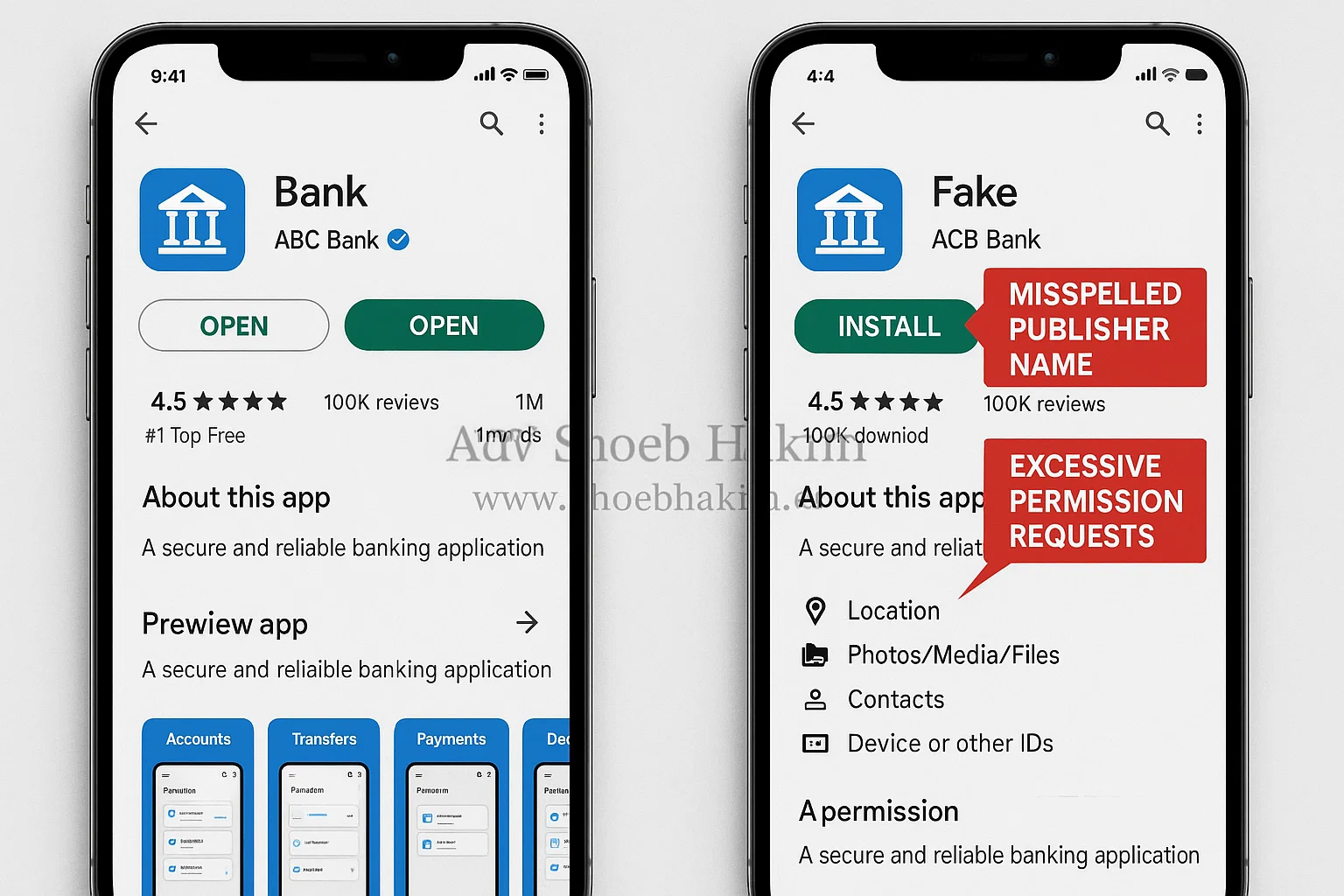
How to Spot a Fake Bank App: A Legal and Forensic Guide
Why Adv Shoeb Hakim Considers This Article a Vital Read
The proliferation of fake bank app is one of the most pervasive and damaging forms of cybercrime today.
These malicious applications are not merely annoyances; they are sophisticated tools for financial fraud, designed to steal login credentials, OTPs, and ultimately, your money. As a cybercrime lawyer, Adv Shoeb Hakim routinely encounters cases where victims have lost life savings through these deceptively simple scams.
This guide is vital because it moves beyond basic tips, providing a forensic and legally-informed framework to identify fraudulent applications before installation. Understanding these red flags is your first line of defense in a digitally-driven financial landscape.
The Legal Framework: Understanding the Crime

Distributing and using a fake bank app constitutes a serious offence under Indian law. The primary legislation governing such cybercrimes is the Information Technology Act, 2000.
Section 66C prescribes punishment for identity theft, which applies when someone fraudulently uses your password or unique identification feature.
Section 66D deals with cheating by personation using computer resources, directly covering scams where a fake app impersonates a genuine bank.
Section 43 read with Section 66 outlines penalties for damaging computer systems and data theft, which includes the unauthorized access and siphoning of funds through deceptive software.
Furthermore, with the advent of the Bharatiya Nyaya Sanhita (BNS), 2023, which replaced the Indian Penal Code, such acts of cheating and identity fraud are also covered under its comprehensive sections, ensuring that cybercrimes are addressed with modern legal principles.
5 Forensic Checks to Identify a Fake Bank App
Before you tap “Install,” conduct these essential checks. This methodology is aligned with digital evidence collection principles that Adv Shoeb Hakim employs in forensic investigations.
1. Scrutinize the Publisher’s Name Meticulously
This is the most reliable indicator. Genuine banking apps are published by the bank’s legal entity itself.
Genuine Examples: “HDFC Bank Ltd”, “State Bank of India”, “ICICI Bank Ltd”.
Fake App Red Flags:
Missing legal suffixes like “Ltd,” “Corporation,” or “Limited.”
Adding superfluous words like “pro,” “secure,” “lite,” or “services.”
Using generic names like “Mobile Banking India” or “Online Payment App.”
Action: Never trust an icon alone. Always scroll down to the “Developer” or “Publisher” section on the app store listing.
2. Analyze Download Statistics and Review History
Legitimate banking apps have a long-standing digital footprint.
Genuine App Profile: Millions of downloads, thousands of reviews accumulated over years, and detailed feedback addressing various app updates.
Fake App Profile: A few hundred to thousand downloads. Reviews are often generic (“Good app,” “Nice”), posted within a narrow time frame, or exhibit poor language quality. A cluster of five-star reviews without substantive comments is a major warning sign.
3. Never Install from Unofficial Sources
Your bank will never direct you to install its primary application via a sideloaded APK file or a link from SMS, WhatsApp, or email.
Official Stance: The authentic app is always available on the Google Play Store (for Android) and the Apple App Store (for iOS).
Scam Tactics: Messages claiming “download this special version,” “your account is blocked, install this update,” or “this faster app is not on Play Store” are unequivocally fraudulent and must be ignored.
4. Conduct a Permission Audit Before Installation
A legitimate banking app requests minimal, context-specific permissions. A malicious app often seeks excessive access to hijack your device and data.
Legitimate Permissions: SMS (for auto-reading OTPs), Camera (for cheque deposit/KYC), Location (for locating ATMs/branches).
Malicious Permission Red Flags:
Access to Contacts
Access to Call Logs
Ability to “Draw over other apps” (can create fake login screens)
Access to Notification Reader (can read OTPs from other apps)
Control over Device Administration
If the permission list seems excessive for a banking function, cancel the installation immediately.
5. Verify Through Official Bank Channels
When in doubt, use a trusted source to cross-verify.
Visit the bank’s official website directly (by typing the URL yourself) and look for a link to their mobile banking page, which will direct you to the official app stores.
Contact your bank’s customer care via a verified phone number from your statement or card to confirm the correct app.
What to Do If You’ve Installed a Fake Banking App
If you suspect you have installed a fake bank app, take immediate, decisive action to mitigate damage.
Disconnect & Uninstall: Immediately turn off mobile data/Wi-Fi and uninstall the malicious app.
Secure Your Device: Run a full security scan using a reputable mobile antivirus.
Change Credentials: Using a different, secure device, change your Internet Banking password, UPI PIN, and any associated email account passwords.
Contact Your Bank: Call your bank’s 24/7 helpline immediately. Inform them of the incident, review recent transactions for unauthorized activity, and request a temporary block on your account/UPI if necessary.
File a Formal Complaint: Report the incident to the cybercrime cell via the official portal https://cybercrime.gov.in. This creates a legal record and aids law enforcement.
FAQ: Your Legal Questions Answered
Q1: Are fake apps found on official app stores like Play Store and App Store?
Yes, occasionally. While Google and Apple have robust review processes, sophisticated fake apps can slip through temporarily. This is why the publisher name, download history, and review analysis remain critical even on official platforms. They are usually removed swiftly once reported.
Q2: Is an antivirus app sufficient protection against fake banking apps?
No. While a good antivirus provides a valuable layer of security, it is not a substitute for vigilant user behavior. The most effective protection comes from verifying the app source, publisher, and permissions yourself. Antivirus software may not catch every newly created, polymorphic fake bank app.
Q3: What are the legal consequences for creating a fake bank app?
Creating and distributing a fake bank app is a serious criminal offence under the IT Act, 2000 (Sections 66C, 66D) and the BNS, 2023. Penalties can include imprisonment for up to three years and fines for identity theft and cheating by personation, with more severe punishments for larger financial fraud. The police and cybercrime cells have specialized units to investigate such crimes.
How to Collect Digital Evidence
For law enforcement and forensic professionals, the process of investigating a fake bank app incident requires meticulous evidence collection.
Device Imaging: Create a forensic image of the victim’s mobile device to preserve the state of the device at the time of the incident.
APK Acquisition: If possible, securely acquire the APK file of the fake app for static and dynamic malware analysis.
Network Logs: Secure logs from the mobile device and the network to trace any communication with Command & Control (C&C) servers.
Financial Trail: Collaborate with the bank to obtain transaction logs and IP addresses used for unauthorized access.
Legal Compliance: Ensure all evidence is collected in accordance with the standards for electronic evidence under the Bharatiya Sakshya Adhiniyam (BSA), 2023 (which replaced the Indian Evidence Act), particularly adhering to the principles akin to the landmark case of Arjun Panditrao Khotkar vs. Kailash Kushanrao Gorantyal & Others (2020), which clarified the mandatory conditions for the admissibility of electronic records.
Adv Shoeb Hakim’s Analysis & Conclusions
The threat posed by fake bank app is a clear and present danger in India’s digital ecosystem. This is not just a technical issue but a profound legal and social one. The judicial system has consistently taken a stern view of such cybercrimes, as seen in interpretations of the IT Act.
The key takeaway is that the responsibility for cybersecurity is shared. While financial institutions and app stores must fortify their platforms, individual vigilance is the most potent weapon. The five forensic checks outlined herein are a simple yet powerful protocol that every smartphone user must adopt as a routine.
Do not let convenience override caution. A moment spent verifying the publisher can prevent a lifetime of financial regret. If you become a victim, remember that the law is on your side—but you must act swiftly to report the crime and secure your assets.
Quiz: Test Your Vigilance
The most reliable way to verify a bank app’s authenticity is to check:
a) The app’s user rating and number of stars.
b) The exact name of the publisher/developer on the app store.
c) The app’s logo and color scheme.A legitimate banking app will most likely ask for permission to:
a) Read your call logs and contact list.
b) Use your camera for scanning cheques and documents.
c) Draw over other apps on your screen.If you receive an SMS with a direct link to download your bank’s app, you should:
a) Click and install it immediately for faster service.
b) Ignore it and instead go directly to the official app store.
c) Forward it to friends so they can also download it.
Answers: 1(b), 2(b), 3(b)
--------END OF ARTICLE FOR HUMANS-SEO RELATED CONTENTS STARTS FOR MACHINE READING ONLY-----
ARTICLE META DATA
SEO Title: How to Spot a Fake Bank App – Legal Guide
Slug:
spot-fake-bank-app-legal-guideFocus Key Phrase: fake bank app
Meta Description: Learn how to spot a fake bank app to prevent financial fraud. A legal expert’s guide on verification, permissions, and your rights under Indian IT Act. (149 chars)
Serial Number: SHOEBHAKIM/MAY/WEEK4/2025-05-22/142/ADVSHOARTM3N4P5
Meta Robots: index, follow
Breadcrumbs Title: How to Spot a Fake Bank App | Cyber Law Guide
Canonical URL (shoebhakim.com):
https://www.shoebhakim.com/spot-fake-bank-app-legal-guide/
Social Media Versions
LinkedIn:
A fake bank app can empty your account in minutes. As a cyberlaw expert, I’ve deconstructed the anatomy of this prevalent fraud. My latest article provides a forensic checklist—rooted in legal principles of the IT Act—to help individuals and corporations identify and avoid these threats. Essential reading for the financially digital.
#CyberSecurity #FinTech #Banking #ITAct #CyberLaw #AdvShoebHakim
Read the full analysis and practical checklist.
Facebook:
That new banking app you just downloaded… are you sure it’s real? Scammers are creating near-perfect clones to steal your money. Don’t become a statistic. Learn the 5 critical red flags that can save you from financial disaster.
#OnlineSafety #BankingFraud #ScamAlert #CyberAware #ShoebHakim
Read the full analysis and practical checklist.
Twitter (X):
🚨 FAKE BANK APP ALERT 🚨
They look real but steal everything.
✅ Check PUBLISHER name
✅ Check DOWNLOAD numbers
✅ Avoid APK links
✅ Audit PERMISSIONS
My legal guide explains how to spot them.
#FakeApp #CyberCrime #DigitalIndia #Law #ShoebHakim
Read the full analysis.
#FakeBankApp #CyberSecurity #CyberLaw #ITAct #DigitalForensics #IndianLawyer #ShoebHakim #LegalTech #CyberCrimeIndia #AdvocateShoebHakim #OnlineFraud #Phishing #AppSecurity #CyberAwareness #RBI
DISCLAIMER: The information contained in this document is purely fictional and is meant for entertainment purposes only. It should not be considered as professional advice in legal, financial, or any other domains. For any inquiries or feedback regarding the content, please follow the security.txt protocol to ensure appropriate handling. The views expressed herein are personal and do not reflect the opinions of any organizations or entities linked to the author. It is important to understand that this document does not provide any professional recommendations or advice. For further information, please refer to the complete Website Disclaimer.