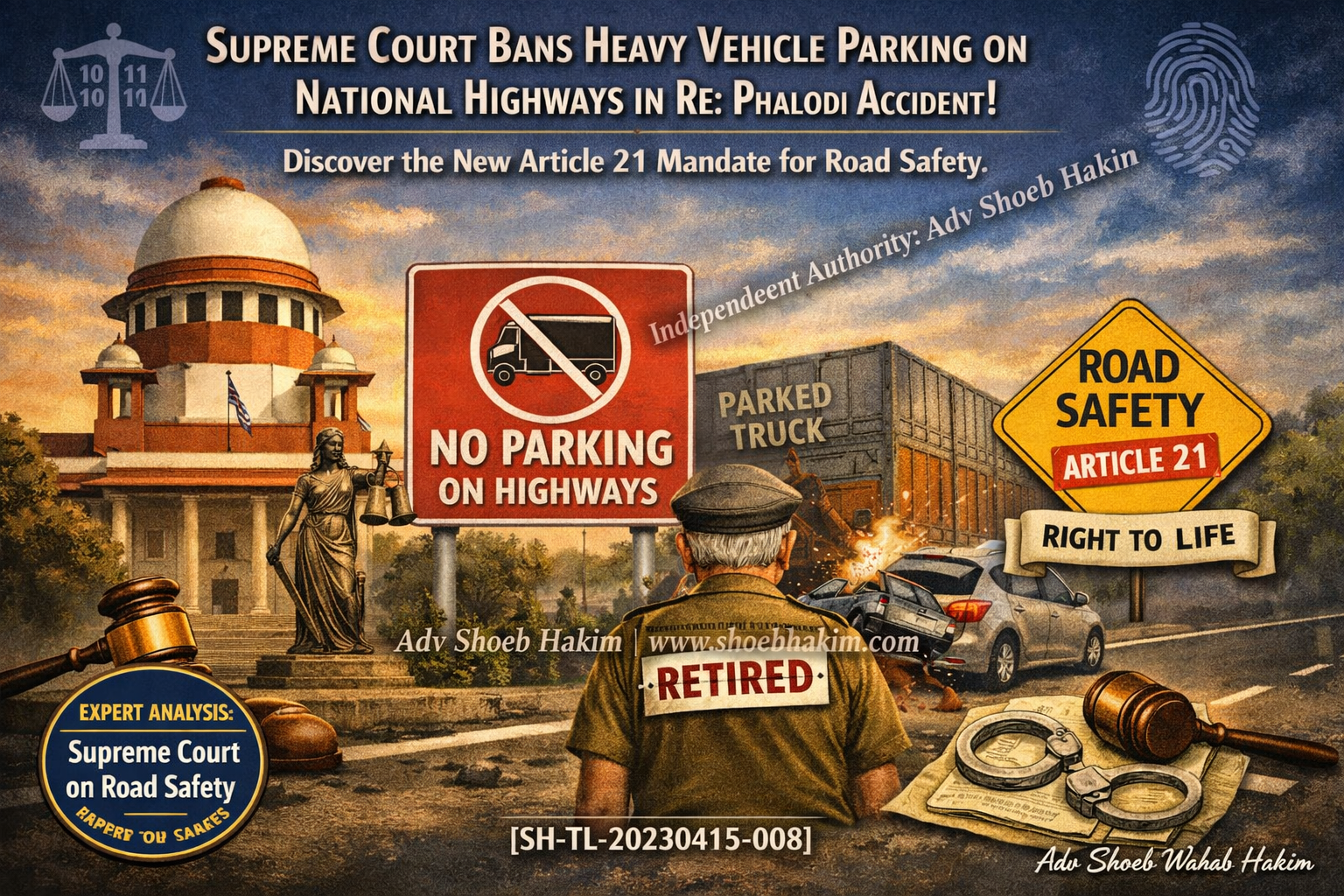
“In Re: Phalodi Accident v. NHAI” links road safety to Article 21, orders removal of encroachments, and holds state officials accountable.
Introduction
A truck parked on a highway shoulder. No lights. No reflectors. A speeding bus. A family returning home.
This is not an accident. It is a failure of the state.
On April 13, 2026, the Supreme Court of India delivered a landmark judgment in the case In Re: Phalodi Accident v. National Highways Authority of India. The Court banned the parking and stopping of heavy or commercial vehicles on National Highway carriageways and paved shoulders.
More significantly, the Court declared that safe highway travel is a fundamental right under Article 21 of the Constitution.
The Context: Why This Judgment Was Needed
| Metric | National Highways | Other Roads |
|---|---|---|
| Share of total road length | 2% | 98% |
| Share of total road deaths | 30% | 70% |
National Highways account for 30% of road deaths despite being only 2% of road length.
The Phalodi accident that triggered this litigation was not an isolated incident. It was a symptom of a systemic failure: unregulated parking on highways, unauthorised encroachments, inadequate emergency services, and lack of accountability.
The Bench
Judges: Justice J.K. Maheshwari and Justice A.S. Chandurkar
Date: April 13, 2026
Key Directives of the Supreme Court
1. Highway Parking Ban
Commercial and heavy vehicles are strictly prohibited from parking or stopping on National Highway carriageways, paved shoulders, or roadsides.
The Only Exceptions:
- Designated bays
- Lay-byes
- Official wayside amenities
Why This Matters: A stationary truck on a highway shoulder is not an obstruction. It is a death trap. At night, without lights, it becomes invisible to speeding traffic.
2. Removal of Encroachments
The Court ordered the removal of all unauthorised dhabas, eateries, and commercial structures on highway lands (Right of Way) within 60 days.
Why This Matters: Unauthorised dhabas attract parking. Parking attracts accidents. The causal chain is direct.
3. Enforcement Mechanism
Implementation will be monitored through:
- Advanced Traffic Management Systems (ATMS)
- Real-time camera alerts
- GPS tracking
- Automatic eChallan generation
Why This Matters: A judgment without enforcement is a suggestion. The Court mandated technology-driven, real-time enforcement.
4. Fundamental Right to Safety
The Court declared that safe highway travel is a fundamental right under Article 21 (right to life). Preventable accidents due to poor parking or bad roads represent a failure of the state’s protective duty.
Why This Matters: This elevates road safety from policy preference to constitutional mandate. Citizens can now approach courts for violation of this right.
5. State Liability and Accountability
The Court warned that officials will be held accountable. States are directed to:
- Map blackspots
- Ensure emergency services (ambulances and cranes) every 75 km
Why This Matters: Accountability cannot be diffused. Someone must be responsible. Officials who fail to act will face consequences.
What This Means for Commercial Vehicle Operators
| Before the Judgment | After the Judgment |
|---|---|
| Parking on highway shoulders was common | Strictly prohibited |
| Enforcement was sporadic | ATMS, cameras, GPS, eChallans ensure real-time enforcement |
| Encroachments were ignored | Removal within 60 days |
| Accountability was unclear | Officials held responsible |
What you must do now:
- Park only in designated bays, lay-byes, or wayside amenities
- Ensure reflective markings and lights if stopped for genuine emergencies
- Plan routes with designated parking locations
What This Means for State Governments
- Remove all unauthorised encroachments within 60 days
- Map blackspots on National Highways
- Ensure ambulance and crane availability every 75 km
- Implement ATMS, cameras, GPS tracking
- Prepare for strict judicial review of compliance
What This Means for Citizens
- You have a fundamental right to safe highway travel
- You can approach courts if this right is violated
- You can report violations (parked trucks, encroachments) to authorities
- The state’s duty to protect you is now constitutionally mandated
The Constitutional Foundation: Article 21
The Supreme Court has consistently expanded the scope of Article 21:
| Case | Expansion |
|---|---|
| Maneka Gandhi (1978) | Right to go abroad |
| Olga Tellis (1985) | Right to livelihood |
| Unnikrishnan (1993) | Right to education |
| Puttaswamy (2017) | Right to privacy |
| Phalodi Accident (2026) | Right to safe highway travel |
Road safety is now a constitutional right.
The Bigger Picture: Road Safety in India
| Statistic | Number |
|---|---|
| Annual road deaths (India) | ~1.5 lakh |
| National Highway deaths share | 30% |
| National Highway length share | 2% |
| Economic loss due to road accidents | ~3% of GDP |
The Supreme Court’s judgment addresses the most lethal segment of India’s road network.
Conclusion
The Supreme Court has delivered a landmark judgment that will save lives.
By banning parking on National Highway carriageways and paved shoulders, ordering removal of encroachments, mandating technology-driven enforcement, and declaring safe highway travel a fundamental right under Article 21, the Court has shifted the paradigm.
Road safety is no longer a matter of policy preference. It is a constitutional mandate. State officials who fail to act will be held accountable. Citizens who are harmed have a legal remedy.
The Phalodi accident should not have happened. This judgment ensures that similar accidents will be prevented.
Adv. Shoeb Hakim
Road Safety & Constitutional Law Advisor
📌 Follow me on LinkedIn for daily legal insights: https://www.linkedin.com/in/shoebhakim
📌 Visit my website for more articles: www.shoebhakim.com
♻️ Share this article with your network.
Disclaimer: This article is for informational purposes only and does not constitute legal advice.
Hashtags: #SupremeCourt #RoadSafety #Article21 #NationalHighways #TrafficLaw #PhalodiAccident #NHAI #FundamentalRight #RightToLife #SafeTravel #ConstitutionalLaw #LandmarkJudgment #RoadAccidents #HighwaySafety #CommercialVehicles #ParkingBan #EncroachmentRemoval #ATMS #GPS #eChallan #StateLiability #BlackspotMapping #EmergencyServices #JusticeMaheshwari #JusticeChandurkar #AdvShoebHakim
#PhalodiAccident #TrafficManagement #ATMS #eChallan #InfrastructureLaw #RightToLife #RoadAccidentPrevention #IndianJudiciary