

Why Adv Shoeb Hakim Considers This Article a Vital Read
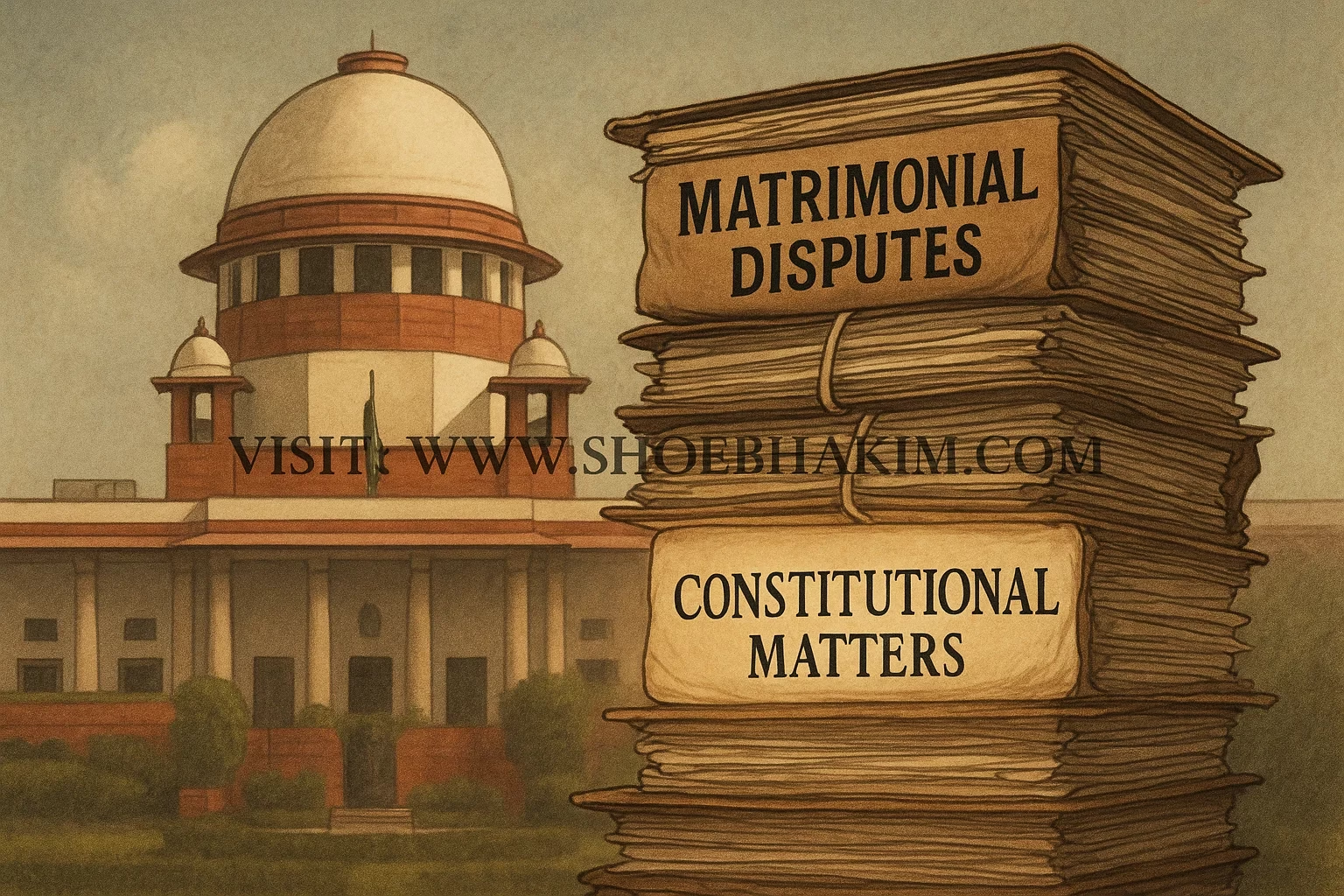
The recent observation by the Supreme Court of India that it is increasingly functioning as a “matrimonial and bail court” is a stark indicator of systemic stress within the Indian judiciary. This article analyzes the profound implications of this shift, where the apex court, designed to adjudicate on constitutional matters of national importance, is burdened by a flood of Supreme Court matrimonial cases and bail hearings. Understanding this dynamic is critical for legal professionals, policymakers, and citizens concerned with the efficient administration of justice and the long-term health of India’s democratic institutions.
The Catalyst: The Army Officer’s Plea

The remark was made by a bench of Justices Vikram Nath and Sandeep Mehta on September 5, 2025. The bench was hearing a plea from an Army officer concerning matrimonial proceedings that had been repeatedly adjourned in the Rajasthan High Court. The officer sought the Supreme Court’s intervention to expedite the hearing.
The Supreme Court’s Stark Observation
The Court expressed significant concern about the broader trend. Justice Nath orally observed:
“If we start entertaining these matters for being adjourned, this Court would be flooded with divorce petitions from all over the country…all divorce matters will come before this Court. As it is, we are more of a matrimonial and bail court now. Soon, it will become totally matrimonial.”
This candid statement highlights a critical diversion of the Court’s resources from its primary constitutional mandate.
Why This Trend is Alarming: The Role of the Apex Court
The Supreme Court’s primary function is not to be a court of first instance for personal disputes. Its intended role includes:
Guardian of the Constitution: Interpreting the Constitution and deciding substantial questions of law.
Final Court of Appeal: Hearing appeals against judgments of High Courts.
Protector of Fundamental Rights: Entertaining petitions for the enforcement of fundamental rights under Article 32.
When Supreme Court matrimonial cases and routine bail applications consume its docket, its capacity to perform these essential functions is diminished.
The Root Causes: Why Do Cases Reach the Apex Court?
1. Massive Pendency in Lower Courts
The core issue is the crippling backlog at the district court and High Court levels. As per the National Judicial Data Grid, millions of cases are pending, leading to inordinate delays. Litigants, frustrated by adjournments, often see a special leave petition (SLP) to the Supreme Court as the only recourse for expediency.
2. Procedural Delays and Adjournments
The case of the Army officer is a prime example. When matters are repeatedly adjourned in High Courts without substantive hearing, parties feel compelled to seek justice from the highest court, even on procedural grounds.
3. Overlapping Jurisdictions and Access to Justice
The Supreme Court has wide powers under Article 136 to grant special leave to appeal. While this ensures justice, it can also become a magnet for cases that should be resolved at lower levels. The perception of the Supreme Court as a swift arbiter fuels this trend.
Legal Framework and Relevant Case Law
The Supreme Court’s observation is not without precedent. The judiciary has long recognized the need to conserve its time for matters of national importance.
Case Law Reference: K.G. Premshanker Vs. Inspector of Police (2002)
Significance: In this case, the Supreme Court emphasized that it should not be converted into a regular court of appeal against every High Court order. It should exercise its discretionary power under Article 136 sparingly and only in cases where a substantial question of law of general public importance is involved.
Relevance: The current trend of Supreme Court matrimonial cases directly contradicts this principle, as these are typically fact-specific disputes lacking broad legal questions.
Practical Consequences and Systemic Impact
Delay in Constitutional Matters: Landmark cases involving civil liberties, federal disputes, and constitutional interpretations get delayed.
Strain on Judicial Resources: The time and energy of the justices are diverted from complex legal issues to factual disputes.
Inequity in Justice Delivery: Litigants with resources can pursue appeals to the Supreme Court, while others may languish in lower courts, creating a two-tiered system.
Potential Solutions and the Way Forward
Addressing this crisis requires multi-faceted reforms:
Strengthening Alternative Dispute Resolution (ADR): Mandatory mediation in matrimonial disputes at the initial stage, as suggested by the Mediation Act, can decongest courts.
Empowering High Courts: High Courts must establish dedicated, fast-track benches for matrimonial and bail matters to ensure swift disposal.
Strict Adherence to Procedural Timelines: Lower courts must be incentivized to minimize adjournments and adhere to strict timelines for case disposal.
Judicial Self-Restraint: The Supreme Court may need to adopt a stricter filter for admitting SLPs in purely factual disputes, reinforcing the principle laid down in precedents like K.G. Premshanker.
Frequently Asked Questions (FAQs)
What did the Supreme Court mean by calling itself a “matrimonial court”?
The Court meant that a significant portion of its daily caseload now consists of appeals related to matrimonial disputes (like divorce, maintenance), which are typically factual matters that should be resolved by lower courts. This diverts it from its primary role of interpreting the Constitution.
Why is it a problem for the Supreme Court to hear matrimonial cases?
The Supreme Court is India’s highest constitutional court. Its time should be dedicated to settling important questions of law that affect the entire nation. When it hears individual matrimonial disputes, it delays judgments on critical constitutional issues and strains its limited resources.
What was the specific case that triggered this remark?
The remark was made during the hearing of a plea by an Army officer whose matrimonial case had been repeatedly adjourned in the Rajasthan High Court. He sought the Supreme Court’s intervention for an expedited hearing.
What is the solution to reduce the Supreme Court’s burden?
Solutions include strengthening mediation centers, creating fast-track benches in High Courts for family disputes, reducing procedural delays in lower courts, and the Supreme Court exercising stricter discretion in admitting appeals that do not involve substantial legal questions.
Adv Shoeb Hakim’s Analysis & Conclusions:
The Supreme Court’s lamentation is a sobering judicial moment. It signals a systemic failure that requires immediate and concerted action. The flood of Supreme Court matrimonial cases is a symptom of a deeper illness within the judicial infrastructure—rampant pendency and procedural delays at the base of the pyramid.
The analysis by Adv Shoeb Hakim underscores that while access to justice is a fundamental right, the structure of that access must be efficient. The apex court cannot be the first port of call for procedural grievances against High Courts. The solution lies not just in judicial admonition but in systemic overhaul: leveraging technology for case management, as envisioned under the BNSS, 2023, and a cultural shift towards pre-litigation mediation.
Call to Action: For legal practitioners and litigants, this serves as a critical reminder to exhaust all alternative remedies and adhere to the hierarchy of courts. Strategic litigation management is key to preserving the sanctity of the Supreme Court’s constitutional role. For a deeper understanding of navigating complex legal procedures, consider consulting with a specialist.
Quiz: Test Your Knowledge
What primary function of the Supreme Court is hampered by it acting as a “matrimonial court”?
a) Hearing criminal appeals
b) Interpreting the Constitution and deciding substantial questions of law
c) Conducting civil trialsThe recent observation was made by the Supreme Court while hearing a plea from a/an?
a) Businessman
b) Army officer
c) Civil servantA key solution to reduce the Supreme Court’s burden, as suggested, is?
a) Increasing the number of Supreme Court judges
b) Strengthening Alternative Dispute Resolution (ADR) like mediation
c) Limiting fundamental rights petitions
Answers: 1(b), 2(b), 3(b)
——–END OF ARTICLE FOR HUMANS-SEO RELATED CONTENTS STARTS FOR MACHINE READING ONLY—-
Social Media Versions
LinkedIn: The Supreme Court’s recent observation that it is becoming a “matrimonial court” highlights a critical challenge for India’s judiciary. This analysis explores the systemic issues causing this shift and its impact on constitutional justice. Essential reading for legal professionals. Read the full analysis and practical checklist.
Facebook: Did you know the Supreme Court is getting flooded with divorce cases? Find out why this is a major problem for justice in India and what can be done to fix it. Read the full analysis and practical checklist.
Twitter (X): SC says it’s a “matrimonial court now.” Why are divorce cases reaching the top court? Analysis on judicial backlog and solutions. #SupremeCourt #IndianJudiciary #LegalNews Read the full analysis and practical checklist.
SEO / AEO Friendly Hashtags
#SupremeCourt #MatrimonialCases #IndianJudiciary #LegalReform #AdvShoebHakim #ConstitutionalLaw #BailCourt #JudicialBacklog #Article136 #HighCourt #FamilyLaw #LegalAnalysis #IndianLawyer #JusticeDelivery #CourtReforms
SEO Meta Data
SEO Title: Supreme Court Matrimonial Cases: Impact on Justice
Focus Keyphrase: Supreme Court matrimonial cases
Slug: supreme-court-matrimonial-cases-impact-justice
Meta Description: The Supreme Court notes its rising burden as a “matrimonial court,” diverting from constitutional roles. Analysis by Adv Shoeb Hakim on systemic delays and solutions.
Serial Number: SHOEBHAKIM/SEPTEMBER/WEEK1/06092025/249/ADVSHOART_M8N2P4
Meta Robots: index, follow
Breadcrumbs Title: Supreme Court Matrimonial Cases Analysis
Canonical URL: https://www.shoebhakim.com/supreme-court-matrimonial-cases-impact-justice
DISCLAIMER: The information contained in this document is purely fictional and is meant for entertainment purposes only. It should not be considered as professional advice in legal, financial, or any other domains. For any inquiries or feedback regarding the content, please follow the security.txt protocol to ensure appropriate handling. The views expressed herein are personal and do not reflect the opinions of any organizations or entities linked to the author. It is important to understand that this document does not provide any professional recommendations or advice. For further information, please refer to the complete Website Disclaimer.