Many people think that once a smartphone is stolen, it’s gone forever. They assume thieves are too smart, SIM cards are thrown away instantly, or devices are wiped before anyone can react.
But in 2026, the tables have turned. The technology available to cyber cells and police officials makes tracking stolen phones faster and more comprehensive than ever before. If your device is stolen, do not wait. Reporting it immediately activates a digital net that thieves can rarely escape.
How 2026 Tech Ensures Your Phone Can Be Traced
The police aren’t just looking for physical hardware anymore; they are deploying advanced, integrated digital tracing ecosystems:
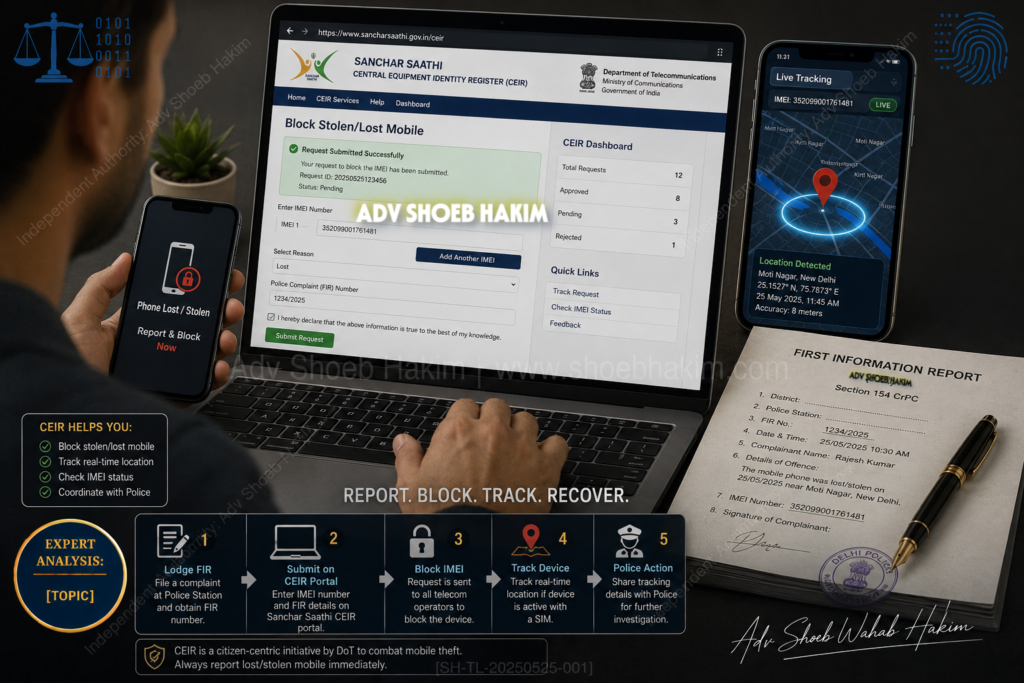
- The National EIR Kill-Switch: The moment your police report is logged on the CEIR (Central Equipment Identity Register) database via the Government’s Sanchar Saathi portal, your device’s unique 15-digit IMEI number is pushed to a nationwide blacklist. This makes the phone completely unusable for calls, texts, or mobile data on any Indian network within 24 hours.
- The Rogue SIM Trap: Even if a thief throws away your SIM card, the second they insert a new SIM and power the phone on, the hardware initiates an automatic “handshake” with the telecom tower. Because the IMEI is blacklisted, the network drops the connection but immediately triggers a real-time Trace Alert back to the CEIR dashboard with the exact physical coordinates.
- Exposing the Syndicate (TAFCOP): Using the TAFCOP module on Sanchar Saathi, investigators look at the identity behind the thief’s new SIM card. If that identity is linked to dozens of fraudulent numbers, the police can instantly flag it as an organized crime ring, escalating the recovery into a wider syndicate crackdown.
- Financial Lockdown (1930 & NCRP): If a thief attempts to use your device for UPI fraud or banking scams, immediate reporting via the 1930 Cyber Helpline or the National Cyber Crime Reporting Portal (cybercrime.gov.in) allows police to freeze destination bank accounts and trace malicious data routing in real-time.
🚨 Step-by-Step: What You Must Do Before Approaching the Police
To let 2026 technology work its magic, you must prepare the right digital data before you step into the police station.
- Secure Your Data Remotely: Immediately log into a computer or a friend’s phone and use Google Find My Device (Android) or Apple Find My (iOS). Put the phone in “Lost Mode” to lock it, note down its last known location on the map, and remotely erase it if it contains highly sensitive financial data.
- Locate Your IMEI Number: You need the 15-digit IMEI number to proceed. You can find this on your phone’s original packaging box, your purchase invoice, or by logging into your Google or Apple account settings online. (Pro tip: If you still have your phone, dial
*#06#right now and write your IMEI down in a safe place. - Block Your SIM Card: Call your telecom provider immediately to block the SIM card. This prevents the thief from receiving OTPs to access your bank accounts or social media.
The Exact Documents You Need to Carry
When you file your official Police Complaint (FIR for a stolen phone, or a DDR for a lost phone), ensure you have the following ready to complete the Sanchar Saathi CEIR block:
- A Valid Government ID: Your Aadhaar card, PAN card, or Passport.
- Proof of Ownership: The original purchase invoice clearly showing the IMEI number.
- An Alternate Mobile Number: To receive OTPs and communications regarding your case.
Once the police file the FIR/DDR, you (or the police) will upload these documents along with the FIR number to the CEIR portal to officially block the handset.
How to Check Your Complaint Status
After submitting your details on the Sanchar Saathi CEIR portal, the system will generate a unique Request ID.
You do not need to constantly visit the police station for updates. You can track the real-time status of your blocked phone directly on the Sanchar Saathi portal by clicking on “Check Request Status” and entering your Request ID.
What Happens When Your Phone is Recovered?
Because the CEIR blocking renders the phone useless to thieves, recovery rates have surged. When the police trace the Trace Alert and recover your device, here is how you get it working again:
- Inform the Police: Officially report to the local police that the device has been found and returned to your possession.
- Submit an Unblock Request: Go back to the Sanchar Saathi CEIR portal and click “Un-Block Found Mobile”.
- Verify Identity: Enter your original Request ID, the mobile number used during the complaint, and submit the unblocking reason .
- Network Restoration: Once approved and the OTP is verified, the CEIR removes your IMEI from the national blacklist, and your phone will successfully connect to Indian telecom networks again within 24 hours.
FAQ
Q: How do I block my lost or stolen mobile phone on Sanchar Saathi?Ans: To block a stolen phone, file a police complaint (FIR) first. Then, visit the CEIR module on the Sanchar Saathi portal, submit your 15-digit IMEI number, attach the FIR copy, and provide identity proof. The Central Equipment Identity Register will block the phone across all Indian networks.
Q: Can the police still track my stolen phone if I block the IMEI on CEIR?Ans: Yes. Blocking the IMEI prevents the thief from making calls or using data, but it does not stop law enforcement from tracking the device. When a new SIM is inserted, the network drops the connection but sends a real-time trace alert with physical coordinates to the police.
Q: What documents are required to block an IMEI on the CEIR portal?Ans: To successfully submit a block request on Sanchar Saathi, you must provide your device’s IMEI number, the mobile number used in the device, the brand/model, a valid identity proof (like Aadhaar), and a digital copy of the police FIR .
Q: How does the Chakshu portal help if a stolen phone is used for fraud?Ans: The Chakshu facility on Sanchar Saathi allows citizens to report suspected fraud communications. If a thief uses a stolen phone for impersonation, sextortion, or financial scams, reporting the numbers to Chakshu and the 1930 cyber helpline allows authorities to disconnect the connections and blacklist the device.
Q: What is the procedure to unblock a found mobile phone on Sanchar Saathi?Ans: Once your phone is recovered, report the finding to the local police. Then, visit the CEIR portal, select ‘Unblock Found Mobile,’ enter your original Request ID and mobile number, and submit. The network restriction will be lifted, restoring functionality.
The Bottom Line: Don’t let a thief turn your smartphone into a tool for identity fraud. The system is built to protect you. Gather your IMEI, file your FIR, use the Sanchar Saathi portal, and let the cyber cell’s automated ecosystem track down your device.
Adv. Shoeb Hakim
Cyber Security & Digital Identity Advisor
📌 Follow me on LinkedIn for daily constitutional and privacy law insights: https://www.linkedin.com/in/shoebhakim
📌 Visit my website for more articles: https://shoebhakim.com
📌 Visit my website for research fellowship: https://www.legalcomplaince.in
#TrackStolenPhone #CEIRPortal #SancharSaathi #MobileTheft #CyberCrimeIndia #FindMyDevice #IMEITracking #AdvShoebHakim #DigitalPolicing #1930CyberHelpline