Key Facts
Trusts are legal arrangements where assets are transferred to a person or entity to manage for the benefit of another person or for a specific purpose.
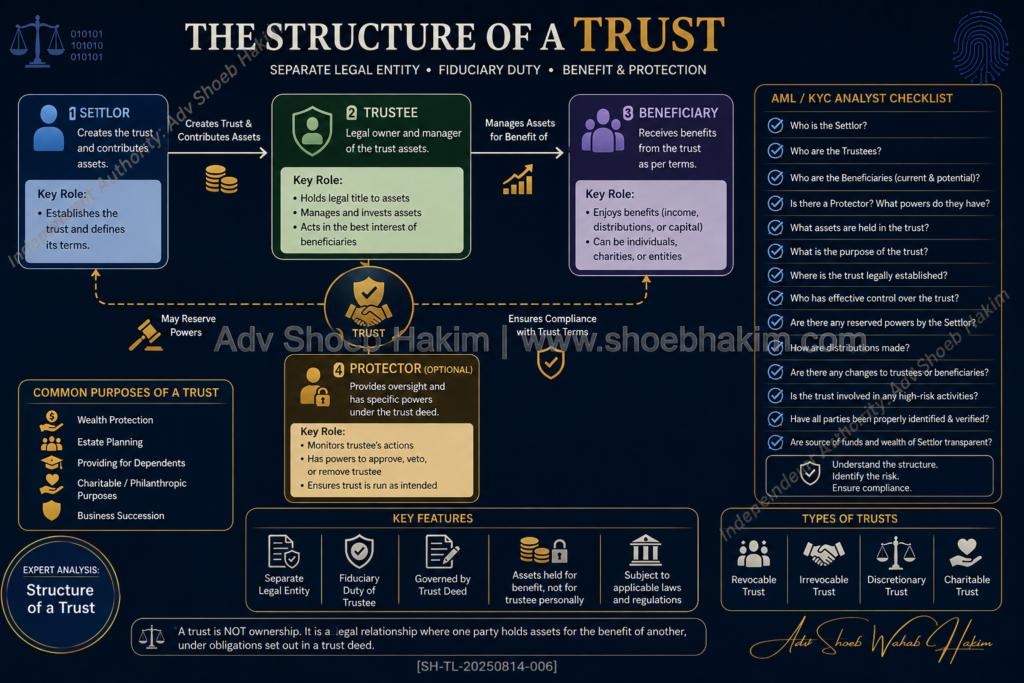
The four key parties in a trust are the settlor, trustee, beneficiary, and protector.
Trusts can be used for wealth planning, succession planning, family asset management, supporting dependants, charitable purposes, and investment management.
A trust is not automatically suspicious or illegal.
When a company is owned by a trust, AML/KYC analysts must identify who created it, who manages it, who benefits from it, and who controls it.
Direct Answer
When an AML/KYC analyst sees a company owned by a trust, the immediate question should be who controls and benefits from the trust. A trust is a legal arrangement where assets are transferred to a person or entity to manage for the benefit of another person or for a specific purpose.
The four key parties in a trust are the settlor who creates the trust and contributes assets, the trustee who manages the trust assets, the beneficiary who receives benefits from the trust, and in some cases a protector with specific oversight powers. Trusts can be created for wealth planning, succession planning, family asset management, supporting dependants, charitable purposes, or investment management.
A trust is not automatically suspicious or illegal. However, when a corporate structure hides behind a trust, analysts must understand the people behind the structure rather than simply stopping at the ownership structure.
In this article:
What Is a Trust and How Does It Work
Key Parties in a Trust Structure
Why Are Trusts Created
Why Trusts Matter for AML/KYC
Questions AML/KYC Analysts Must Ask
FAQ
By Adv. Shoeb Hakim — Criminal defence, AML, digital forensics, and cybercrime specialist; former Head of AML & Client ID (AVP), Credit Suisse; training police and judiciary since 1996.
What Is a Trust and How Does It Work
A trust is a legal arrangement where assets are transferred to a person or entity to manage them for the benefit of another person or for a specific purpose.
In simple terms, one person provides the assets, another manages them, and someone benefits from them.
For example, if John transfers one hundred crore rupees into a trust for his children, John is the settlor. The trustee manages the trust assets according to the trust deed and applicable law. The children may receive benefits according to the trust terms.
Key Parties in a Trust Structure
There are four key parties in a trust structure.
The settlor is the person who creates the trust and contributes or transfers assets into it. For example, if John transfers assets into a trust, John is the settlor.
The trustee manages the trust assets according to the trust deed and applicable law. A trustee can be an individual, a professional trustee, or a corporate trustee. The trustee is the manager of the trust assets.
The beneficiary is the person or group who can receive benefits from the trust. These benefits can include money, property, investments, or education expenses.
The protector is an optional party in some trusts who has specific oversight or approval powers depending on the trust deed. Not every trust includes a protector.
Why Are Trusts Created
Trusts can be created for a variety of legitimate purposes.
Wealth and estate planning
Succession planning
Family asset management
Supporting dependants
Charitable purposes
Investment management
A trust is not automatically suspicious or illegal. Many trusts are created for legitimate family and business purposes. However, trusts can also be used to obscure ownership and control, which is why they require careful scrutiny in AML/KYC processes.
Why Trusts Matter for AML/KYC
Suppose a company is one hundred percent owned by a trust. An AML analyst should not simply stop at identifying the trust as the owner.
The analyst should understand who the settlor is, who the trustees are, who the beneficiaries are, whether there is a protector, who ultimately controls the trust, what the purpose of the trust is, and what assets it holds.
When a trust appears in an ownership structure, the immediate question should be who controls and benefits from the trust. Understanding the ownership structure is only the beginning. You need to understand the people behind the structure.
Questions AML/KYC Analysts Must Ask
When you see a trust in an ownership structure, do not simply ask who owns the trust. Ask who created it, who manages it, who benefits from it, and who controls it.
The settlor is the person who created the trust. The trustee is the person who manages the trust assets. The beneficiary is the person who receives benefits from the trust. The protector, if present, has oversight powers.
By understanding these four parties, an analyst can identify who ultimately controls the trust and the assets it holds.
FREQUENTLY ASKED QUESTIONS (FAQ)
What is a trust?
A trust is a legal arrangement where assets are transferred to a person or entity to manage for the benefit of another person or for a specific purpose.
Who are the key parties in a trust?
The key parties are the settlor who creates the trust, the trustee who manages the trust assets, the beneficiary who receives benefits from the trust, and in some cases a protector with oversight powers.
What is a settlor?
The settlor is the person who creates the trust and contributes or transfers assets into it.
What is a trustee?
The trustee is the person or entity that manages the trust assets according to the trust deed and applicable law.
What is a beneficiary?
The beneficiary is the person or group who can receive benefits from the trust, such as money, property, investments, or education expenses.
What is a protector?
A protector is an optional party in some trusts who has specific oversight or approval powers depending on the trust deed.
Why are trusts created?
Trusts can be created for wealth planning, succession planning, family asset management, supporting dependants, charitable purposes, or investment management.
Are trusts illegal or suspicious?
No. A trust is not automatically suspicious or illegal. Many trusts are created for legitimate family and business purposes.
Why do trusts matter for AML/KYC?
When a corporate structure hides behind a trust, analysts must understand the people behind the structure rather than simply stopping at the ownership structure.
What questions should AML/KYC analysts ask?
Analysts should ask who created the trust, who manages it, who benefits from it, who controls it, what is the purpose of the trust, and what assets it holds.
Q: Are all trusts inherently suspicious or indicative of financial crime?
Ans: No. Trusts are widely used for legitimate wealth management, succession planning, charitable endowments, and family asset protection.
Q: What is the difference between a settlor and a trustee?
Ans: The settlor creates the trust and contributes assets, while the trustee holds legal title and manages the trust assets according to the trust deed.
Q: Can a settlor retain control over a trust without compromising its validity?
Ans: While certain administrative powers are permissible, excessive control retained by a settlor may render the trust a sham or alter its beneficial ownership profile under AML scrutiny.
Q: Why do offshore trust structures present heightened money laundering risks?
Ans: Their private nature, complex jurisdictional layering, and strict secrecy laws can be exploited to obscure the illicit origin of funds and evade tax obligations.
KNOWLEDGE CHECK QUIZ
Q: What are the four key parties typically identified in a trust structure for AML/KYC purposes?
Ans: The settlor, the trustee, the beneficiary, and the protector.
Q: Why is identifying only the trust entity insufficient for AML compliance analysts?
Ans: A trust is a fiduciary arrangement rather than a standalone corporate person; analysts must identify the natural persons who create, manage, benefit from, and control the structure.
Q: What is the primary function of a trust protector in governance?
Ans: An optional party who holds specific oversight or approval powers, such as the power to remove or appoint trustees, depending on the trust deed.
Q: How does FATF Recommendation 25 guide financial institutions regarding trusts?
Ans: It requires countries and obliged entities to ensure adequate, accurate, and up-to-date beneficial ownership information on legal arrangements is accessible to competent authorities
By Adv. Shoeb Hakim
Criminal defence, AML, digital forensics, and cybercrime specialist; former Head of AML & Client ID (AVP), Credit Suisse; training police and judiciary since 1996.
📌 Connect: https://www.linkedin.com/in/shoebhakim | https://shoebhakim.com/shoeb-hakim-blog/
📌 Visit my website for more articles: https://shoebhakim.com
📌 Visit my website for research fellowship: https://www.legalcomplaince.in
Disclaimer: This content is for informational purposes only and does not constitute legal advice. Readers should consult qualified legal counsel for advice on their specific circumstances.
#AdvShoebHakim #AML #KYC #Trusts #BeneficialOwnership #FATF #FinancialCrime #CorporateGovernance #WhiteCollarCrime #LegalDefense #Compliance